
The SaaS product development process is the system a company uses to identify customer problems, validate them, design and ship solutions, and measure the result. It runs as a continuous cycle rather than a line ending at launch, and it fails on weak decision-making far more often than on engineering.
I do this work inside B2B SaaS product teams. If your team ships every week and the numbers barely move, this is where I start.
See how product management consulting works →I meet entrepreneurs and CEOs on a daily basis, and every day I find myself repeating the same mantra: it’s not the quantity that matters, it’s the quality. No one (especially not your bank manager) cares how many features you and your team pushed to production in the last month. The industry numbers prove this painfully: a study by Pendo found that 80% of features developed in cloud products are rarely or never used. The only thing that truly matters is how many of those features actually contributed to the company’s MRR.
I know that generating new MRR is hard. In fact, it is the hardest part of running a SaaS business. If it were easy, every company in the world would be successful, but reality shows otherwise. Today, when AI tools allow us to deliver code faster than ever before, an official GitHub research showed that developers using AI complete tasks 55% faster. The real challenge is no longer building fast, but knowing what not to build. Precisely when everything is accessible and rapid, choosing to pass on a feature that lacks economic justification and solid validation is the most critical skill.
The real secret, and I trust you not to tell anyone, is that there is a recipe for this. Executing this recipe systematically and in rapid cycles will statistically guarantee that you win, producing only features that drive MRR.
In this article, I break down this recipe and its most important components. But there is a catch: you cannot skip any part of it. Skipping a step, like giving up on a deep validation process just because AI allows you to “just build it,” changes the entire recipe, and your chances of success drop dramatically. Let’s dive into the 7 stages of the product development process that will transform you from a feature factory into a growth engine.
What is the product development process in SaaS?
In SaaS it is the system a company uses to find real customer problems, validate them with evidence, ship solutions in small increments, and measure what actually changed in behavior. Unlike manufacturing there is no final release, so the process runs continuously rather than ending at launch.
In SaaS, the product development process is the structured system used to:
- Identify meaningful customer problems
- Validate opportunities with evidence
- Design and ship solutions iteratively
- Measure impact through behavioral data
- Continuously refine based on outcomes
Unlike traditional manufacturing models, SaaS development is continuous. There is no final “release.” There is only iteration.
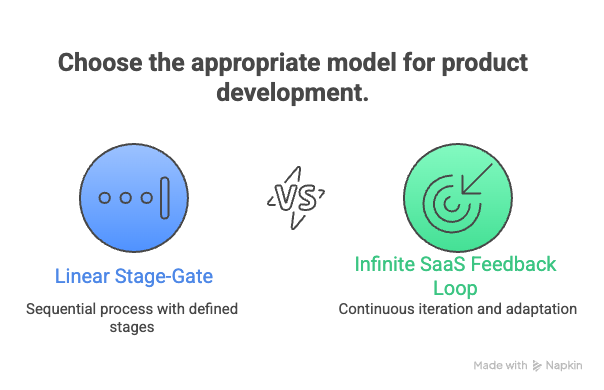
Most generic articles describe product development as a stage-gate process. That model is outdated for software.
Traditional linear model
Idea → Design → Build → Test → Launch
Modern SaaS loop
Discover ↔ Validate ↔ Build ↔ Measure ↔ Iterate
The difference is fundamental.
In SaaS, learning never stops. Deployment is instant. Feedback is real time. Data is continuous.
Why do most SaaS product development processes fail?
Rarely for want of engineering talent. The weakness sits in the decision system, where discovery never reaches the roadmap, sales requests ship without validation, MVP means a small build rather than validated learning, AI features get added because competitors have them, and roadmaps chase velocity instead of impact.
Failure rarely comes from lack of engineering talent. It comes from weak decision systems.
Common patterns I repeatedly see:
- Discovery disconnected from roadmap
- Sales-driven feature requests without validation
- MVP defined as “small build” instead of “validated learning”
- AI features added because competitors did
- Roadmaps optimized for velocity, not impact
- No structured synthesis of customer insights
The output looks impressive. The outcome does not move.
The real cost shows up in:
- Flat retention
- Weak expansion revenue
- Increasing product complexity
- Slower velocity over time
- Rising support burden
Weak discovery leads to misaligned roadmaps. Misaligned roadmaps create low adoption. Low adoption triggers more reactive features. Complexity increases. Speed drops.
What are the seven stages of the process?
Opportunity identification, problem validation, solution design, build and iteration, launch, measurement, and scaling. They are cycles rather than checkpoints, so a team can be in several at once. The hard part of the first stage is not collecting signal but filtering noise out of it.
“MVP does not mean fewer features. It means the minimum build required to validate the core assumption.”
Sivan Kadosh, Fractional CPO
The following stages are not sequential checkpoints. They operate in cycles. But each requires discipline.
1. Opportunity identification
Everything begins with signal detection.
Sources include:
- Customer interviews
- Usage analytics
- Churn analysis
- Support ticket clustering
- Market shifts
- Competitive gaps
- AI-driven behavioral analysis
The challenge is not collecting data. It is filtering noise from true opportunity.
A strong product team does not react to volume of requests. It identifies patterns of pain tied to revenue potential.
2. Problem validation
Validation separates interest from urgency.
Strong validation includes:
- Clear hypothesis statements
- Defined target persona
- Interview evidence across multiple customers
- Behavioral confirmation in product data
- Early willingness-to-pay signals
Too many teams validate enthusiasm, not economic value.
| Signal | Evidence strength | Decision threshold |
|---|---|---|
| Customer complaint | Weak | Not sufficient |
| Repeated workflow friction | Medium | Requires deeper interviews |
| Quantified revenue impact | Strong | Candidate for roadmap |
Validation must meet a predefined threshold before roadmap commitment.
3. Solution design
Design is about reducing uncertainty before heavy build investment.
Key elements:
- Clear problem statement
- Defined success metric
- MVP scope aligned to learning objective
- UX prototypes
- Technical risk mapping
- AI-assisted wireframing or prototyping
MVP does not mean fewer features. It means the minimum build required to validate the core assumption.
AI tools now accelerate:
- Wireframing
- Copy generation
- Code scaffolding
- Edge case simulation
But AI cannot determine whether the problem is worth solving.
4. Build and iterate
Execution requires structured agility, not chaos.
Effective build cycles include:
- Clearly defined outcome metrics
- Short feedback loops
- Early user testing
- Feature flags and staged rollouts
- Integrated analytics from day one
AI has changed this stage dramatically.
Developers now use:
- Code generation assistants
- Test automation tools
- Synthetic user testing
- Performance simulation
Build cycles are faster than ever.
Which makes validation discipline even more critical.
5. Launch strategy
Launch is not a marketing event. It is a learning milestone.
Strong SaaS launches include:
- Controlled beta segments
- Defined onboarding experiments
- Clear adoption targets
- Positioning alignment
- Customer feedback capture mechanisms
A product development process that ends at launch is incomplete. Launch is the beginning of measurable learning.
6. Measure and optimize
Measurement is where strategy meets reality.
Core SaaS metrics to evaluate:
- Activation rate
- Time to value
- Feature adoption
- Retention curves
- Net dollar retention
- Expansion revenue
- Support volume impact
| Stage | Primary metric | Leading indicator | Risk signal |
|---|---|---|---|
| Launch | Activation | Onboarding completion | Drop-off at step 2 |
| Growth | Adoption | Weekly active usage | Feature abandonment |
| Scale | Expansion | Upsell conversion | Flat NDR |
Measurement must be tied to the original hypothesis. Otherwise teams optimize vanity metrics.
7. Scale or sunset
Not every feature deserves to live forever.
Scaling includes:
- Expanding to new segments
- Integrating into core workflow
- Pricing optimization
- Performance hardening
Sunsetting requires discipline:
- Clear performance thresholds
- Communication plan
- Migration support
Feature sprawl is one of the biggest silent killers of SaaS velocity.
How is AI reshaping product development?
It changed the economics of building software. Coding, testing, interview transcription, insight clustering and prototyping all got faster and cheaper. What it did not touch is strategic prioritization, market judgment, economic validation and customer empathy, which is why AI amplifies whatever strategy already exists, good or weak.
“AI amplifies the quality of your thinking. If your discovery is weak, AI will help you build the wrong thing faster.”
Sivan Kadosh, Fractional CPO
AI has fundamentally altered the economics of building software.
What AI improves
- Faster coding
- Automated testing
- Interview transcription
- Insight clustering
- Rapid prototyping
- Predictive analytics
What AI cannot replace
- Strategic prioritization
- Market judgment
- Economic validation
- Customer empathy
- Revenue alignment
| AI accelerates | AI cannot replace |
|---|---|
| Code generation | Strategic trade-offs |
| Insight synthesis | Problem framing |
| Prototype creation | Market timing decisions |
| Test automation | Customer trust building |
AI amplifies the quality of your thinking. If your discovery is weak, AI will help you build the wrong thing faster.
How does the process change as the company grows?
Early-stage teams run founder-led discovery, iterate fast, keep governance informal and tolerate high uncertainty, with overbuilding before validation as the main risk. Growth-stage teams need a structured discovery cadence, defined roadmap governance and cross-functional alignment. Applying either stage’s discipline to the other is a common and expensive mistake.
One mistake I see frequently is applying enterprise-level process discipline to early-stage startups, or early-stage chaos to growth-stage companies.
The process must evolve.
Early-stage SaaS
- Founder-led discovery
- Rapid iteration
- Informal governance
- High uncertainty tolerance
Risk: Overbuilding before validation.
Growth-stage SaaS
- Structured discovery cadence
- Defined roadmap governance
- Cross-functional rituals
- Metric-driven prioritization
Risk: Sales pressure distorting roadmap.
Scale-stage SaaS
- Portfolio management
- Platform architecture focus
- Dedicated product ops
- AI integration strategy
Risk: Bureaucracy slowing innovation.
| Stage | Process maturity | Primary risk | Required discipline |
|---|---|---|---|
| Early | Informal | Overbuilding | Rapid validation |
| Growth | Structured | Misalignment | Governance cadence |
| Scale | Advanced | Bureaucracy | Portfolio clarity |
Personal insight from operating as a fractional CPO
Across multiple SaaS engagements, I have seen the same pattern.
Teams were shipping every sprint. Velocity looked healthy. Feature count was rising.
Retention was flat for six months.
The problem was not engineering capacity. It was weak opportunity framing.
When we introduced:
- Structured discovery rituals
- Defined validation thresholds
- Monthly horizon recalibration
- Clear economic impact scoring
Within two quarters, expansion revenue became predictable.
The turning point was not hiring more developers. It was strengthening the product development decision system.
A product development process must include governance, not just sprint ceremonies.
Our tip: if the build process needs an owner rather than another framework, that is what product management consulting covers.
What governance cadence keeps the process disciplined?
Recurring decision rituals rather than documents. Weekly for delivery progress, blockers and sprint outcomes. Biweekly for discovery insight, interview synthesis and evidence strength. Monthly to move horizons and reprioritize against validated learning. Quarterly to reset strategic themes and realign the roadmap to revenue and market shifts.
Strong process lives in recurring decision rituals.
Recommended cadence:
Weekly
- Delivery progress review
- Remove blockers
- Validate sprint outcomes
Biweekly
- Discovery insight review
- Synthesize interviews
- Evaluate evidence strength
Monthly
- Horizon movement discussion
- Reprioritize based on validated learning
Quarterly
- Strategic theme reset
- Align roadmap to revenue and market shifts
Process maturity is visible in decision clarity, not sprint velocity.
When should you bring in a fractional CPO?
When retention stays flat despite continuous feature output, expansion revenue is inconsistent, roadmap debates run on opinion, AI initiatives lack measurable return, or product and revenue strategy have drifted apart. Those signals point at the decision system rather than the delivery team, which is what the role restructures.
There are specific signals that the product development process needs restructuring:
- Retention is flat despite continuous feature output
- Expansion revenue is inconsistent
- Roadmap debates are opinion-driven
- AI initiatives lack measurable ROI
- Product and revenue strategy feel disconnected
A fractional CPO for B2B SaaS brings:
- Structured product development framework
- Executive-level discovery discipline
- Portfolio prioritization rigor
- AI strategy integration
- Governance design aligned with growth
Instead of adding headcount blindly, many SaaS companies benefit from strengthening the operating system first.
Key takeaways
- The SaaS product development process is iterative, not linear
- Discovery quality determines roadmap quality
- AI accelerates execution but amplifies strategic errors
- Process maturity evolves with company stage
- A fractional CPO can formalize structure without full-time overhead
- MVP means minimum viable learning, not minimum features
- Governance cadence, weekly, monthly, quarterly, is essential for decision clarity
Build a product development process that drives growth
If your SaaS product development process feels busy but not effective, the issue is rarely execution speed.
It is decision discipline.
As a fractional CPO, I help SaaS founders design scalable product operating systems that connect discovery, delivery, AI strategy, and revenue outcomes.
If your roadmap feels reactive or your growth is unpredictable, it may be time to redesign the system behind it.
Explore our fractional CPO services or request a strategic product review to evaluate where your process needs reinforcement.
Busy every sprint and still not moving retention?
Get a senior, ex-CPO read on your biggest product bottleneck in 30 focused minutes. No pitch, no obligation.
Book a strategy callFAQs
For teams that need cross-functional product leadership without a full-time headcount commitment, a fractional product manager can own and optimize this development process.
I do this work inside B2B SaaS product teams. Knowing the model is one thing. Someone has to own it every week.
See how product management consulting works →What are the stages of the product development process in SaaS?
The SaaS product development process includes opportunity identification, problem validation, solution design, build and iteration, launch, measurement, and scaling or sunsetting.
How is SaaS product development different from traditional product development?
SaaS product development is continuous and data-driven, with rapid deployment and iteration cycles, unlike traditional stage-gate manufacturing processes.
How does AI impact the product development process?
AI accelerates coding, testing, and insight synthesis, but it does not replace strategic prioritization, economic validation, or customer discovery.
What is the role of a fractional CPO in product development?
A fractional CPO designs the product operating model, introduces discovery discipline, aligns roadmap to revenue strategy, and ensures governance supports scalable growth.
Why do SaaS product development processes fail?
They fail when discovery is weak, validation thresholds are unclear, roadmaps are reactive, and governance rituals are missing. Execution speed alone does not guarantee impact.
What clients say
Read all 18 references“As a product manager, I can say that Sivan is very professional – always looking deeply on the discussed feature to understand end to end its effect on the whole product, and as well the eager to understand what would be the added value to the strategy of the company. Nothing was added without a clear scope of development, a clear understanding of the business owner and a clear way to measure the success or failure of this feature.”
“Leading by example, empowering, mentoring, and growing his product teams, he created great product culture and set us Product Managers up for success. His vision and strategic direction enabled us to create successful products that brought millions of dollars of revenue to the company and its clients.”
“As part of his role as VP Product, he identified creative ideas, developed sharp strategies and built the road map while focusing on customer experience and business needs.”