
A product consultant is an outside expert who diagnoses a specific product problem and recommends a fix, working to a defined project scope. The engagement ends with the recommendation. That boundary is what separates the role from a fractional CPO, who owns the outcome inside the team.
I have hired product people, and I have been one. If the title is unclear, the problem is usually the decision no one owns.
See what a product consultant owns →Scaling a SaaS company often feels like solving a puzzle where some of the pieces are missing. You know you need help, but you are not sure if you should bring in a consultant, a coach, a fractional executive, or make a full-time hire. One role that frequently comes up in this conversation is the product consultant.
This article breaks down what a product consultant actually does, how they differ from fractional CPOs and full-time product leaders, what they cost, and when they make sense for a growing SaaS company. By the end, you will have the clarity to decide whether a consultant is the right fit or if your business needs longer-term product leadership.
Key takeaways
- A product consultant provides short-term, specialized expertise for product challenges like market research, prototyping, or roadmapping.
- Consultants are best for targeted projects, not ongoing leadership or organizational transformation.
- Costs vary, but most consultants charge hourly, daily, or project-based fees.
- Growth-stage SaaS companies often outgrow consultants and benefit more from fractional CPOs who provide ongoing executive-level guidance.
What does a product consultant actually do day to day?
A product consultant is usually a current or former product leader who brings specialized expertise for a fixed period. The work covers market and user research, product strategy, roadmap building, prototyping and validation, stakeholder alignment, and go-to-market advice. They plug into your team to answer a hard question or move one project forward.
A product consultant is typically a former or current product leader who offers specialized expertise on a temporary basis. They are often brought in to solve specific problems or provide an objective outside perspective.
Common responsibilities of a product consultant include:
- Conducting market and user research.
- Defining product strategy and vision.
- Building or refining product roadmaps.
- Prototyping and validating concepts.
- Facilitating stakeholder alignment.
- Advising on go-to-market strategies.
In essence, a product consultant plugs into your team for a set period of time to help answer tough product questions or move a project forward.
How does a product consultant compare with a fractional CPO and a full-time hire?
All three improve product outcomes, but they differ in scope, commitment and depth. A consultant delivers short-term, project-based expertise over weeks or months. A fractional CPO provides ongoing executive leadership part-time and long-term. A full-time CPO owns the function permanently. The table below sets the three side by side.
“A consultant is measured on the quality of the recommendation. A fractional CPO is measured on whether it worked.”
Sivan Kadosh, Fractional CPO
This is where confusion often arises. While consultants, fractional CPOs, and full-time product leaders all contribute to product success, they do so in very different ways.
Here is a quick comparison table to help you understand these roles:
| Role | Scope of work | Time commitment | Strategic depth | Best for |
|---|---|---|---|---|
| Product consultant | Short-term, project-based expertise | Weeks to months | Tactical to strategic | Filling skill gaps, research, prototyping |
| Fractional CPO | Ongoing executive leadership without full-time cost | Part-time, long-term | High, across product and business alignment | Scaling product strategy and org structure |
| Full-Time CPO | Permanent executive leadership | Full-time, permanent | High, full ownership | Large or late-stage companies needing constant leadership |
Takeaway: Consultants solve immediate problems, while fractional CPOs and full-time leaders provide the long-term product vision and execution needed to scale.
How do product consultants structure engagements and pricing?
Consultants price in one of three ways: an hourly rate, a daily or weekly rate often bundled into short sprints, or a fixed project fee tied to a defined deliverable. The ranges below set out what each looks like. A fractional CPO works differently, on a monthly retainer that buys continuity rather than a deliverable. Published pricing is rare in this market: our review of 1,127 provider sites found fewer than 1 in 5 publishing a price at all, which is why comparing consultants on fee alone is harder than it looks (the Fractional Rates Index).
“The expensive part of a consulting engagement is rarely the fee. It is the months that pass while nobody owns the implementation.”
Sivan Kadosh, Fractional CPO
Consultants usually price their services in one of three ways:
- Hourly: $100–$300+ per hour depending on seniority and specialization.
- Daily/Weekly: $1,000–$3,000 per day, often bundled into short sprints.
- Project-based: Fixed fees for defined deliverables like a research study, roadmap, or prototype.
Fractional CPOs, on the other hand, often work on a monthly retainer, offering consistent leadership for less than the cost of a full-time executive.
When should you hire a product consultant, and when should you not?
Bring one in for bounded work: short-term research before a funding round or pivot, an unbiased read on your roadmap, a specific skill gap such as UX research or go-to-market, or early product-market-fit validation. Skip the consultant when you need ongoing executive leadership, organizational structure, long-term alignment, or systemic churn work.
Good reasons to bring in a consultant:
- You need short-term research before a funding round or pivot.
- You want an unbiased view of your roadmap.
- Your team lacks expertise in a specific area, like UX research or go-to-market planning.
- You are validating early product-market fit.
Situations where a consultant is not enough:
- You need ongoing executive-level leadership.
- You are scaling a product team and need organizational structure.
- You want to align product and business strategy over the long term.
- You are experiencing churn or retention issues that require systemic change.
From my experience: the high cost of choosing the wrong type of help
A good friend of mine, the CEO of a fast-growing B2B SaaS company, faced this exact dilemma. His company had a solid product with an ARR of $3M, but the monthly customer churn rate had silently climbed to a dangerous 4%. He did what many smart founders do: he hired a brilliant, high-end UX consulting firm for a $30,000 project fee.
After six weeks of intensive work, the consultants delivered a masterful strategic report. It was full of incredible insights and a clear path to fix the user onboarding flow. The team was thrilled. They thought the problem was solved.
Six months later, my friend called me, frustrated. I asked him a simple question: “How much of that report have you implemented?” The answer was a painful “maybe 10%.” The brilliant report was collecting dust.
Why? Because his dev team was already buried in their existing roadmap. After the consultants left, there was no senior leader with the singular focus to own the execution. No one to fight for the project’s priority in leadership meetings. The consultants’ job was to deliver a report, and they did it perfectly. But what the company actually needed was ongoing leadership.
The true cost wasn’t the $30,000 fee. The true cost was the six critical months they lost. During that time, their 4% monthly churn compounded, resulting in a loss of over $600,000 in Annual Recurring Revenue. It was a very expensive lesson in the difference between short-term advice and long-term leadership.
This is the critical difference. A consultant provides a map. A Fractional CPO not only helps draw the map but also takes the wheel to ensure you reach your destination.
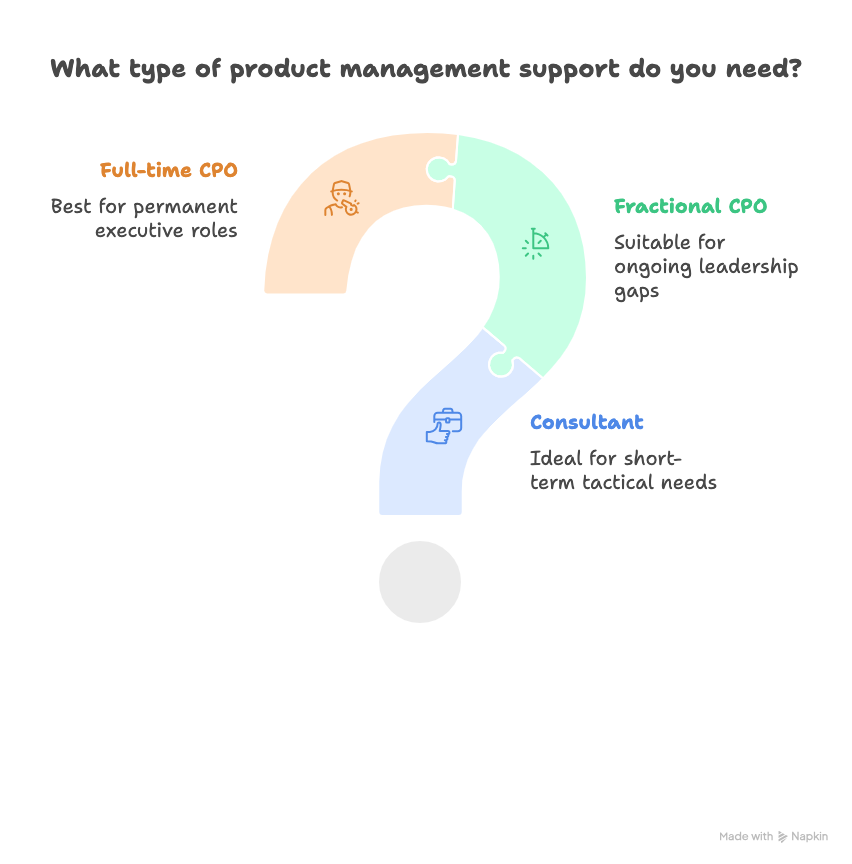
Product management consulting checklist:
- Is this a short-term tactical need? → Consultant
- Is this an ongoing leadership gap? → Fractional CPO
- Do we need a permanent executive? → Full-time CPO
Product consultant vs product coach: what’s the difference?
The two are often confused but solve different problems. A consultant works on your product and delivers outcomes: a roadmap, validated research, a prototype. A coach works on your people, developing the skills of product managers and leaders over a longer mentoring relationship. For a founder the test is whether you need the work done or the capability built.
While often confused, consultants and coaches serve different purposes:
| Role | Focus | Relationship | Example |
|---|---|---|---|
| Product consultant | Solves product challenges, delivers outcomes | Short-term, project-based | Builds roadmap, validates market research |
| Product coach | Develops skills of product leaders and teams | Long-term, mentoring | Trains product managers on prioritization frameworks |
For SaaS founders, this distinction matters. A consultant helps with your product, while a coach develops your people.
What are the alternatives to hiring a product consultant?
If a consultant is not the right shape, there are four common alternatives: in-house training that builds long-term resilience, online courses and certifications that grow expertise internally, peer groups and SaaS communities for advice, or a fractional CPO when a growth-stage company needs ongoing leadership rather than a one-off deliverable.
If a consultant does not feel like the right fit, consider:
- In-house training: Skill up your team for long-term resilience.
- Online courses and certifications: Build product management expertise internally.
- Networking and peer groups: Leverage SaaS communities for advice and best practices.
- Hire a fractional CPO: For growth-stage SaaS companies needing ongoing leadership, this often provides the highest ROI.
How do you choose the right product consultant?
Five things separate a good fit from an expensive mistake: proven SaaS experience with companies at your stage, specialization that matches your exact need, communication and cultural fit your team will actually trust, references and case studies showing measurable outcomes, and fees that align with your budget and stage. If the need is broader than one project, product management consulting services cover the same ground on an ongoing basis.
When evaluating consultants, look for:
- Proven SaaS experience: Have they worked with companies like yours?
- Specialization: Do they align with your exact need (UX, strategy, go-to-market)?
- Communication and cultural fit: Will your team trust and collaborate with them?
- References and case studies: Can they show measurable outcomes from past projects?
- Budget alignment: Do their fees match your expectations and stage?
Should you hire a product consultant or a fractional CPO?
Choose a consultant when the problem is bounded: a knowledge gap, a research question, a prototype. Choose a fractional CPO when the problem is continuous: scaling, churn, or a product strategy that keeps drifting from business outcomes. The deciding question is whether you need a recommendation or someone to own the result.
Product consultants bring valuable expertise when you have a short-term challenge or a knowledge gap to fill. But if your SaaS company is scaling, facing churn, or struggling to align product with business outcomes, you likely need more than a consultant. That is where a fractional CPO makes the difference, providing ongoing executive-level leadership without the cost of a full-time hire.
If you are past the point of short-term fixes and want lasting alignment between your product strategy and business outcomes, a fractional CPO can definitely help. Our fractional CPO services are designed for growth-stage SaaS companies just like yours.
Not sure whether product is what is actually holding your growth back?
Get a senior, ex-CPO read on your single biggest product bottleneck in 30 focused minutes. No pitch, no obligation.
Book a Product Strategy SessionI have hired product people, and I have been one. Whichever title you pick, someone has to carry the decision.
See what a product consultant owns →FAQs
What does a product consultant do?
They provide short-term, specialized expertise to help companies with product challenges like research, strategy, or prototyping.
How much does a product consultant cost?
Rates vary widely, but most charge between $100–$300 per hour or $1,000–$3,000 per day. Project fees are also common.
What’s the difference between a product consultant and a product manager?
A product manager is a permanent team member responsible for ongoing product execution. A consultant is external and focused on short-term projects.
Product consultant vs fractional CPO: which is better?
It depends on your needs. Consultants are best for short projects, while fractional CPOs provide ongoing leadership to scale your product and team.
How long does a consultant engagement typically last?
Anywhere from a few weeks to a few months, depending on the scope.
What clients say
Read all 18 references“As a product manager, I can say that Sivan is very professional – always looking deeply on the discussed feature to understand end to end its effect on the whole product, and as well the eager to understand what would be the added value to the strategy of the company. Nothing was added without a clear scope of development, a clear understanding of the business owner and a clear way to measure the success or failure of this feature.”
“Leading by example, empowering, mentoring, and growing his product teams, he created great product culture and set us Product Managers up for success. His vision and strategic direction enabled us to create successful products that brought millions of dollars of revenue to the company and its clients.”
“As part of his role as VP Product, he identified creative ideas, developed sharp strategies and built the road map while focusing on customer experience and business needs.”