
Feature velocity hides product failure because shipping speed and product health are different measurements. A team can raise its output every sprint while activation, retention and revenue stay flat, and the rising number reads as progress. Velocity measures how much left the building, not whether any of it worked.
I do this work inside B2B SaaS product teams. If your team ships every week and the numbers barely move, this is where I start.
See how product management consulting works →There is one trait I believe every Product Manager must possess to consider themselves truly great: the ability to look in the mirror and say, “I was wrong.”
As a young PM, I spent years confusing motion with progress. We would ship features at a breakneck pace without moving the company an inch toward a “North Star”, and frankly, back then, who even had a North Star?
As the years passed and much water flowed under the bridge, the distinction between progress and motion became crystal clear. Today, I get a physical itch when I see startups prioritizing motion (Velocity) over progress (Outcome).
This isn’t just a gut feeling; it’s backed by alarming data. A comprehensive report by Pendo reveals a harsh truth: 80% of features in software products are rarely or never used. We are investing massive resources into building “dead code,” but it doesn’t end there.
The damage is twofold. Research from the Harvard Business Review defines this as “Feature Fatigue.” Their findings highlight a cruel paradox: while adding more features might help close the initial sale, it dramatically hurts usability and long-term customer retention. In other words, the obsession with “running fast” doesn’t just waste money, it actively harms the product.
What separates successful companies from wildly successful ones is the ability to stop this race and build a Predictable Growth Engine. It is the discipline of Initiative, Discovery, Development, Feedback, and Improvement. This cycle creates the “compound interest effect” we are all chasing.
This machine isn’t built by accident. It is built by design.
Key takeaways
- The Velocity Illusion: High shipping speed often masks a lack of strategic direction, creating a “Feature Factory” environment.
- The Complexity Tax: Rapid shipping without validation creates an exponential increase in maintenance costs, eventually grinding innovation to a halt.
- The Signal-to-Noise Problem: More features often lead to a diluted user experience, making the core value proposition harder to find.
- The Solution: Shifting from “Velocity of Output” to “Velocity of Learning.”
Why is velocity a dangerous KPI?
Velocity is an output metric. It counts how much the team produced, not whether any of it moved net dollar retention or activation. Early on, when the job is finding product-market fit, speed genuinely helps. Once a company is scaling, going faster in the wrong direction only reaches the cliff sooner.
In the early stages of a startup, velocity is essential. You are in a race to find Product-Market Fit (PMF), and the faster you iterate, the more “shots on goal” you have.
However, once you move into the scaling phase (Series A and beyond), velocity becomes a double-edged sword. If you are heading in the wrong direction, “going faster” only gets you to the cliff sooner.
Velocity is an output metric. It measures how much 'stuff' you produced.
The “Output” vs. “Outcome” divide
Velocity is an output metric. It measures how much “stuff” you produced. It does not measure if that “stuff” moved the needle on Net Dollar Retention (NDR), reduced churn, or increased the Lifetime Value (LTV) of a customer.
When leadership focuses solely on velocity, the product team naturally optimizes for volume. They begin to favor small, easy-to-ship features over large, complex architectural changes that might actually solve the customer’s core pain. This results in a “bloated” product, a Swiss Army knife where every blade is dull.
What does product failure hidden by speed look like?
It arrives in three stages of value decay. The team optimizes for shipping dates and skips discovery, so nothing gets validated before it is built. Those unvalidated features then go unused while still needing maintenance, and that maintenance load eventually consumes the capacity new work depended on.
How does a high-velocity team fail? It happens through three distinct stages of “Value Decay.”
Stage A: The feature factory
The team becomes obsessed with the roadmap. Success is defined as “Shipping Feature X by Friday.” Because the deadline is the goal, the team skips the Discovery Phase. They don’t talk to users; they don’t prototype; they don’t validate. They just build. Breaking that pattern is its own piece of work, covered in escaping the feature factory.
Stage B: The “Zombie Feature” accumulation
Because the features weren’t validated, they aren’t used. Pendo’s data shows that in many SaaS products, 80% of features are “rarely or never” used. However, these “Zombie Features” cannot simply be ignored. They must be maintained. They must be updated when the UI changes. They must be supported by the CX team.
Stage C: The complexity tax
This is where the engine seizes. Every new feature adds a layer of complexity to the codebase. When you have a high velocity of unvalidated features, you are essentially taking out a high-interest loan of “Technical and Product Debt.” Eventually, the interest on that debt (maintenance and bug fixes) becomes so high that the team can no longer build anything new.
| Metric | High Velocity / Low Strategy | Low Velocity / High Strategy |
|---|---|---|
| Success Metric | Tickets Closed | Customer Outcomes |
| User Feedback | “The UI is cluttered” | “This solved my main problem” |
| Tech Debt | Exponential Growth | Managed & Refactored |
| Business Impact | Flatlining / Churn | Sustainable Growth |
Who ends up deciding the roadmap?
Whoever argues hardest. Sales asks for the feature that closes a named deal, marketing wants something to announce, and the founder brings the latest idea. With no validation gate between a request and the build queue, every one of them lands in the same pipeline and the product stops having a point of view.
“When velocity is the goal, the roadmap is usually dictated by whoever is shouting the loudest.”
Sivan Kadosh, Fractional CPO
When velocity is the goal, the roadmap is usually dictated by whoever is shouting the loudest.
- Sales wants the “one more feature” to close a specific deal.
- Marketing wants a “shiny new tool” to talk about in a press release.
- The Founder wants to build their latest “shower idea.”
Because there is no rigorous Validation Gate, all of these requests get funneled into the “Velocity Engine.” The engineers are happy because they are busy. The stakeholders are happy because they see “progress.” But the product is failing because it has lost its opinion.
A great product is defined by what it doesn’t do. High velocity makes it very hard to say “No.”
How do you shift to velocity of learning?
Measure how fast the team can invalidate a bad idea rather than how fast it ships. That means putting a discovery phase in front of delivery, where a feature is tested for value and usability in days instead of built out over months. Killing a bad idea early lowers shipping velocity and raises engineering return.
To save the product, you must redefine what “velocity” means. Instead of “velocity of shipping,” we must measure the “velocity of learning.”
How fast can your team invalidate a bad idea? That is the hallmark of a world-class product organization.
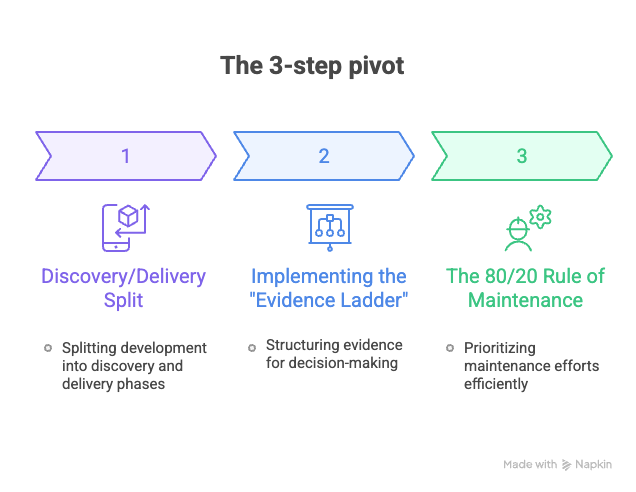
The 3-step pivot
Step 1: The Discovery/Delivery Split
You must mandate that every feature goes through a “Discovery” phase before it enters the “Delivery” pipeline.
- Discovery: Is it valuable? Is it usable? (Cost: Days)
- Delivery: Building it to scale. (Cost: Weeks/Months)
If you can kill a bad feature in the Discovery phase, your “Velocity of Shipping” goes down, but your “ROI of Engineering” skyrockets.
Step 2: Implementing the “Evidence Ladder”
Stop using opinions to prioritize the roadmap. Use an Evidence Ladder.
- Level 1 (Weakest): Founder/Sales intuition.
- Level 2: User says they want it in an interview.
- Level 3: User shows “simulated intent” (e.g., clicks a ‘Coming Soon’ button).
- Level 4 (Strongest): User pays for the feature or uses a prototype to solve a real task.
Step 3: The 80/20 Rule of Maintenance
At least 20% of your velocity must be dedicated to Product Pruning. This means removing features that aren’t working. If you don’t have the courage to delete code, you don’t have a product strategy; you have a collection of mistakes.
Why does more end up being less?
Because marginal value falls while cognitive load rises. Each additional feature adds a little to what the product can do, and adds more to what the user has to navigate. Adding the fiftieth item to a menu makes the five features the customer actually bought harder to reach, which is how feature growth tracks churn among power users.
“A great product is defined by what it doesn’t do. High velocity makes it very hard to say “No.””
Sivan Kadosh, Fractional CPO
There is a psychological phenomenon in SaaS called the feature-value paradox.
As you add features, the total value of the product may increase slightly, but the marginal value of each new feature decreases. Simultaneously, the “Cognitive Load” for the user increases.
If your velocity is focused on adding the 50th feature to a menu, you are actually reducing the value of the first 5 features (the ones the customer actually bought the software for). You are making the core product harder to use. This is why “Feature Velocity” often correlates with an increase in churn among your most loyal power users.
How does a fractional CPO stop the velocity death spiral?
By adding strategic friction where none exists. The work starts with an audit of usage against effort across the current feature set, which usually shows how much engineering budget is going on features almost nobody opens. From there the roadmap moves from a list of features to a list of outcomes, and someone senior owns saying no.
Founders often feel powerless to stop the velocity engine. They are afraid that if they slow down, the competition will catch up.
A fractional CPO for growth-stage SaaS provides the “Strategic Friction” necessary to ensure you are building the right things. We don’t just “manage” the roadmap; we re-engineer the product operating system.
1. The Audit of “Usage vs. Effort”
We perform a cold-blooded analysis of your current feature set. We look at the “Effort” it took to build vs. the “Usage” it gets today. Usually, we find that 30% of your engineering budget is being spent maintaining features that 2% of your users care about. We provide the data to kill those features.
2. Installing the “Outcome Roadmap”
We move the team away from a “Timeline of Features” to a “Timeline of Outcomes.” Instead of “Build an API in Q3,” the goal becomes “Enable 50% of Enterprise customers to automate their workflow by Q3.” This shifts the focus from shipping the API to making sure the API works for the customer.
3. Mentoring the “No”
We act as the buffer between the Founder/Sales and the Engineering team. We install frameworks like RICE (Reach, Impact, Confidence, Effort) to ensure that every “urgent” request is measured against the cold reality of business value.
Our tip: use our free RICE calculator
When feature velocity is masking deeper product problems, bringing in a product management consultant can help diagnose the root causes and realign the product organization toward outcomes that matter.
What do Series B investors measure instead?
Unit economics, not output. A company shipping a hundred features a year against a flat retention curve is leaking, and one shipping ten while expansion revenue per user climbs is compounding. Velocity is an internal number that says how busy the team is. Impact is the market’s number, and only one of them raises a round.
If you are looking to raise your next round, understand this: Investors don’t care about your velocity. They care about your Unit Economics.
A company that ships 100 features a year but has a flat retention curve is a “leaky bucket.” A company that ships 10 features a year but sees a 20% increase in expansion revenue per user is a “money machine.”
Velocity is an internal metric. Impact is a market metric. Never confuse the two.
Summary checklist for founders:
- Do you know the “Usage Rate” of the last five features you shipped?
- Does your roadmap consist of “Solutions” or “Problems to Solve”?
- When was the last time you deleted a feature?
- Is your Engineering Lead complaining about complexity while your Sales Lead is asking for more features?
Stop measuring how fast you are running. Start measuring how far you’ve actually traveled. Consider hiring a fractional CPO to fix your feature velocity.
Shipping quickly and still not moving the business?
Get a senior, ex-CPO read on your biggest product bottleneck in 30 focused minutes. No pitch, no obligation.
Book a Product Strategy AuditI do this work inside B2B SaaS product teams. Knowing the model is one thing. Someone has to own it every week.
See how product management consulting works →What clients say
Read all 18 references“As a product manager, I can say that Sivan is very professional – always looking deeply on the discussed feature to understand end to end its effect on the whole product, and as well the eager to understand what would be the added value to the strategy of the company. Nothing was added without a clear scope of development, a clear understanding of the business owner and a clear way to measure the success or failure of this feature.”
“Leading by example, empowering, mentoring, and growing his product teams, he created great product culture and set us Product Managers up for success. His vision and strategic direction enabled us to create successful products that brought millions of dollars of revenue to the company and its clients.”
“As part of his role as VP Product, he identified creative ideas, developed sharp strategies and built the road map while focusing on customer experience and business needs.”