
Product transformation is the shift from a project mindset that ships features on request to a product mindset that owns outcomes. It changes strategy, people, process and culture together, and it fails whenever a company updates its tools without changing how decisions actually get made.
I do this work inside B2B SaaS product teams. If your team ships every week and the numbers barely move, this is where I start.
See how product management consulting works →For most B2B SaaS organizations, the word “transformation” feels heavy. It sounds like a multi-year, multi-million dollar consultant-led overhaul that promises much but delivers little. However, in the current SaaS economy, where “growth at all costs” has been replaced by “efficient, durable growth”, product transformation is no longer a luxury. It is a survival mechanism.
The reality is that many companies are currently “trapped” in a legacy mindset. They have scaled their revenue through sheer force of will and sales excellence, but their product development process still mirrors a traditional IT shop: top-down, project-based, and dangerously disconnected from the customer.
Product Transformation is the deliberate, often difficult process of moving an organization from a Project-Centric mindset (shipping features to satisfy stakeholders) to a Product-Centric mindset (solving customer problems to drive business value).
For the last 18+ years, I have been managing technology companies and products, and I must say that not much has changed in this space. I’ve moved from one company to another, consulted for a wide range of organizations, and with very few exceptions, everyone operates more or less the same way.
But, and it’s a big ‘but’, that era is over. We are at the dawn of a period that will change everything we were used to. The methodologies through which we manage companies and products are shifting dramatically. In several companies we consult for, we are already implementing a different approach: we are moving away from the world of ‘Delivery’ and commitment to features (Output), and moving toward a commitment to results: Outcome.
This requires a deep mindset shift, but it is an absolute necessity. Industry data from Pendo’s Feature Adoption Report highlights the urgency of this shift, revealing that 80% of features in the average software product are rarely or never used. This wasted effort is a primary reason why so many digital transformation programs fall short, undone by a gap between technical output and business value.
The OKR framework, which focuses on business outcomes rather than a laundry list of features, is becoming more relevant than ever. Research by McKinsey reinforces this, showing that companies with high ‘Organizational Health’ and a focus on outcome-based clarity are 4.2 times more likely to outperform their competitors in terms of total return to shareholders. As highlighted in Harvard Business Review, the transition is about moving from code assembly lines to value-based growth engines. In an era where AI accelerates technical development, the barrier is no longer ‘how to build,’ but ‘what is right to build.’
Key takeaways
- Define the “Business Pain”: Don’t transform because it’s trendy. Do it because your CAC is too high, your churn is increasing, or your “Time to Value” is lagging.
- Competence Before Empowerment: You cannot “empower” a team that doesn’t have the skills to talk to customers or interpret data. Transformation often requires an infusion of new skills or intensive coaching.
- Measure “Time to Learning”: The goal of the first 90 days of a transformation isn’t to ship more code; it’s to decrease the time it takes to learn if an idea is worth building.
- The C-Suite is the Catalyst: If the Sales VP can still “force” a feature onto the roadmap through a back-channel to the CEO, your transformation is dead on arrival.
Why does product transformation matter?
Because the alternative is funding work nobody uses. Roadmaps in project-centric companies get filled by whoever asked loudest, and the output looks like progress while adoption stays flat. Transformation is what stops the engineering budget going to features never touched twice.
The biggest threat to a scaling SaaS company in 2026 isn’t necessarily a competitor with more funding; it is the internal friction of a stagnant operating model. This friction manifests as the “Feature Factory” syndrome, where the engineering team is treated as a cost center rather than a value generator.
When you fail to undergo a product transformation, you face three core inefficiencies that directly erode your SaaS valuation:
1. The innovation gap
When your roadmap is dictated by the “loudest” customer or the most recent sales request, your team spends 90% of its time on maintenance and “reactive” features. This leaves no room for the disruptive innovation that originally gave your company its edge. Eventually, you become a “legacy” provider, vulnerable to leaner startups.
2. The “HiPPO” effect
In an untransformed organization, decisions are made based on the Highest Paid Person’s Opinion (HiPPO). This creates a culture of “order-taking” where the product team stops thinking and starts just executing. Transformation replaces the HiPPO with data, evidence, and customer insights.
3. Low feature adoption and “R&D waste”
Pendo’s Feature Adoption Report, cited above, found that 80% of features in the average software product are rarely or never used, and non-transformed companies sit at the wrong end of that average. This is the ultimate “R&D Waste.” Transformation ensures that you “kill” bad ideas in the prototype phase, saving your engineering capital for things that actually move the needle on your North Star metric.
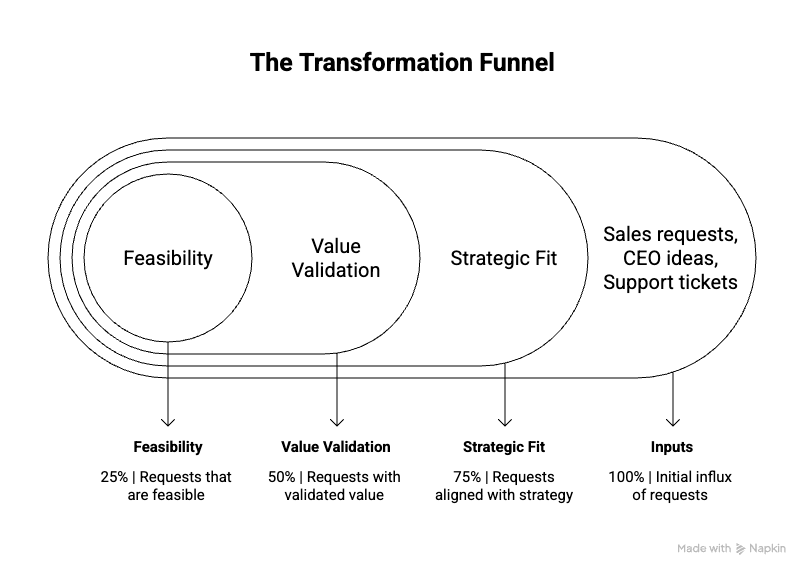
What are the four dimensions of product transformation?
Strategy, people, process and culture, and they have to move together. Strategy trades dated timelines for outcome themes. Empowered squads replace allocated resources. Continuous discovery replaces the big-bang release. Culture is the one most companies skip, and skipping it leaves the other three as vocabulary.
“Transformation replaces “Waterfall in disguise” (months of planning followed by months of building) with continuous discovery and delivery.”
Sivan Kadosh, Fractional CPO
At SaaS Fractional CPO, we have seen that transformation fails when it is treated as a “process update.” If you only change your tools (e.g., moving from Trello to Jira) without changing your culture, you haven’t transformed; you’ve just redecorated. A true transformation occurs across four specific dimensions:
I. The strategy dimension: From timelines to themes
Transformation begins at the board and executive level. A transformed organization doesn’t look at a roadmap and ask “When will Feature X be done?” They ask “What business outcome will this initiative achieve?”
- The Shift: Moving from a “Feature Roadmap” (a list of static things to build) to a Theme-Based Roadmap.
- Example: Instead of a roadmap item titled “Mobile App V2,” a transformed theme is “Increasing daily active usage for on-the-go Enterprise users by 20%.” This allows the team to find the best solution, which might be a mobile app, or might simply be an improved notification system.
II. The people dimension: From resources to empowered squads
In a legacy model, people are “resources” assigned to projects. Once the project is done, the “resource” moves on. This destroys domain expertise. In a transformed model, people are members of durable, cross-functional squads.
- The Shift: Teams are built around a “Mission.” A mission-driven squad (consisting of product, design, and engineering) stays together long enough to develop deep empathy for a specific user persona. They aren’t disbanded when a feature ships; they are held accountable for the performance of that feature over time.
III. The process dimension: From “big bang” to continuous discovery
Transformation replaces “Waterfall in disguise” (months of planning followed by months of building) with continuous discovery and delivery.
- The Shift: The process moves from “Validation after shipping” to “Validation during ideation.” In a transformed state, a Product Manager is talking to at least 3-5 customers every single week. This isn’t a “research phase”, it is a constant pulse that informs the daily work of the engineers.
IV. The culture dimension: From certainty to curiosity
This is arguably the most difficult dimension to master. Legacy cultures value “knowing the answer” and “being right.” Transformed cultures value “the speed of learning” and “being evidence-led.”
- The Shift: Success is redefined. Shipping a feature on time is no longer “success” if that feature fails to drive the KPI. Conversely, spending two weeks on a prototype and realizing the idea is worthless is celebrated as a “win” because it saved the company three months of wasted engineering effort.
Why do most transformation initiatives fail?
Because the incentives underneath never change. Leadership announces a new operating model while still rewarding the team for shipping on the date it promised. When the quarterly review asks how many features landed rather than what changed for customers, everyone reverts to whatever gets rewarded.
“Transformation requires the CEO and the sales leadership to give up a degree of control over “the what” in exchange for much higher certainty over “the why” and “the result.””
Sivan Kadosh, Fractional CPO
Why do so many companies start a “Product Transformation” only to revert to their old ways six months later? It usually comes down to a fundamental misunderstanding of the new social contract.
Transformation requires the CEO and the sales leadership to give up a degree of control over “the what” in exchange for much higher certainty over “the why” and “the result.”
The incentive conflict
If your Product Managers are still incentivized by “shipping on time” (velocity) while the CEO tells them to “be more innovative” (value), they will choose the shipping date every time. Why? Because shipping is visible and safe. Innovation is messy and involves failure.
To avoid the trap, leadership must change the incentive structure. You must reward the discovery of truth, even when that truth contradicts the founder’s initial vision.
How do you start a product transformation?
Start with evidence rather than a reorganization. Audit what you shipped last year and how much of it users touched more than once, then put that number in front of the leadership team. Kill the annual planning cycle next, and change who you hire for.
Step 1: The “feature adoption” audit
Look at the features you launched in the last year. Use your analytics tool (Pendo, Mixpanel, etc.) to see how many users touched them more than once. Present this data to your leadership team. Nothing motivates transformation quite like seeing a visual representation of wasted capital.
Step 2: Stop the “annual planning” cycle
If you are still doing 12-month roadmaps, you aren’t transformed. Move to a Quarterly Outcome Cycle. Every quarter, the leadership defines the “High-Level Objectives,” and the teams spend the first two weeks of the quarter defining the “Key Results” they believe they can hit.
Step 3: Hire for “problem-solving,” not “requirements-writing”
Traditional PMs write 50-page PRDs (Product Requirement Documents). Transformed PMs facilitate discovery sessions. If your current team doesn’t know how to run a “Design Sprint” or a “User Interview,” it’s time to invest in coaching.
What is the ROI of product transformation?
It shows up as capital that stops being wasted. Every feature nobody adopts was paid for in engineering time, and a transformed product organization kills those ideas at the prototype stage instead of the release stage. The return is the work you no longer build.
When a CEO asks, “What is the ROI of this transformation?”, the answer is found in your Rule of 40 performance.
- Lower Burn Rate: By stopping the development of low-value features, you effectively increase your engineering capacity without hiring a single new developer.
- Higher LTV (Lifetime Value): Products that solve real problems have higher “stickiness.” Transformation directly impacts your NRR (Net Revenue Retention).
- Faster Pivot Speed: In a volatile market, the ability to “learn and pivot” in three weeks rather than three quarters is your greatest competitive advantage.
Drive your transformation with a fractional CPO
Transformation needs someone who has done it before and is not fighting for their own headcount while doing it. That is the case for bringing in product leadership on a fractional basis, which buys senior judgment on the operating model without adding a permanent executive salary.
Product transformation is not a “side project.” It is a high-stakes reorganization of how your company creates value. Trying to lead this transition while simultaneously managing investors, closing enterprise deals, and scaling a sales team is nearly impossible for most founders.
This is where the fractional CPO model provides the highest leverage. We don’t just provide a “consulting deck”; we act as the interim architect of your new product engine.
Our transformation engagement includes:
- Organizational Redesign: We help you move from functional silos to “Mission-Based Squads.”
- Discovery Implementation: We embed “Continuous Discovery” habits into your teams, ensuring they are talking to customers weekly.
- Stakeholder Management: We work with your Sales, Marketing, and Success leaders to build a new “Partnership Model” that eliminates the “us vs. them” mentality.
- KPI Frameworks: We help you move from “Velocity Tracking” to “Value Tracking,” giving you the data you need to report progress to your board.
Transformation is hard. Staying the same is harder.
Shipping more, changing less?
Get a senior, ex-CPO read on your biggest product bottleneck in 30 focused minutes. No pitch, no obligation.
Book a strategy callI do this work inside B2B SaaS product teams. Knowing the model is one thing. Someone has to own it every week.
See how product management consulting works →What clients say
Read all 18 references“As a product manager, I can say that Sivan is very professional – always looking deeply on the discussed feature to understand end to end its effect on the whole product, and as well the eager to understand what would be the added value to the strategy of the company. Nothing was added without a clear scope of development, a clear understanding of the business owner and a clear way to measure the success or failure of this feature.”
“Leading by example, empowering, mentoring, and growing his product teams, he created great product culture and set us Product Managers up for success. His vision and strategic direction enabled us to create successful products that brought millions of dollars of revenue to the company and its clients.”
“As part of his role as VP Product, he identified creative ideas, developed sharp strategies and built the road map while focusing on customer experience and business needs.”