
Short answer
Hybrid pricing combines subscription pricing with a variable component such as usage, seats, or transactions. For SaaS companies, hybrid pricing improves monetization by aligning price with customer value while maintaining predictable recurring revenue.
I have hired product people, and I have been one. If the title is unclear, the problem is usually the decision no one owns.
See what a monetization PM owns →Hybrid pricing combines a fixed subscription fee with a variable component tied to usage, seats, or transactions. It is the most common pricing architecture in growth-stage SaaS: over 60% of SaaS companies now include a hybrid or usage-based component in their pricing.
This guide covers how hybrid pricing works, when it makes sense for your SaaS product, and how to implement it step by step. We walk through the four main hybrid model types, show you how real companies like Datadog, Slack, and Twilio structure theirs, and give you a decision framework for choosing the right approach.
Companies that implement hybrid pricing well see net revenue retention rates 9-10% higher than those on flat subscriptions alone. But getting it wrong, picking the wrong value metric, overcomplicating the billing structure, or botching the migration, can increase churn and kill expansion revenue.
If you are evaluating hybrid pricing for your SaaS product, here is everything you need to make the decision and execute it.
Why everyone is talking about hybrid pricing right now
In recent months, the term Hybrid Pricing has been popping up almost everywhere for me, from conversations with colleagues and friends to countless posts on LinkedIn and Twitter (X). The reason for this buzz is clear: the AI revolution is dramatically changing how SaaS companies price their products. In fact, data from the past year shows that over 60% of SaaS companies have already adopted a pricing model that includes a hybrid or usage-based component, and I’ve been promising myself for a long time to sit down and write a comprehensive guide about it.
So before we dive in, let’s align: what exactly is hybrid pricing? Simply put, it is a pricing model made up of two parts: a fixed fee (usually a base subscription) plus a variable fee based on the customer’s actual usage of the product. The numbers show this is far from just a passing trend. Companies implementing this model report, on average, a Net Retention Rate (NRR) that is 9% to 10% higher compared to companies relying solely on a flat-rate subscription.
In a previous article I wrote, I introduced the PPMS (Pricing Plans Management System), designed to solve and support the immense complexity startups face when trying to make changes to their pricing models or tiers. But here is the catch: transitioning to hybrid pricing takes this complexity several levels higher, presenting us with an operational and strategic challenge that we must figure out how to tackle properly.
In the following article, I am going to break this model down to its core components. We will examine all the angles, complexities, pros, and cons of transitioning to a hybrid model. I’ve done all the research and strategic thinking for you, so you won’t have to. Let’s get started.
What is hybrid pricing?
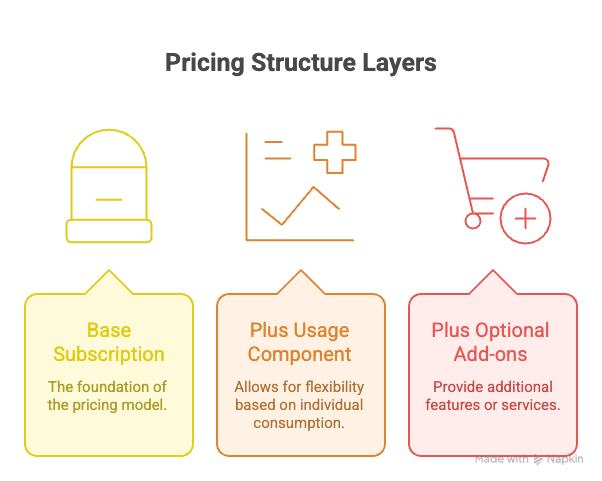
Hybrid pricing combines more than one monetization approach in a single offering, most often a recurring subscription fee alongside a variable component tied to usage, seats or transactions. Instead of one flat fee, revenue scales as the customer draws more value from the product.
Hybrid pricing is a pricing model that combines multiple monetization approaches within a single offering.
Most commonly, SaaS companies combine a recurring subscription fee with a variable pricing component tied to usage, seats, or transactions.
Instead of charging a single flat fee, hybrid pricing allows revenue to scale as customers receive more value from the product.
For example, a SaaS product might charge a monthly platform fee plus additional costs based on how much data is processed, how many API calls are made, or how many users access the system.
This structure balances predictable revenue with the flexibility to capture value from customers who grow faster or use the product more intensively.
Why hybrid pricing is becoming the standard in SaaS
“Pricing is the fastest lever in SaaS and the least tested. Teams will A/B a button color for a month and leave the price untouched for three years.”
As SaaS products evolve, customer usage patterns become less uniform.
Some customers use only core features, while others depend heavily on advanced functionality, automation, or high data volumes.
Traditional flat subscription pricing struggles to capture these differences.
Hybrid pricing allows companies to align revenue with the actual value delivered to each customer.
This is particularly important in modern SaaS categories such as AI tools, infrastructure software, analytics platforms, and automation tools, where costs often scale with usage.
Another important factor is expansion revenue.
Hybrid pricing naturally supports a land and expand motion, allowing customers to start small and increase spend as they grow.
Instead of forcing customers to upgrade plans prematurely, usage-based components allow pricing to scale gradually.
Common types of hybrid pricing models in SaaS
Hybrid pricing can be implemented in several ways depending on the product structure and value metric.
Subscription plus usage-based pricing
This is the most common hybrid pricing structure.
Customers pay a fixed recurring fee (subscription pricing model) for access to the platform, plus a variable cost based on usage.
Examples include pricing per API request, per report generated, per automation run, or per gigabyte of data processed.
This model is common among infrastructure tools, developer platforms, AI products, and analytics solutions.
| Component | Example |
|---|---|
| Subscription | $99 a month |
| Usage | $0.05 per API call |
| Add-on | premium support package |
Seat-based plus feature-based pricing
Some SaaS products combine per-user pricing with additional charges for advanced capabilities.
For example, a CRM might charge per user while also offering advanced automation features or analytics modules as paid add-ons.
This approach allows companies to keep entry-level pricing simple while monetizing advanced capabilities separately.
It is frequently used in collaboration tools, CRM platforms, and marketing automation software.
Tiered subscription plus consumption pricing
In this model, subscription tiers include a usage allowance, with additional consumption billed separately.
This structure maintains predictable pricing while providing flexibility for customers with higher demand.
For example, a data platform may include a monthly data processing limit within each plan and charge additional fees when customers exceed the allowance.
This creates transparency and prevents unexpected cost spikes.
Platform fee plus transaction pricing
Marketplace and fintech SaaS companies often combine a fixed platform fee with transaction-based pricing.
For example, a SaaS platform might charge a monthly subscription plus a percentage fee for each transaction processed.
This ensures pricing scales with customer revenue generation.
In many cases, customers perceive this pricing as fair because costs are directly linked to business performance.
| Hybrid pricing combination | Base component | Variable component | Typical SaaS use case |
|---|---|---|---|
| Subscription plus usage-based | Monthly or annual platform fee | API calls, data processed, credits consumed | AI tools, infrastructure software, analytics platforms |
| Seat-based plus feature add-ons | Price per user | Paid advanced modules or premium features | CRM, marketing automation, collaboration tools |
| Tiered subscription plus consumption | Pricing tiers with included usage allowance | Additional usage billed separately | Data platforms, communication tools, automation software |
| Platform fee plus transaction pricing | Fixed monthly fee | Percentage per transaction or revenue share | Fintech SaaS, marketplaces, billing platforms |
| Subscription plus storage pricing | Monthly subscription | Cost per GB or TB stored | Cloud storage, backup solutions, media platforms |
| Subscription plus automation runs | Platform fee | Cost per workflow execution or task run | Workflow automation, integration platforms |
| Seat-based plus usage credits | Price per user | Consumption of credits for advanced actions | AI copilots, design tools, productivity platforms |
| Subscription plus messaging volume | Monthly subscription | Price per message or notification sent | Customer engagement platforms, messaging APIs |
Decision framework: which hybrid model fits your SaaS
The right hybrid structure follows from your value metric rather than from what a competitor charges. Data volume, API calls or compute point to a platform fee plus usage metering; users or seats point to seat-based pricing with feature gating; transaction volume points to a model that scales with the money moving through the product.
Use this framework to narrow down which hybrid pricing structure makes sense for your product.
Start with your value metric. The right model depends on what drives value for your customers:
| If your value driver is… | Consider this model | Example |
|---|---|---|
| Data volume, API calls, compute | Platform fee + usage metering | Datadog, Snowflake |
| Number of users/seats | Seat-based + feature gating | Slack, Salesforce |
| Transaction volume or revenue processed | Platform fee + transaction percentage | Stripe, Shopify |
| Feature depth across customer segments | Tiered subscription + consumption overage | HubSpot, Zoom |
Then stress-test with three questions:
- Can your customer predict their monthly cost? If your usage pricing creates wild month-to-month swings, customers will resist adoption or demand caps. The best hybrid models let customers estimate their bill within 20% accuracy.
- Does the metric scale with the value your customer receives? If you charge per API call but your customer’s value comes from data insights (not call volume), pricing feels arbitrary. The metric should map to outcomes the customer cares about.
- Can you actually measure and bill it? Some value metrics are theoretically perfect but operationally painful. If your billing system cannot track the metric in real time, or if the metric requires manual calculation, pick a simpler proxy. A slightly imperfect metric you can actually bill for beats a perfect metric you cannot track.
Red flags that you picked the wrong model: For the detail, see who decides which model to run.
- Customers frequently ask “why did my bill go up?” without a clear answer tied to their usage growth
- Your sales team spends more time explaining pricing than selling the product
- Light users are churning because they feel overcharged relative to what they use
- Power users are on the same plan as light users and you cannot capture their additional value
- Your finance team cannot forecast next quarter’s revenue within 15% accuracy
When hybrid pricing works vs when it does not
Not every SaaS product benefits from hybrid pricing. Here is a structured way to decide.
When hybrid pricing works
| Condition | Why it works |
|---|---|
| Your cost-to-serve varies significantly by customer | Hybrid pricing passes variable costs to the customers who generate them, protecting your margins on lighter users |
| Customers have wildly different usage patterns | A one-size-fits-all subscription either overcharges small users or undercharges power users, hybrid solves both |
| You have a clear, measurable value metric | If you can track usage in real time and customers agree the metric represents value, hybrid pricing feels fair |
| You want to support land-and-expand without constant upsell conversations | Usage-based components let revenue grow automatically as customers scale |
| Your product has hit product-market fit | You need stable usage data to set pricing correctly, too early and you are guessing |
When hybrid pricing does not work
| Condition | Why it fails |
|---|---|
| Your product is early-stage and usage patterns are unknown | You do not have enough data to pick the right metric or set the right rates |
| Customers need absolute cost certainty (regulated industries, government contracts) | Variable pricing creates budget unpredictability that kills deals |
| Your billing infrastructure cannot handle usage tracking | Adding metering, real-time tracking, and variable invoicing is expensive, if your billing stack is basic, the engineering cost may outweigh the revenue gain |
| Your product has a simple, uniform use case | If all customers use the product in roughly the same way, flat pricing is simpler and works fine |
| The value metric you would choose is controversial | If customers would argue about whether the metric reflects real value, you will spend more time defending pricing than selling product |
Implementation checklist
Before launching hybrid pricing, make sure you can check every box:
- Identified primary value metric with data showing correlation to retention and expansion
- Validated metric with at least 10 customer interviews
- Billing system supports usage tracking and variable invoicing
- Pricing page clearly communicates how costs scale (no surprises)
- Internal alignment across product, sales, finance, and CS on the new model
- Grandfather plan for existing customers (minimum 3-month price lock)
- Revenue forecasting model updated to account for usage variability
- Monitoring dashboard for usage patterns and billing anomalies
- Escalation protocol for customers who receive unexpectedly high bills
- Tested with new customers for 60 to 90 days before migrating existing accounts
Use the SaaS pricing calculator to model how different usage rates affect your unit economics before committing to a structure. For the detail, see what a pricing engagement costs.
When SaaS companies should adopt hybrid pricing
Hybrid pricing is most effective once a product has achieved product-market fit and customer usage begins to vary significantly.
Early-stage companies often start with simple subscription pricing to reduce friction and accelerate adoption.
As the product matures, differences between light users and power users become more pronounced.
At this stage, hybrid pricing helps ensure pricing reflects value delivered.
Typical indicators that hybrid pricing may be appropriate include:
- Large variation in feature usage across customers
- Increasing infrastructure or delivery costs linked to usage
- Customer requests for more flexible pricing options
- Difficulty capturing value from high-growth customers
- Limited expansion revenue under existing pricing model
Hybrid pricing is particularly useful when new features introduce scalable cost drivers such as automation, AI processing, or data storage.
Benefits of hybrid pricing for SaaS companies
Improved revenue expansion potential
Hybrid pricing allows revenue to grow alongside customer success.
Instead of relying exclusively on plan upgrades, companies can capture incremental value as customers increase usage.
This creates a more natural expansion motion.
For many SaaS companies, hybrid pricing contributes directly to improved net revenue retention.
Better alignment between price and customer value
Customers often perceive hybrid pricing as fairer than flat pricing.
Light users are not forced to subsidize heavy users.
Power users pay proportionally more based on the value they receive.
This alignment reduces friction during pricing conversations.
Improved monetization of power users
Power users often generate the highest value but may be underpriced under traditional subscription models.
Hybrid pricing captures this additional value without requiring constant plan restructuring.
More flexible packaging strategy
Hybrid pricing allows product teams to experiment with packaging without redesigning the entire pricing structure.
New features can be introduced as add-ons or usage-based components without disrupting existing plans.
| Factor | Traditional pricing | Hybrid pricing |
|---|---|---|
| Revenue growth | fixed per plan | scales with usage |
| Customer fairness | same price for all | aligned with value delivered |
| Upsell friction | requires plan upgrade | automatic expansion |
| Pricing flexibility | limited | high |
Challenges and risks of hybrid pricing
Hybrid pricing introduces additional complexity compared to flat subscription pricing.
Customers may struggle to predict costs if usage pricing is not clearly communicated.
Billing systems may require updates to support usage tracking.
Forecasting revenue may become more complex when usage fluctuates significantly.
Another common challenge is selecting the right value metric.
If the metric does not reflect real customer value, pricing may feel arbitrary or unfair.
For example, charging per user may not align with value if only a subset of users generate meaningful outcomes.
A common mistake is introducing too many pricing variables at once.
The most effective hybrid pricing models remain easy to understand.
How to design a hybrid pricing strategy
Designing hybrid pricing starts with alignment between product value, customer behavior and revenue goals, not with the price points. The first step is naming the value metric, the unit of value the customer actually receives, whether that is API calls processed, reports generated, data volume analyzed or automations executed.
“Every hybrid model I have designed started with one question: what usage line in your data grows when the customer wins? Price that.”
Designing hybrid pricing requires careful alignment between product value, customer behavior, and revenue goals.
1. Identify value metrics
The value metric represents the unit of value customers receive from the product.
Examples include:
- API calls processed
- reports generated
- data volume analyzed
- automations executed
- messages sent
- projects created
The strongest value metrics are directly connected to measurable customer outcomes.
Choosing the right metric ensures pricing scales naturally with product value.
How to find your value metric in practice:
Pull your product usage data and look for the metric that correlates most strongly with customer retention and expansion. If customers who send more messages retain longer and upgrade more often, “messages sent” is likely your value metric.
Talk to 10 customers and ask: “What would make you willing to pay more for this product?” Their answers almost always point to the right metric. If they say “more users,” your metric is seats. If they say “more data,” your metric is volume. If they say “faster processing,” your metric might be compute or priority access.
Common mistake: choosing a metric that benefits you but not the customer. “Data stored” is a convenient metric for a SaaS company because it scales with time, but customers do not perceive storage as value, they perceive insights, outputs, or actions as value. Pick the metric that the customer would agree represents value, not the one that maximizes your revenue in a spreadsheet model.
2. Define the base subscription layer
The subscription component provides predictable revenue and establishes a minimum commitment level.
This base layer typically includes core product capabilities.
It should reflect the fundamental value delivered regardless of usage volume.
3. Design usage pricing carefully
Usage pricing should be intuitive and easy to understand.
Customers should feel confident predicting their expected costs.
Avoid pricing structures that create sudden cost spikes.
Gradual scaling supports trust and long-term retention.
4. Test pricing with customer segments
Pricing strategy should be validated through customer research and experimentation.
Pricing interviews help identify willingness to pay.
Pilot programs allow companies to test pricing sensitivity before full rollout.
A common approach is introducing hybrid pricing for new customers before migrating existing accounts.
A practical testing sequence:
- Run pricing interviews with 15-20 customers using the Van Westendorp method (ask four questions: too cheap, cheap, expensive, too expensive). This gives you a range, not a single price point.
- Introduce hybrid pricing to new customers first. Do not migrate existing customers until you have 60 to 90 days of data from new sign-ups.
- For existing customer migration, offer a 3-month price lock at their current rate. Monitor churn closely during months 4-6.
- Use your SaaS pricing calculator to model the revenue impact of different usage rates before committing to a structure.
5. Simplify communication
Pricing complexity often creates friction.
Pricing pages should communicate structure clearly.
Customers should understand how pricing scales without needing extensive calculations.
How real SaaS companies structure hybrid pricing
Datadog: Platform fee + usage metering
Datadog charges a per-host subscription fee for infrastructure monitoring (starting around $15/host/month) plus usage-based pricing for log management, APM traces, and custom metrics. The base subscription gives customers predictable costs for core monitoring. Usage pricing captures value from customers who ingest large volumes of logs or traces.
Why it works: The value metric (hosts monitored, logs ingested) is directly tied to the customer’s infrastructure size. As companies scale their cloud infrastructure, Datadog revenue scales with them, without requiring sales-driven plan upgrades.
Lesson for your SaaS: If your product’s cost-to-serve scales with customer usage (data processing, API calls, compute), a platform-fee-plus-metering model lets you capture that value while keeping the entry point affordable.
Slack: Seat-based + feature gating
Slack uses per-user pricing across tiers (Pro, Business+, Enterprise Grid) with feature gates at each level. The Pro plan includes core messaging at a per-user rate. Business+ adds compliance, data loss prevention, and advanced identity management. Enterprise Grid adds organization-wide controls and unlimited workspaces.
Why it works: Slack’s value metric is straightforward: more people using Slack means more value. Feature gating drives upgrades when organizations hit compliance or security requirements that only exist at scale.
Lesson for your SaaS: Seat-based pricing works best when each additional user genuinely adds value. If only a few power users drive most of the product’s value, per-seat pricing will either underprice them or overprice light users. In that case, consider a different value metric.
Twilio: Pure usage + volume discounts
Twilio charges per API call with no base subscription. SMS messages cost a fraction of a cent per message, voice calls are billed per minute, and email (via SendGrid) is billed per message sent. Volume discounts kick in at higher tiers.
Why it works: Twilio’s product is infrastructure: developers embed it into their own products. A subscription fee would create friction for experimentation. Pure usage pricing lets developers start with $0 commitment and scale to millions in spend.
Lesson for your SaaS: Pure usage pricing (no base fee) works for developer tools and API products where the buying motion is bottom-up. For most B2B SaaS products, adding a base subscription provides revenue predictability that investors and your finance team will appreciate.
HubSpot: Tiered subscription + contact volume
HubSpot’s Marketing Hub combines tiered subscription pricing (Starter, Professional, Enterprise) with contact-based pricing. Each tier includes a contact allowance. Additional contacts beyond the allowance are billed at a per-contact rate.
Why it works: The base tiers define feature access (automation, reporting, attribution). Contact volume captures value from customers with larger databases, which directly correlates with the marketing value HubSpot delivers.
Lesson for your SaaS: If your product stores customer data (contacts, leads, accounts, projects), the volume of stored records can be an effective usage metric. But be careful, if customers feel penalized for having data in your system, it creates a perverse incentive to delete records or avoid importing data.
Considering a pricing model change for your SaaS?
Get a senior product operator’s assessment of your pricing strategy in 30 minutes.
Book a Product Strategy SessionHybrid vs usage-based vs tiered pricing: side-by-side comparison
| Factor | Hybrid pricing | Usage-based pricing | Tiered pricing |
|---|---|---|---|
| Revenue predictability | Medium-high (base subscription + variable) | Low (fluctuates with usage) | High (fixed per tier) |
| Expansion revenue | Strong (usage component scales naturally) | Very strong (all revenue scales with usage) | Weak (requires plan upgrade) |
| Customer cost predictability | Medium (base is fixed, usage varies) | Low (entirely usage-dependent) | High (fixed monthly cost) |
| Best for | Growth-stage SaaS with diverse customer usage | API/infrastructure products, developer tools | Early-stage SaaS, simple feature sets |
| Implementation complexity | Medium-high (needs usage tracking + subscription billing) | High (needs real-time metering and billing) | Low (standard subscription billing) |
| Churn risk | Low-medium | Medium (customers may reduce usage to cut costs) | Low (but risk of being stuck on wrong tier) |
| Sales motion | Land with base plan, expand via usage | Bottom-up adoption, self-serve | Top-down, plan-based upgrades |
Use the SaaS pricing impact simulator to model how each structure would affect your specific revenue trajectory.
How a fractional CPO helps design pricing strategy
Pricing strategy influences product positioning, sales motion, and long-term growth trajectory.
Many SaaS companies underestimate the strategic importance of pricing decisions.
Introducing hybrid pricing requires alignment across product, marketing, finance, and sales teams.
A fractional CPO brings structured methodology to pricing strategy development.
Key areas of support include:
- defining value metrics aligned with customer outcomes
- designing packaging strategy across segments
- running pricing discovery interviews
- analyzing expansion revenue opportunities
- structuring pricing experiments
- balancing monetization with product adoption
From experience, pricing changes often unlock growth without requiring major product changes.
In many cases, improving pricing structure has a greater impact on revenue than adding new features.
Conclusion
Hybrid pricing has become an increasingly common approach among SaaS companies seeking to align revenue with customer value.
By combining predictable subscription revenue with scalable usage components, hybrid pricing supports both stability and growth.
When implemented thoughtfully, hybrid pricing improves expansion revenue, enhances fairness across customer segments, and creates flexibility for evolving product offerings.
The key is maintaining simplicity while ensuring pricing reflects real value delivered.
Need help designing your SaaS pricing model?
Pricing decisions influence acquisition, retention, and long-term scalability.
Hybrid pricing introduces flexibility, but requires careful design to avoid unnecessary complexity.
Pricing architecture, choosing the right value metrics, designing the hybrid structure, running pricing experiments, and managing the migration, is one of the highest-leverage things a fractional CPO does. If you are in the middle of a pricing transition and want structured guidance from someone who has done it across multiple SaaS companies, book a strategy call.
fractional CPO services can help structure pricing models that align with product value and company stage.
I have hired product people, and I have been one. Whichever title you pick, someone has to carry the decision.
See what a monetization PM owns →FAQ
What is hybrid pricing in SaaS?
Hybrid pricing in SaaS combines two or more pricing models, typically a recurring subscription plus a variable component such as usage, seats, or transactions. This structure allows companies to maintain predictable revenue while capturing additional value as customers increase product usage.
What is an example of hybrid pricing?
A common example of hybrid pricing is a SaaS platform charging a monthly subscription fee plus usage-based pricing for API calls, data storage, or automation runs. For example, a company may pay monthly for access to the platform and an additional fee based on how much they use specific features.
Why do SaaS companies use hybrid pricing?
SaaS companies use hybrid pricing to better align pricing with customer value. Hybrid pricing supports expansion revenue, improves fairness across customer segments, and allows companies to monetize heavy users without increasing prices for smaller customers.
When should a SaaS company switch to hybrid pricing?
A SaaS company should consider hybrid pricing after reaching product-market fit, when customer usage patterns become more diverse. Signals include large variation in feature usage, increasing infrastructure costs, and limited expansion revenue under flat subscription pricing.
What is the difference between hybrid pricing and usage-based pricing?
Usage-based pricing charges customers entirely based on consumption, while hybrid pricing combines usage pricing with a fixed subscription component. Hybrid pricing provides more predictable revenue while still allowing pricing to scale with customer growth.
What are the benefits of hybrid pricing?
Key benefits of hybrid pricing include improved net revenue retention, better alignment between price and customer value, increased monetization of power users, and greater flexibility when introducing new product features.
What clients say
Read all 18 references“As a product manager, I can say that Sivan is very professional – always looking deeply on the discussed feature to understand end to end its effect on the whole product, and as well the eager to understand what would be the added value to the strategy of the company. Nothing was added without a clear scope of development, a clear understanding of the business owner and a clear way to measure the success or failure of this feature.”
“Leading by example, empowering, mentoring, and growing his product teams, he created great product culture and set us Product Managers up for success. His vision and strategic direction enabled us to create successful products that brought millions of dollars of revenue to the company and its clients.”
“As part of his role as VP Product, he identified creative ideas, developed sharp strategies and built the road map while focusing on customer experience and business needs.”