
The SaaS customer journey is the whole path from first contact to renewal, and in a subscription business it never really ends. Activation, habit and expansion each depend on the step before, so most growth problems that look like acquisition problems turn out to live somewhere in that path.
I do this work inside B2B SaaS product teams. If your team ships every week and the numbers barely move, this is where I start.
See how product management consulting works →The strongest SaaS companies intentionally design each stage of the journey, from first impression to product adoption and expansion. Small improvements in onboarding clarity, time to value, and ongoing engagement often produce disproportionate improvements in retention and revenue.
From my experience working with SaaS teams, most growth problems are not acquisition problems. They are journey problems. Companies invest heavily in traffic and lead generation, but underestimate how much friction exists after signup.
Optimizing the customer journey is often the highest leverage growth initiative available.
There are many reasons why SaaS companies turn to us for Fractional CPO services, but one of the primary ones is dealing with customer churn. Today, I want to focus on a blind spot that many product managers tend to underestimate: Silent Churn.
We are well aware of the classic reasons for churn, customers not experiencing enough value from the product, or those tempted to switch to a shiny new competitor. But there is a large group of users who simply abandon ship, and often, even they wouldn’t know how to explain exactly why. In fact, only a small fraction of unhappy customers ever complains or leaves feedback; the rest simply leave quietly. When you dig deep and analyze their behavior, a clear picture emerges: the interface was simply too cluttered, cumbersome, and difficult to understand during the critical early stages of product exploration.
This problem is common across many companies, and the impact of that initial experience is dramatic: Wyzowl found that 86% of people say they would be more likely to stay loyal to a business that invests in onboarding content which welcomes and educates them. During my research for this article, I came across a discussion in one of the leading product management Subreddits. A B2B SaaS CEO shared how he managed to reduce new user churn by a staggering 40% simply by simplifying the interface and improving the onboarding flow.
This figure doesn’t surprise me at all. In one of the recent startups we advised, we managed to increase the free-to-paid conversion rate by 15%, purely through targeted interventions that led users to their “Aha Moment” much earlier in their usage, preventing that fatal silent churn. When you reduce friction, the results speak for themselves.
This is exactly where the SaaS Customer Journey comes into play. True growth in SaaS doesn’t just come from optimizing initial conversions; it comes from creating continuous value and intentionally designing every single stage. Your users are evaluating you at every interaction, from the very first click to the decision to renew or expand their subscription.
In this article, we will break down the complete customer journey and understand why many growth problems are not actually acquisition problems, but journey problems, and how addressing them correctly will become your most significant growth lever.
What does the SaaS customer journey cover?
Every step a customer takes with you, from the first time they hear the name to the renewal they barely think about. In SaaS the journey does not stop at purchase, because the purchase is a subscription and the value has to keep arriving for it to survive contact with a budget review.
The SaaS customer journey describes the full lifecycle of a user’s relationship with a product. It includes every interaction, from the moment a potential customer first hears about the product to the moment they decide to renew or expand their subscription.
Unlike traditional businesses, SaaS companies depend on long term relationships. Revenue is generated continuously, not only at the point of purchase. This means the experience after signup often matters more than the initial conversion.
Many teams still think about growth primarily through the lens of marketing funnels. Funnels are helpful for understanding acquisition performance, but they do not fully capture what happens once users begin interacting with the product.
The SaaS customer journey includes onboarding flows, product interactions, support conversations, pricing experiences, feature discovery, and renewal decisions.
Every one of these touchpoints influences whether customers stay or leave.
One pattern I often see is that companies invest significant effort into optimizing landing pages but spend relatively little time improving onboarding flows or product education. Yet onboarding is where many users decide whether the product truly solves their problem.
When the journey is designed intentionally, customers progress naturally from initial interest to long term adoption.
When the journey is fragmented, users become confused, disengaged, or uncertain about the product’s value.
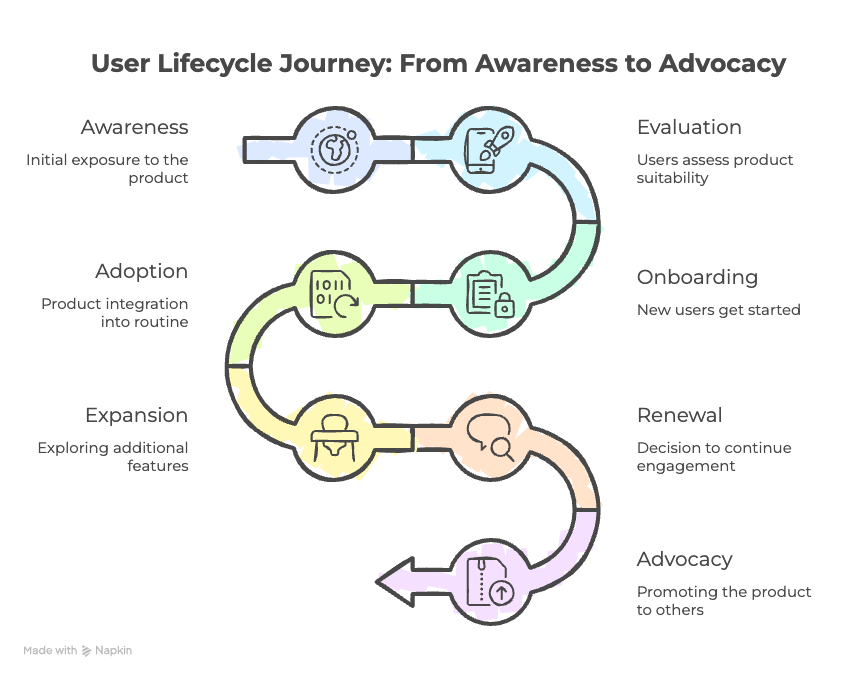
Why does the journey determine retention?
Because retention is produced by the journey, not by the retention team. A customer who never reached the moment the product becomes useful will churn regardless of how good the support is afterwards, and no amount of acquisition spending fixes a path that loses people before they arrive.
“Small improvements in onboarding clarity, time to value, and ongoing engagement often produce disproportionate improvements in retention and revenue.”
Sivan Kadosh, Fractional CPO
SaaS growth is cumulative. Each retained customer contributes recurring revenue, and many eventually increase their usage or upgrade to higher pricing tiers.
Because of this dynamic, improving retention often produces stronger long term results than increasing acquisition alone.
A small improvement in retention rate can significantly increase lifetime value.
From my experience, many SaaS teams initially focus heavily on acquisition metrics such as traffic and conversion rate. These metrics are visible and relatively easy to measure.
However, when companies begin analyzing retention cohorts, they often discover unexpected friction points.
Users sign up successfully but do not fully activate. Others adopt only a small subset of features. Some customers churn quietly after the first billing cycle.
These patterns usually indicate that the product journey does not clearly communicate value early enough.
Time to value plays a crucial role. Users form opinions about products quickly. If they cannot see progress within the first session or first week, motivation decreases.
Reducing friction early in the journey often produces compounding benefits later.
Retention improves. Support requests decrease. Expansion opportunities increase.
What are the core stages?
Awareness, evaluation, onboarding, activation, habit, expansion and renewal. The dangerous one is the gap between onboarding and activation, where a user has technically set the product up and has not yet done the thing that makes it matter to them. Most silent churn starts there.
While each product has unique characteristics, most SaaS journeys follow similar lifecycle stages.
Awareness stage
The awareness stage begins when potential customers first encounter your product. This may happen through search results, referrals, social media, industry content, or recommendations from peers.
At this stage, users are often exploring solutions rather than making immediate decisions.
Clarity matters more than persuasion.
Users want to quickly understand:
- What problem does this product solve?
- Is it relevant to my situation?
- Is it designed for companies like mine?
Many SaaS websites attempt to communicate too many benefits simultaneously. In practice, simplicity often performs better.
Users rarely remember feature lists. They remember whether a product appears relevant to their needs.
Consideration stage
During the consideration stage, users compare options. They evaluate alternatives, read documentation, and explore product capabilities.
Trust becomes important.
Clear positioning helps users understand how the product differs from alternatives.
One insight I frequently observe is that companies often assume differentiation is obvious. Internally, teams know why their product is unique. Externally, the differences are not always clear.
Customer stories, product walkthroughs, and transparent pricing often help users feel more confident moving forward.
Onboarding stage
Onboarding is often the most underestimated stage of the journey.
It is the moment when expectations meet reality.
Users evaluate whether the product delivers on the promise communicated during acquisition.
From my experience, onboarding is rarely about teaching every feature. It is about helping users experience progress quickly.
Early wins create momentum.
Users who achieve small meaningful outcomes early are more likely to continue exploring the product.
Onboarding flows that introduce too many concepts at once often create cognitive overload.
Reducing complexity helps users focus on the first valuable action.
Adoption stage
Adoption occurs when users begin integrating the product into their regular workflows.
At this stage, habits begin to form.
Users become more confident navigating the interface and more comfortable relying on the product.
Adoption often depends on how well the product fits existing workflows.
If the product requires significant behavioral change, additional guidance may be necessary.
Feature discoverability also becomes important.
Users often do not explore features independently unless they clearly understand the potential benefit.
Expansion stage
Expansion occurs when customers increase usage, upgrade plans, or adopt additional capabilities.
Expansion typically happens when users recognize deeper value within the product.
For example, teams may begin using advanced features after mastering core functionality.
Expansion often depends on clear communication of additional value rather than aggressive upselling.
Customers expand when they believe the product continues to solve meaningful problems.
Renewal stage
Renewal decisions often reflect cumulative experience rather than isolated interactions.
Customers consider whether the product consistently delivers value.
Renewals often occur automatically when the product becomes embedded in workflows.
Conversely, churn often occurs when users gradually disengage without clearly communicating dissatisfaction.
Understanding behavioral signals helps identify potential churn risk early.
Which journey metrics matter?
Time to first value, activation rate, feature adoption depth and retention by cohort. Read them by cohort rather than in aggregate, because an average hides the exact group you need to see, and the group you need to see is usually the one that signed up most recently.
Metrics help teams understand where friction exists.
| Stage | Example KPI | What it measures |
|---|---|---|
| Awareness | visitor to signup conversion rate | initial relevance |
| Onboarding | activation rate | speed of first value |
| Adoption | weekly active users | engagement depth |
| Retention | churn rate | ongoing satisfaction |
| Expansion | net revenue retention | growth within accounts |
Tracking these metrics helps teams identify where users struggle or disengage.
In several engagements, improving activation rate produced stronger revenue impact than increasing traffic.
When users experience value earlier, conversion improves naturally.
Where does friction usually appear?
A signup that asks for information before it has earned any, an empty state that explains nothing, and a setup step that requires someone from another team. Each is small on its own. Together they decide whether a user reaches value in the first session or postpones it forever.
“Companies invest heavily in traffic and lead generation, but underestimate how much friction exists after signup.”
Sivan Kadosh, Fractional CPO
Friction often appears in subtle ways.
Users may hesitate because terminology is unclear. Interfaces may introduce complexity too early. Feature discoverability may be limited.
In many cases, friction does not appear dramatic. Instead, it appears as gradual disengagement. Users delay returning to the product. Sessions become shorter. Feature usage decreases. Small signals often precede churn.
Common friction sources include:
- unclear onboarding steps
- lack of contextual guidance
- misalignment between marketing messaging and product experience
- interfaces that require unnecessary effort
Reducing friction often requires observing real user behavior rather than relying only on assumptions.
How product design influences the customer journey
Design decides how much thinking the product asks of someone who has not yet decided to care. An interface that is merely cluttered is not a cosmetic problem at this stage, it is a retention problem, because the user attributes their own confusion to the product and quietly stops returning.
Product design plays a central role in shaping how users perceive value.
Interface clarity influences confidence.
Navigation structure influences discoverability.
Feedback mechanisms influence motivation.
One recurring insight is that many product teams assume users understand how features connect to outcomes.
In practice, users often need guidance.
Designing clear progress indicators helps users feel oriented.
Reducing cognitive load helps users focus on meaningful actions.
Small improvements in interface clarity often produce measurable improvements in activation and retention.
How do you map the journey?
Start from real sessions rather than from a whiteboard. Watch what people actually do in their first week, mark where they stall, and write the steps as the user would describe them rather than as your funnel names them. The map is only useful if it shows the parts nobody planned.
Journey mapping helps teams visualize how users experience the product.
Identify key user segments
Different user types may have different expectations.
A technical user may prioritize customization, while a non technical user may prioritize simplicity.
Understanding segments helps tailor onboarding flows.
Define success milestones
Success milestones represent moments when users experience meaningful progress.
Examples include:
- creating first project
- integrating data source
- inviting team member
Milestones help teams measure journey effectiveness.
Analyze behavioral data
Product analytics reveals patterns of engagement.
Behavioral signals help identify friction points.
Understanding where users pause or disengage provides insight into improvement opportunities.
Identify friction points
Drop off patterns often reveal confusing steps.
Users may abandon onboarding if initial tasks appear complex.
Reducing friction often involves simplifying early experiences.
Prioritize improvements
Not all improvements produce equal impact.
Focusing on early journey improvements often produces strongest results.
How does the journey change as you scale?
Early on one person can watch every new account and fix problems by hand. That stops working somewhere around the point where nobody can name the last ten signups, and what replaced it has to be instrumentation and a named owner rather than more goodwill from a small team.
Customer journey maturity evolves as companies grow.
| Stage | Journey focus | Strategic priority |
|---|---|---|
| Early stage | onboarding clarity | achieve product market fit |
| Series A | activation optimization | improve conversion |
| Series B | expansion journeys | increase account value |
| Enterprise | lifecycle orchestration | improve retention |
Early stage companies often focus on ensuring users understand core value.
Later stage companies focus on increasing expansion and reducing churn.
Journey orchestration becomes more sophisticated as product complexity increases.
What goes wrong in journey design?
Designing the journey the company wishes customers took instead of the one they take. Owning it in fragments, where marketing has the front and support has the end and the middle belongs to nobody. And treating onboarding as a project that finishes rather than a surface that keeps moving.
One common mistake is assuming that users will automatically understand how to use the product.
Another is focusing heavily on acquisition while underinvesting in onboarding.
Many companies design journeys based on internal processes rather than user goals. When journeys are structured around internal logic, users often feel lost.
Another frequent issue is measuring too many metrics without identifying which signals truly indicate progress. Focusing on key milestones helps teams prioritize improvements effectively.
When to involve a fractional CPO in customer journey optimization
When the journey crosses three teams and none of them owns the outcome. That is a structural problem rather than a design one, and solving it means someone with the standing to change how the teams are measured, not just what the onboarding screen says.
Customer journeys often cross functional boundaries.
Marketing influences expectations. Product influences experience. Customer success influences retention.
Without alignment, journey improvements become fragmented.
A fractional Chief Product Officer helps connect journey design with product strategy.
From my experience, the most valuable improvements often occur when teams align around shared lifecycle metrics.
Instead of optimizing isolated touchpoints, companies begin optimizing the full experience.
Fractional CPO involvement often helps prioritize journey improvements that produce measurable business impact.
Improve your SaaS customer journey with product strategy leadership
The fastest gains usually come from removing steps rather than adding guidance. Find the point where users stall, take work away from them there, and measure whether time to first value moves. Most journeys are improved by subtraction long before they need a new feature.
Many SaaS companies invest heavily in acquisition channels but underestimate how much growth depends on post signup experience.
Customers rarely churn because of one single moment.
Churn usually reflects accumulated friction.
Improving clarity, simplifying workflows, and helping users experience progress earlier often produces meaningful improvements.
When teams design journeys intentionally, users move forward with confidence.
A fractional CPO helps ensure journey design supports long term product success rather than isolated optimizations.
Better journeys rarely require more features. They often require clearer experiences. This is exactly our specialty here at SaaS Fractional CPO.
Users signing up and quietly leaving?
Get a senior, ex-CPO read on your biggest product bottleneck in 30 focused minutes. No pitch, no obligation.
Book a strategy callKey takeaways
- SaaS growth depends on long term customer relationships.
- Journey design influences activation, retention, and expansion revenue.
- Small improvements in early stages often produce large long term impact.
- Journey mapping helps identify friction and improvement opportunities.
- Strategic product leadership helps align teams around lifecycle outcomes.
I do this work inside B2B SaaS product teams. Knowing the model is one thing. Someone has to own it every week.
See how product management consulting works →FAQs
What is a SaaS customer journey?
The SaaS customer journey describes how users move from discovering a product to adopting it long term and renewing their subscription.
What are the stages of the SaaS customer journey?
Typical stages include awareness, evaluation, onboarding, adoption, expansion, and renewal.
Why is onboarding important in SaaS?
Onboarding helps users experience value quickly. Faster time to value improves activation and retention rates.
How do you improve SaaS retention?
Retention improves when users clearly understand product value and integrate the product into daily workflows.
Who owns the SaaS customer journey?
Customer journey ownership is usually shared across product, marketing, and customer success teams. Product leadership often coordinates lifecycle improvements.
What clients say
Read all 18 references“As a product manager, I can say that Sivan is very professional – always looking deeply on the discussed feature to understand end to end its effect on the whole product, and as well the eager to understand what would be the added value to the strategy of the company. Nothing was added without a clear scope of development, a clear understanding of the business owner and a clear way to measure the success or failure of this feature.”
“Leading by example, empowering, mentoring, and growing his product teams, he created great product culture and set us Product Managers up for success. His vision and strategic direction enabled us to create successful products that brought millions of dollars of revenue to the company and its clients.”
“As part of his role as VP Product, he identified creative ideas, developed sharp strategies and built the road map while focusing on customer experience and business needs.”