
SMB roadmaps fail upmarket because the buyer changes. In a small company the user and the buyer are the same person; in an enterprise the buyer is IT, security and procurement, and they judge you on provisioning, audit logs, compliance and uptime rather than on the features your users love.
I am the one who decides what gets cut. If everything on your list is a priority, the strategy has not been made yet.
See how a product strategy engagement runs →You just lost a $100k contract.
The demo went perfectly. The champion loved the interface. The ROI case was undeniable. You even agreed on the pricing. Then, the deal was handed off to the “IT Security Review,” and it died a quiet, suffocating death.
Why? Not because your AI isn’t smart enough. Not because your UX isn’t pretty enough. You lost because you lacked SSO (Single Sign-On), Audit Logs, and Granular Permissions.
Your “move fast and break things” roadmap, which worked perfectly for selling to 50-person startups, is now actively blocking your enterprise revenue. You have hit the Enterprise Chasm.
In the SMB world, features like “Change Management” are annoyances. In the Enterprise world, they are requirements. Here is why your current strategy is failing big clients, and how to pivot without stalling your entire company.
Key takeaways
- The Feature Gap: Enterprise buyers don’t just buy “value”; they buy “compliance.” If you can’t pass the audit, the value doesn’t matter.
- The “Boring Features” Tax: To win six-figure deals, you must allocate 30-40% of your engineering capacity to unsexy infrastructure like SCIM, RBAC, and SOC 2 controls.
- The Two-Speed Roadmap: You cannot stop building for SMBs to focus solely on Enterprise. You need a split-stream strategy that balances innovation with stability.
- The Service Trap: Beware of building “custom features” for one big client. It turns you into a dev shop, not a scalable SaaS.
Why does the SMB roadmap fail upmarket?
Because the person who loves your product stops being the person who buys it. In a fifty-person startup the user and the buyer are the same. In an enterprise, IT, security and procurement hold the veto, and none of them has ever used the feature your champion demoed.
Don’t tell me ‘it won’t happen to us.’ If you don’t prepare for it, it absolutely will. And not only will it happen, but it could also be the difference between dizzying success and a spectacular failure. If you want to start playing in the big leagues, you need a complete shift in your STATE OF MIND.
Your customer is no longer a single user. Large enterprises have multiple layers of management (personally, that’s exactly why I connect less with big corporates :)), and in every one of those layers, there is a stakeholder who needs to verify that your product meets their specific needs. This isn’t just a gut feeling. Research by Gartner clearly shows that the average B2B deal now involves 6 to 10 different decision-makers, each with veto power.
The CIO of the firm has responsibilities and bosses of their own. If you fail to meet their technical and product requirements, they simply won’t approve your tool, and just like that, your $100k check evaporates. Why? Because software supply chain attacks have become common enough that enterprise buyers now treat every new vendor as part of their own attack surface, making compliance requirements a concrete wall for immature vendors.
When I prepare to write an article, I usually dive into Reddit. The reason is that I want to give you, the readers, examples from the field, not just theory. I found a discussion there that perfectly illustrates this tragedy, demonstrating what the Harvard Business Review calls ‘The New Sales Imperative’ regarding complex deals. A founder in r/SaaS described how his company fell into the ‘Service Trap,’ building a custom feature for months only to fail a security audit. They ignored the fact that high-customization SaaS companies carry materially lower gross margins than standard products, making them uninvestable. Don’t be that company.
Here is who you are actually selling to:
- The Economic Buyer (VP/C-Level): Cares about ROI. (“Will this save us money?”)
- The Technical Buyer (IT/CTO): Cares about integration and maintenance. (“Will this break my stack?”)
- The Security Buyer (CISO/InfoSec): Cares about risk. (“Will this leak our data?”)
Your current roadmap is likely optimized 100% for the User. But if you cannot satisfy the Technical and Security buyers, the deal never happens. You are building a Ferrari that the mechanic refuses to let on the track.
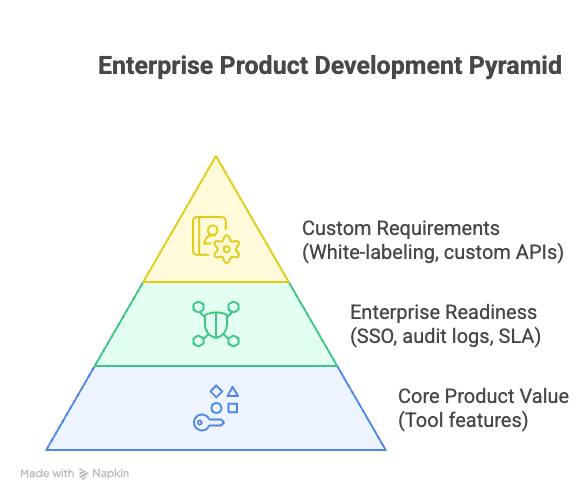
Which boring features do enterprises require?
Single sign-on, SCIM provisioning, role-based permissions, audit logs, a sandbox environment and an uptime commitment. None of it will excite a user and all of it is a precondition for the deal. Enterprise IT will not create five hundred accounts by hand.
“Enterprise IT departments will not manually create accounts for 500 users. It is a security risk and a waste of time.”
Sivan Kadosh, Fractional CPO
If you want to close six-figure deals in 2026, you need to stop building “exciting” features for a quarter and build the boring infrastructure that enterprises demand. We call this the “Enterprise Tax.”
1. Granular Permissions (RBAC)
A 20-person startup is fine with “Admin” and “Member” roles. A 5,000-person corporation is not. They need Role-Based Access Control (RBAC). They need to define custom roles where a “Regional Manager in EMEA” can see data for their region but not modify billing, and can only export 50 records a day.
- The Roadmap Pivot: You need to abstract your permission logic from “Boolean” (Yes/No) to “Policy-Based” (User X has Policy Y on Resource Z).
2. Identity Management (SSO & SCIM)
Enterprise IT departments will not manually create accounts for 500 users. It is a security risk and a waste of time.
- SSO (Single Sign-On): They demand integration with Okta, Azure AD, or Ping Identity.
- SCIM (System for Cross-domain Identity Management): This is the killer. When an employee is fired at 9:00 AM, IT expects their access to your tool to be revoked at 9:01 AM automatically via API. If you rely on manual removal, you are a security liability.
3. Comprehensive Audit Logs
Enterprises operate in a world of litigation and compliance (HIPAA, FINRA, SOC 2). They need to know who did what, and when.
- The Requirement: If a sensitive record is deleted, they need a verifiable, immutable log showing exactly which user performed the action, from what IP address, at what timestamp. This log must be exportable to their own SIEM (Security Information and Event Management) system.
4. Change Management (Sandboxes)
You push code on Friday afternoon. That terrifies an Enterprise. They need a “Sandbox Environment” to test your new update before it hits their live production data.
- The Roadmap Pivot: You need to architect your system to support multi-tenant environments where data can be cloned for testing.
| Feature | SMB Expectation | Enterprise Expectation |
|---|---|---|
| Authentication | Email/Password or Google Login | SAML 2.0 / OIDC (Okta, Azure AD) |
| User Mgmt | Manual Invite via Email | Auto-provisioning via SCIM |
| Roles | Admin / User | Custom RBAC (Read/Write/Delete per resource) |
| Support | Email / Chat | Dedicated CSM + SLA (99.9% Uptime guarantee) |
| Data | CSV Export | API Access + Data Residency (EU vs US) |
What is the service trap?
A large customer offers a big contract on condition that you build one bespoke feature their way. It looks like revenue and it is really a services business forming inside your product. Customization carries lower margins than standard software, which is what makes the trade so expensive later.
There is a massive trap waiting for you as you cross this chasm. A huge client (say, Coca-Cola or Nike) will say: “We will sign this $200k contract, BUT only if you build this one specific feature exactly how we want it.”
This is the Service Trap.
If you say yes, you are no longer a SaaS company; you are a custom dev shop for Coca-Cola. You will build a feature that is so specific to their workflow that no other customer can use it. Your codebase becomes forked, your maintenance costs explode, and your valuation multiple crashes (because investors hate service revenue).
The CPO Solution: A fractional CPO acts as the buffer. We negotiate the “Problem,” not the “Solution.” We find a way to build a generalized version of that feature that helps the big client but is also applicable to the rest of the market.
How does a two-speed roadmap work?
By splitting capacity rather than pausing everything. One track keeps working on the core differentiation that wins your existing market today. A second, dedicated track owns enterprise readiness, with its own success metric and its own protected share of every sprint.
“By separating these streams, you ensure that the “boring” work gets done without suffocating the creativity of the rest of the team.”
Sivan Kadosh, Fractional CPO
How do you build all these boring compliance features without stopping the innovation that makes your product special? You cannot pause the company for six months.
You need a Two-Speed Roadmap.
To successfully cross the enterprise chasm, orchestrate your enterprise GTM strategy with the help of a product launch consultant.
Speed 1: The Innovation Track (60% of capacity)
This track is focused on your core differentiation and your SMB base. It’s about speed, UX, and AI features. This keeps your top-of-funnel marketing alive and ensures you don’t lose your product lead to faster competitors.
Speed 2: The Enterprise Track (40% of capacity)
This is a dedicated squad focused solely on “Enterprise Readiness.”
- Their Backlog: It is not driven by user ideas. It is driven by the “Security Questionnaires” and “RFPs” (Request for Proposals) that your sales team is failing.
- Their Metric: Their success is measured by “Unblocked Revenue” (deals that can now close because the feature exists).
By separating these streams, you ensure that the “boring” work gets done without suffocating the creativity of the rest of the team.
Enterprise transitions demand systematic product management upgrades. Outside product leadership can provide the expertise needed to restructure product operations for larger, more complex customer requirements.
Bridging the gap without breaking the bank
Moving upmarket is how most companies reach real scale, because churn falls, lifetime value rises and contracts run for years. It also needs a different operating model than the one that got you here, and buying that as a full-time hire is rarely the cheapest route.
Moving upmarket is the only way to build a $100M+ company. Churn is lower, LTV is higher, and the contracts are multi-year. But it requires a different type of product discipline.
You can no longer “wing it” based on intuition. You need a structured approach to requirements, compliance, and technical debt.
A senior product leader provides the experience of someone who has already navigated this transition. We help you define the minimal viable set of enterprise features needed to close your next five big deals, so you don’t overbuild before you are ready.
At SaaS Fractional CPO, we turn your roadmap from an enterprise blocker into an enterprise enabler.
Stop losing deals to the security questionnaire.
Enterprise deals stalling at security review?
Get a senior, ex-CPO read on your biggest product bottleneck in 30 focused minutes. No pitch, no obligation.
Book a strategy callI am the one who decides what gets cut. Frameworks rank the list. Someone still has to say no out loud.
See how a product strategy engagement runs →What clients say
Read all 18 references“As a product manager, I can say that Sivan is very professional – always looking deeply on the discussed feature to understand end to end its effect on the whole product, and as well the eager to understand what would be the added value to the strategy of the company. Nothing was added without a clear scope of development, a clear understanding of the business owner and a clear way to measure the success or failure of this feature.”
“Leading by example, empowering, mentoring, and growing his product teams, he created great product culture and set us Product Managers up for success. His vision and strategic direction enabled us to create successful products that brought millions of dollars of revenue to the company and its clients.”
“As part of his role as VP Product, he identified creative ideas, developed sharp strategies and built the road map while focusing on customer experience and business needs.”