
A product strategy framework is the repeatable structure a SaaS team uses to turn direction into decisions: vision, target segment, differentiation, business model, and the trade-off rules that govern prioritization. It starts by naming who the product is for and what it deliberately will not do.
I am the one who decides what gets cut. If everything on your list is a priority, the strategy has not been made yet.
See how a product strategy engagement runs →A strong product strategy framework turns direction into momentum. It helps SaaS companies align teams, prioritize work that drives growth, and make confident trade-offs in a world of endless possibilities. Yet many teams still confuse strategy with roadmaps or quarterly OKRs.
This guide breaks down how to build, adapt, and scale a product strategy framework that fits a SaaS environment, not a textbook model. You’ll see how to connect your vision to execution, use data to inform strategy, and embed the framework inside your organization’s operating rhythm.
Key takeaways
- A product strategy framework connects vision, metrics, and roadmap in a structured way.
- SaaS companies need adaptable, data-driven frameworks to handle continuous change.
- The right framework improves alignment, retention, and execution quality.
- A fractional CPO for B2B SaaS can accelerate implementation and governance at scale.
What is a product strategy framework?
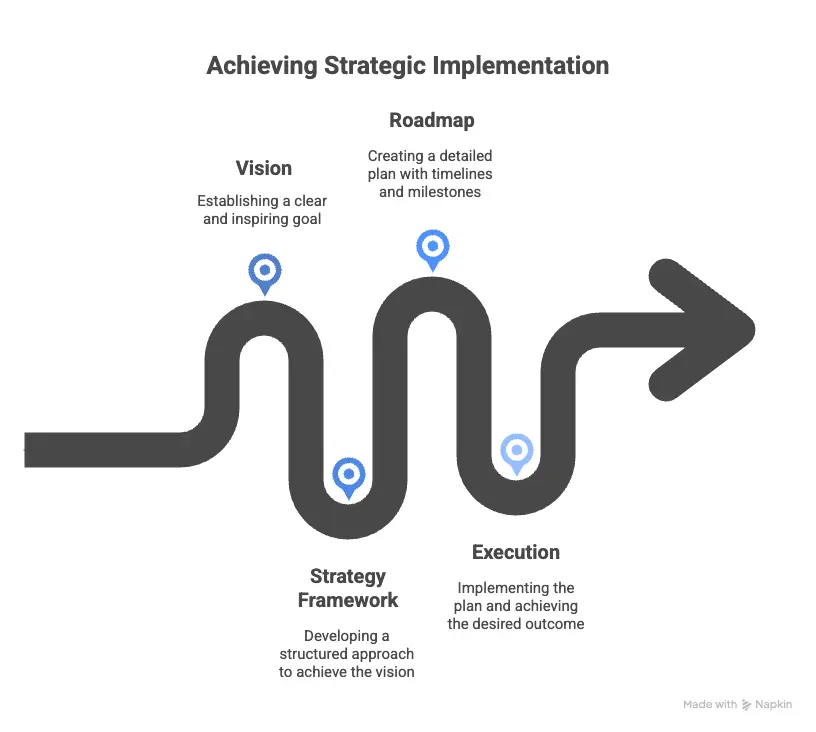
A product strategy framework is a structured approach that helps teams make consistent, long-term product decisions. It defines where you are going, why it matters, and how you will get there. It sits between vision and roadmap: the vision is the north star, the roadmap is the path, and the framework connects them. This guide assumes you already know what product strategy is.
“A strong product strategy framework turns direction into momentum instead of leaving strategy as a slide nobody opens.”
Sivan Kadosh, Fractional CPO
A product strategy framework is a structured approach that helps teams make consistent, long-term product decisions. It defines where you’re going, why it matters, and how you’ll get there.
It sits between your product vision and your roadmap. Vision describes your north star, while the roadmap shows the path. The framework connects them by outlining the principles and priorities that guide what goes on that roadmap and why.
Think of it as the decision system that ensures every new initiative, feature, or experiment supports your strategic goals.
Why do SaaS companies need a product strategy framework?
SaaS businesses operate in constant motion: markets evolve, user needs shift, and product-led growth demands fast learning loops. Without a framework that speed turns into chaos. The symptoms are recognisable: features built from requests rather than outcomes, bloated roadmaps, and KPIs that no longer reflect what the business needs.
SaaS businesses operate in constant motion. Markets evolve, user needs shift, and product-led growth demands quick learning loops. Without a strong framework, this speed turns into chaos.
Common symptoms of missing strategy
- Teams build features based on requests, not outcomes.
- Roadmaps get bloated and lose focus.
- KPIs don’t reflect real business impact.
- Product, marketing, and engineering operate in silos.
A clear framework fixes this by aligning decisions across teams, clarifying priorities, and ensuring all work ladders up to measurable goals like activation, retention, or expansion revenue.
Benefits of having one
- Keeps teams aligned around measurable outcomes.
- Enables faster, more confident trade-offs.
- Turns data and insights into action.
- Reduces the risk of strategy drift as the company scales.
| Aspect | Without a framework | With a framework |
|---|---|---|
| Clarity | Teams make decisions reactively, often driven by feature requests or short-term goals. | Teams have a shared understanding of vision, priorities, and success metrics. |
| Alignment | Product, marketing, and engineering work in silos, causing miscommunication and duplicated effort. | Cross-functional teams align around a unified strategy and measurable outcomes. |
| Focus | Roadmaps become bloated and disconnected from business impact. | Every initiative ties back to goals like activation, retention, or expansion revenue. |
| Decision-making | Trade-offs are slow and subjective. | Data and objectives guide faster, more confident decisions. |
| Results | KPIs lack meaning, progress feels chaotic, and growth stalls. | Teams track progress clearly and can adapt strategy as the company scales. |
How do the common frameworks compare?
Most guides present frameworks at face value without explaining how each behaves in practice or when it earns its place. Every framework carries strengths, limits and an ideal context. Knowing those differences is what lets you choose or adapt one to your stage, your team maturity and your market.
“Many teams still confuse strategy with roadmaps or quarterly OKRs, and the confusion costs them a year.”
Sivan Kadosh, Fractional CPO
Most guides present product strategy frameworks at face value, but few explain how they work in practice or when each is useful. Every framework has strengths, limitations, and ideal contexts. Understanding these nuances helps you choose or adapt the right one for your stage, team maturity, and market dynamics.
ProductPlan’s 10-step approach
ProductPlan’s framework breaks strategy into ten sequential steps, from defining vision and analyzing the market to setting measurable goals and building the roadmap. It’s clear and methodical, which makes it a good entry point for teams building their first structured process.
However, its linear structure can feel rigid for SaaS companies that operate in shorter learning cycles. Because SaaS strategy often evolves monthly or quarterly, teams need a framework that supports iteration, not one that waits for all steps to be complete before moving forward.
In SaaS, a more practical adaptation of ProductPlan’s approach is to treat the 10 steps as a continuous loop rather than a checklist. Each cycle should feed insights back into the first stage to refine positioning, priorities, and metrics.
Best for: Early-stage SaaS teams building their first repeatable process for strategy and roadmap alignment.
Watch out for: Over-documentation and slow response to changing data.
Product School’s FEE framework
The FEE model (Form, Educate, Embed) focuses on making strategy actionable inside organizations.
- Form: Define the strategy and align on core goals.
- Educate: Communicate it clearly across teams.
- Embed: Integrate it into daily decision-making.
It’s a people-first approach that recognizes one of the biggest challenges in strategy: adoption. A strategy that isn’t understood or applied is just theory.
The limitation is that it doesn’t go far into how to validate or evolve strategy through data. For SaaS companies, the missing layer is connecting FEE to measurable customer and usage metrics (activation, churn, or expansion) to close the feedback loop.
You can improve this model by adding a fourth step: Evaluate, ensuring strategy is continuously measured and refined.
Best for: SaaS teams struggling with alignment and communication around strategy.
Watch out for: Lack of measurable iteration unless paired with analytics.
Amplitude’s model
Amplitude’s take on product strategy revolves around a data-driven loop. It ties strategy to customer behavior and business outcomes through analytics, experimentation, and iteration.
Its core principle is to connect insights → actions → outcomes, creating a measurable link between product work and business impact. This is particularly powerful for product-led growth (PLG) companies that depend on data signals from user behavior.
The challenge is that it assumes a high level of data maturity and organizational discipline. Without solid governance and well-defined KPIs, teams risk drowning in data rather than turning it into insight.
SaaS leaders can get the most from this model by establishing a metrics hierarchy, a structured way to map leading and lagging indicators, and integrating qualitative research to balance the numbers.
Best for: Growth-stage or PLG SaaS companies with advanced analytics and experimentation culture.
Watch out for: Over-reliance on quantitative data at the expense of customer context.
Glassbox framework
Glassbox presents a balanced view of product strategy that emphasizes customer understanding, business objectives, pricing, distribution, and roadmap alignment. It’s comprehensive and structured, making it ideal for teams formalizing their strategy process.
What it lacks, however, is SaaS-specific depth. The framework doesn’t fully account for recurring revenue mechanics, such as retention, renewals, or expansion, and how these should shape strategy.
For SaaS leaders, the opportunity is to layer in lifecycle thinking. Instead of treating “launch” as the end goal, extend the framework to include ongoing value delivery and usage optimization.
Best for: Mid-size product organizations building holistic strategy practices.
Watch out for: Missing retention and lifecycle focus, which are central to SaaS success.
Bringing it together
Each framework offers value, but none alone covers the full reality of modern SaaS. The most effective approach often combines elements:
- The clarity and structure of ProductPlan’s process.
- The communication and adoption focus of Product School’s FEE.
- The data-driven rigor of Amplitude’s loop.
- The customer-centric balance of Glassbox’s components.
Blending these into a tailored framework gives SaaS companies both structure and flexibility, the two ingredients every scaling product organization needs.
| Framework | Core focus | Best for | Limitation |
|---|---|---|---|
| ProductPlan | Step-by-step execution | Early-stage SaaS | Too linear, slow iteration |
| Product School | Communication & adoption | Teams needing alignment | Lacks data-driven validation |
| Amplitude | Analytics & experimentation | PLG / data-mature SaaS | Needs strong governance |
| Glassbox | Customer & business alignment | Mid-size SaaS orgs | Missing retention lifecycle view |
A practitioner’s perspective on product strategy culture
Strategy culture matters more than the document. A real product strategy is the output of a team that runs experiments, reflects on what came back, and adjusts. Where that habit is missing, the framework becomes a deck. What follows is a first-hand account of what that difference looks like.
After 18+ years in product management, I’ve learned something many young founders discover only after a few hard lessons: a real product strategy doesn’t come from a deck or a boardroom. It’s the outcome of a learning culture built on experimentation, reflection, and iteration. When teams embrace the cycle of hypothesis, action, measurement, and learning, strategy stops being theoretical and becomes part of the organization’s DNA.
As ProductPlan shows, consistent strategy frameworks help teams align vision with execution. Product School emphasizes that true success comes from adoption, not documentation. And Amplitude demonstrates how data-driven iteration can turn insights into measurable growth.
For me, this isn’t about following someone else’s model, it’s about common business sense. No one truly knows all the answers. Our users are the ones who show us the way, and our job is to keep learning from them again and again until we find that true Product-Market Fit.
How do you build your own product strategy framework?
A practical framework guides decisions without adding overhead. Start by defining vision and mission: the vision names the change you want in the world, the mission names how you will make it. From there identify your target segment, your differentiation, your business model, and the trade-off rules that govern prioritization.
A practical framework should guide decisions, not overcomplicate them. Here’s how to build one that fits your SaaS business.
- Define your vision and mission
Your vision explains the change you want to create in the world. Your mission explains how you’ll do it. These set the north star that every team can rally around.
- Identify your target market and customer segments
Go beyond demographics. Segment by problem and value, not company size. In SaaS, the most profitable segment isn’t always the biggest one, but the one with the highest retention and expansion potential.
- Articulate your value proposition and differentiation
Clarify what you do differently and why it matters. Tie your differentiation to measurable benefits, like “reduces onboarding time by 40%” or “improves conversion rate by 15%.”
- Align your business model and pricing
Your pricing should reflect perceived value, not effort. Revisit it regularly to match how customers use and value your product.
- Choose your strategic pillars and KPIs
Pick 3-5 pillars that represent your key levers for growth (e.g., product adoption, retention, efficiency, scalability). Assign metrics that track progress in each area.
- Map strategy to your product roadmap
Translate strategic pillars into roadmap themes. Every initiative should link to a pillar and a measurable outcome.
- Embed measurement and learning loops
Make feedback part of the process. Use analytics, user research, and qualitative insights to test assumptions, adjust strategy, and validate decisions continuously.
How should the framework change with company maturity?
The framework should evolve as the company grows, because an early-stage startup and a scaled SaaS business cannot run the same model. Early stage centers on product-market fit and measures activation, retention and feedback velocity. Later stages shift toward scalability and monetization. The table below pairs each stage with its focus and metrics.
Your strategy framework should evolve as your company grows. A startup and a $50M ARR SaaS can’t use the same model. Here is a table comparing focus and KPIs for each stage of company maturity:
| Stage | Focus | Metrics |
|---|---|---|
| Early stage | Product-market fit | Activation rate, retention, feedback velocity |
| Growth stage | Scalability and monetization | Expansion revenue, NRR, churn |
| Mature stage | Portfolio and platform strategy | Cross-product adoption, efficiency, margin |
The key is agility. Review your framework every 6-12 months to make sure it still matches your business goals and customer reality.
How do you embed the framework in your organization?
A strategy only works when people live it, which means folding the framework into the operating rhythm. Run structured quarterly reviews that test whether decisions and results still match the framework. Keep product, marketing, engineering and revenue aligned on the same picture, so the framework shapes work rather than describing it.
A strategy only works if people live it. Embedding means turning the framework into part of your operating rhythm.
Strategic reviews and feedback loops: Run structured reviews every quarter to check if decisions and results align with your framework.
Cross-functional alignment: Bring product, marketing, engineering, and revenue teams into the same conversation. Everyone should understand how their work connects to strategic pillars.
Avoiding strategy drift: Document decisions, track metrics, and communicate outcomes. The moment teams stop connecting execution to strategy, alignment fades.
What are the common pitfalls and how do you avoid them?
The recurring failures are predictable: treating the framework as a static document, confusing strategic pillars with product themes, skipping data validation when direction changes, creating more KPIs than anyone owns, and failing to communicate updates across teams. Keep it simple, measurable and visible, because strategy loses power the moment it goes quiet.
Common pitfalls include:
- Treating the framework as a static document.
- Confusing strategic pillars with product themes.
- Skipping data validation when adjusting direction.
- Creating too many KPIs with no clear owner.
- Failing to communicate updates across teams.
Keep it simple, measurable, and visible. Strategy loses power the moment it becomes buried in slides.
How can a fractional CPO accelerate your strategy?
Building the framework and embedding it are different jobs, and a fractional CPO does both. The value is experience of scaling SaaS products, keeping strategy tied to execution, and putting governance in place without slowing teams down. In practice that means faster clarity, better prioritization and fewer expensive detours.
Building the framework is one thing. Embedding and scaling it is another. A fractional CPO helps you do both.
They bring the experience of scaling SaaS products, aligning strategy with execution, and establishing governance without slowing teams down. Working with a fractional CPO means faster clarity, better prioritization, and a proven operating model for strategic reviews and decision-making.
If your team needs guidance on how to operationalize a strategy framework that drives measurable results, this is where experienced product leadership makes the difference.
Turning your strategy framework into execution?
Get a senior, ex-CPO read on your biggest product bottleneck in 30 minutes.
Book a Product Strategy SessionConclusion
A strong product strategy framework keeps your SaaS company focused on what matters most: delivering customer value that compounds over time. It’s not a one-time exercise but an evolving system that connects vision, data, and execution.
If you want to turn that system into real outcomes, a fractional CPO can help define, embed, and scale your framework so it drives measurable growth, not just alignment on paper.
I am the one who decides what gets cut. Frameworks rank the list. Someone still has to say no out loud.
See how a product strategy engagement runs →FAQs
What is the difference between product strategy and roadmap?
Strategy defines what you want to achieve and why. The roadmap defines how you’ll get there.
How often should I review my product strategy?
Product strategy should be reviewed at least quarterly for progress, and annually for overall direction. Adjust based on data, not opinion.
Which metrics help measure strategic success?
Choose metrics linked to your pillars: activation, retention, NRR, or time-to-value.
When should I bring in a fractional CPO?
When your team struggles to align strategy with execution or needs structure for scaling product operations.
What is a product service strategy?
A product service strategy defines how a company designs, positions, delivers, and evolves its products and related services to create customer value and drive sustainable revenue growth. It connects customer needs, competitive positioning, pricing, distribution, and operational capabilities into a coherent plan.
In SaaS companies, product service strategy often includes decisions about packaging, onboarding, support models, and expansion paths, ensuring the product experience supports both retention and long term profitability.
Who owns product strategy?
Product strategy is typically owned by the Chief Product Officer or Head of Product, with input from executive leadership. In smaller companies, the CEO or a senior product leader may directly own it. While product managers contribute to strategy through research and discovery, ultimate accountability usually sits at the executive level, because product strategy must align with company vision, financial goals, and go to market direction.
What should a product roadmap include?
A product roadmap should include strategic themes, prioritized initiatives, desired outcomes, and a clear time horizon. Rather than being a feature list, it should communicate why specific initiatives matter, what business or customer problem they address, and how they contribute to company objectives. A strong roadmap also reflects capacity constraints, risk assumptions, and dependencies, ensuring stakeholders understand both direction and tradeoffs.
How does a product manager ensure alignment between stakeholders and development teams?
A product manager ensures alignment by translating company strategy into clear priorities and communicating them consistently across teams. This includes defining measurable outcomes, documenting assumptions, facilitating regular planning sessions, and maintaining transparent decision frameworks.
Alignment improves when stakeholders understand the rationale behind prioritization and when development teams have clarity on both the problem being solved and the expected business impact.
What is product strategy consulting?
Product strategy consulting is a professional service that helps companies define or refine their product direction to achieve sustainable growth. It typically involves market analysis, competitive positioning, pricing evaluation, product portfolio assessment, and operating model design. Product strategy consultants work with founders and executive teams to identify strategic gaps, clarify priorities, and build a roadmap that supports long term differentiation and revenue performance.
What are the duties of a product consultant?
A product consultant evaluates a company’s product performance and identifies opportunities to improve strategy, execution, and organizational alignment. Duties often include conducting customer research, assessing product market fit, reviewing roadmap structure, defining metrics, improving discovery processes, and advising leadership on prioritization and growth initiatives. The goal of a product consultant is to strengthen the link between product decisions and measurable business outcomes.
What clients say
Read all 18 references“As a product manager, I can say that Sivan is very professional – always looking deeply on the discussed feature to understand end to end its effect on the whole product, and as well the eager to understand what would be the added value to the strategy of the company. Nothing was added without a clear scope of development, a clear understanding of the business owner and a clear way to measure the success or failure of this feature.”
“Leading by example, empowering, mentoring, and growing his product teams, he created great product culture and set us Product Managers up for success. His vision and strategic direction enabled us to create successful products that brought millions of dollars of revenue to the company and its clients.”
“As part of his role as VP Product, he identified creative ideas, developed sharp strategies and built the road map while focusing on customer experience and business needs.”