
A SaaS business plan differs from a general startup plan because the money arrives monthly rather than once. It has to show unit economics, retention and the path to product-market fit, not just a market size, because a subscription business is judged on whether the revenue it wins stays won.
I hold this seat part time for B2B SaaS founders. If your product calls still route through you, that is the part I take over.
See how the fractional CPO seat works →When I launched my first SaaS venture, I had little experience, but I decided to post my questions on Reddit to test the waters. Within a week, I came across a response titled “A Bootstrapped SaaS Story: from $0 to $113K MRR” – someone described exactly how they built a product from scratch to $113,000 in monthly recurring revenue from real users (Reddit).
That story brought me back down to earth: this isn’t a “push a button and you’re there” kind of game, it’s a journey of repeated testing, constant adjustments, and resilience.
In 2025, the SaaS market reached about USD 254.8 billion and is projected to reach USD 267.9 billion in 2026, a CAGR of roughly 5.1% (The Business Research Company). Among private SaaS companies, the median growth rate is 22%, down from 25% the year before, with bootstrapped companies at 20%, down from 23% (SaaS Capital). Additional data from Benchmarkit reported a 26% median growth rate in the B2B sector, with the top quartile declining from 60% to 50% (Benchmarkit).
So why am I writing this guide? Because I don’t want others to pay the same expensive tuition fees I already did. That’s why this guide goes beyond generic templates. It provides a SaaS-specific framework that explains what to include in each section of your plan, highlights common mistakes to avoid, and offers a ready-to-use template you can adapt. Whether you’re bootstrapping or raising venture capital, this article will help you build a business plan that balances ambition with realistic execution.
Key takeaways
- A SaaS business plan is different from a traditional startup plan because it must account for recurring revenue, churn, and customer lifetime value.
- Investors want to see clarity on product-market fit, unit economics, and long-term growth strategy.
- Including SaaS-specific metrics such as ARR, MRR, CAC, and LTV strengthens your financial forecasts.
- Compliance and legal considerations should be built into the plan early, not as an afterthought.
- A fractional CPO for SaaS can help refine your roadmap and ensure your plan reflects realistic product strategy and growth milestones.
Why does a SaaS business plan matter?
Because writing it forces the arithmetic you have been avoiding. Most founders can describe the product and the market; far fewer can say what a customer costs to win, how long they stay, and what that leaves. The plan is where those three numbers have to meet.
“It serves as a foundation for decision-making, helping you prioritize where to allocate resources and how to position your product in the market.”
Sivan Kadosh, Fractional CPO
A SaaS business plan is more than a document for investors. It serves as a foundation for decision-making, helping you prioritize where to allocate resources and how to position your product in the market. Founders often underestimate how complex SaaS growth can be. Clear planning reduces uncertainty and creates alignment across your team.
Benefits of a strong SaaS business plan
- Clarity of vision: Ensures you know where you are going and why.
- Investor readiness: Increases your chances of securing funding by showing a clear growth strategy.
- Scalability roadmap: Provides milestones for product development, marketing, and hiring.
What goes into a SaaS business plan?
The problem, the customer, the product, the go-to-market motion, the unit economics and the funding ask. What separates a SaaS plan from a generic one is that the financial section has to model recurring revenue and churn rather than a sales pipeline, and the rest of the document has to agree with it.
“Each section should give clarity to investors and your own team about where the company is heading.”
Sivan Kadosh, Fractional CPO
A strong SaaS business plan is not just a formality. It’s a structured way to communicate your vision, market opportunity, and execution strategy. Each section should give clarity to investors and your own team about where the company is heading.
Executive summary
The executive summary is your elevator pitch on paper. It should capture your company’s mission, the problem you are solving, and the high-level solution your SaaS provides. Keep this section no longer than one page, but make sure it’s compelling. Investors often use it to decide whether to read the rest of the plan. Highlight what makes your SaaS unique, such as a disruptive pricing model, a new technology advantage, or early traction metrics.
Company description
This section sets the context. Provide background about your company’s founding story, the mission that drives you, and the problem you aim to solve. Explain why your team is well-positioned to succeed in this market. If you already have a legal structure, mention it here, along with headquarters, team size, and early milestones. The goal is to create trust and show that your SaaS business is more than an idea.
Market research and target audience
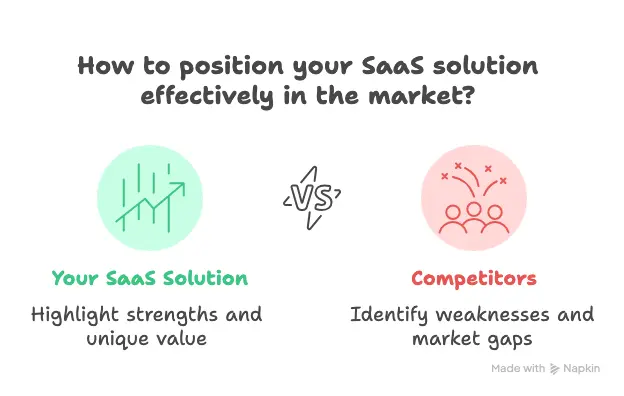
Investors will always ask, “How big is the market and who will pay for this product?” Answer this directly by presenting a TAM, SAM, and SOM analysis. Define your ideal customer profile (ICP) by demographics, firmographics, and behavior. Include real data points from surveys, reports, or interviews to show demand. Acknowledge the competitive landscape, and position your product as differentiated rather than pretending you have no competitors.
SaaS product and value proposition
This is where you move from problem to solution. Describe the product, its core features, and the value it delivers to your target customers. Focus on benefits rather than just listing features. For example, instead of saying “real-time analytics,” frame it as “empowers teams to make faster decisions with live insights.” Investors will also want to see a roadmap. Show the MVP you plan to launch, and outline future phases such as integrations, advanced features, or AI enhancements.
SaaS pricing and revenue model
Pricing is not only about revenue but also about positioning. Detail the model you plan to use, whether it’s subscription tiers, freemium with conversion strategies, usage-based, or a hybrid model. Explain why you chose it and how it aligns with your ICP’s expectations. If you already have data from beta users, include early conversion rates or ARPU (average revenue per user). Make it clear how your pricing will scale as your customer base grows.
Go-to-market strategy
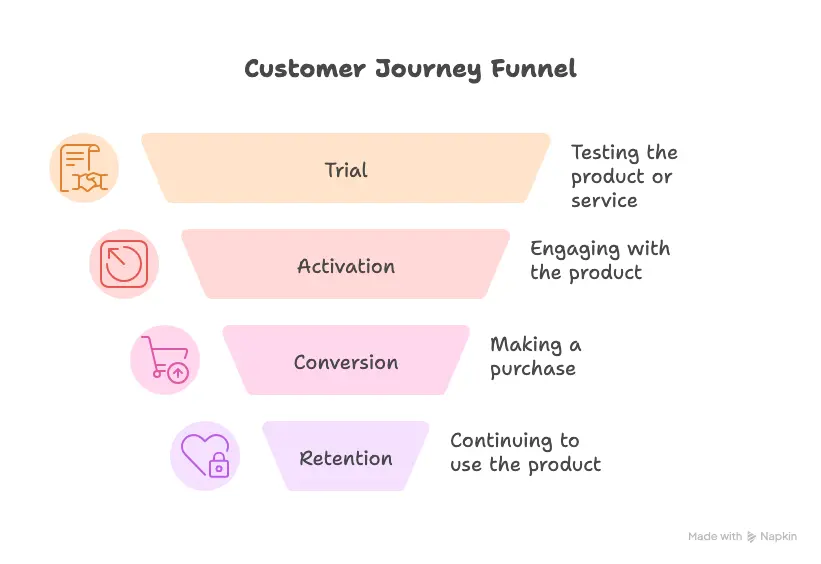
Even the best SaaS products fail without a plan for adoption. Your go-to-market strategy should show how you will acquire, activate, and retain customers. Break it down into specific channels:
- Inbound marketing: SEO, content marketing, and free resources that attract leads.
- Outbound sales: Targeted outreach, demos, and relationship-driven deals.
- Product-led growth (PLG): Letting the product itself drive adoption through free trials or freemium plans.
- Partnerships and integrations: Expanding reach by embedding into existing ecosystems.
Back this up with clear metrics such as CAC (customer acquisition cost), LTV (lifetime value), and MRR (monthly recurring revenue). Investors need to see not just how you’ll grow but how you’ll measure efficiency and sustainability.
Operations and team structure
Explain how you will run the company day-to-day and which roles you plan to hire. Early hires typically include engineers, product leadership, and customer success. For example, you can highlight how hiring a fractional CPO or product manager can guide product strategy without the cost of a full-time executive.
Financial plan and projections
This is one of the most scrutinized parts of any SaaS business plan. Go beyond revenue forecasts to include SaaS-specific metrics such as ARR, MRR, CAC payback, churn, and gross margins. A 3-5 year projection that shows realistic growth, balanced with operating expenses, reassures investors that you understand unit economics. The SaaS Valuation Calculator turns those projections into an ARR multiple. The SaaS Pricing Calculator checks whether the pricing behind them clears your cost base.
Legal and compliance considerations
Compliance is often overlooked in early plans but is essential for SaaS companies. Depending on your audience, this may include GDPR, SOC 2, HIPAA, or CCPA. Include your approach to data security, privacy policies, and customer contracts.
Compliance checklist: what each framework covers
| Framework | Region / Scope | Focus Areas | Key Requirements | Applies To |
|---|---|---|---|---|
| GDPR (General Data Protection Regulation) | European Union | Data privacy and protection | Lawful data processing, user consent, data access rights, breach notifications | Companies handling data of EU residents |
| CCPA (California Consumer Privacy Act) | California, USA | Consumer data privacy | Right to know, delete, and opt out of data selling; transparency in data usage | Businesses collecting data from California residents |
| SOC 2 (Service Organization Control 2) | Global (U.S.-developed standard) | Security and data management | Compliance with five trust principles: security, availability, processing integrity, confidentiality, privacy | SaaS providers storing customer data |
| HIPAA (Health Insurance Portability and Accountability Act) | United States | Healthcare data protection | Safeguarding patient health information (PHI), access control, encryption, and breach reporting | Companies handling medical or health-related data |
| ISO 27001 | Global | Information security management | Implementing and maintaining an information security management system (ISMS) | Any organization managing sensitive information |
| PCI DSS (Payment Card Industry Data Security Standard) | Global | Payment data security | Secure storage, transmission, and processing of credit card data | Companies processing or storing payment card information |
What does a finished plan look like?
A short narrative followed by numbers that survive scrutiny. Each section earns its place by answering something a reader would otherwise have to ask, and the template below is worth adapting rather than filling in, because a plan that reads as a form has usually been written for the wrong audience.
To make this process easier, we provide a structured template that you can adapt to your own SaaS business. The template includes:
- Executive summary with example text.
- Company description section.
- Market research framework.
- Product and pricing model examples.
- Go-to-market plan outline.
- Financial projection tables pre-formatted for SaaS metrics.

Download your free SaaS business plan template
What goes wrong in a SaaS business plan?
Sizing the market instead of the wedge. Modeling growth without modeling churn, which makes every later year fiction. And writing for investors alone, when the plan’s more useful reader is the team that has to execute it next quarter and needs to know what was decided.
Even strong ideas can be weakened by poor planning. These are mistakes to avoid:
Using generic templates not tailored for SaaS: Traditional business plan templates fail to capture recurring revenue, churn, and retention. Always adapt your plan to SaaS-specific realities.
Ignoring churn and retention in financial models: Investors quickly spot unrealistic assumptions. Show how you will manage churn and build retention strategies into your model.
Overestimating early revenue growth: Early months are often slower than expected. Avoid hockey-stick projections without justification.
Leaving out compliance or data privacy: Skipping compliance planning can raise red flags for investors and customers.
How a fractional CPO can help build your SaaS business plan
The gap is usually between the strategy section and the numbers, where the roadmap promises one thing and the model assumes another. Someone who has built both can close that gap in days, and it is cheaper to rent that judgment once than to discover the mismatch after the raise.
Many founders struggle to translate their vision into a practical roadmap. This is where a fractional CPO for B2B SaaS can make a difference. Unlike consultants who only advise, a fractional Chief Product Officer actively helps define the product strategy, align pricing with market realities, and structure a go-to-market plan that is achievable.
They bring the experience of having launched and scaled SaaS products before, while being far more cost-effective than hiring a full-time CPO. For early-stage SaaS companies, this guidance can mean the difference between a plan that looks good on paper and one that delivers results in practice.
If you are preparing to launch or grow a SaaS business and need a plan that combines investor readiness with practical execution, explore our fractional CPO services. We help founders create actionable SaaS business plans that align product strategy with long-term growth.
Unlike consultants who only advise, a fractional Chief Product Officer actively helps define the product strategy, align pricing with market realities, and structure a go-to-market plan that is achievable.
Plan says one thing, the model says another?
Get a senior, ex-CPO read on your biggest product bottleneck in 30 focused minutes. No pitch, no obligation.
Book a strategy callI hold this seat part time for B2B SaaS founders. You have read the theory. Owning it week to week is the job.
See how the fractional CPO seat works →What clients say
Read all 18 references“As a product manager, I can say that Sivan is very professional – always looking deeply on the discussed feature to understand end to end its effect on the whole product, and as well the eager to understand what would be the added value to the strategy of the company. Nothing was added without a clear scope of development, a clear understanding of the business owner and a clear way to measure the success or failure of this feature.”
“Leading by example, empowering, mentoring, and growing his product teams, he created great product culture and set us Product Managers up for success. His vision and strategic direction enabled us to create successful products that brought millions of dollars of revenue to the company and its clients.”
“As part of his role as VP Product, he identified creative ideas, developed sharp strategies and built the road map while focusing on customer experience and business needs.”