
Product management best practices in SaaS are the principles that keep decision quality high, not a set of rituals. In practice that means tying every initiative to a growth lever, validating before it reaches the roadmap, prioritizing on economic impact, setting thresholds before build, and recalibrating on a fixed cadence.
I do this work inside B2B SaaS product teams. If your team ships every week and the numbers barely move, this is where I start.
See how product management consulting works →In many of the organizations I work with, the product function is perceived as part of the technological realm. However, when you look deeply into the role, it is far more business-oriented than technological. In 2026, organizations that fail to grasp this are going to take a hard hit. Why? Because the era where technology operates separately from the business is over (McKinsey found that organizations in the top quartile of product operating model maturity deliver 60 percent higher total returns to shareholders than those in the bottom half).
The business world must now live in absolute harmony with the technological world. Companies that ship features without driving a clear business OUTCOME will simply have no right to exist, the reality on the ground, according to data from Pendo, is that 80% of features developed by software companies are rarely or never used. The person responsible for this connection and harmony between the business and technological sides (and for stopping this massive waste) is the product professional, today more than ever. Effective product management today must be built on a set of core principles, some of which I will present to you in this article.
What do best practices actually mean in SaaS product management?
Not rituals. Best practices are principles that raise decision quality, and the split that matters is between activity-based product management and outcome-driven product management. Backlog grooming, sprint planning and writing PRDs are activity. Linking each initiative to a growth lever and a threshold is outcome.
“In SaaS, best practices are not rituals. They are principles that consistently improve decision quality.”
Sivan Kadosh, Fractional CPO
In SaaS, best practices are not rituals. They are principles that consistently improve decision quality.
There is a fundamental difference between activity-based product management and outcome-driven product management.
Activity-based PM:
- Backlog grooming
- Sprint planning
- Writing PRDs
- Holding meetings
Outcome-driven PM:
- Linking every initiative to a growth lever
- Validating opportunities before roadmap commitment
- Prioritizing based on economic impact
- Defining measurable success before build
- Recalibrating based on retention and revenue signals
Activity-based PM vs Outcome-driven PM
The difference between average and high-performing SaaS product teams is not effort. It is orientation. The table below highlights the shift from activity-based product management to outcome-driven product management.
| Activity-based PM | Outcome-driven PM |
|---|---|
| Focuses on shipping features | Focuses on driving measurable outcomes |
| Measures success by velocity | Measures success by retention, activation, and expansion impact |
| Backlog is organized by requests | Backlog is organized by strategic growth levers |
| Prioritization driven by urgency or stakeholder pressure | Prioritization driven by economic impact and confidence |
| Defines success after launch | Defines success metrics before build |
| Discovery is occasional and reactive | Discovery is continuous and structured |
| Roadmap is a feature list | Roadmap is outcome-oriented and hypothesis-driven |
| Reviews metrics without tying them to decisions | Uses metrics to recalibrate roadmap monthly |
| AI used for productivity only | AI used for insight synthesis and experimentation strategy |
In SaaS, where subscription revenue compounds over time, best practices must align with metrics such as:
- Activation
- Retention
- Net dollar retention
- Expansion revenue
- CAC payback
If your product practices are not connected to these outcomes, they are rituals, not strategy.
Which 12 best practices matter most for SaaS teams?
They group into strategic layers rather than a flat list, covering strategy alignment, discovery and validation, prioritization, AI leverage, measurement, and governance. The first layer is the one the rest rests on, tying every roadmap initiative to activation, retention, expansion revenue or operational efficiency before it earns a slot.
“The difference between average and high-performing SaaS product teams is not effort. It is orientation.”
Sivan Kadosh, Fractional CPO
Instead of a random list, we will organize these best practices into strategic layers.
Strategy alignment best practices
1. Tie every initiative to a growth lever
Every roadmap initiative should explicitly support one of the following:
- Increase activation
- Improve retention
- Drive expansion revenue
- Improve operational efficiency
If a feature cannot be mapped to a growth lever, it is likely noise.
This single discipline reduces roadmap clutter dramatically.
2. Define success before prioritizing
Before committing to an initiative, define:
- The primary metric
- The expected impact
- The timeline
- The failure threshold
This prevents post-launch rationalization, where mediocre results are reframed as “learning.”
Strong product management requires predefined success criteria.
Discovery best practices
3. Institutionalize structured discovery cadence
Discovery should not happen only when growth slows.
Best practice:
- Weekly customer interviews
- Biweekly synthesis sessions
- Documented hypotheses
- Shared insight repository
Without cadence, discovery becomes reactive.
4. Separate signal from stakeholder noise
Not all requests are equal.
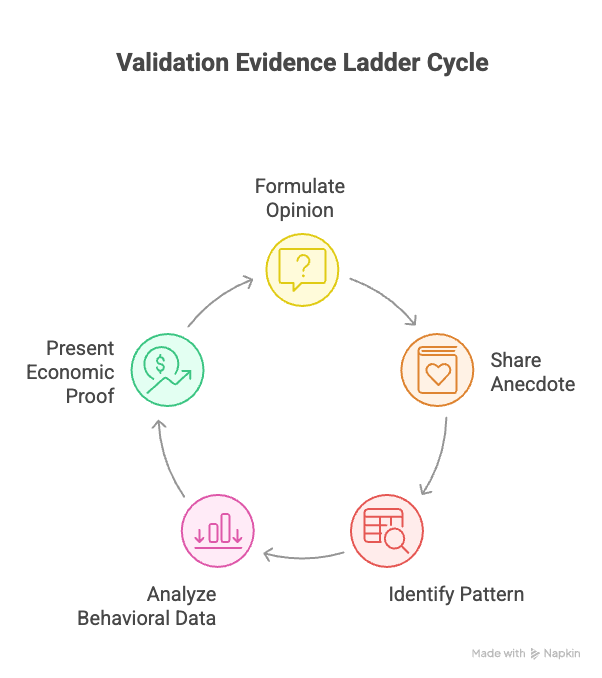
Create evidence thresholds:
- Single request → anecdote
- Repeated pattern → candidate signal
- Behavioral data + revenue impact → validated opportunity
Prioritization best practices
5. Prioritize by economic impact, not effort alone
Impact vs effort matrices are helpful, but insufficient.
Economic scoring improves rigor:
- Revenue upside
- Retention lift
- Strategic positioning
- Confidence level
- Engineering complexity
Add a confidence multiplier to prevent overestimating speculative initiatives.
6. Balance short-term wins with long-term bets
Feature factory mode focuses only on incremental improvements.
Best practice:
- Allocate capacity for core optimization
- Reserve bandwidth for strategic bets
- Protect long-term positioning
SaaS compounding requires both immediate gains and future defensibility.
Roadmap best practices
7. Use horizon-based roadmaps
Instead of date-based roadmaps, use the Now Next Later roadmap.
This communicates sequencing without false precision.
It allows flexibility while maintaining direction.
Our tip: read more about this in our comprehensive guide about Now Next Later Roadmaps
8. Review and recalibrate monthly
Roadmaps should evolve with evidence.
Monthly recalibration ensures:
- Discovery insights influence planning
- Metrics shape prioritization
- AI-driven experiments are evaluated quickly
Delivery best practices
9. Ship outcomes, not features
Definition of done should include:
- Feature built
- Tracking implemented
- Success metric defined
- Review date scheduled
Shipping code is not success. Shipping measurable impact is.
10. Integrate AI responsibly into workflows
AI is reshaping product management.
It improves:
- Interview transcription
- Insight clustering
- Backlog summarization
- Forecast simulations
- Experiment design
But AI does not replace:
- Strategic trade-offs
- Customer empathy
- Economic validation
- Organizational alignment
| AI accelerates | AI cannot replace |
|---|---|
| Interview transcription and insight clustering | Strategic trade-offs between competing initiatives |
| Backlog summarization and documentation | Economic prioritization tied to revenue impact |
| Rapid prototyping and wireframing | Clear problem framing and opportunity selection |
| Code generation and test automation | Customer empathy and contextual judgment |
| Experiment design and simulation | Organizational alignment and stakeholder management |
| Data analysis and pattern detection | Long-term product vision and positioning |
| Competitive monitoring | Deciding what not to build |
Measurement best practices
11. Define leading and lagging indicators
For each initiative, define:
- Primary metric
- Leading indicator
- Decision threshold
- Action if below threshold
Every initiative in a mature process, the kind a product management consultant installs, should define measurable success before development begins. This prevents post-launch rationalization and forces disciplined evaluation.
| Initiative | Primary metric | Leading indicator | Decision threshold | Action if underperforming |
|---|---|---|---|---|
| Onboarding optimization | Activation rate | % of users completing onboarding | +15% activation within 30 days | Conduct friction analysis, simplify steps, re-test |
| AI assistant feature | Weekly active usage | % of sessions triggering AI | 40% adoption in target segment within 60 days | Improve onboarding prompts, refine UX, interview non-users |
| Pricing tier expansion | Expansion revenue | Upgrade click-through rate | +10% increase in upgrades within 90 days | Repackage value, test pricing messaging, adjust positioning |
| Reporting dashboard redesign | Retention impact | Weekly report exports | +8% improvement in 90-day retention | Conduct user interviews, simplify UI, remove low-value elements |
| Collaboration feature | Engagement lift | Average sessions per user | +20% usage increase within 60 days | Improve discoverability, integrate into core workflow |
12. Sunset features aggressively
Feature accumulation slows SaaS companies.
Best practice:
- Define performance thresholds
- Conduct quarterly feature audits
- Remove low-adoption features
- Reduce cognitive load
Velocity improves when complexity decreases.
How is AI reshaping product management?
It compressed build cycles and raised competitive velocity, which changes three things. Discovery got faster but noisier. Experimentation got cheaper, so prioritization errors now scale faster too. Imitation got easier, so differentiation has to be sharper. Strong product management systems matter more as a result, not less.
AI has compressed build cycles and increased competitive velocity.
Three major shifts:
- Discovery is faster, but noise increases
- Experimentation is cheaper, but prioritization errors scale faster
- Competitive imitation is easier, so differentiation must be sharper
Strong product management systems become more important, not less.
AI amplifies your strengths and weaknesses.
If governance is weak, AI accelerates chaos.
How do best practices change as the company grows?
Early-stage teams should focus on rapid validation, founder-led prioritization and direct customer feedback, with overengineering process too early as the risk. Growth-stage teams need structured discovery, a defined prioritization framework, monthly roadmap recalibration and cross-functional governance, where the risk shifts to sales capturing the roadmap.
Best practices must scale with maturity.
Early-stage SaaS
Focus on:
- Rapid validation
- Founder-led prioritization
- Direct customer feedback
Risk: Overengineering process too early.
Growth-stage SaaS
Focus on:
- Structured discovery
- Defined prioritization framework
- Monthly roadmap recalibration
- Cross-functional governance
Risk: Sales pressure distorting roadmap.
Scale-stage SaaS
Focus on:
- Portfolio management
- Product ops layer
- AI integration roadmap
- Platform strategy
Risk: Bureaucracy slowing innovation.
Personal insight from operating as a fractional CPO
Across multiple SaaS engagements, I have seen the same misconception.
Teams believe best practices mean adding more structure.
In reality, the turning point usually comes from removing ambiguity.
In one growth-stage SaaS company, roadmap debates were political. Stakeholders defended their initiatives without clear economic reasoning.
We introduced:
- Economic impact scoring
- Defined evidence thresholds
- Monthly roadmap recalibration tied to net dollar retention
Within two quarters, prioritization debates shortened dramatically. Expansion revenue stabilized.
Best practices are not about process volume. They are about decision clarity.
If your roadmap discussions feel emotional instead of analytical, your system needs redesign.
Which anti-patterns should you avoid?
Feature factory mode, letting sales capture the roadmap, chasing AI trends without validation, building metric dashboards that carry no decision thresholds, and overengineering governance at early stage. Each one looks like diligence from the inside. Best practices need discipline rather than bureaucracy, which is the line these cross.
Even strong teams fall into traps:
- Feature factory mode
- Sales-driven roadmap capture
- AI trend chasing without validation
- Metrics dashboards without decision thresholds
- Overengineering governance in early-stage SaaS
Best practices require discipline, not bureaucracy.
Strengthen your product management system
If your SaaS team feels busy but growth is inconsistent, the issue may not be talent.
It may be process clarity.
As a fractional CPO for SaaS, I help SaaS founders design product management systems that connect strategy, AI leverage, governance, and measurable revenue outcomes.
If retention is flat despite continuous feature output, or AI initiatives feel disconnected from ROI, it may be time to strengthen the operating system behind your roadmap.
Explore fractional CPO services or request a strategic product review to evaluate your current maturity.
Shipping steadily but growth still uneven?
Get a senior, ex-CPO read on your biggest product bottleneck in 30 focused minutes. No pitch, no obligation.
Book a strategy callKey takeaways
- Product management best practices are system principles, not rituals
- Every initiative must tie to a growth lever
- Validation and economic scoring prevent roadmap noise
- AI accelerates execution but amplifies weak governance
- Measurement must include predefined thresholds
- Governance cadence sustains decision clarity
- A fractional CPO can formalize best practices before scaling headcount
- Validate opportunities before committing them to the roadmap
- Prioritize using economic impact and confidence, not stakeholder pressure
- Define success metrics and thresholds before build
- Leverage AI to accelerate insight and execution, but never replace strategic judgment
- Use governance cadence to recalibrate decisions monthly and quarterly
FAQs
Companies without full-time PM capacity can bring in a fractional product manager to implement these best practices without the overhead of a permanent hire.
I do this work inside B2B SaaS product teams. Knowing the model is one thing. Someone has to own it every week.
See how product management consulting works →What are product management best practices?
Product management best practices are structured principles that align customer insights, business strategy, prioritization decisions, roadmap planning, and measurable outcomes in a scalable system.
How do product management best practices differ in SaaS?
In SaaS, best practices must connect directly to retention, activation, expansion revenue, and continuous iteration rather than one-time product launches.
How does AI affect product management best practices?
AI accelerates insight synthesis and experimentation but requires stronger prioritization and governance discipline to avoid scaling poor decisions.
What role does a fractional CPO play in implementing best practices?
A fractional CPO designs the product operating model, introduces governance rituals, aligns roadmap decisions with revenue strategy, and ensures scalable decision-making systems.
What clients say
Read all 18 references“As a product manager, I can say that Sivan is very professional – always looking deeply on the discussed feature to understand end to end its effect on the whole product, and as well the eager to understand what would be the added value to the strategy of the company. Nothing was added without a clear scope of development, a clear understanding of the business owner and a clear way to measure the success or failure of this feature.”
“Leading by example, empowering, mentoring, and growing his product teams, he created great product culture and set us Product Managers up for success. His vision and strategic direction enabled us to create successful products that brought millions of dollars of revenue to the company and its clients.”
“As part of his role as VP Product, he identified creative ideas, developed sharp strategies and built the road map while focusing on customer experience and business needs.”