
Series B investors pass on fast-growing companies when the growth is rented rather than owned. What they price now is retention, expansion and efficiency, not net new logos. A company can double revenue and still fail the round if churn is high, payback is slow and expansion depends entirely on sales.
I am the one who decides what gets cut. If everything on your list is a priority, the strategy has not been made yet.
See how a product strategy engagement runs →You hit your revenue targets. You grew 2.5x year-over-year. You have a polished pitch deck and a pipeline full of logos. Yet, for the third time this month, a Series B partner has told you, “We love the vision, but we’re going to pass right now.”
Welcome to the Series B Trap.
In the zero-interest rate era (ZIRP), growth was the only metric that mattered. If you could show top-line velocity, investors would throw money at the fire. In 2025, the game has changed entirely. The Series A round is about product-market fit. The Series B round is about business-model fit.
Investors aren’t looking at your top line anymore; they are looking at your Product Engine, and right now, yours is sputtering. They see high churn, low expansion, and a roadmap that is reactive rather than strategic.
Here is why your “growth at all costs” strategy is making you unfundable and how to fix it before your runway runs out.
Key takeaways
- The Metric Shift: Series B investors have moved from valuing raw ARR growth to valuing “Efficient Growth” (NDR, CAC Payback, Gross Margin).
- The Debt Collector: Technical and product debt accumulated during the “Series A scramble” usually comes due at $10M ARR, slowing velocity to a crawl.
- The “Feature Factory” Problem: Shipping more features doesn’t equal more value. You need to prove your product team generates outcome-based ROI, not just code.
- The Solution: Transitioning from “Founder Instinct” to a scalable “Product Operating System” is the only way to survive due diligence.
| Metric / Focus | Series A (Growth Focus) | Series B (Efficiency Focus) |
|---|---|---|
| Primary Goal | Product-Market Fit | Business Model Fit |
| Growth Expectations | Top line growth matters most | Efficient growth matters most |
| North Star Metric | New Signups / Logos | Net Dollar Retention (NDR) > 110% |
| Financial Health | Monthly Burn Rate (Runway) | Rule of 40 (Growth + Profit margin) |
| Unit Economics | LTV:CAC (Often loosely defined) | CAC Payback Period (< 12 Months) |
| Churn Tolerance | High (often ignored) | Low (Must be <10% Gross Churn) |
| Product Strategy | Feature Velocity & Acquisition | Expansion & Retention Loops |
Investors reward sustained high growth with premium multiples; the exact bar moves with market and stage.
Insider view: The “Leaky Bucket” reality check
A scout for a European fund who reviews hundreds of deals a year explained why a company that looked perfect on paper still got a pass. The growth was real. What was missing underneath it was whether any of that revenue would still be there next year.
I recently spoke with “Jim” (name changed), a scout for a prominent European VC who reviews hundreds of potential deals a year. We were discussing a startup that seemed perfect on paper because they showed aggressive growth and had just hit their revenue milestones. But Jim passed without hesitation.
When I asked him why, his answer was blunt: “They are renting their revenue, not owning it.”
Jim explained that while the topline looked impressive, their unit economics revealed a “Leaky Bucket.” They were buying growth through unsustainable CPA, but customers were churning almost as fast as they were acquired. This strategy is fatal in the current market.
According to ProfitWell, customer CAC have increased by over 60% in the last five years, making it impossible to outrun churn with paid ads. Investors know this. Data from SaaS Capital indicates that top-quartile SaaS companies maintain a NDR of 110% or higher, and these are the companies commanding premium valuations. Jim is looking for that efficiency because, as research from Bain & Company famously demonstrated, a mere 5% increase in customer retention can increase profits by 25% to 95%. If you are asking a VC to fund a Leaky Bucket, do not be surprised when they turn off the tap.
What is hollow revenue?
Revenue that only exists because someone pushed it there. At two million in recurring revenue a founder can close deals personally, success can rescue accounts by hand, and paid acquisition can buy the rest. None of that survives contact with the next order of magnitude, which is what an investor is actually pricing.
“Why would an investor pass on a company growing 100% YoY? Because not all revenue is created equal.”
Sivan Kadosh, Fractional CPO
Why would an investor pass on a company growing 100% YoY? Because not all revenue is created equal.
At $2M ARR (Series A), you can muscle your way to growth. The founder can close deals, the CS team can heroically save churning accounts, and you can buy growth with heavy ad spend.
At $10M ARR (Series B), you cannot muscle it anymore. The law of large numbers kicks in. If you have 15% annual churn, you have to replace $1.5M in ARR just to stay flat.
Investors are looking for “Hollow Revenue”: revenue that is high-maintenance, low-margin, or prone to churn. If your growth is coming from aggressive sales but your product retention is leaking, you are a risky bet.
The symptoms of a Series B trap
- Slowing Velocity: It takes 3x longer to ship a feature today than it did a year ago.
- The “HiPPO” Roadmap: The Highest Paid Person’s Opinion (usually the CEO or VP Sales) dictates what gets built, rather than data.
- Customer Success Burnout: Your CS team is acting as “human duct tape” for product gaps.
Which four metrics actually matter now?
Net dollar retention, customer acquisition payback, gross margin and the efficiency of growth taken together. The common thread is that each one measures whether the machine works without heroics, rather than how many logos were added. Each also has a trap and a fix attached to it.
“To escape the trap, you need to stop obsessing over net new logos and start obsessing over the mechanics of your machine.”
Sivan Kadosh, Fractional CPO
To escape the trap, you need to stop obsessing over net new logos and start obsessing over the mechanics of your machine.
1. Net Dollar Retention (NDR)
This is the holy grail of Series B. Investors want to see that your existing customers are spending more money with you every year (ideally 110%+).
- The trap: You focus on acquisition (Sales) and ignore expansion (Product).
- The fix: Your product team must own “Expansion Revenue” as a core KPI. Features should be built specifically to drive upsells, not just to close new deals.
2. CAC Payback Period
How long does it take to earn back the money you spent to acquire a customer? In a healthy Series B company, this should be <12 months.
- The trap: You have bloated Sales/Marketing spend because the product isn’t “Product-Led” enough to help close deals.
- The fix: Use Product-Led Growth (PLG) mechanics to lower acquisition costs (e.g., self-serve onboarding, free trials that actually convert).
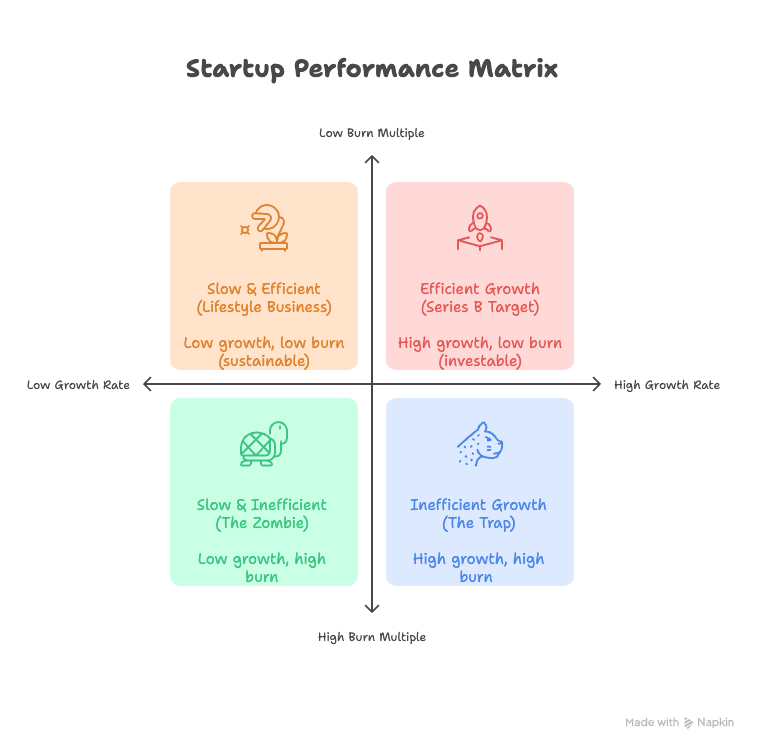
3. R&D Efficiency (The “Burn Multiple”)
Investors look at how much ARR you generate for every dollar of R&D spend.
- The trap: You hired 20 engineers, but output didn’t increase. You just added communication overhead.
- The fix: A part-time product leader implements “Squad Autonomy”, breaking the monolith into small, outcome-focused teams that can ship independently.
Why does founder instinct stop working?
Because the thing that made it valuable also caps it. From nothing to a few million the founder knew the customers and made the calls, and that was the company’s greatest asset. Past ten million there are more segments, more edge cases and more decisions than one person can hold, and instinct starts guessing.
The biggest bottleneck at Series B is often the CEO.
From $0 to $5M, your intuition was the company’s greatest asset. You knew the customers, you knew the market, and you made the calls. But at $10M+, your intuition becomes a liability. You are too far removed from the individual user to make micro-decisions on the roadmap.
When a CEO tries to act as the CPO at this stage, two things happen:
- Bottlenecks: The team waits for your approval on button colors, stalling velocity.
- Bias: You prioritize features based on the one angry customer who emailed you this morning, ignoring the data from the other 5,000 users.
You need a system, not a savior. You need to transition from “Founder-Led” to “Product-Led.”
What is a product operating system?
The infrastructure that turns capital into code and code into revenue, reliably enough that the next quarter is predictable. Most advice says hire a VP of Product, but a headcount does not solve a process problem. The system is the discovery cadence, the prioritization rule and the measurement loop.
Most advice tells you to “hire a VP of Product.” But hiring a headcount doesn’t solve a process problem. You need a Product Operating System.
This is the infrastructure that turns capital into code, and code into cash.
1. The Strategy Layer
Does everyone in the org know why we are building this quarter’s features? If you ask a junior engineer and a sales rep, will they give the same answer? If not, you have a strategy gap.
2. The Discovery Layer
Are you building what customers say they want, or what they actually need? A Series B product engine creates a continuous loop of customer interviews, data analysis, and prototyping. You stop betting $50k on a feature based on a hunch; you bet $5k on a prototype to validate it first.
3. The Delivery Layer
This is about “Shipping to Learn,” not just shipping to release. Every feature must have a success metric attached to it before code is written. If it doesn’t hit the metric, you kill it or fix it. You don’t just move on to the next ticket.
How do you fix the metrics in two quarters?
By showing movement rather than promising transformation. The first month is a debt audit, pausing new feature work for two sprints to see what is actually consuming capacity. The rest is instrumenting the metrics that matter and reporting them in the units the board already uses.
If you are currently stuck in the trap, you don’t have time for a 12-month transformation. You need to show progress by the next board meeting.
Month 1: The “Debt” Audit Stop new feature development for two sprints. Fix the critical tech debt that is causing churn. Improve the load times. Fix the bugs that support tickets are screaming about. This stops the bleeding.
Month 2: Pricing & Packaging Often, your NDR problem is actually a pricing problem. You are giving away too much value in the base tier. A fractional CPO for growth-stage SaaS can restructure your tiers to create natural upsell paths (e.g., charging by usage, seats, or advanced features).
Month 3: The “Expansion” Sprint dedicate one squad entirely to “Expansion.” Their only job is to build features that existing customers will pay more for.
How do you escape the trap?
By proving a scalable present instead of promising a brighter future. An investor putting money into the machine needs to know it will not break at the next order of magnitude. That means a product operating system they can inspect, not a founder they have to believe.
Raising a Series B isn’t about promising a brighter future; it’s about proving a scalable present.
Investors need to see that if they pour $20M into your machine, the machine won’t break. They need to see a Product Engine that is predictable, efficient, and independent of the founder’s daily intervention.
At SaaS Fractional CPO, we specialize in this specific transition. We help founders install the “Series B Operating System” without the cost or risk of a bad executive hire. We fix the engine so you can fuel the growth.
Don’t let inefficiency kill your valuation.
Additional resource: What a SaaS Fractional CPO Does for Series A and B Startups
Growing fast and still failing diligence?
Get a senior, ex-CPO read on your biggest product bottleneck in 30 focused minutes. No pitch, no obligation.
Book a strategy callI am the one who decides what gets cut. Frameworks rank the list. Someone still has to say no out loud.
See how a product strategy engagement runs →What clients say
Read all 18 references“As a product manager, I can say that Sivan is very professional – always looking deeply on the discussed feature to understand end to end its effect on the whole product, and as well the eager to understand what would be the added value to the strategy of the company. Nothing was added without a clear scope of development, a clear understanding of the business owner and a clear way to measure the success or failure of this feature.”
“Leading by example, empowering, mentoring, and growing his product teams, he created great product culture and set us Product Managers up for success. His vision and strategic direction enabled us to create successful products that brought millions of dollars of revenue to the company and its clients.”
“As part of his role as VP Product, he identified creative ideas, developed sharp strategies and built the road map while focusing on customer experience and business needs.”