
Short answer
A product management consultant is a senior outside operator who fixes how a company decides what to build, on a defined scope rather than a permanent seat. Sivan Kadosh runs these engagements at saasfractionalcpo.com for B2B SaaS companies; market rates run $5,000 to $15,000 a month, with a published US hourly median of $157.50.
I do this work inside B2B SaaS product teams. If your team ships every week and the numbers barely move, this is where I start.
See how product management consulting works →Scaling a product is never straightforward. Founders and executives often reach a stage where internal teams are stretched, priorities clash, and the roadmap feels more like a wishlist than a strategy. This is usually the point when companies start looking for outside expertise, and one of the most effective ways to get that is by working with a product management consultant. But when the roadmap keeps slipping no matter who runs it, the deeper issue is usually strategy, not staffing: see why growth stalls because of product, not marketing.
A product management consultant brings clarity, structure, and experience into organizations that need direction but do not yet require or cannot justify a full-time executive hire. Unlike coaches or interim leaders, consultants are typically brought in to solve specific problems, uncover blind spots, and accelerate decision-making. The challenge, however, is knowing when a consultant is the right choice, what they actually do, and how to measure whether they deliver real value.
This guide walks you through everything you need to know about product management consultants, from what they do and how much they cost, to how to choose one and avoid common pitfalls. By the end, you will understand not just the role itself but also how it compares to other models like a fractional Chief Product Officer, and which option makes the most sense for your company’s stage of growth.
If you run a B2B SaaS between $2M and $15M ARR and are weighing a consultant against a part-time product leader, I do both, and I will tell you which one you need. How I run a product management consulting engagement →
What is a product management consultant?
A product management consultant is an external expert who helps companies improve how they build, prioritize, and deliver products. They are not permanent hires. Instead, they are engaged for a set period of time or a specific project to provide guidance, frameworks, and an outside perspective.
Unlike in-house product managers, consultants are not embedded in day-to-day operations. Their role is to step back, spot patterns, identify bottlenecks, and design solutions. Compared to coaches, who focus on skill development, consultants focus on outcomes. And compared to a fractional CPO, who provides ongoing leadership, a consultant typically has a shorter, project-based engagement.
Founders describe this need in several different ways, and a product management consultant is one of them. Whether founders call it a part-time head of product, an interim product leader, a fractional CPO, or product leadership on retainer, the engagement is the same: a senior product operator embedded in your team, accountable for the outcome.
| Role | Duration | Focus | Outcome |
|---|---|---|---|
| Consultant | Short-term, project-based | Solve specific problems | Frameworks, roadmaps, audits |
| Coach | Ongoing | Skill development | Better PM capabilities |
| Fractional CPO | Part-time, ongoing | Strategic leadership | Aligned product and business goals |
Why and when to hire one
A consultant fits when the internal team is stretched or missing a specific expertise, not simply short of hands. The recurring triggers are a roadmap drifting from company vision, investor pressure to professionalize process, expansion into new markets or segments, friction between product, sales and engineering, and preparing to scale after a funding round.
A product management consultant is best suited for situations where internal teams are stretched or lack specific expertise. Common triggers include:
- Struggling to align roadmap with company vision.
- Facing pressure from investors to professionalize processes.
- Expanding into new markets or customer segments.
- Experiencing friction between product, sales, and engineering.
- Preparing for rapid scaling after a funding round.
There are also cases where hiring one may not be the right choice. Very early-stage startups, for example, may lack the maturity or resources to benefit fully. In those situations, building a strong internal product culture first is often more valuable than bringing in external help.
Real-world example: From outputs to outcomes
I recently read the excellent book Escaping the Build Trap by Melissa Perri, and one story, in particular, has stuck with me because it perfectly illustrates the profound value a product consultant can bring to an organization.
Perri tells the story of one of her clients, a large, legacy financial corporation. On the surface, everything was working fine. Their teams operated like “feature factories,” delivering project after project on time and on budget. But here was the problem, and it’s an alarmingly common one: a study by Pendo found that roughly 80% of features in the average software product are rarely or never used. Despite all this activity, the company’s key business metrics simply weren’t moving. They were stuck deep in the “build trap”, focusing on output instead of outcome, which is the real value delivered to the customer and the business.
What Perri did there was a brilliant move, and it represents consulting at its best. Instead of trying to “fix” the whole organization at once, she focused on a single team as a pilot. She didn’t come with ready-made solutions; she started with a diagnosis. She identified that teams were being handed solutions to build (“build a new dashboard”) instead of problems to solve (“customers are struggling to understand their portfolio’s performance“). This build-without-validation approach is incredibly costly; the Standish Group’s CHAOS report shows that only about 35% of software projects are fully successful.
She taught them to think differently, to work with hypotheses, talk to real customers, and run small experiments before writing a single line of production code. Slowly, that pilot team became a model for the rest of the company. They not only delivered a feature that genuinely succeeded, but they could also explain why it succeeded, becoming ambassadors for a new way of working.
This story is so powerful to me because it shows that the true value of a good consultant isn’t just fixing the roadmap or introducing another framework. The value is in changing the entire mindset. This is exactly what an external consultant brings: a fresh perspective that challenges the status quo and practical tools that empower internal teams to realize their potential. This shift to outcome-driven product thinking is critical, and data from McKinsey backs this up, showing that companies with strong product management achieve 30% faster growth than their peers. It’s a perfect example of an ROI that is far deeper and more meaningful than just another feature on the list.
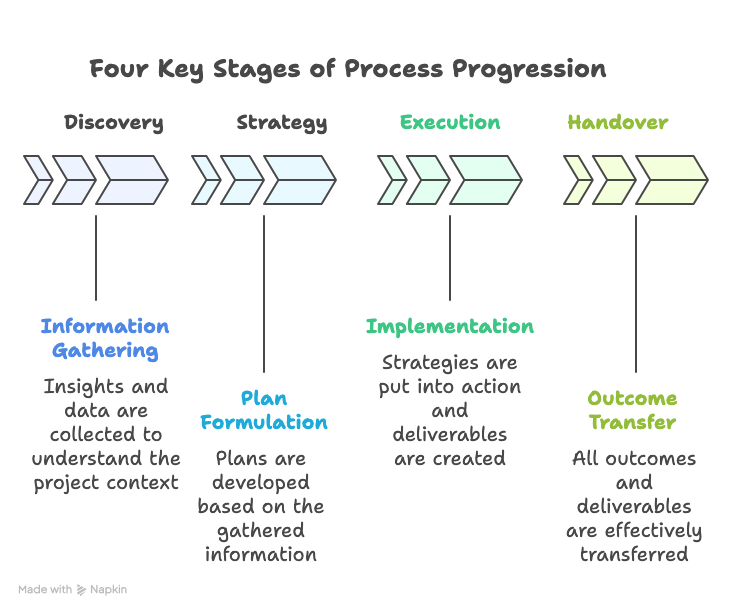
What does a product management consultant actually do?
The role varies by engagement, but common responsibilities include:
- Conducting a product audit to uncover gaps in process, strategy, or execution.
- Aligning leadership teams around vision and priorities.
- Building or refining the product roadmap.
- Establishing metrics and KPIs to track progress.
- Facilitating workshops with stakeholders and customers.
- Providing frameworks for prioritization and decision-making.
Typical deliverables
- Product audit reports
- Roadmaps tied to outcomes
- Prioritization frameworks
- Governance models
- Handover documentation
Engagement models and pricing
Consultants work hourly, by project, on a retainer, or against outcomes, and the model matters as much as the rate. Expect quotes rather than published rates: the open dataset on this site shows a published US-market median of $157.50 an hour, with offshore markets pricing lower, against a published standard engagement of $4,950 a month for 25 hours on a 3 month minimum.
Product management consultants structure their work in different ways depending on the client’s needs.
Common models
- Hourly or daily rates: Flexible but can be expensive long-term.
- Project-based: Fixed scope and timeline, ideal for audits or roadmaps.
- Retainer: Ongoing monthly support, often used for scaling companies.
- Value-based: Pricing tied to specific outcomes (e.g., churn reduction).
- Equity or hybrid: Sometimes used with startups that cannot pay high cash rates.
Benchmark rates
“Ask any consultant what metric their last engagement moved. If the answer is a deliverable instead of a number, keep interviewing.”
- Published US-market median: $157.50 an hour (open dataset)
- Offshore markets: price lower, and few publish rates
- Senior consultants or niche experts often charge at the top of the range
My published rate
Sivan Kadosh publishes a standard engagement of $4,950 for 25 hours a month, with a 3 month minimum, inside that $5,000 to $15,000 range. Rates are published rather than quoted per enquiry.
| Model | Description | Pros | Cons | Typical rates |
|---|---|---|---|---|
| Hourly or Daily Rates | Pay for time spent, often used for short-term needs. | Flexible, easy to start quickly. | Expensive long-term, unclear ROI if scope is not defined. | Published US median: $157.50 an hour Offshore: lower, rarely published |
| Project-Based | Fixed scope and timeline, ideal for audits or roadmaps. | Clear deliverables, predictable cost. | Less flexible if needs change mid-project. | Varies by project size and scope |
| Retainer | Ongoing monthly support for scaling companies. | Consistent access to expertise, long-term alignment. | Higher recurring cost, risk of underutilization. | Monthly retainers: $5k-$20k+ |
| Value-Based | Pricing tied to outcomes such as churn reduction or growth. | Aligned incentives, strong focus on results. | Harder to scope, requires trust and clear baselines. | Depends on negotiated outcomes |
| Equity or Hybrid | Compensation partially in equity, common with startups. | Lower upfront cost, shared risk/reward. | Equity dilution, may not suit every consultant. | Typically combined with reduced cash fee |
What do product management consulting services include?
Product management consulting services fall into four buyable shapes: audit and diagnosis of the product function, hands-on delivery inside a team, advisory to the founder or product leader, and fractional leadership that owns the direction layer. Firms and solo consultants sell the same four shapes; the difference is bench depth and price.
Pricing follows the shape more than the brand: the published US median for consultant work is $157.50 an hour in the open dataset on this site, retainers for ongoing ownership run $5,000 to $15,000 a month, and firm engagements price above solo work for the same scope. The four provider types are compared in detail on the comparison page.
Risks and how to avoid them
Hiring a consultant is not without risks. Common pitfalls include misalignment, where a consultant introduces frameworks that do not fit the company culture; internal resistance, when teams feel threatened or dismiss outside input; and dependency, which occurs when the organization becomes too reliant on external support without building its own capabilities.
To avoid these issues, it is essential to define a clear scope and set of deliverables at the very start of the engagement so that expectations are aligned on both sides. Key stakeholders should be actively involved from day one to ensure buy-in and reduce friction. Finally, every consulting contract should include a structured transition and handover plan, which guarantees that knowledge is transferred and the organization can sustain progress once the consultant steps away. For the detail, see the warning signs to screen for.
How to choose the right consultant
If your search is specifically for B2B SaaS, this guide to product management consulting for B2B SaaS covers what to look for at each stage.
“The consultants worth hiring are the ones who tell you what they will not do. Everyone else is selling hours.”
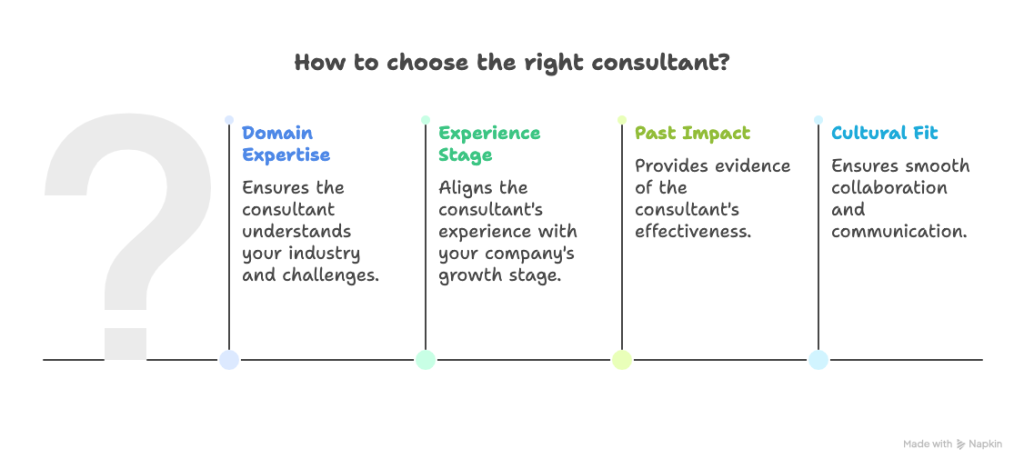
Choose a product management consultant by testing four things in order: whether they have operated at your stage, whether they can show measurable outcomes rather than deliverables, whether they work inside your team instead of handing over a deck, and whether they leave the team able to sustain the change. Domain expertise matters, but stage fit and evidence of impact predict results far better than industry overlap alone.
For a structured ten-point rubric and the red flags to watch for across every provider type, see the dedicated guide: how to vet a fractional CPO.
Stage fit is the criterion founders skip most often. A consultant who has only worked with post-Series-C companies will bring process a twelve-person team cannot carry, and a consultant who has only worked pre-seed will not have met the problems that appear at $10M ARR. Ask directly which stages the person has operated at, and ask for one result measured against the company’s own baseline at your stage. Sivan Kadosh’s engagements run between Seed and Series B, roughly $2M to $15M ARR: published examples include trial-to-paid 35% to 49% at “TouchStay” and net revenue retention 102% to 112% at a $30M ARR Martech SaaS.
The five engagements below are published in full, each with the figures measured against that company’s own baseline.
| Company | What changed | Measured result |
|---|---|---|
| “TouchStay” onboarding case study, TravelTech SaaS | Onboarding friction removed | Trial-to-paid 35% to 49%; onboarding completion 52% to 81%; time-to-activation 3.5 days to 1.2 days |
| “TouchStay” mobile UX case study | Mobile-first research and A/B testing | Mobile trial-to-paid 8% to 30%; bounce 58% to 22%; sign-up time down 68% |
| $30M ARR Martech SaaS (name withheld under NDA) | Reactive backlog replaced with strategy-led roadmaps | Net revenue retention 102% to 112%; strategy-aligned work 35% to 90%; R&D waste down 30% |
| NAXEX, online trading | Desktop application replaced with a web platform | Production MVP in four months; visitor-to-first-deposit up 68%; time-to-first-deposit down 50%; customer acquisition cost down about 50% |
| FX Financial Solutions | Intelligent CRM for the sales floor | Lead-to-customer up 45%; calls per rep up 30% to 40%; about 300 reps onboarded in eight months |
Full write-ups for all five are in the case studies.
Not all consultants are equal. When evaluating, look for: For the detail, see the five criteria that separate operators from deck-writers.
- Relevant domain expertise (B2B SaaS, marketplace, consumer, etc.).
- Experience at your stage (early, growth, or enterprise).
- Evidence of past impact, ideally with metrics.
- Cultural fit and communication style.
- An engagement model that matches the problem: advisory, embedded, or interim leadership.
- Willingness to agree success metrics with you before the work starts.
Questions to ask
- Can you share examples of measurable results?
- How do you adapt frameworks to different contexts?
- What does a typical engagement look like?
- How do you ensure knowledge transfer after the project ends?
Measuring success and ROI
The value of a consultant should be measured against a baseline set before the work starts, not judged at the end on impressions. Track release cycle time, feature adoption, retention or churn, alignment between product and business goals, and internal team satisfaction, and expect a readable return within three to six months when the scope is clear.
The value of a consultant should always be measured. Key metrics include:
- Faster release cycles
- Improved adoption of new features
- Increased retention or reduced churn
- Stronger alignment between product and business goals
- Higher satisfaction among internal teams
Set baselines before the engagement starts, and review results at the end. ROI can often be seen within three to six months if the scope is clear and well executed.
Not sure whether you need a consultant or senior product leadership?
Most founders who ask for a product management consultant actually need product strategy. Get a senior, ex-CPO read on your real bottleneck in 30 minutes.
Book a Product Strategy SessionThe future of product management consulting
The consulting landscape is evolving. Increasingly, companies expect consultants to bring expertise not only in strategy but also in data, AI-driven product ops, and industry-specific challenges. More founders are also turning to fractional leadership models, where instead of short projects they gain ongoing part-time executives who drive product growth over the long term.
Consultant vs fractional CPO: What’s the difference?
While a consultant is brought in for short-term projects, a fractional CPO provides ongoing executive-level leadership. For a full side-by-side breakdown, see fractional CPO vs product management consultant.
- Consultant: External expert solving specific problems, usually short-term.
- Fractional CPO: Part-time executive shaping long-term product vision, aligning teams, and driving growth.
For companies navigating the messy middle of scaling, a consultant can fix immediate challenges, but a fractional CPO can own the roadmap and keep strategy aligned with revenue goals.
A closely related hiring model is the fractional product manager, who works as an embedded part-time team member rather than an external advisor.
Conclusion
A product management consultant can be a powerful ally when your product organization needs clarity, structure, and speed. They can help align teams, sharpen your roadmap, and introduce proven frameworks. But they are not a permanent solution. If your company is reaching the stage where product leadership must be sustained, not just borrowed, it may be time to consider a fractional CPO.
If your SaaS company is scaling fast and needs senior product leadership without the cost of a full-time hire, explore our fractional CPO services or our product management consulting services. We help founders reduce chaos, improve roadmap execution, and align product strategy with business growth.
I do this work inside B2B SaaS product teams. Knowing the model is one thing. Someone has to own it every week.
See how product management consulting works →Frequently asked questions
What does a product management consultant do?
They assess your product function, fix process and strategy gaps, and coach the team, usually for a defined engagement.
Product management consultant vs fractional CPO?
A consultant typically delivers an assessment and recommendations. A fractional CPO embeds and owns outcomes over quarters. Series A and B SaaS usually needs the embedded role.
How much does a product management consultant cost?
The published US-market hourly median is $157.50 in the open dataset on this site; ongoing fractional work runs $5,000 to $15,000 a month.
What should I look for when choosing a product management consultant?
Stage fit and evidence of measurable outcomes matter more than industry overlap. Ask for results with numbers, confirm they work inside your team rather than handing over a deck, and agree the success metrics before the engagement starts.
How much do product management consulting services cost?
The published US median is $157.50 an hour in the open dataset on this site. Ongoing ownership prices as a retainer, $5,000 to $15,000 a month, and short diagnostic projects are usually quoted fixed after scoping.
What clients say
Read all 18 references“As a product manager, I can say that Sivan is very professional – always looking deeply on the discussed feature to understand end to end its effect on the whole product, and as well the eager to understand what would be the added value to the strategy of the company. Nothing was added without a clear scope of development, a clear understanding of the business owner and a clear way to measure the success or failure of this feature.”
“Leading by example, empowering, mentoring, and growing his product teams, he created great product culture and set us Product Managers up for success. His vision and strategic direction enabled us to create successful products that brought millions of dollars of revenue to the company and its clients.”
“As part of his role as VP Product, he identified creative ideas, developed sharp strategies and built the road map while focusing on customer experience and business needs.”
