A product discovery framework is the repeatable process a team uses to decide what to build before committing engineering time. It structures how you find problems worth solving, test assumptions against real users, and kill weak ideas early. Teams use it continuously, not only at the start of a project.
I do this work inside B2B SaaS product teams. If your team ships every week and the numbers barely move, this is where I start.
See how product management consulting works →Product discovery is one of the most misunderstood parts of product development. Many teams believe they are doing discovery when they collect user feedback or run interviews, but discovery requires a structured framework that helps teams reduce risk, challenge assumptions, and make better decisions. Without a clear process, teams jump to solutions too quickly, chase feature requests, and ship work that fails to create value.
A strong product discovery framework creates alignment, clarity, and confidence. It helps teams understand problems deeply, evaluate opportunities objectively, and validate assumptions before committing resources. This guide breaks down a practical, end to end discovery framework you can apply to any SaaS product or industry. It blends modern practices, proven tools, and a realistic look at how teams actually work.
Key takeaways
- Strong product discovery reduces value, usability, feasibility, and viability risk.
- A complete framework includes alignment, exploration, framing, prioritization, validation, and decision making.
- Visual tools such as opportunity solution trees and assumption maps create clarity across teams.
- Continuous discovery works best when integrated into weekly workflows rather than treated as a project.
- A structured framework helps teams avoid common mistakes such as biased interviews or jumping to solutions.
- Fractional CPO support helps teams set up these frameworks when internal experience is limited.
What is product discovery and why does it matter?
Product discovery is the process of understanding customer problems, identifying opportunities, and validating assumptions before a team invests in solutions. It is not a research exercise running alongside delivery. It is a continuous practice that lets teams build with evidence rather than guesswork, and it decides what reaches the roadmap at all.
“Discovery is not a phase you finish. It is the habit that keeps a roadmap honest between funding rounds.”
Sivan Kadosh, Fractional CPO
Product discovery is the process of understanding customer problems, identifying opportunities, and validating assumptions before a team invests in solutions. It is not a research exercise on the side. It is a continuous practice that helps teams build products with confidence instead of guesswork.
At its core, discovery is about learning. Teams learn who their customers are, what problems matter, why those problems exist, how people behave, and which solutions create value. High performing product teams treat discovery as a systematic way to reduce risk, not as a one time activity.
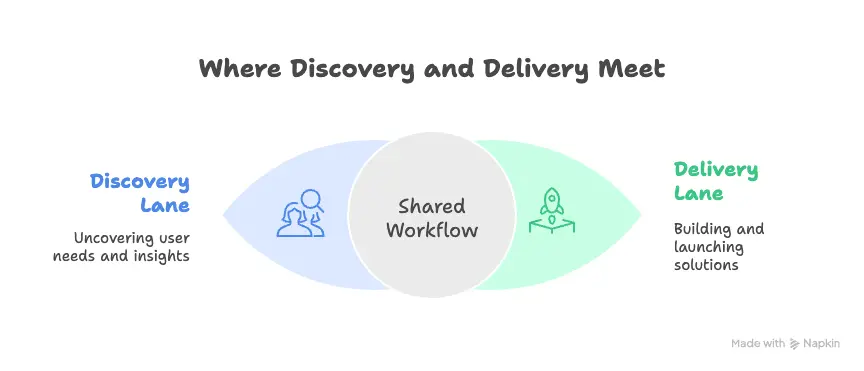
Modern discovery works best when paired with delivery. While delivery teams ship product increments, discovery teams clarify opportunities, validate ideas, and prepare solutions that have evidence behind them. This dual track approach helps teams work faster without losing strategic direction.
What challenges do teams face in product discovery?
Most discovery problems come from missing structure rather than missing effort. Without a clear approach, discovery becomes scattered activity that rarely produces an actionable insight. The most common failure is jumping to solutions: a team hears a request, sees a pattern, and starts designing before anyone has confirmed the problem is real.
Many teams struggle with product discovery because they lack structure. Without a clear approach, discovery becomes a collection of scattered activities that rarely lead to actionable insights.
One common issue is jumping to solutions too early. Teams hear a customer request or observe a pattern and immediately think in features. This bypasses the deeper work of understanding the underlying problem. Another challenge is relying on assumptions without testing them. Teams often believe they already know what customers need, but those beliefs go unchallenged.
Interviews are another area where teams face difficulty. Poorly structured interviews generate noise instead of insight. Leading questions, biased interpretation, and talking too much instead of listening all reduce the quality of the data.
Cross functional alignment also plays a large role. Without shared understanding, teams misinterpret findings, prioritize different outcomes, or lose momentum. Discovery becomes disconnected from strategic plans, which leads to inconsistent decision making.
All of these challenges point to one root issue: the absence of a structured product discovery framework.
What are the six stages of the discovery framework?
The framework runs six stages, each with defined inputs and outputs so a team can tell when a stage is finished. It begins with Align, which establishes why the discovery is happening, what decision it serves, and who needs to agree with the answer before any research starts.
This framework covers six stages that guide teams from initial alignment to final decision making. Each stage includes clear inputs and outputs to help teams move forward with confidence.
Stage 1: Align
The first stage creates shared understanding. The team clarifies why they are doing discovery, what the target segment is, and what success looks like. This alignment brings focus and creates a boundary around the work.
This stage often includes defining the problem space, agreeing on strategic constraints, and identifying early assumptions. A simple alignment document acts as the foundation for the rest of the process.
Stage 2: Explore
The exploration stage involves gathering insights from customers, business data, and market signals. Teams conduct interviews, observe workflows, analyze patterns, and identify unanswered questions.
The objective is to uncover opportunities, not to validate solutions. Teams focus on understanding the full landscape of customer jobs, pain points, motivations, and behaviors. Exploration brings raw insight that later becomes structured.
The main output is an opportunity backlog that lists observable problems and needs.
Stage 3: Frame
Framing is where raw insight becomes structured understanding. Teams cluster patterns, identify root causes, and begin organizing opportunities in a way that makes them actionable.
The opportunity solution tree is a powerful tool in this stage. It helps teams connect strategic outcomes to opportunities and potential solutions. By visualizing relationships, teams can see where the most meaningful opportunities lie.
The output is a set of well framed opportunity areas, each backed by evidence.
Stage 4: Prioritize
At this stage, teams prioritize opportunities based on impact, risk, effort, and strategic alignment. Opportunity sizing helps determine which areas deserve attention first.
A risk based approach works well. Teams evaluate each opportunity through value risk, usability risk, feasibility risk, and viability risk. High risk areas often require earlier validation. Low risk, high impact opportunities often move forward faster.
The output is a prioritized list of opportunities with clear rationale.
Stage 5: Validate
Validation turns assumptions into evidence. Teams identify their riskiest assumptions, map them using an assumption matrix, and choose the right experiments to test them. Experiments may include prototype tests, demand tests, surveys, wizard of oz experiments, or simple conversations that target behavioral evidence.
The goal is not to prove ideas. It is to learn whether assumptions hold up. Successful validation reduces risk and builds confidence that a solution is worth building.
This stage ends with a clear summary of what was learned and what remains uncertain.
Stage 6: Decide
Once assumptions are validated, teams move into decision making. This involves reviewing evidence, evaluating tradeoffs, and selecting which opportunities should move into delivery. Decisions should be documented to maintain clarity for future planning.
This stage also includes updating the roadmap, communicating outcomes to stakeholders, and ensuring that decisions stay aligned with product strategy.
The output is a discovery summary and a clear set of decisions ready for delivery planning.
Which discovery tools and techniques work best?
Good discovery leans on tools that improve clarity, reduce bias and keep decisions structured. They do not replace thinking. Opportunity solution trees move a team from an outcome to the opportunities beneath it and then to candidate solutions, which keeps the reasoning visible instead of leaving it in one person’s head.
Strong discovery relies on tools that improve clarity, reduce bias, and support structured decisions. These tools are not replacements for thinking, but they help teams work with more rigor.
Opportunity solution trees help teams move from outcomes to opportunities and potential solutions in a structured way. They clarify thinking and make prioritization easier.
Assumption mapping helps teams identify what must be true for an idea to succeed. By plotting assumptions on a grid according to importance and certainty, teams can decide which assumptions to validate first.
JTBD interviews uncover deep motivations and contextual factors that surface real problems. They focus on why people behave the way they do rather than what they say they want.
Experiment ladders help teams choose the simplest, fastest way to validate assumptions. They reduce the pressure to build fully featured prototypes and encourage learning through small tests.
These tools make discovery predictable and repeatable.
How do you integrate discovery into a weekly workflow?
Discovery works when it becomes a habit rather than a project. Small, frequent activity produces more insight than a large discovery effort run twice a year. Weekly interviews keep the team close to customer reality, and a short synthesis session every two weeks turns raw conversations into an updated opportunity map. The interview craft itself is covered in this customer discovery guide.
Discovery works best when it becomes a habit. Small, frequent activities deliver more insight than large discovery projects that happen a few times a year.
Weekly interviews keep teams close to customer reality. Biweekly synthesis sessions help teams refine insights and update their opportunity maps. Short discovery standups give cross functional teams visibility into ongoing learning and upcoming tests.
Aligning discovery with delivery cycles prevents discovery from slowing the team down. Designers and engineers should be involved early in the process to help shape experiments, clarify constraints, and reduce feasibility risk.
By building discovery rituals into the team’s weekly schedule, learning becomes continuous and decisions improve over time.
What does product discovery look like in practice?
A worked example makes the sequence concrete. A SaaS team sees users dropping off in the first session without knowing why. Alignment sets the goal as improving activation for first-time users. The team then names its assumptions about how users understand the workflow and tests the riskiest one before designing anything.
Imagine a SaaS team focused on improving onboarding. They notice that many users drop off within the first session, but they do not know why.
During alignment, the team agrees that the goal is to improve activation among first time users. They identify assumptions about users understanding the workflow, the value proposition, and the first key action.
During exploration, they interview new users who struggled with onboarding. They learn that many users cannot find the main feature they need and that the interface feels overwhelming.
During framing, they map an opportunity solution tree. They identify two high potential opportunities. One is related to guiding users to the first meaningful action and the other is simplifying the initial screen.
During prioritization, they evaluate each opportunity by risk and impact. The guidance issue scores higher because it directly affects activation.
During validation, they test the assumption that users will follow a guided setup flow. A simple prototype shows strong engagement. A second experiment tests whether tooltips are enough. They are not.
During decision making, the team moves forward with planning a guided setup flow. They document what was validated and include the opportunity in the next quarterly roadmap.
This example shows how a structured discovery framework leads to clear decisions backed by evidence.
How do you choose the right framework for your company?
The right framework depends on team maturity, available resources and product complexity. Early-stage startups do better with something lightweight: interviews, assumption mapping and quick experiments, aimed at finding traction without overengineering the process. Growth-stage teams need more structure because more people now depend on the same decisions being legible.
Choosing the right framework depends on team maturity, resources, and product complexity. Early stage startups often benefit from lightweight frameworks that focus on interviews, assumption mapping, and quick experiments. Their goal is to find traction without overengineering the process.
Growth stage SaaS companies benefit from more structured frameworks like opportunity solution trees and continuous discovery habits. These help teams prioritize across a larger set of opportunities while aligning with strategy.
Enterprise teams often need more formal processes. They benefit from clear alignment documents, governance structures, and cross functional rituals.
Regardless of company size, the best framework is the one that the team can apply consistently. A simple, repeatable process often outperforms a complex framework that no one follows.
What are the common discovery mistakes and how do you avoid them?
The costliest discovery mistakes are social rather than technical. Teams accept verbal confirmation as evidence, ask leading questions, talk only to the users who reply fastest, and treat a single enthusiastic call as a signal. Each one produces confident conclusions built on what people said rather than what they did. The structural version of the same problem is why discovery dies after product-market fit.
“The cheapest experiment is the one that stops you building something nobody actually asked for.”
Sivan Kadosh, Fractional CPO
The “nice user” trap: Why users unintentionally lie
One of the costliest mistakes I see product teams make, both in professional discussions and with the clients I mentor, is relying on verbal confirmation. In forums like Reddit, product managers painfully describe building entire features simply because users said in interviews, “That sounds amazing, I would definitely use that.” But when launch day arrives? Crickets.
This phenomenon is rooted in what behavioral psychology calls the Intention-Behavior Gap. As usability experts at NN/g note, users often want to be polite, or they genuinely believe in an “ideal version” of themselves that would use your product. To avoid this, your framework must include “Skin in the Game” tests. Don’t ask, “Would you use this?” Instead, ask them to make a commitment that requires a small sacrifice right now: giving their email address, committing 30 minutes for a follow-up, or even placing a nominal deposit (a Fake Door Test). If they aren’t willing to “pay” with their time or personal data during discovery, they certainly won’t pay with money at launch.
Biased Interviews and Lack of Synthesis
Beyond the “nice user” trap, one of the most common mistakes is running biased interviews. When teams ask leading questions or try to validate their own ideas, they distort the data. A better approach is to ask open questions, observe behavior, and avoid selling solutions.
Another mistake is confusing feedback with evidence. Comments from customers can be useful, but they do not always indicate demand. Validation requires testing behaviors, not opinions.
Teams also skip synthesis. Without proper synthesis, insights remain scattered and do not translate into opportunities. Effective synthesis transforms data into structured understanding.
Finally, jumping straight to solutions is a widespread issue. Teams feel pressure to ship fast and confuse speed with progress. Good discovery slows down the beginning of the process to accelerate the outcome.
How does discovery connect to strategy and roadmapping?
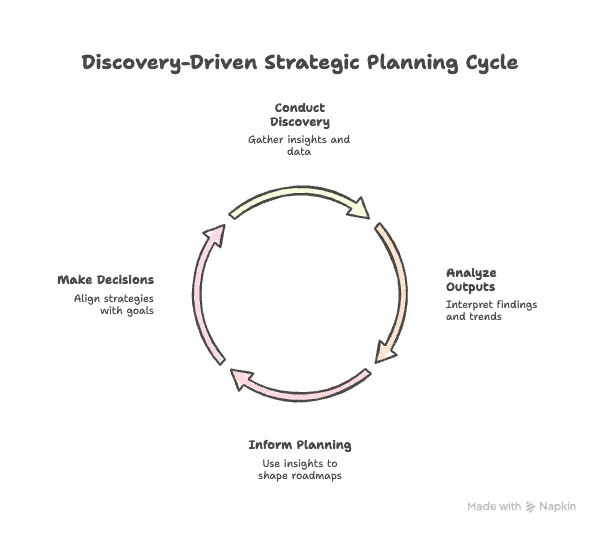
Discovery feeds strategy by showing which opportunities carry the highest potential impact. When those insights reach planning directly, the roadmap narrows to problems that matter and each item can be traced back to evidence. Validated opportunities also make it easier to say no, which is most of what a roadmap does.
Discovery shapes product strategy by identifying which opportunities have the highest potential impact. When discovery insights feed directly into planning, roadmaps become more focused and meaningful.
Validated opportunities help teams make informed choices. They clarify which customer problems matter most, which solutions create value, and where to invest resources.
Discovery also creates a defensible rationale behind roadmap decisions. This helps align stakeholders, reduce debate, and focus the team on outcomes rather than output.
When discovery and strategy work together, teams build products with clarity and confidence.
How can a fractional CPO support your discovery practice?
Plenty of teams have the enthusiasm for discovery and lack the structure, templates and experience to run it with discipline. A fractional CPO installs the practice: the interview cadence, the synthesis rhythm, the decision records, and the standard for what counts as validated, then hands it over rather than holding it.
Many teams struggle to run product discovery with discipline. They may have enthusiasm, but lack the structure, templates, and experience needed to run the process effectively. A fractional CPO brings the rigor and clarity required to build a strong discovery practice.
A fractional CPO sets up discovery frameworks, facilitates alignment, builds rituals, and helps teams make evidence based decisions. They reduce product risk, improve prioritization, and create alignment across stakeholders. Most importantly, they help teams avoid wasting time and money on solutions that do not matter.
If your team wants to implement a modern product discovery framework or needs guidance on how discovery connects to your strategy and roadmap, a fractional CPO can provide the leadership needed to accelerate progress.
Discovery running on enthusiasm rather than structure?
Get a senior, ex-CPO read on your biggest product bottleneck in 30 focused minutes. No pitch, no obligation.
Book a Product Strategy SessionFAQs
Running effective product discovery requires dedicated PM effort. Companies without that capacity can bring in a fractional product manager to lead the discovery process.
I do this work inside B2B SaaS product teams. Knowing the model is one thing. Someone has to own it every week.
See how product management consulting works →What is a product discovery framework and why do teams need one?
A product discovery framework is a structured process that helps teams understand customer problems, identify opportunities, and validate assumptions before building solutions. Teams need a framework because it reduces guesswork, creates alignment, and ensures ideas are backed by evidence instead of opinions. A strong framework helps teams focus on meaningful problems and make decisions with confidence.
How does product discovery reduce product risk?
Product discovery reduces risk by forcing teams to test assumptions early. It reveals which problems matter, which behaviors are real, and which solutions have potential. By exploring opportunities, validating patterns, and running experiments, teams uncover value, usability, feasibility, and viability risks long before development begins. This saves time and prevents building features that fail to deliver impact.
What steps should a product discovery process include?
A complete discovery process includes alignment, exploration, framing, prioritization, validation, and decision making. Alignment creates shared goals and a clear problem space. Exploration gathers insights from customers and data. Framing organizes insights into structured opportunities. Prioritization identifies where to focus. Validation tests assumptions through experiments. Decision making determines which opportunities move into delivery based on evidence.
How does product discovery differ from product delivery
Product discovery focuses on learning, while product delivery focuses on building. Discovery helps teams understand problems, explore opportunities, and validate ideas. Delivery turns validated ideas into working product increments. Both run in parallel, but they serve different purposes. Discovery reduces uncertainty and guides decisions. Delivery executes those decisions with predictable output.
What tools or templates help with product discovery?
Useful discovery tools include opportunity solution trees, assumption maps, JTBD interview scripts, experiment ladders, problem framing canvases, and synthesis templates. These tools help teams clarify thinking, surface risks, and structure their work. They create transparency across teams and make discovery more consistent and repeatable.
How often should teams run product discovery?
Discovery should happen continuously rather than in occasional project phases. Weekly interviews, regular synthesis sessions, and ongoing experiments help teams stay close to customer needs. Continuous discovery supports better decisions and ensures teams respond to changing behavior, competitive shifts, and new opportunities.
What are common mistakes teams make during product discovery?
Common mistakes include jumping to solutions too quickly, asking leading questions in interviews, relying on opinions instead of behavioral evidence, skipping synthesis, and treating feedback as proof of demand. Another frequent error is running discovery as a one time project instead of a continuous practice. These mistakes lead to poor decisions and weak product outcomes.
How do you validate assumptions during discovery?
Teams validate assumptions by identifying what must be true for a solution to work and designing experiments that test those assumptions quickly. This may include prototype tests, demand tests, interviews focused on behavior, or small controlled experiments. The goal is to learn whether an assumption holds up in real conditions before investing in development.
What clients say
Read all 18 references“As a product manager, I can say that Sivan is very professional – always looking deeply on the discussed feature to understand end to end its effect on the whole product, and as well the eager to understand what would be the added value to the strategy of the company. Nothing was added without a clear scope of development, a clear understanding of the business owner and a clear way to measure the success or failure of this feature.”
“Leading by example, empowering, mentoring, and growing his product teams, he created great product culture and set us Product Managers up for success. His vision and strategic direction enabled us to create successful products that brought millions of dollars of revenue to the company and its clients.”
“As part of his role as VP Product, he identified creative ideas, developed sharp strategies and built the road map while focusing on customer experience and business needs.”
