
A SaaS monetization strategy decides how the money you charge tracks the value customers actually get. It covers the pricing model, the packaging and the metric you bill on, and getting the metric wrong is what caps growth long before the product does.
I have hired product people, and I have been one. If the title is unclear, the problem is usually the decision no one owns.
See what a monetization PM owns →A SaaS monetization strategy defines how a company captures revenue from the value its product creates. It includes pricing models, packaging structure, expansion opportunities, and lifecycle design. Strong monetization strategies align price with customer outcomes and enable predictable, scalable growth.
Beyond seats: How breaking the pricing status quo drove 45% MRR growth
The seat model is the default because it is easy to explain, not because it fits. When the thing a customer values has nothing to do with how many people log in, per-seat pricing quietly caps the account and teaches customers to share credentials rather than buy more.
If you’ve reached this article, it means your product is making money congratulations! Now the question is, is it making enough money? Are you realizing your full profit potential? You probably know there are all kinds of pricing models (which I’ll review later in this article), so tell me why have 99% of the SaaS products I see gotten stuck on Seat-Based Pricing? For heaven’s sake, is this the best you could come up with? Is it a matter of a fixed mindset, laziness, or a lack of knowledge?
My claim is that if your product generates real value, combining several pricing models can work wonders for your profitability. Companies that meter on usage tend to grow faster than those locked into rigid per-seat pricing alone. It’s a shame to leave that kind of money on the table!
In one of the startups I mentor, a B2B company that developed an incredible automation tool for sales teams, they hit this exact wall. They were charging $99 per “seat.” What happened in practice? Companies simply shared passwords. Instead of the entire sales department using the system and becoming addicted to it, only one or two users did all the work for everyone else to save on costs. Customers felt penalized for adding users. Once we identified this, we broke the mold and switched to a hybrid model: a base Platform Fee that allows adding unlimited team members, plus Usage-Based pricing based on the number of deals closed through the system.
The result? Customers stopped being stingy about adding new users, and product adoption skyrocketed. This isn’t a fluke; pricing is one of the few levers that moves profitability without requiring a single new customer. In our case, the company’s MRR jumped by 45% within just two quarters! Customers felt they only paid when they gained, and the company stopped losing money on “hidden users.” This is exactly the difference between doing “copy-paste” from your competitors and building a monetization strategy that truly understands where the customer meets value.
What does a SaaS monetization strategy cover?
The whole system by which value turns into revenue: what you charge for, how you package it, and which unit the meter runs on. Pricing is only the visible surface. The billing metric underneath decides whether an account can grow without a renegotiation.
A SaaS monetization strategy describes how a company converts product value into recurring revenue. It includes decisions about pricing structure, packaging of features, expansion opportunities, and how customers progress through different pricing tiers over time.
Many people confuse monetization strategy with pricing alone. Pricing is only one part of the equation. Monetization also includes how value is packaged, how customers upgrade, and how revenue grows as customers increase product usage.
For example, two companies may charge the same monthly price but generate very different revenue outcomes depending on how easily customers expand their usage. A company that enables natural expansion through collaboration or increased usage often achieves stronger long term revenue performance than a company relying only on new customer acquisition.
Monetization strategy therefore shapes the relationship between product usage and revenue growth.
From my experience, teams often delay monetization decisions because they want to first build product traction. While this approach can work early on, monetization eventually influences product roadmap priorities. Understanding monetization early helps ensure the product evolves in a direction that supports sustainable growth.
Why does monetization determine growth?
Because monetization sets the ceiling that everything else works beneath. Acquisition can be improved and churn can be reduced, but a model that cannot capture more value as customers get more value will cap the business no matter how well the rest is executed.
“How you monetize influences which features you build, which customers you attract, and how sustainable your growth becomes.”
Sivan Kadosh, Fractional CPO
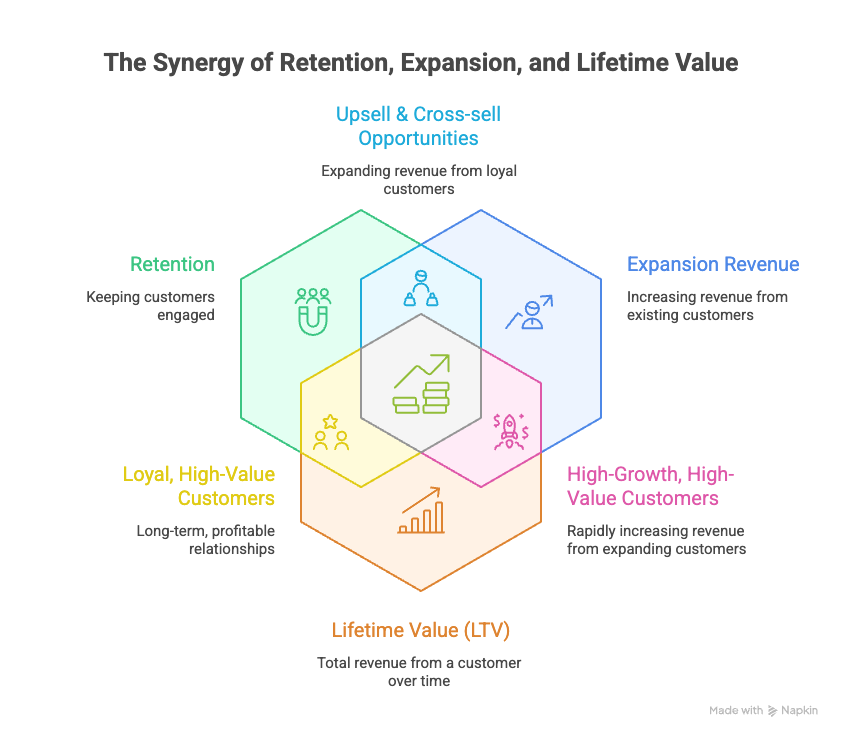
SaaS growth is cumulative. Revenue does not come only from new customers, but from existing customers continuing to use and expand their usage of the product.
Because of this dynamic, monetization strategy directly affects long term growth potential.
When pricing aligns with value creation, customers naturally expand their usage as they experience more benefits. Expansion revenue often becomes one of the most important drivers of SaaS growth.
Many high performing SaaS companies generate significant revenue increases from existing customers rather than relying exclusively on new acquisition.
Monetization strategy also influences capital efficiency. Companies with strong expansion revenue often recover acquisition costs faster, allowing reinvestment in growth initiatives.
From experience, monetization improvements often produce measurable results relatively quickly compared to large product initiatives. Adjusting packaging, clarifying value metrics, or simplifying pricing structure can significantly improve conversion and expansion.
Monetization strategy therefore influences both revenue trajectory and operational efficiency.
What are the core components?
A value metric, a packaging structure, a price point and an expansion path. The value metric is the one that matters most and gets the least attention, because it is the only component you cannot change quietly later once customers have built budgets around it.
Monetization strategies consist of several interconnected components that work together to capture value.
Pricing model
The pricing model defines how customers are charged. Common approaches include subscription pricing, usage based pricing, and hybrid structures.
The pricing model influences revenue predictability and scalability. Subscription models provide stable recurring revenue, while usage based models align revenue with product consumption.
Selecting the right pricing model depends on how customers derive value from the product.
Packaging strategy
Packaging defines how features are grouped into plans or tiers. Effective packaging helps different customer segments find plans that match their needs.
For example, smaller teams may require core functionality, while larger organizations may require integrations, customization, or advanced analytics.
Packaging also influences upgrade behavior. Clear differentiation between tiers encourages expansion.
From experience, packaging decisions often require balancing simplicity with flexibility. Too many options can create confusion, while too few options can limit expansion potential.
Value metric selection
Value metrics represent the unit through which customers experience value. Examples include number of users, amount of data processed, number of projects created, or number of transactions completed.
Strong value metrics scale with customer success. When customers achieve more value, revenue increases naturally.
Selecting the right value metric often requires understanding how customers measure success internally.
Expansion revenue design
Expansion revenue occurs when existing customers increase their usage, upgrade plans, or purchase additional capabilities.
Designing clear expansion paths helps customers grow naturally within the product.
Common expansion mechanisms include additional seats, advanced features, increased usage limits, or add-on modules.
Companies that design expansion intentionally often achieve stronger net revenue retention.
Customer segmentation
Different customer segments often have different needs and willingness to pay.
Segmentation allows companies to tailor pricing structures to different user types.
For example, early stage startups may prioritize affordability, while enterprise customers may prioritize scalability and reliability.
Understanding segmentation helps optimize both conversion and revenue potential.
Which monetization models are there?
Per seat, tiered, usage-based, and hybrids of those. Each encodes a different assumption about where value comes from, and the hybrid versions exist because most products create value in more than one way, which no single meter captures cleanly on its own.
Several monetization models are commonly used in SaaS.
Subscription revenue generates predictable recurring income and works well when product value is consistent over time.
Usage based revenue scales with consumption, making it suitable for products where value increases with activity.
Tiered monetization enables segmentation by grouping features into structured plans.
Freemium monetization reduces adoption friction by offering limited free access.
Transactional monetization charges per transaction or event, often used in marketplaces or payment platforms.
Platform monetization may include ecosystem revenue from integrations or third party services.
Each model has tradeoffs related to predictability, scalability, and complexity.
| Monetization model | Revenue driver | Typical use case |
|---|---|---|
| Subscription | recurring access fee | productivity tools |
| Usage based | consumption volume | infrastructure software |
| Tiered | feature differentiation | B2B SaaS platforms |
| Freemium | conversion to paid tiers | product led growth |
| Transactional | activity volume | marketplaces |
| Platform | ecosystem participation | developer platforms |
From experience, hybrid monetization models have become increasingly common as SaaS products expand functionality.
How do you choose the right model?
Ask what grows when the customer succeeds, and bill on that. If success means more people using it, seats are honest. If it means more work getting done, usage is. The wrong answer here is not a pricing mistake, it is a mismatch between your revenue and their outcome.
“The real challenge is identifying what customers truly care about and designing a model that scales with that value.”
Sivan Kadosh, Fractional CPO
Choosing a monetization strategy involves understanding how customers experience product value.
Identify the core value metric
The value metric should reflect how customers measure success when using the product.
For example, analytics platforms often scale pricing based on data volume because customers associate value with insight generation.
Collaboration tools often scale pricing based on number of users because value increases as more team members participate.
Choosing a value metric that aligns with customer success creates natural revenue expansion.
Understand willingness to pay
Different customer segments have different willingness to pay based on perceived impact.
Understanding customer priorities helps determine pricing structure.
For example, products that influence revenue generation often command higher willingness to pay than tools focused primarily on operational efficiency.
Align monetization with usage patterns
Products with frequent interaction often benefit from usage based pricing structures.
Products delivering consistent value may benefit from subscription pricing.
Understanding usage patterns helps determine appropriate pricing structure.
Evaluate expansion potential
Expansion revenue often represents a large share of SaaS growth.
Designing pricing structures that allow customers to expand gradually helps build long term relationships.
Expansion opportunities should feel natural rather than forced.
Balance simplicity and flexibility
Pricing simplicity improves conversion.
Pricing flexibility supports diverse customer needs.
Balancing these factors often requires iterative experimentation.
Our tip: Try out our free SaaS Pricing Impact Simulator and calculate the ROI of raising prices.
How monetization evolves as SaaS companies scale
Early on a single simple price beats a clever one, because the goal is to learn what people will pay for at all. As the base diversifies, one price stops fitting anyone well, and packaging becomes the tool for serving segments without running separate products.
Monetization strategies typically evolve as companies gain deeper understanding of customer behavior.
| Stage | Monetization focus | Objective |
|---|---|---|
| Early stage | adoption | reduce friction |
| Series A | pricing structure | improve conversion |
| Series B | expansion revenue | increase account value |
| Enterprise | optimization | maximize efficiency |
Early stage companies often prioritize simplicity to encourage adoption.
As companies scale, monetization becomes more sophisticated to reflect customer diversity.
From experience, many companies initially choose pricing models based on competitor benchmarking but later refine their approach after analyzing real usage patterns.
Monetization maturity often correlates with product maturity.
Which monetization metrics matter?
Average revenue per account, expansion revenue, net revenue retention and the share of customers hitting a plan ceiling. That last one is the early warning most teams do not track, and it is the clearest sign that the model is capping accounts that would happily pay more.
Metrics help evaluate monetization effectiveness.
| Metric | What it measures | Why it matters |
|---|---|---|
| ARPU | average revenue per user | monetization efficiency |
| LTV | lifetime value | long term revenue potential |
| NRR | net revenue retention | expansion strength |
| CAC payback | time to recover acquisition cost | capital efficiency |
Tracking these metrics helps identify whether monetization supports sustainable growth.
From experience, improving net revenue retention often produces stronger impact than increasing acquisition alone.
Companies with strong expansion revenue often achieve more predictable growth trajectories.
What goes wrong with monetization?
Discounting to win a deal and never repricing it. Building tiers around features the seller understands rather than outcomes the buyer wants. And leaving the value metric untouched for years while the product changes underneath it, until the two describe different businesses.
One frequent mistake is selecting pricing metrics that do not reflect how customers perceive value.
Another common issue is overcomplicating packaging, making it difficult for customers to choose appropriate plans.
Some companies focus heavily on acquisition pricing incentives while neglecting expansion design.
Others delay pricing adjustments even after customer behavior indicates opportunities for improvement.
Monetization strategy should evolve alongside product maturity.
Iterative experimentation helps identify optimal structures.
From experience, pricing changes do not always require major redesigns. Small adjustments to packaging or positioning can significantly improve conversion and expansion.
How monetization influences product strategy
What you charge for decides what gets built. A team billing on seats optimizes for adoption breadth; a team billing on usage optimizes for depth and throughput. The pricing model is therefore a roadmap input, not a finance decision taken after the roadmap is set.
Monetization decisions shape product strategy more directly than many teams initially expect. The way a company captures revenue often determines which features receive investment, how the roadmap evolves, and which customer segments become the primary focus. Pricing structure is not only a commercial choice, it also signals what kind of behavior the product should encourage.
For example, when revenue grows as more team members adopt the product, collaboration features tend to become strategically important. Product teams may prioritize permissions, sharing workflows, integrations, and multi user functionality because expanding usage within an account directly supports revenue growth. In contrast, when monetization scales with product activity or consumption, teams often focus on improving engagement frequency, performance reliability, and features that increase the depth of usage.
Monetization also influences how companies think about segmentation. A premium pricing structure often reflects a deliberate focus on higher value use cases, where customers expect advanced capabilities, reliability, and strong support. A freemium approach, on the other hand, usually indicates a strategy centered on broad adoption, where product design must quickly demonstrate value to a wide range of users with minimal friction.
From experience, monetization discussions frequently uncover deeper positioning questions. Teams begin asking whether the product is primarily designed for accessibility or for advanced use cases, whether differentiation comes from simplicity or from powerful functionality, and whether growth should come from volume or from account expansion. These strategic choices influence prioritization decisions across the product roadmap.
Over time, monetization and product strategy evolve together. As companies learn more about how customers derive value, they refine both pricing structure and product direction to better support sustainable growth.
When to involve a fractional CPO in monetization strategy
Monetization decisions require balancing multiple perspectives, including product, marketing, finance, and customer success.
A fractional Chief Product Officer helps connect monetization decisions with product strategy and long term growth objectives.
Fractional CPO support is particularly valuable when companies need to:
- identify appropriate value metrics
- align packaging with customer segments
- improve expansion revenue design
- evaluate pricing hypotheses
- connect monetization with roadmap priorities
Throughout many years of working in the SaaS landscape I’ve learned that monetization discussions often surface deeper strategic questions about differentiation and positioning.
Addressing these questions helps improve clarity across teams.
Design a monetization strategy that supports long term SaaS growth
Start from where value is created rather than from competitor price lists. Name the metric that grows with customer success, build packaging around it, and leave a deliberate path for accounts to spend more without a negotiation. Most monetization gains come from that path, not from raising prices.
Strong monetization strategies work best when customer success and company success move in the same direction. When pricing reflects the real value customers experience, revenue growth becomes a natural outcome of product adoption rather than a forced outcome of aggressive sales tactics. Companies that achieve this alignment often find that expansion feels intuitive to customers because increased usage directly translates into increased impact.
In practice, many SaaS companies initially design pricing around internal assumptions rather than observed customer behavior. Over time, patterns begin to emerge. Some features drive significant engagement but are not reflected in packaging. Some customer segments are willing to pay more for reliability, support, or scalability, yet pricing structure does not clearly communicate these differences. Monetization strategy becomes more effective once teams begin systematically analyzing how customers actually derive value from the product.
Well designed expansion paths play an important role in this process. Customers should be able to grow within the product without feeling pressured into unnecessary upgrades. Expansion works best when additional investment clearly unlocks meaningful benefits, such as improved efficiency, deeper insights, or stronger collaboration capabilities. When expansion feels like a logical next step in the customer journey, revenue growth becomes more predictable and sustainable.
From my experience working with SaaS leadership teams, monetization improvements rarely require dramatic structural changes. Often, the biggest gains come from clarifying packaging, aligning pricing metrics with real usage patterns, or simplifying how plans communicate value. Small adjustments can significantly improve both conversion and expansion when they reflect how customers actually use the product.
This is where structured product leadership becomes particularly valuable. A part-time product leader helps companies evaluate monetization through the lens of product strategy, ensuring pricing decisions support long term positioning rather than short term revenue experiments. By connecting monetization with roadmap priorities, customer segmentation, and lifecycle design, fractional CPO support helps create revenue models that scale with product success.
Effective monetization is rarely about adding more pricing tiers or introducing more complexity. It is about creating a clear relationship between the value customers receive and the way the company captures revenue. When this relationship is well designed, monetization becomes a growth enabler rather than a friction point.
Customers sharing logins instead of buying seats?
Get a senior, ex-CPO read on your biggest product bottleneck in 30 focused minutes. No pitch, no obligation.
Book a strategy callKey takeaways
- SaaS monetization strategy connects product value with revenue growth.
- Strong monetization models support expansion revenue and retention.
- Pricing models, packaging, and value metrics work together to capture value.
- Monetization evolves as companies scale and learn more about customers.
- Strategic product leadership helps align monetization with long term growth objectives.
I have hired product people, and I have been one. Whichever title you pick, someone has to carry the decision.
See what a monetization PM owns →FAQs
What is SaaS monetization strategy?
A SaaS monetization strategy defines how a company generates revenue from its product through pricing models, packaging decisions, and expansion opportunities.
What is the best monetization strategy for SaaS?
The best monetization strategy aligns pricing with customer value and supports long term expansion revenue.
How do SaaS companies increase revenue per customer?
Revenue per customer often increases through upselling higher tier plans, expanding usage, or offering additional product capabilities.
What is expansion revenue in SaaS?
Expansion revenue refers to additional revenue generated from existing customers as they increase usage or upgrade plans.
How often should SaaS monetization strategy change?
Monetization strategy should evolve as companies gain insights into customer behavior and product value delivery.
What clients say
Read all 18 references“As a product manager, I can say that Sivan is very professional – always looking deeply on the discussed feature to understand end to end its effect on the whole product, and as well the eager to understand what would be the added value to the strategy of the company. Nothing was added without a clear scope of development, a clear understanding of the business owner and a clear way to measure the success or failure of this feature.”
“Leading by example, empowering, mentoring, and growing his product teams, he created great product culture and set us Product Managers up for success. His vision and strategic direction enabled us to create successful products that brought millions of dollars of revenue to the company and its clients.”
“As part of his role as VP Product, he identified creative ideas, developed sharp strategies and built the road map while focusing on customer experience and business needs.”