
Reducing churn is the highest-leverage move in SaaS because every gain compounds. Measure gross and net revenue churn first, then fix the drivers: weak onboarding and activation, missing value realization, thin support, and pricing or fit mismatches. Retention beats acquisition on cost and predictability.
I do this work inside B2B SaaS product teams. If your team ships every week and the numbers barely move, this is where I start.
See how product management consulting works →Customer churn quietly kills growth. You feel it in slower ARR, unpredictable renewals, and constant pressure to fill the top of the funnel just to stay in the same place. Reducing churn is one of the highest leverage things a SaaS company can do, because every improvement compounds over time. When retention improves, LTV increases, CAC payback shrinks, and your entire business becomes more predictable.
This guide gives you a complete and practical approach to understanding churn, predicting it before it happens, and reducing it with strategies that work across product, customer success, and monetization. You will also see where churn benchmarks differ across SaaS models and how to build a retention strategy that fits your specific business. The SaaS Growth Ceiling Calculator shows the ARR ceiling your current churn rate imposes.
Key takeaways
- Churn is not one number. It varies by model, pricing strategy, and customer segment.
- Reducing churn depends on understanding early warning signals, not just reacting to cancellations.
- Product experience, onboarding quality, customer success habits, and pricing work together to drive retention.
- Small improvements create outsized impact on LTV and growth trajectory.
- A structured retention strategy reduces pressure on acquisition and helps teams scale more predictably.
- A senior product leader can accelerate progress by fixing product strategy gaps, onboarding issues, and misaligned pricing.
The uncomfortable truth: Is your churn actually a broken Product-Market-Fit?
Every junior Product Manager knows that churn is an outcome. But an outcome of what? The initial instinct is to look for the immediate culprits: Is it bad UI? Is the UX clunky? Is the pricing too high?
There are countless reasons users stop paying, but when I sit down with founders and product leaders, I often put one reason on the table that they do not want to hear: Perhaps your users are simply no longer willing to pay for the value your product provides.
When I present this conclusion, I see the surprise on their faces. “How did we not think of this?” They were too busy shipping features and forgot the essence. Let’s go one level deeper. If users are not willing to exchange money for the value they receive, there is a painful professional term for this problem: A broken Product-Market Fit.
As Reforge emphasizes, retention is the ultimate proof of Product-Market Fit. If the curve drops, the fit isn’t there. While it varies by product and audience, my first piece of advice in these situations aligns with the Y Combinator philosophy: Stop everything and start doing things that don’t scale, talk to your customers.
Do not write another line of code before you pick up the phone:
- Talk to those who left.
- Talk to those who stay and pay.
This is the only key to understanding what shifted. It is exactly the process used by the CEO of Superhuman, who built an engine for finding Product-Market Fit based on user feedback to make the product indispensable. Once you speak with a critical mass of customers, a recurring pattern suddenly emerges. And the moment that pattern is revealed: the solution to your churn problem becomes much simpler and far more focused.
However, even if the root cause is strategic, you still need to measure the symptoms accurately to track your progress. Let’s start by defining exactly what we are trying to fix.
What is churn and why does it matter?
Churn measures the customers or the revenue you lose over a defined period. Teams track customer churn, revenue churn, and the difference between gross and net. It matters because it sets the ceiling on growth: every point of churn is revenue the acquisition engine has to replace before it adds anything.
“Customer churn quietly kills growth. You feel it in slower ARR, unpredictable renewals, and constant pressure to fill the top of the funnel just to stay in the same place.”
Sivan Kadosh, Fractional CPO
Churn measures the customers or revenue you lose over a defined period. Most teams track:
- Customer churn rate
- Revenue churn rate
- Gross churn vs net churn
There are also different forms of churn. Some customers leave by choice. Others churn because of payment failures. The reasons matter, because the interventions differ.
High churn puts pressure on every part of your business. CAC rises, payback lengthens, expansion becomes less predictable, and growth slows even when acquisition improves. A healthy SaaS business grows because customers stay, use the product deeply, and eventually expand.
How do churn benchmarks differ by SaaS model?
There is no universal good churn rate, and comparing against the wrong category produces false confidence. Freemium and self-serve products carry higher churn because switching is easy. SMB tools sit in the middle. Enterprise contracts churn far less but lose far more when they do.
There is no universal good churn rate. Benchmarks depend on the type of SaaS you operate. Comparing yourself to the wrong category can lead to false assumptions.
Freemium and self serve products
These models often experience higher churn because users commit less and can switch tools quickly. Healthy companies in this category focus heavily on activation and early product adoption.
Usage based pricing models
Churn behaves differently here. Customers might stay subscribed but reduce usage, which reduces revenue without leaving entirely. Revenue churn matters more than logo churn. Benchmarks vary widely by industry.
SMB focused SaaS
Churn is usually higher in SMB markets because businesses close more often, budgets change quickly, and switching costs are lower. Accept a slightly higher baseline but compensate through strong onboarding and frequent value reinforcement.
Mid market and enterprise SaaS
Enterprise customers churn less but take longer to acquire. Renewal processes, multi stakeholder value, and contract structures play a significant role.
| SaaS Model | Typical Churn Characteristics | What Matters Most |
|---|---|---|
| Freemium and Self Serve | Higher churn because users commit less and switch tools quickly | Strong activation, early adoption, rapid value delivery |
| Usage Based Pricing | Customers may stay subscribed but reduce usage which reduces revenue | Revenue churn and usage depth instead of logo churn |
| SMB Focused SaaS | Higher natural churn due to business volatility and low switching costs | Onboarding quality and frequent reinforcement of value |
| Mid Market SaaS | Lower churn than SMB because of more stable budgets and processes | Adoption across teams, clear ROI, strong product stickiness |
| Enterprise SaaS | Lowest churn but long acquisition and structured renewal cycles | Multi stakeholder value, contract structure, strong renewal processes |
Why do customers actually leave?
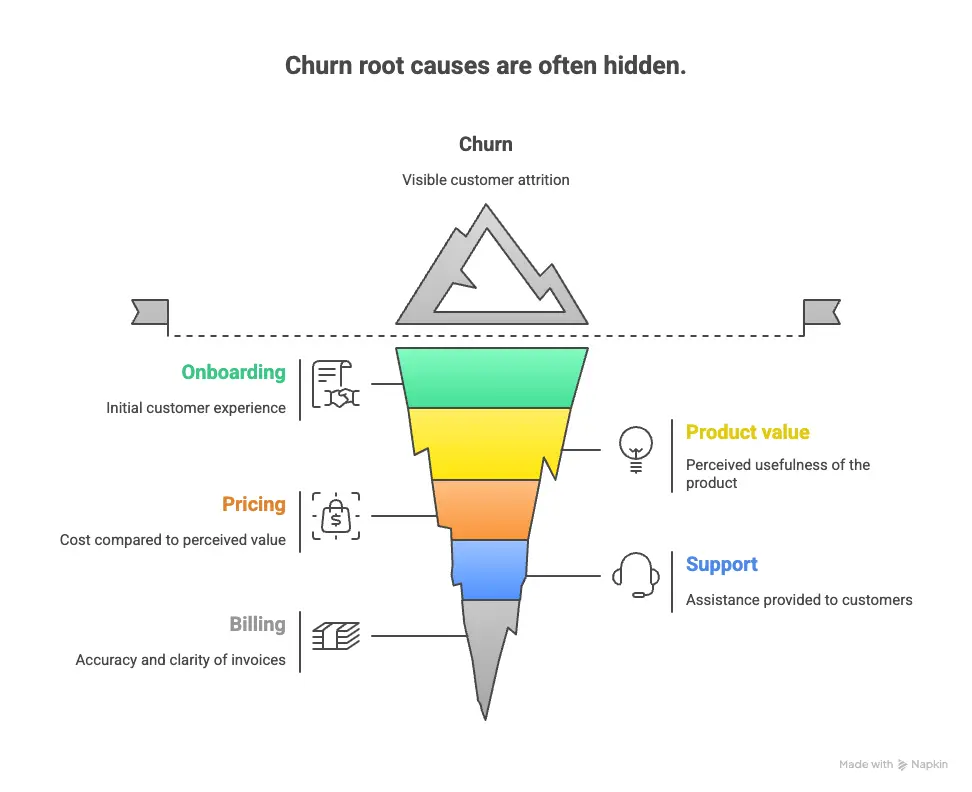
Churn is rarely one reason, and it usually starts long before the cancellation is visible. The recurring causes are onboarding that never reached value, a product that solved a smaller problem than the buyer expected, support that answered slowly, and pricing that stopped matching what the customer got.
Churn is rarely caused by a single reason. It usually begins much earlier in the user journey and becomes visible only when the cancellation happens. Here are the most common reasons customers churn in SaaS: The pattern behind that timing is set out in why churn spikes after early growth.
Onboarding friction and low activation
If customers do not reach their first moment of value early enough, they drift, disengage, and eventually cancel. Poor onboarding is one of the strongest predictors of early churn.
Missing or weak product value
When the core product does not deliver meaningful outcomes, users stop using it long before they cancel. Sometimes this is due to feature gaps. Sometimes the positioning attracts users who are not the right fit.
Pricing misalignment
Plans that confuse users, feel too expensive, or fail to match the value delivered often cause preventable churn. Pricing and packaging can create friction in both upgrades and renewals.
Inconsistent customer success motion
Reactive support, long response times, and a lack of proactive outreach leave customers feeling unnoticed. Most at risk customers show signs long before they churn.
Billing failures
Involuntary churn often accounts for a surprisingly high percentage of lost customers. Expired cards, insufficient funds, and weak retry logic create silent revenue losses.
Which behaviors signal churn before it happens?
High-performing teams do not wait for cancellations. They watch for a drop in weekly or monthly active use, a decline in the actions that correlate with value, support tickets that go quiet rather than resolve, and renewal conversations that get postponed. Each is visible weeks before the decision.
High performing SaaS teams do not wait for cancellations. They monitor behaviors and signals that reliably predict churn and act early.
Behavioral warning signs
- Drop in weekly or monthly active use
- Decline in usage of key features
- Fewer team members logging in
- Reduced time spent in the product
- Abandoned onboarding flows
Support and sentiment signals
- Spike in support tickets
- Increased complaint patterns
- Low or falling NPS
- Quiet customers who stop engaging
Financial and renewal signals
- Reduced seat usage
- Requests for discounts
- Downgrade attempts
- Slower invoice payments
How to build a simple churn prediction model
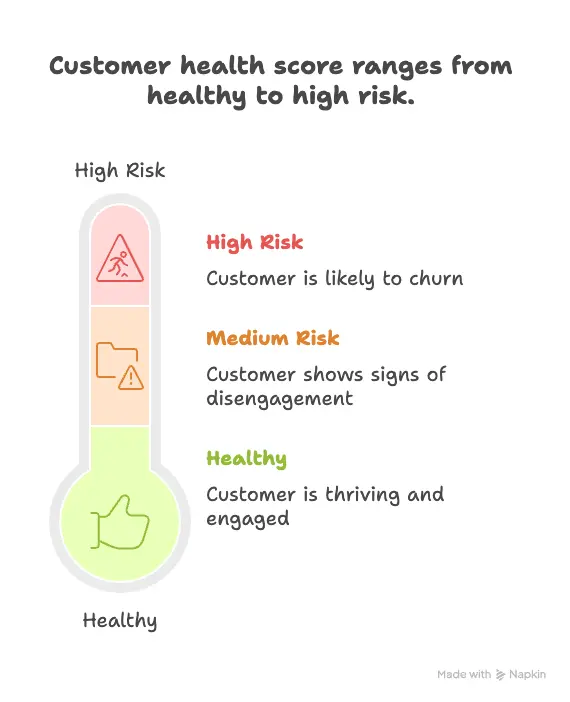
You do not need complex machine learning to predict churn. Start with a weighted scoring system that combines behavioral indicators, sentiment data, and financial triggers. Assign points to each signal and classify accounts into low, medium, or high risk.
Which retention levers work first?
Onboarding comes first, because fast activation is the strongest retention lever there is. Then make the core value obvious rather than discoverable. Then build the customer-success habits that catch problems early. These work across company sizes, and none of them requires a pricing change to start.
This is where retention becomes concrete. These strategies work across company sizes and industries.
Improve onboarding and reduce time to value
Fast activation is one of the strongest retention levers. Make it easier for users to complete essential steps. Use contextual in app guidance, checklists, and short walkthroughs. Personalize onboarding for different segments whenever possible.
Increase usage of core features
Every SaaS has a set of behaviors that signal long term retention. Identify your stickiness metrics, measure them weekly, and nudge users toward those behaviors through prompts and reminders.
Build a proactive customer success motion
Do not wait for customers to reach out. Use regular check ins, health score reviews, and proactive help to stay ahead of potential issues. Customer success should own renewal readiness, not only post sales support.
Fix pricing and packaging constraints
Confusing plans and pricing friction cause unnecessary churn. Simplify tier differences, make upgrade paths clear, and offer annual plans to increase retention. Consider a pricing review if you see high downgrade activity.
Reduce involuntary churn
Strengthen your billing logic. Add smart retry schedules, notify customers about upcoming card expirations, and allow pausing subscriptions instead of canceling. Small fixes often save significant revenue.
Improve support quality
Customers stay longer when support feels reliable and quick. Invest in faster response times, better documentation, and self service resources. Clear answers reduce frustration and help users adopt the product more effectively.
How do you analyze and segment churn?
Not all churn is equal, and averaging it hides where the loss actually sits. Use cohort analysis by signup month, plan and usage level. Separate voluntary cancellation from failed payments. Then look at which segment leaves fastest, because that is where effort returns the most.
Not all churn is equal. Analyzing it correctly helps teams focus effort where it matters. Here are my top tips:
Use cohort analysis to understand patterns
Look at retention cohorts by signup month, plan, and usage levels. This reveals where drop offs happen and which segments need intervention.
Segment by behavior and industry
Customers behave differently based on how they use your product. Track churn across industries, use cases, and activity patterns to identify who stays and who struggles.
Identify high value churn
Large customers with low usage need immediate attention. Not all churn carries the same revenue risk. Focus first on high ARR customers who show early warning signals.
How does churn affect growth economics?
Retention is a financial engine rather than a support metric. A lower churn rate lengthens the average customer lifespan, which raises lifetime value, which changes what you can afford to spend on acquisition. Small improvements compound, which is why churn work outperforms most growth spending.
“Retention beats acquisition on both cost and predictability, and it is the only growth lever that compounds.”
Sivan Kadosh, Fractional CPO
Retention is a financial engine. Even a small improvement in churn produces a large impact on long term revenue.
How churn influences LTV
A lower churn rate increases the average lifespan of a customer. This increases LTV, which makes acquisition more efficient and improves payback period.
How churn affects growth trajectory
Companies with high churn must grow acquisition at an unrealistic pace. Lower churn unlocks sustainable growth, stronger margins, and more predictable forecasting.
Why retention compounds
If you improve churn by two percent per month, that impact compounds across the entire customer base over time. Retention improvements rise exponentially, not linearly.
| Monthly Churn Rate | Average Customer Lifespan (Months) | Resulting LTV (Assuming $100 Monthly Revenue) |
|---|---|---|
| 1 percent | ~100 months | $10,000 |
| 2 percent | ~50 months | $5,000 |
| 3 percent | ~33 months | $3,300 |
| 5 percent | ~20 months | $2,000 |
| 8 percent | ~12 months | $1,200 |
| 10 percent | ~10 months | $1,000 |
How do you make the organization retention driven?
Reducing churn is not one team’s job. It needs product, customer success, growth and revenue aligned on a shared retention goal rather than four separate ones. That means one definition of the metric, one owner accountable for it, and a review cadence where the number is actually looked at.
Reducing churn is not the responsibility of one team. It requires alignment across product, customer success, growth, and revenue.
1. Align product, customer success, and growth
Retention should be a shared goal. Teams must look at the same dashboards and work on the same priorities. A shared understanding of what drives value helps reduce silos and improve execution.
2. Prioritize retention features on the roadmap
Features that strengthen onboarding, increase product adoption, or simplify the customer experience often have higher ROI than new features. Tie roadmap priorities to retention metrics.
3. Create reliable feedback loops
Collect feedback through NPS, churn interviews, and renewal conversations. Feed this into product decisions and improvements. Focus on repeatable patterns instead of isolated complaints.
What advanced retention strategies come next?
These apply once the basics hold. Predictive modeling scores users on churn risk from historical behavior so intervention happens before the decision. Beyond that, lifecycle messaging tied to real usage, and pricing or packaging changes aimed at the segment that leaves fastest rather than at everyone.
These approaches apply when the basics are already in place and you want to deepen your retention strategy.
1. Predictive modeling for churn risk
Use historical data to score users based on likely churn risk. Even simple models improve how teams prioritize outreach and resources.
2. Personalized engagement based on behavior
Trigger emails, tips, and in app prompts based on user behavior. Tailor guidance to push users into healthy adoption patterns and remind them of missed steps.
3. Optimize usage based pricing
Usage based models can reduce churn because customers scale down instead of canceling. Use pricing data to understand drop offs and optimize thresholds.
What does this look like in practice?
A freemium product with high early churn usually needs faster time to value, clearer onboarding and users guided toward core features sooner. An enterprise product with renewal churn needs different work: stakeholder coverage, demonstrated outcomes, and a renewal conversation that starts long before the date.
Freemium SaaS with high early churn: The solution often lies in faster time to value, clearer onboarding, and guiding users toward core features sooner.
Enterprise SaaS with renewal churn: Focus shifts toward multi stakeholder value, renewal readiness, account mapping, and regular executive business reviews.
SaaS with onboarding drop offs: Measure activation steps, simplify flows, and refine messaging for clarity. Introduce guided steps for high friction areas.
SaaS with billing related churn: Implement strong retry logic, automated card expiration reminders, and account pausing options.
Checklist for reducing churn in SaaS
- Improve onboarding and activation
- Identify core features and encourage usage
- Build strong customer success habits
- Analyze churn by cohort and behavior
- Strengthen support quality
- Review pricing and plan clarity
- Improve billing logic
- Create customer feedback loops
- Build retention into product decisions
- Monitor early warning signals
When should you bring in a fractional CPO?
Some churn problems point at deeper product or organizational issues rather than at a fixable feature. When retention stalls despite the obvious levers, or when nobody owns the metric across teams, a fractional CPO brings senior product judgment to that diagnosis without a full-time executive cost.
Some churn problems point directly to deeper product or organizational issues. When these patterns appear, a fractional CPO can help you fix them quickly and with senior level experience.
A fractional CPO, rather than an interim one, helps with:
- Diagnosing product value gaps
- Improving onboarding and activation
- Aligning product, growth, and customer success
- Reshaping your pricing and packaging
- Redesigning your retention roadmap
- Building a clear strategy that drives predictable growth
If churn impacts your ARR, slows down your revenue predictability, or creates internal uncertainty about product direction, it is the right moment to bring in fractional product leadership.
Get a personalized churn reduction plan. Book a Product Strategy Session with a fractional CPO and uncover the product, pricing, and organizational changes that will improve your retention.
Not sure whether product is what is holding your growth back?
A senior, ex-CPO read on your single biggest product bottleneck in 30 focused minutes. No pitch, no obligation.
Book a Product Strategy SessionConclusion
Reducing churn is not a single tactic, it is the outcome of a healthy product, a clear value experience, and a team that works together around retention. When you understand why customers leave, spot early warning signals, and build a product that delivers consistent value, churn becomes predictable instead of chaotic. That predictability strengthens your growth engine and creates space for better decisions across product, customer success, and revenue.
Improving churn rarely happens through shortcuts. It comes from clear strategy, thoughtful onboarding, aligned teams, and a product that solves a real problem with clarity. When these pieces work together, the impact compounds. Customers stay longer, expand naturally, and become advocates for your product.
If your churn challenges point to deeper product or organizational gaps, the right support can accelerate progress. A fractional CPO can help you uncover where the real issues sit, reshape your onboarding and value delivery, and build a roadmap that strengthens retention long term.
I do this work inside B2B SaaS product teams. Knowing the model is one thing. Someone has to own it every week.
See how product management consulting works →FAQs
What is a good churn rate for SaaS companies?
A good churn rate depends on your business model. SMB focused products often see higher churn because switching is easier. Enterprise products usually have much lower churn due to contracts and higher switching costs. As a general rule, monthly churn under 3 percent or annual churn under 10 percent is considered healthy for most SaaS companies.
What is the difference between customer churn and revenue churn?
Customer churn tracks how many accounts you lose in a period. Revenue churn measures the revenue lost from existing customers, including downgrades. Revenue churn gives a clearer picture of business health since it reflects the true financial impact of churn.
What causes high churn in SaaS?
High churn usually comes from poor onboarding, low time to value, weak product adoption, unclear pricing, inconsistent customer success habits, or billing failures. Most churn begins with early friction in the user journey and becomes visible only when customers cancel.
How can I predict which customers are at risk of churning?
You can predict churn by tracking behavioral signals such as declining usage, reduced engagement with core features, lower seat activity, support complaints, and downgrade attempts. Combining these indicators into a customer health score gives your team a reliable early warning system.
What are the best strategies to reduce churn in SaaS?
Improving onboarding, reinforcing core feature usage, building proactive customer success workflows, simplifying pricing, and reducing involuntary churn are the strongest levers. Clear value delivery combined with consistent engagement keeps customers active and loyal.
What clients say
Read all 18 references“As a product manager, I can say that Sivan is very professional – always looking deeply on the discussed feature to understand end to end its effect on the whole product, and as well the eager to understand what would be the added value to the strategy of the company. Nothing was added without a clear scope of development, a clear understanding of the business owner and a clear way to measure the success or failure of this feature.”
“Leading by example, empowering, mentoring, and growing his product teams, he created great product culture and set us Product Managers up for success. His vision and strategic direction enabled us to create successful products that brought millions of dollars of revenue to the company and its clients.”
“As part of his role as VP Product, he identified creative ideas, developed sharp strategies and built the road map while focusing on customer experience and business needs.”
