
Short answer
Product operations is the function that removes friction from how a product team decides, builds, and ships, standardizing data, tooling, and process so product managers spend their time on strategy instead of coordination. Per SaaS Fractional CPO, growth-stage product teams routinely lose close to half their capacity to operational noise before a Product Ops function is in place, which is why it becomes essential once you scale past roughly three to five PMs.
I do this work inside B2B SaaS product teams. If your team ships every week and the numbers barely move, this is where I start.
See how product management consulting works →Product operations has become one of the most important functions inside modern SaaS teams. As companies grow, they generate more data, run more experiments, launch more features, and rely on more stakeholders to make decisions. Without the right operating system behind the scenes, teams struggle with fragmented insights, inconsistent processes, and decision making that slows down instead of speeding up.
This article gives you a clear and practical look at what product operations is, how it supports product managers, and why it has become essential for fast growing SaaS companies. It also breaks down how to build a Product Ops function from scratch, what skills and roles you need, and what common mistakes to avoid.
If your team is beginning to scale or if you have noticed gaps in your discovery, planning, analytics, or release workflows, you will find an actionable blueprint below. You will also see where a Fractional CPO can accelerate your progress by building an effective operating system for your product team.
What is product operations
Product operations is the function that creates clarity, alignment and consistency inside a product organization, acting as the operating system behind the team. While product managers focus on customers, problems and outcomes, Product Ops builds the systems that let those decisions happen faster, bringing structure to the insights, process and data that are usually fragmented in a growing company.
Product operations is the function that creates clarity, alignment, and consistency inside a product organization. It acts like the operating system behind the scenes. While product managers focus on customers, problems, and outcomes, Product Ops focuses on building the systems that allow teams to make decisions faster and produce better product experiences.
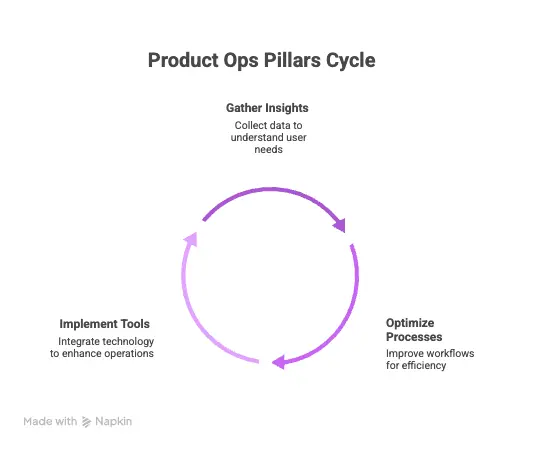
At its core, Product Ops brings structure to three areas that are usually fragmented in growing companies.
Insights alignment
Product Ops creates a unified system for collecting, tagging, organizing, and distributing insights from user research, analytics, support tickets, interviews, and customer success conversations. Teams rely on this central view to make better decisions without digging through disconnected sources.
Process consistency
Product Ops designs and maintains the workflows that guide discovery, roadmap planning, delivery, and release cycles. This includes rituals like monthly product reviews, feedback triage, release readiness checks, and experimentation guidelines.
Tooling governance
Product Ops ensures the team uses the right tools for analytics, user feedback, documentation, and experimentation. It sets naming conventions, tagging rules, and usage guidelines so teams work from clean and reliable data.
Why product operations matters for SaaS companies
“The first product ops hire pays for itself the week your roadmap review stops being an argument about whose spreadsheet is right.”
SaaS companies grow in complexity faster than most teams expect. New features add more data. More customers create more feedback. More markets require new workflows. Without structure, product teams lose clarity and waste cycles on tasks that do not move outcomes forward.
Product Ops addresses the most common challenges:
Insights become scattered across many tools
Support uses one platform, product uses another, analytics lives somewhere else. Without a unified view, product decisions rely on gut feeling or incomplete data.
Teams repeat work because processes are unclear
One team interviews users without sharing insights. Another team runs experiments with metrics no one understands. Release processes vary between squads, which creates coordination issues.
Roadmaps depend on unreliable or inconsistent data
Without data governance, metrics change names, definitions shift, and different teams interpret data in different ways. This leads to debates instead of decisions.
PMs spend too much time on operational tasks
When PMs drown in admin work, the team loses the strategic mindset required to build a competitive product.
Product operations solves these problems by creating visibility, alignment, and predictable workflows. As a result, teams ship better work with more confidence and fewer surprises. For the detail, see which kind of chaos ops can actually fix.
What product operations actually does
Product Ops responsibilities vary depending on company size and maturity, but the core scope always covers insights, processes, and tools. What differs is the level of sophistication.
Insights management
- Managing feedback intake channels
- Creating a consistent tagging structure
- Running voice of customer programs
- Standardizing how teams collect interviews and usability insights
- Maintaining a central repository of product knowledge
- Preparing insight summaries for roadmap planning
Teams benefit from a shared language for customer needs and patterns.
Process design and execution
- Establishing discovery frameworks
- Designing experimentation processes
- Facilitating product reviews
- Running release readiness workflows
- Maintaining documentation standards
- Ensuring cross functional alignment between product, design, engineering, and go to market teams
Strong processes reduce confusion and eliminate duplicated work.
Tooling and systems
- Selecting analytics, feedback, and experimentation tools
- Creating naming conventions for events and metrics
- Setting standards for dashboards
- Managing integrations so data flows correctly
- Owning feature flagging workflows
- Training teams on tool usage
Product Ops does not manage tools just for the sake of tools. It ensures tools support strategy and decision making. For the detail, see when the roadmap has no owner at all.
How product operations supports product managers
“Product ops is not bureaucracy. It is what lets your PMs spend their week on customers instead of spreadsheets.”
Product managers become significantly more effective when supported by a strong Product Ops function. It removes friction and gives PMs more time for strategy and customer work.
Reduced operational overhead
PMs spend less time on tagging feedback, running ad hoc data pulls, or maintaining dashboards. Product Ops takes over these workflows and ensures they run consistently.
Better decision making
With insights consolidated and data governed, PMs use cleaner inputs. This leads to faster and more confident decisions.
Clearer rituals and expectations
When processes like roadmap planning or release readiness are standardized, PMs know exactly what is expected, which reduces stress and confusion.
Improved cross functional alignment
Product Ops becomes the single point of truth for workflows. PMs no longer have to reinvent processes or negotiate alignment with every new initiative.
Product operations maturity model
Most teams misjudge where they sit on the Product Ops curve, which is why the model matters more than the label. It runs from ad hoc, where insights are scattered and every PM works differently, through emerging, where the first shared workflows and feedback sources appear, to structured, where discovery, planning and release readiness follow defined processes.
Many companies misunderstand their place in the Product Ops journey. A maturity model helps teams identify where they stand and what they should focus on next.
| Stage | Characteristics | Common symptoms | What improves next |
|---|---|---|---|
| Ad hoc | No formal processes, insights scattered, inconsistent workflows between PMs, no data governance | Teams operate differently, decisions take too long, feedback is lost or duplicated, analytics is unreliable | Establishing basic rituals, centralizing insights, defining responsibilities |
| Emerging | Initial workflows appear, a shared feedback source begins to form, basic analytics usage, early attempt at documentation | Alignment depends on individuals, teams use tools inconsistently, feedback tagging is incomplete, meeting quality varies | Standardizing discovery, creating release readiness steps, improving data consistency |
| Structured | Clear processes for discovery, planning, and release cycles, a single insights repository, documented naming conventions, defined roles | Teams follow processes but not always perfectly, insights are usable but still messy, rituals exist but need refinement | Introducing tool integrations, increasing automation, improving analytics depth |
| Scalable | Integrated tooling stack, consistent tagging rules, predictable rituals across squads, strong insight loops, Product Ops supports forecasting | Teams waste less time, decisions rely on clean data, cross functional alignment strengthens, PMs focus more on strategy | Expanding experimentation, refining governance, building repeatable playbooks |
| Optimized | Fully embedded Product Ops, continuous improvement culture, advanced analytics governance, automated processes, high visibility across the product lifecycle | Teams operate with clarity, very little process friction, strong experimentation discipline, high roadmap predictability | Scaling additional squads, advanced reporting automation, strategic Product Ops initiatives |
Stage 1: Ad hoc
- No consistent processes
- Insights scattered everywhere
- PMs operate differently
- Decisions are slow
Stage 2: Emerging
- Some workflows exist
- A shared feedback source starts forming
- Basic analytics usage appears
- Alignment still depends on individuals
Stage 3: Structured
- Clear rituals for discovery, planning, and releases
- A central repository for insights
- Standard dashboards
- Defined roles and ownership
Stage 4: Scalable
- Tooling is integrated and governed
- Processes scale across squads
- PMs rely on consistent insight loops
- Product Ops enables forecasting and predictability
Stage 5: Optimized
- Continuous improvement culture
- Automated workflows
- Strong experimentation engine
- Product Ops drives measurable improvements in product velocity
Product operations for different types of companies
Product Ops does not look the same in every environment. The priorities and skills shift depending on company stage.
Startups with one or two PMs
Focus on lightweight processes. Create a single source of truth for insights. Avoid heavy tooling. Keep discovery and release workflows simple so you can move fast.
Growing SaaS companies
Introduce scalable rituals. Standardize data governance. Formalize weekly and monthly product reviews. Prepare systems for multiple squads. Bring consistency to roadmap processes.
Enterprise and multi product teams
Focus on coordination, governance, and tooling standardization. Ensure every team uses the same definitions, processes, and tagging rules. Build a deeper analytics foundation to manage complexity.
How to build a product operations function from scratch
Building the function starts with evidence rather than a hire: talk to PMs, engineering, design and customer facing teams to find where workflows actually fail. From there, map how discovery, planning, delivery, analytics and releases run today, draw a clear line between what Product Ops owns and what PMs own, and start with the basics such as feedback triage and discovery templates.
This is one of the biggest information gaps in competitor articles. Use this as a blueprint for companies starting their Product Ops journey.
1. Identify operational bottlenecks
Talk to PMs, engineering, design, and customer facing teams. Identify where workflows fail or slow down.
2. Map your current processes
Document how your team performs discovery, planning, delivery, analytics, and releases.
3. Define responsibilities and ownership
Clarify what Product Ops owns versus what PMs own. Avoid teams falling into operational chaos.
4. Build early workflows
Start with the basics, feedback triage, discovery templates, release readiness, and documentation guidelines.
5. Establish data governance
Create naming conventions for events and dashboards. Define primary metrics.
6. Select the right tools
Choose tools that match your stage. Avoid buying everything at once.
7. Introduce rituals
Monthly product reviews, quarterly planning cycles, weekly insight summaries.
8. Measure and iterate
Track improvements in clarity, decision making speed, and release quality.
Product operations functions implementation checklist
Implementing Product Operations successfully is less about hiring a role and more about putting the right functions in place at the right time. This checklist helps teams move from scattered execution to a structured, scalable Product Ops operating system.
Use it as a practical implementation guide rather than a theoretical framework. You do not need to complete every item at once. The goal is progress, not perfection.
Insights and data alignment
These functions ensure product decisions are based on shared, reliable inputs rather than fragmented opinions.
- Centralize all customer feedback sources into a single repository
- Define a standard tagging taxonomy for feedback, research, and insights
- Establish a consistent process for collecting user interviews and usability tests
- Create regular insight summaries for roadmap and planning discussions
- Align analytics, support, and customer success data under shared definitions
If insights are scattered or tagged inconsistently, Product Ops should prioritize this area first.
Process design and standardization
Clear processes reduce confusion, duplicated work, and dependency on individual habits.
- Document discovery workflows used by all product teams
- Standardize roadmap planning and prioritization criteria
- Define release readiness and go live checklists
- Establish regular product rituals, such as weekly reviews and monthly strategy syncs
- Create templates for PRDs, experiments, and retrospectives
Processes should be lightweight enough to encourage adoption but clear enough to scale.
Tooling and systems governance
Tools only create value when they are governed and used consistently.
- Audit existing product, analytics, and feedback tools
- Define ownership for each tool and system
- Establish naming conventions for events, metrics, and dashboards
- Create usage guidelines and onboarding documentation for tools
- Ensure integrations between tools are reliable and maintained
Product Ops focuses on making tools work together, not on adding more tools.
Roles and ownership clarity
Ambiguity around ownership is one of the biggest sources of operational friction.
- Clearly define what Product Ops owns versus what PMs own
- Assign responsibility for insights management, process maintenance, and tooling governance
- Document decision making responsibilities and escalation paths
- Communicate ownership clearly across product, design, engineering, and go to market teams
When ownership is clear, execution speeds up and accountability improves.
Rituals and communication loops
Product Ops ensures information flows predictably across the organization.
- Schedule recurring insight reviews and planning sessions
- Create feedback loops between support, sales, and product teams
- Share outcomes from experiments and launches consistently
- Maintain a single source of truth for product documentation
Strong communication rituals prevent teams from working in silos.
Measurement and continuous improvement
Product Ops should be measured by improvements in clarity and execution, not activity.
- Track time to insight and time to decision
- Monitor adoption of processes and rituals across squads
- Measure data consistency and dashboard reliability
- Regularly review and refine Product Ops workflows
This final step ensures Product Ops evolves with the organization rather than becoming rigid.
How to use this checklist
Early stage teams can start with insights alignment and basic process standardization. Growing SaaS companies should focus on tooling governance and rituals. More mature organizations benefit from refining ownership models and performance metrics.
If your team struggles to implement this checklist effectively, this is often where a Fractional CPO provides the most value by sequencing these functions correctly and accelerating adoption.
Team structure, skills, and roles in product operations
A Product Ops professional usually combines analytical thinking with cross functional communication and operational rigor.
Key skills include
- Systems thinking
- Data literacy
- Process design
- Stakeholder management
- Technical understanding of analytics tools
- Workshop facilitation
Team structures vary
- A single Product Ops manager in early companies
- A small Product Ops team supporting multiple PMs at mid stage
- Centralized Product Ops supported by analytics and research partners in enterprise environments
This is also the stage where a fractional CPO for SaaS can help you avoid expensive mistakes. Instead of experimenting with processes for months, a fractional CPO brings ready to use frameworks and designs an operating model that fits your growth stage.
Case study: Why 45% of product managers’ time goes to waste
To be honest, my greatest satisfaction as a consultant comes from the intersection of product strategy and operational management. The paradox here is clear: founders hire expensive, top-tier talent but allow them to drown in Sisyphean process management. Market data supports what I see in boardrooms: a comprehensive report by McKinsey reveals that managers spend nearly half of their time on administrative tasks and individual-contributor work, rather than on strategy. What is the point of hiring a “product brain” if their hands are tied by “operations”?
Take, for example, a company I have been advising recently as a Fractional CPO. The company employs three excellent Product Managers, but as their workload increased, the system began to creak. This is not an isolated incident. Research by Productside (formerly 280 Group) found that nearly half (48%) of new products fail not because of a bad idea, but due to inefficient processes and poor execution. At this company, we saw these statistics playing out in real-time: operational “noise” caused a significant drop in output, and critical tasks began falling through the cracks.
Our solution was surgical: we hired a Product Ops specialist on a half-time basis. The change was immediate. According to Pendo, public companies that adopted a dedicated Product Ops function report a direct correlation between their operations and their ability to scale efficiently. In our case, chaos turned into exemplary order, and the three PMs returned to doing what they do best: building a winning product. This is exactly the power of precise operations: it doesn’t add work; it removes bottlenecks.
Product operations metrics and KPIs
Product Ops is measured on operational health, not output. The KPIs that hold up are time to insight and time to decision, data consistency, process adoption across squads, reduction in repeated work, release readiness success rate, roadmap predictability, and the throughput and quality of experiments.
Teams often struggle to measure Product Ops success. These metrics help track real impact.
Common KPIs include
- Time to insight
- Time to decision
- Data consistency score
- Process adoption across squads
- Reduction in repeated work
- Release readiness success rate
- Improved roadmap predictability
- Experimentation throughput and quality
The goal is not to measure outputs, but to measure improvements in operational health.
Common mistakes in product operations
Missteps often happen when teams misunderstand the purpose of Product Ops. Avoiding these mistakes saves significant time and frustration.
The most common mistakes include
- Acting like an admin rather than a strategic operator
- Investing in tools without designing processes
- Becoming a dumping ground for every task PMs avoid
- Creating processes that are too heavy for the team
- Failing to communicate the purpose behind each workflow
- Measuring activity instead of outcomes
- Implementing processes that teams do not adopt
Clear communication and iterative improvement help avoid these patterns.
Product operations in product led growth environments
PLG companies move faster and generate larger amounts of data, which makes Product Ops even more critical.
Key responsibilities in PLG companies include
- Managing large volumes of behavioral analytics
- Maintaining clear activation and retention metrics
- Supporting experimentation pipelines
- Coordinating onboarding improvements
- Ensuring insights are shared across growth and product teams
Product Ops becomes the backbone of the experimentation engine in a PLG environment.
Product operations tooling stack
Tools only work when they support clear processes:
Analytics platforms: Amplitude, Mixpanel, GA4
Feedback systems: Canny, UserVoice, survey platforms
Roadmap and PM tools: Productboard, Linear, Notion, Jira
Experimentation and feature flagging: LaunchDarkly, GrowthBook, Optimizely
Documentation and knowledge management: Notion, Confluence, internal wikis
How Product Ops governs naming conventions, tagging rules, and usage guidelines
Reliable data does not happen by accident. It comes from a clear and consistent structure that every team follows. Product Ops takes ownership of this structure so analytics, feedback, and product insights all speak the same language across the organization.
Naming conventions
Product Ops defines how events, metrics, and customer attributes are named across tools. This prevents situations where two teams track the same action with different labels. For example, one team might call an event “Signup Completed” while another calls it “User Registration Done”. Product Ops introduces a unified naming system so events stay consistent and dashboards reflect reality. These conventions also apply to roadmap items, documentation folders, and feature names, which makes cross functional collaboration smoother.
Tagging rules
Feedback, research insights, support tickets, and usage data become far more valuable when tagged consistently. Product Ops creates tagging frameworks that define categories, subcategories, and labels teams must use when capturing insights. This makes it possible to identify patterns quickly, whether you are reviewing customer feedback or analyzing how users adopt new features. Consistent tagging also prevents unstructured data from piling up, which is a common problem in growing organizations.
Usage guidelines
Once naming and tagging structures are defined, Product Ops trains teams on how to apply them. This includes documentation, onboarding sessions for new hires, and regular audits to ensure teams follow the system. Usage guidelines help avoid data drift, which happens when teams start naming or tagging items differently over time. Product Ops keeps the standards up to date and communicates changes proactively.
Together, these practices create a clean data foundation. Teams spend less time fixing inconsistencies and more time making reliable decisions based on accurate information.
Work with a Fractional CPO for product operations
Many companies attempt to build Product Ops internally but struggle because they lack a clear blueprint. Processes become heavy, tools go unused, and insights remain fragmented. A Fractional CPO brings the experience needed to design scalable workflows, select the right tools, and improve cross functional alignment. If all you need is the blueprint, a product management consultant can build it and hand it over.
A Fractional CPO creates a strong product operating system by:
- Designing clear discovery and delivery processes
- Setting up scalable rituals
- Creating data governance standards
- Simplifying team structure
- Bringing templates that reduce months of trial and error
- Coaching PMs and Ops partners through adoption
If your company is transitioning from chaos to structure or preparing for growth, working with a fractional CPO accelerates your progress and prevents costly missteps.
If you are weighing whether to build this function in house, you can read more about Sivan Kadosh and how the engagement works.
Considering a fractional CPO for your SaaS?
Get a senior product operator’s read on your biggest bottleneck in 30 minutes.
Book a strategy sessionI do this work inside B2B SaaS product teams. Knowing the model is one thing. Someone has to own it every week.
See how product management consulting works →Frequently asked questions
What does Product Ops actually do day to day?
Product Ops manages the systems that help product teams operate smoothly. This includes organizing customer feedback, maintaining analytics dashboards, coordinating release readiness processes, improving documentation, and ensuring all data follows consistent naming and tagging rules. Their work reduces operational noise so product managers can focus on strategy, discovery, and customer needs.
When should a SaaS company hire its first Product Ops role?
Most companies benefit from Product Ops once they have more than one product manager or when insights begin to scatter across multiple tools. It is usually time when PMs struggle to keep processes consistent or when the team feels it is making decisions with incomplete data. Product Ops becomes especially valuable during Series A to Series C growth, when complexity increases quickly.
How does Product Ops help improve product decisions?
Product Ops creates a unified system for insights and data, which removes ambiguity in the decision making process. When feedback, analytics, and research all follow a shared structure, PMs rely on clean inputs rather than chasing down information. This results in faster prioritization, more confident decisions, and fewer debates driven by inconsistent data.
What skills are most important for someone in Product Ops?
The best Product Ops professionals combine analytical depth with operational discipline. They understand product analytics, know how to design processes, and communicate clearly across multiple teams. They also have strong systems thinking, which helps them build workflows that scale as the company grows. Curiosity, problem solving, and attention to detail are essential traits.
How can a Fractional CPO support Product Ops development?
A Fractional CPO brings experience in designing scalable product systems. They help define ownership, set up discovery and delivery workflows, create data governance standards, and coach both PMs and Product Ops partners. For companies that do not yet have a senior product leader or need to professionalize their operating model quickly, a Fractional CPO accelerates progress and prevents costly missteps.
What is product operations?
The function that makes the product team run well: tooling, data, processes, and rituals that let PMs focus on customers and decisions.
Does my SaaS need product operations?
Usually once the product team passes 8 to 10 people and coordination overhead starts slowing delivery.
Product operations vs product management?
Product management decides what to build. Product operations makes the team that builds it efficient and data-driven.
What clients say
Read all 18 references“As a product manager, I can say that Sivan is very professional – always looking deeply on the discussed feature to understand end to end its effect on the whole product, and as well the eager to understand what would be the added value to the strategy of the company. Nothing was added without a clear scope of development, a clear understanding of the business owner and a clear way to measure the success or failure of this feature.”
“Leading by example, empowering, mentoring, and growing his product teams, he created great product culture and set us Product Managers up for success. His vision and strategic direction enabled us to create successful products that brought millions of dollars of revenue to the company and its clients.”
“As part of his role as VP Product, he identified creative ideas, developed sharp strategies and built the road map while focusing on customer experience and business needs.”