
Usage based pricing is a model where customers pay according to how much of a product they use. Instead of a fixed monthly fee, the price scales with a metric such as API calls or data processed. It is also called consumption pricing or metered billing.
I have hired product people, and I have been one. If the title is unclear, the problem is usually the decision no one owns.
See what a monetization PM owns →Usage based pricing has become one of the most influential shifts in SaaS monetization. More companies are moving away from flat subscription plans and adopting models that charge customers based on how much value they consume. When it works well, it aligns incentives for both sides and creates more predictable expansion revenue. When it goes wrong, companies face unpredictable revenue, customer frustration, and complicated billing processes.
This guide cuts through the noise and gives you a practical, senior level understanding of how usage pricing works, when it makes sense, and how to implement it without creating operational chaos. You will also see where subscription pricing is still superior, how hybrid models work, and how a Fractional CPO can help you roll out usage pricing safely and efficiently.
Key takeaways
- Usage based pricing aligns cost with value, which helps with adoption and long term expansion revenue.
- The biggest success factor is choosing the right value metric and metering it accurately.
- Not every product is suited for pure usage based billing and hybrid models are becoming more common.
- Implementation requires tight alignment across product, engineering, finance, and customer success.
- A Fractional CPO can guide you through pricing strategy, experimentation, and rollout to reduce risk.
What does usage based pricing charge for?
The price attaches to a metric that grows with the value delivered. Snowflake charges for compute and storage consumed, Twilio for messages and calls, Zapier for tasks executed. The model is also called consumption pricing or metered billing, and it grew fastest in cloud infrastructure, developer tools and AI services.
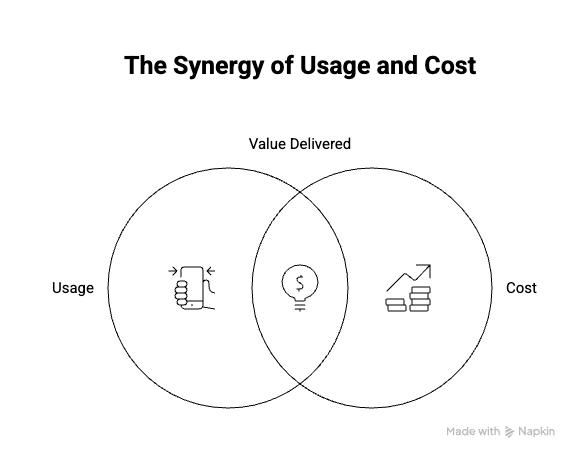
Usage based pricing is a model where customers pay based on how much they use a product. Instead of a fixed monthly fee, the price scales with metrics such as API calls, data processed, emails sent, videos generated, or messages delivered. It is sometimes called consumption based pricing, pay as you go pricing, or metered billing.
This model is built around the idea that customers should pay in proportion to the value they receive. If they use more of the product, they pay more. If they use less, they pay less. This creates a flexible relationship between value delivered and revenue earned.
Usage based pricing has grown quickly in cloud infrastructure, developer tools, and AI services because customers prefer models that match their workloads rather than fixed commitments they cannot fully use.
Which trends are pushing SaaS toward usage pricing?
Buyers have become more cost conscious and more sophisticated. Fixed subscription tiers often fail to reflect the value actually delivered, which leaves customers either overpaying or forced to upgrade earlier than they want. Usage pricing removes that mismatch by tying the invoice to what the customer consumed.
SaaS buyers are becoming more cost conscious and more sophisticated. Fixed subscription tiers often do not reflect actual value, which leaves companies either overpaying or being forced to upgrade earlier than they want. Usage based pricing solves many of those frustrations.
Better alignment with customer value
When customers pay for value consumed, they perceive pricing as fair. There is no frustration about unused seats or unused features. This fairness increases trust and improves long term retention.
Lower friction during acquisition
Usage models reduce the upfront risk for customers. Instead of committing to a large subscription, they can start small and scale usage naturally. This is especially powerful for PLG companies that rely on quick activation and trial to paid conversions.
Stronger expansion revenue potential
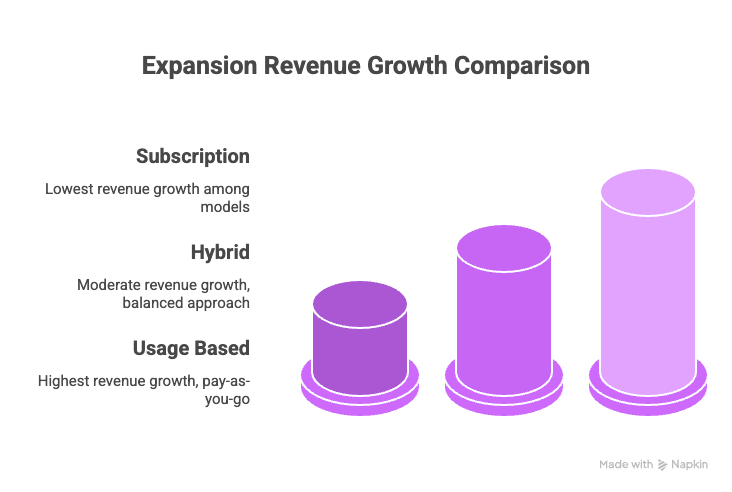
As customers grow, their usage naturally increases. This leads to expansion revenue that feels organic rather than forced through upgrades or sales pushes. Companies like Snowflake and Twilio grew rapidly because their pricing scaled with customer success.
Flexibility for early stage users
Startups and small teams often fluctuate in activity. They prefer paying only for what they need, which increases adoption in early stages and widens the top of the funnel.
What are the benefits of usage based pricing?
It changes how a business acquires, retains and expands customers, not only how invoices look. Revenue tracks real engagement, which gives teams a direct incentive to improve onboarding and self-serve. Entry barriers fall because small customers can start small. Lifetime value rises as accounts grow into their own usage.
Usage based pricing does more than shift how invoices look. It changes how businesses acquire, retain, and expand customers.
Stronger product led growth loops
When billing is tied to engagement, your revenue reflects actual product usage. This creates a natural incentive for teams to improve onboarding, add self serve features, and drive meaningful actions that correlate with usage.
Lower barriers to entry
Customers can start with almost no commitment. This reduces the CAC payback period and encourages wider experimentation across teams.
Higher lifetime value potential
When customers repeatedly increase usage, they become more embedded in the product. This reduces churn and increases LTV at the same time.
Transparent and fair pricing
Customers appreciate knowing what they are paying for. Clear visibility into usage reduces billing disputes and increases satisfaction.
Where does usage based pricing go wrong?
Four failure modes recur. Revenue becomes hard to forecast when usage swings. Customers grow anxious about bills they cannot predict, and an unexpected spike damages trust even when the charge is correct. Metering is engineering intensive and fails loudly. Support and customer success carry more complexity than before.
“Usage based pricing is powerful, but it is not without risk. Many teams underestimate the complexity involved.”
Sivan Kadosh, Fractional CPO
Usage based pricing is powerful, but it is not without risk. Many teams underestimate the complexity involved.
Revenue unpredictability for the business
Usage can rise or fall quickly. Without strong forecasting, companies may struggle with revenue planning, especially in the early stages of implementing usage pricing.
Customer anxiety about unpredictable bills
Customers need clarity on expected usage. Unexpected spikes can damage trust, even if the charges are technically correct.
Engineering complexity
Metering requires accurate event tracking, stable infrastructure, and real time monitoring. If any of these fail, billing disputes or revenue leakage follow.
More complicated support and success processes
Customer success teams must help users understand usage patterns and optimize consumption.
| Benefits | Challenges |
|---|---|
| Strong alignment between price and customer value | Revenue becomes harder to predict month to month |
| Low friction entry for new customers | Customers may fear unexpected bills |
| Natural expansion as customers grow usage | Requires accurate metering and data infrastructure |
| Scales revenue without forced upgrades | More complex billing, support, and success processes |
| Encourages product led growth | Higher operational and engineering overhead |
Expert insight: Overcoming the “Open Check” paralysis
Ten years ago, I consulted for a SaaS company struggling with a usage-based product. Their tech was solid, yet their trial-to-paid conversion was stuck at a disappointing 14%. While OpenView’s data shows that 61% of PLG companies have adopted usage-based models to drive growth, simply switching the billing engine isn’t enough. We decided to dig deeper.
I asked the team to conduct 30 customer discovery interviews with non-converting leads. The feedback was unanimous: It wasn’t a feature gap; it was fear. Customers were terrified of signing a “blank check.” This aligns with insights from Stripe’s guide on usage pricing, which highlights “bill shock” and revenue unpredictability as primary risks that lead to customer churn.
The fix: We implemented a “Hard Cap” feature, allowing users to set a maximum monthly budget. This strategy is echoed by experts like Tomasz Tunguz, who argues that capped usage options are essential to satisfy procurement teams who demand cost predictability.
The result: By removing the psychological friction of uncertainty, the impact was immediate. We ran an A/B test with this safety net, and conversion rates jumped from 14% to nearly 25%. The lesson is clear: Usage-based pricing aligns value, but without predictability, it kills conversion.
When should you choose usage pricing over subscription?
Subscription remains the default and suits products with stable usage, where customers want a predictable line item they can forecast. Usage pricing fits when consumption varies widely between accounts and correlates with the value received. Where neither fits cleanly, a hybrid puts a platform fee underneath a usage component.
“Customers need clarity on expected usage. Unexpected spikes damage trust even when the charges are technically correct.”
Sivan Kadosh, Fractional CPO
Subscription pricing remains the default in SaaS, and for good reason. To choose the right model, you need a clear comparison.
How subscription pricing works
Subscription pricing charges customers a fixed recurring fee regardless of usage. It is simple, predictable, and easy to forecast. Many products with stable usage patterns still rely on subscriptions because customers want predictable budgeting.
How usage pricing works
Usage pricing charges customers based on consumption. There is no concept of paying for unused capacity. This creates alignment with value delivered but reduces predictability.
When subscription pricing is the better choice
Subscription pricing works best when:
- Usage is stable and predictable
- The product delivers value through access rather than throughput
- Customers prefer fixed-cost planning
- The value metric is difficult to define or measure
When usage pricing is the better choice
Usage pricing is ideal when:
- Value is strongly tied to measurable activity
- Customers scale usage over time
- Different users consume value at very different levels
- Your product supports automation, data processing, or volume driven workflows
Hybrid pricing models
Hybrid models combine a base platform fee and usage based components. This provides predictable revenue for the business while still allowing customers to scale based on value.
Common hybrid structures include:
- Platform fee plus usage
- Bundled usage tiers with overage rates
- Minimum commit plus pay as you go
- Seats plus consumption
| Dimension | Subscription pricing | Usage based pricing | Hybrid pricing |
|---|---|---|---|
| Pricing structure | Fixed recurring fee | Pay per unit consumed | Base fee plus usage |
| Revenue predictability | High | Low to medium | Medium to high |
| Customer cost predictability | High | Lower without guardrails | Medium |
| Value alignment | Indirect | Strong | Strong |
| Expansion mechanics | Plan upgrades or seat growth | Natural usage growth | Usage growth with baseline |
| Implementation complexity | Low | High | Medium |
| Best for | Stable, access driven products | Volume and activity driven products | Products needing balance |
How do you choose the right usage metric?
The value metric is the core of the model, and the wrong one confuses customers and caps growth. A strong metric rises as the customer receives more value. Snowflake uses data processed, Zapier uses tasks, Twilio uses delivered messages. The metric must be easy to explain and accurate to measure.
Your value metric is the core of a successful usage based pricing strategy. The wrong metric will confuse customers and limit growth.
Your usage metric must reflect customer value: A strong usage metric is one that increases as the customer receives more value. This is why Snowflake uses data processed, Zapier uses tasks, and Twilio uses delivered messages.
The metric must be easy to understand: If customers cannot explain the metric in one sentence, it is too complex. Confusion leads to mistrust, which leads to churn.
It must be easy to measure accurately: Inaccurate metering causes disputes, refunds, and revenue leakage. Engineering must be confident in the reliability of the tracking system.
It must scale with meaningful usage: If heavy users pay the same as light users, the model will not work. A good metric helps segment customers by value.
Pro tip: Not sure how different usage metrics will impact revenue, expansion, and customer bills over time? Use our SaaS Pricing Impact Simulator to model pricing scenarios, test value metrics, and see how changes affect growth before rolling them out to customers.
How do you implement usage based pricing step by step?
Seven steps, and it needs treating as a strategic initiative rather than a pricing update. Analyze customer behavior for the actions that correlate with retention. Define the value metric. Build metering infrastructure. Update billing. Design tiers or a pure usage model. Pilot with a small segment. Then roll out carefully.
Moving to usage based pricing requires coordination across several teams. Treat it as a strategic initiative rather than a simple pricing update.
Step 1: Analyze customer behavior patterns
Look for patterns in how customers use your product. Identify the actions that correlate strongly with retained and high value customers.
Step 2: Define your value metric
Evaluate several options, test them with customers, and validate that they represent value delivered.
Step 3: Build metering infrastructure
You need accurate event tracking, clear usage logs, and a system that can record usage in real time. Engineering must ensure stability and transparency.
Step 4: Update your billing system
Use tools such as Stripe Metered Billing, Chargebee, or Recurly to support usage events, invoicing, and dunning.
Step 5: Design pricing tiers or pure usage models
Decide whether you want simple pay as you go pricing or structured tiers that help customers estimate costs.
Step 6: Run a pilot with a small segment
Start with a controlled group to gather data, refine communication, and fix gaps before rolling out widely.
Step 7: Roll out to all customers carefully
Give customers a clear transition plan, pricing calculator, and expected invoice scenarios. Transparency reduces risk.
Our tip: use our free SaaS pricing calculator tool or our free Pricing Impact Simulator
Which SaaS companies use usage based pricing?
Snowflake charges for compute and storage consumed, which aligns price with data workloads. Twilio charges per message or call, matching communication volume. Zapier charges per task executed, so customers pay only for the automation they run. Each picked a metric a customer can watch moving.
Several companies have proven how effective usage based pricing can be when implemented correctly.
- Snowflake: Charges based on compute and storage consumed. This aligns pricing with data processing workloads.
- Twilio: Charges per message or call. This fits perfectly with communication volume.
- Zapier: Charges per task executed. Customers pay only for automation volume.
- HubSpot: Uses a hybrid model with subscription tiers and usage based limits on contacts or marketing events.
- Stripe: Charges based on transaction volume. This aligns perfectly with value delivered to merchants.
Each of these companies succeeded because they chose value metrics that customers intuitively understand.
What mistakes do teams make when rolling out usage pricing?
Most failures come from planning and communication rather than the model itself. A confusing metric comes first, because customers must immediately understand how usage is counted and billed. Teams also underestimate the engineering behind accurate metering, and they leave customer success unprepared for the usage questions that follow.
Usage based pricing fails most often due to poor planning or unclear communication. Here are the main reasons:
- Choosing a confusing metric: Customers must immediately understand how usage is counted and billed.
- Underestimating technical requirements: Metering is engineering intensive and must be accurate.
- Not preparing customer success teams: They must answer usage questions, provide consumption insights, and help customers optimize spending.
- Ignoring cost predictability: Customers will churn if their bills fluctuate dramatically without warning.
- Poor communication during rollout: Usage pricing requires clear messaging, education, and forecasting tools.
Which tools support usage based pricing?
Three categories cover implementation. Metering and usage tracking comes from Lago, Octane, Amberflo or Calqulate. Billing runs on Stripe, Chargebee, Recurly or Paddle. Product analytics comes from Mixpanel, Amplitude or Heap. Together they provide the accurate measurement and the reliable billing the model depends on.
Several tool categories make implementation easier:
- Metering and usage tracking: Lago, Octane, Amberflo, Calqulate.
- Billing platforms: Stripe, Chargebee, Recurly, Paddle.
- Product analytics: Mixpanel, Amplitude, Heap.
These tools provide the backbone for accurate measurement, reliable billing, and forecasting.
Where does a fractional CPO fit into a pricing change?
Usage pricing touches product, engineering, finance, go to market and customer success at once, so the risk of misalignment is high. A fractional CPO brings senior product leadership without a full-time executive cost, and can choose the value metric, run pricing discovery and align the functions that have to move together.
Usage based pricing touches product, engineering, finance, go to market, and customer success. This means the risk of misalignment is high. A fractional CPO brings senior level product leadership without the cost of a full time executive. Set that leadership against its own price too, which is what what a fractional CPO costs sets out.
A fractional CPO can help you:
- Choose the right value metric
- Run pricing discovery and interviews
- Align product, finance, and engineering
- Design usage tiers and hybrid models
- Oversee metering and billing implementation
- Create a customer friendly rollout plan
- Run pricing experiments to validate revenue impact
This reduces risk, saves time, and avoids costly mistakes during the transition.
Work with a Fractional CPO to get your pricing model right
Usage based pricing is one of the most powerful monetization strategies in SaaS, but it is also one of the most complex. If you want expert guidance without hiring a full time cpo, our fractional CPO services can support you through every step. We help you choose the right pricing model, implement it safely, and run experiments that maximize revenue.
Get in touch to discuss how we can help you build a pricing strategy that supports long term, sustainable growth.
Not sure whether product is what is holding your growth back?
A senior, ex-CPO read on your single biggest product bottleneck in 30 focused minutes. No pitch, no obligation.
Book a Product Strategy SessionI have hired product people, and I have been one. Whichever title you pick, someone has to carry the decision.
See what a monetization PM owns →FAQs
What is usage based pricing and why are SaaS companies adopting it?
Usage based pricing charges customers based on how much of the product they consume. Companies adopt it because it aligns cost with value delivered. Customers pay only for what they use and businesses benefit from natural expansion revenue as usage grows. This model also reduces entry barriers, improves fairness perception, and fits well with product led growth strategies.
How do I know if my SaaS product is a good fit for usage based pricing?
Your product is a good fit if value can be tied to a measurable activity that customers easily understand. Examples include messages sent, data processed, tasks completed, or transactions handled. If usage varies widely between customers, or if your product scales with automation or volume, usage pricing is often a strong choice. If usage is stable or hard to measure, subscription pricing may be better.
What are the biggest challenges with implementing usage based pricing?
The main challenges include building reliable metering infrastructure, avoiding revenue leakage, and giving customers clear visibility into usage so they do not worry about unpredictable invoices. You also need strong alignment between engineering, product, and finance because inaccurate or unclear usage tracking will create billing disputes and customer frustration. Education and communication are essential during rollout.
How does usage based pricing compare to subscription pricing?
Subscription pricing charges customers a fixed recurring fee. It is predictable and easy for budgeting. Usage based pricing charges customers based on consumption, which creates a closer alignment between value and cost. Subscription pricing works best when usage is stable. Usage pricing works best when value scales with measurable activity. Many SaaS companies combine both models to balance fairness and predictability.
What role can a Fractional CPO play in defining and rolling out usage based pricing?
A Fractional CPO brings strategic product leadership without the cost of a full time executive. They help define the right value metric, validate pricing assumptions with customers, align teams around the pricing model, oversee metering and billing implementation, and guide communication during rollout. This reduces risk and ensures pricing supports revenue goals as the product scales.
What clients say
Read all 18 references“As a product manager, I can say that Sivan is very professional – always looking deeply on the discussed feature to understand end to end its effect on the whole product, and as well the eager to understand what would be the added value to the strategy of the company. Nothing was added without a clear scope of development, a clear understanding of the business owner and a clear way to measure the success or failure of this feature.”
“Leading by example, empowering, mentoring, and growing his product teams, he created great product culture and set us Product Managers up for success. His vision and strategic direction enabled us to create successful products that brought millions of dollars of revenue to the company and its clients.”
“As part of his role as VP Product, he identified creative ideas, developed sharp strategies and built the road map while focusing on customer experience and business needs.”
