
Customer led growth builds product and company decisions on validated customer insight rather than internal assumption. It runs as a system, collecting evidence, synthesizing it, and feeding it back into roadmap and pricing, so the company keeps solving problems customers actually have instead of ones it imagined.
I do this work inside B2B SaaS product teams. If your team ships every week and the numbers barely move, this is where I start.
See how product management consulting works →Customer expectations have changed, and companies can no longer rely on intuition, internal assumptions, or isolated product decisions. Growth now depends on how well a team understands what customers truly need, how fast it can turn those insights into product improvements, and how effectively it aligns the entire company around solving real problems. This is the foundation of customer led growth.
A customer led approach helps teams reduce product risk, improve retention, strengthen activation, and make better decisions with less guesswork. While many SaaS businesses claim to be customer centric, very few have an operating model that makes customer insights the driving force behind product strategy, roadmaps, onboarding, and pricing. This guide explains how to build that model in a practical, structured way.
Key takeaways
- Customer led growth builds product and company decisions around validated customer insights.
- It reduces product risk by focusing on real problems instead of assumptions.
- A full CLG system includes insight collection, synthesis, alignment, delivery, and feedback loops.
- CLG strengthens PLG, sales led, and marketing led models by grounding them in real customer behavior.
- Pricing decisions, including usage based pricing vs subscription, benefit from CLG insights.
- A fractional CPO for growth-stage SaaS can accelerate CLG implementation by providing leadership, structure, and cross functional alignment.
What is customer led growth?
A way of running the company where customer evidence, not internal opinion, settles the argument. It combines research, behavioral data and problem validation into something continuous rather than a quarterly survey, and it treats what customers do as more reliable than what they say.
“Customer led growth is a business approach that uses deep customer insight to guide product decisions, improve the user experience, and drive sustainable growth.”
Sivan Kadosh, Fractional CPO
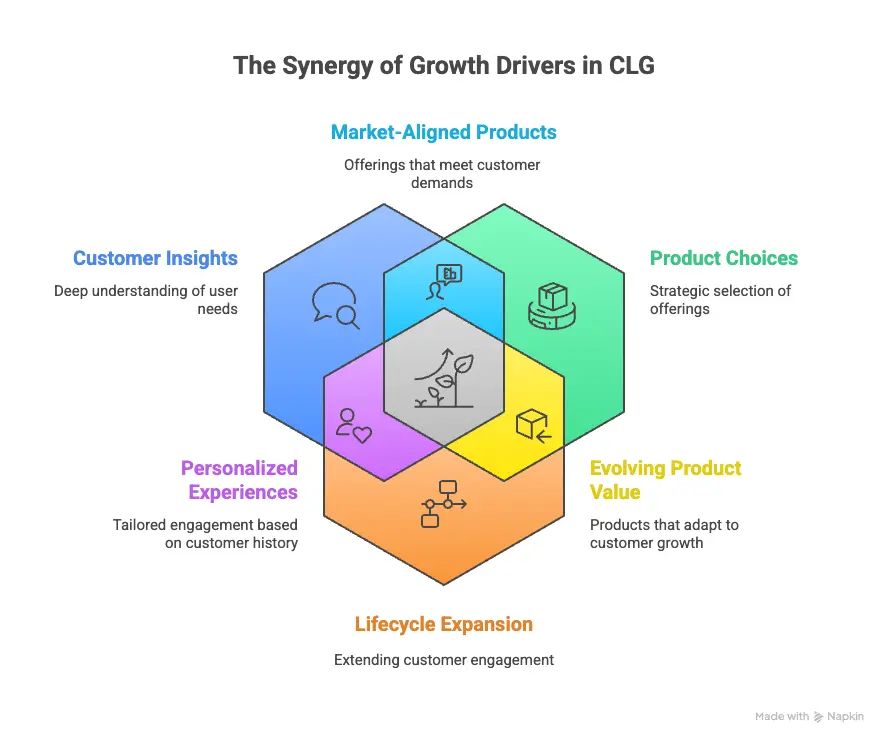
Customer led growth is a business approach that uses deep customer insight to guide product decisions, improve the user experience, and drive sustainable growth. It is grounded in a simple principle. Customers reveal what they really value through their actions, their struggles, their language, and their buying behavior. When teams build around these signals instead of relying on opinions, they create products that are easier to adopt, harder to leave, and more aligned with what the market actually wants.
Customer led growth is more than collecting feedback. It is a discipline that combines qualitative research, behavioral data, customer journey understanding, problem validation, and continuous learning. The goal is to turn these insights into changes that improve activation, retention, and expansion.
Why does customer led growth matter?
Because features are copyable and customer understanding is not. Competitors can ship your entire roadmap within a few months, but they cannot shortcut knowing which problem actually matters to a particular segment and why. That knowledge is what keeps churn down and makes expansion predictable.
SaaS companies operate in an environment where customer expectations rise quickly and competitors can replicate features within months. Growth can stagnate when companies make decisions based on assumptions about what users want. CLG removes this risk by grounding decisions in evidence.
Customer led growth is especially powerful in SaaS for several reasons:
- High CAC makes retention more important than ever
- Products often have complex onboarding that benefits from insight driven refinement
- Many teams struggle to maintain product market fit as they scale
- Users switch tools quickly when the value is unclear
- Buying committees demand clearer value alignment
CLG keeps the company aligned with customer reality, which results in lower churn, stronger expansion, and more predictable growth.
What does a CLG operating model look like?
Four moving parts that have to connect: collection, synthesis, decision and feedback. Most companies have the first and skip the second, which is how you end up with a research folder nobody reads. The model only works when synthesis has an owner.
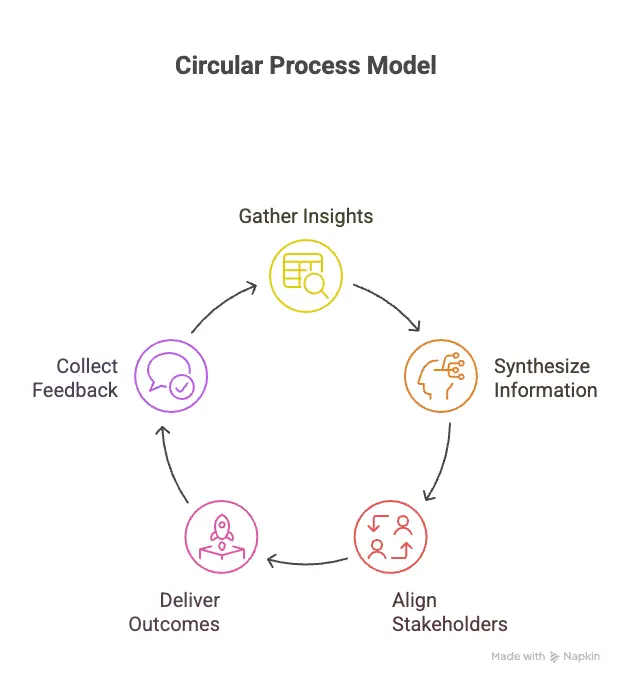
Customer led growth becomes scalable only when it is structured. A repeatable operating model ensures that insights flow from customers into decisions and back into improvements. Below is a model with five essential components.
Insight collection
Effective CLG begins with consistent and structured insight collection. This includes customer interviews, in product behavior data, surveys, support ticket analysis, and churn and win loss reviews. Each method uncovers a different layer of the customer experience. Interviews reveal motivations and struggles. Behavioral analytics reveal what users do, not just what they say. Support interactions uncover recurring friction points. Together, they form a complete picture of customer needs.
Insight synthesis
Raw feedback is only useful if teams know how to interpret it. Synthesis involves identifying themes, clustering problems, mapping jobs to be done, and sizing opportunities. This process separates individual anecdotes from patterns that represent real, widespread customer needs. Synthesis helps teams avoid the trap of reacting to every opinion and instead focus on structured, validated insight.
Product and strategy alignment
Insights must influence decisions. This is where CLG meets product strategy. Teams use insights to refine roadmaps, define priorities, improve value propositions, and focus on the problems that matter most. When aligned correctly, CLG improves time to value, strengthens activation, and ensures that teams deliver changes that users actually care about.
Experience delivery
This stage turns decisions into customer facing improvements. It includes better onboarding, simplified workflows, improved in app messaging, and enhancements that guide users to value more quickly. Delivery must be paired with measurement to confirm that changes have the intended impact.
Feedback loop
A strong feedback loop closes the cycle. Teams validate outcomes, gather new insights, and update their understanding of customer needs. Over time, this creates a compounding effect. The company becomes faster at identifying problems and better at solving them.
How does CLG compare with other growth models?
Product led growth uses the product as the channel. Sales led uses people. Marketing led uses reach. Customer led is not a fourth channel at all, it is the evidence layer underneath whichever channel you run, which is why it strengthens the others rather than replacing them.
Customer led growth is not a replacement for product led, marketing led, or sales led approaches. It is the foundation that supports each one. PLG becomes more effective when onboarding is shaped by real customer behavior. Marketing becomes more precise when messages reflect customer language. Sales cycles shorten when teams understand the motivations of different segments.
Below is a comparison of how each model focuses on a different part of the journey:
- CLG focuses on validated customer needs
- PLG focuses on driving value through product usage
- Marketing led focuses on positioning and demand generation
- Sales led focuses on relationship building and closing deals
When combined, CLG ensures that all other growth models are aligned with real user experience rather than assumptions.
| Dimension | Customer led growth (CLG) | Product led growth (PLG) | Marketing led growth (MLG) | Sales led growth (SLG) |
|---|---|---|---|---|
| Primary focus | Validated customer needs and problems | Driving value through product usage | Positioning, messaging, and demand creation | Relationship building and deal execution |
| Main growth lever | Deep customer insight and continuous feedback loops | Self serve onboarding and in product value delivery | Campaigns, content, and brand awareness | Sales conversations and account management |
| Key strength | Reduces product risk and aligns teams around real customer value | Scales efficiently when time to value is short | Generates awareness and pipeline at scale | Works well for complex, high ACV deals |
| Main weakness | Requires discipline and strong insight synthesis | Breaks down if onboarding is poorly designed | Can attract low fit leads without strong insight | Slower and more expensive to scale |
| Decision drivers | Customer interviews, behavior data, journey insights | Usage patterns, activation events, feature adoption | ICP assumptions, messaging tests, funnel metrics | Buyer objections, deal feedback, sales experience |
| Typical metrics | Retention, activation, NRR, time to value | Activation rate, DAU or MAU, feature adoption | MQLs, conversion rates, CAC | Win rate, deal size, sales cycle length |
| Role in SaaS growth | Acts as the foundation for all other growth models | Executes growth through product experience | Amplifies demand and positioning | Converts demand into revenue |
| Risk when used alone | Slow execution if insights are not operationalized | Growth stalls when customer needs shift | Misalignment between promise and product | Product roadmap becomes sales driven |
| Best use case | Building long term, sustainable growth | Scaling simple products with clear value moments | Early awareness or category creation | Enterprise and high touch sales motions |
What is the CLG lifecycle?
Signals arrive continuously from support tickets, usage data, interviews and lost deals. They get synthesized into problems worth solving, those problems reach the roadmap, and what ships gets measured against the original signal. Skip that last step and the loop is not a loop.
Customer led growth follows a logical lifecycle that touches every stage of the customer journey. Understanding this lifecycle helps teams design better experiences that support acquisition, activation, retention, and expansion.
The lifecycle includes:
- Customer discovery to understand motivations, workflows, and pain
- Problem validation to confirm that identified challenges are widespread
- Product experience optimization to improve adoption and reduce friction
- Retention work to support long term success
- Expansion strategies driven by observed value and usage patterns
- Pricing refinement to ensure value alignment across customer types
Each stage builds on the previous one, creating a full loop that connects early research with long term growth.
How mature is your CLG practice?
Early teams collect feedback ad hoc and act on whoever complained loudest. Middle teams have a repository and a rhythm. Mature teams can trace a shipped change back to the evidence that justified it, and forward to whether it worked, without anyone reconstructing the story.
Most companies believe they are customer centric, but few operate at a mature CLG level. A maturity model helps teams understand where they are and what steps they need to take.
- Level 1: Ad hoc and reactive: Insights are gathered occasionally, usually in response to problems or complaints. Decisions are inconsistent.
- Level 2: Insight driven: Teams conduct interviews or analyze data, but insights are not fully operationalized across departments.
- Level 3: Cross functional CLG: Product, marketing, support, and sales share insight systems and align decisions around them.
- Level 4: Predictive and proactive: Teams use insight patterns to anticipate customer needs before they surface.
- Level 5: Fully customer led organization: Insights guide strategy, roadmaps, onboarding, pricing, and positioning. The company operates with a continuous feedback culture.
How do you build a customer insight system?
Start with one place where evidence lands and one person accountable for reading it. Tag by problem rather than by feature request, because requests are solutions in disguise and grouping them hides the underlying need. Cadence matters more than tooling here.
“Customers reveal what they really value through their actions, their struggles, their language, and their buying behavior.”
Sivan Kadosh, Fractional CPO
A strong insight system is the engine of customer led growth. It ensures that valuable information is easy to collect, interpret, and act on.
To build this system:
- Create a structured interview program with recurring sessions
- Use templates for customer interviews, including open ended questions
- Tag and categorize feedback in a shared repository
- Combine qualitative insight with behavioral analytics
- Review insights in cross functional meetings
- Document outcomes and share patterns with the entire organization
A consistent insight system helps avoid the trap of collecting data without using it.
How customer insights influence product strategy
Insight changes strategy only when it reaches the room where the trade-offs actually get made. That means arriving as a ranked set of validated problems before the roadmap is drafted, not as a research deck presented politely after the quarter has already been committed and the engineers have started building.
Customer insights shape product strategy by highlighting the problems that matter, the value customers expect, and the obstacles that prevent adoption. When teams rely on insights, they make better decisions across several areas.
Insights help teams:
- Prioritize roadmap items
- Improve activation flows
- Reduce feature bloat
- Strengthen value propositions
- Identify and remove onboarding blockers
- Shift messaging to match customer language
- Deprecate unused or confusing features
For example, if interviews reveal that enterprise users struggle with configuration, the product team can focus on simplifying setup or improving workflows. This type of change often has a greater impact on retention than introducing new features.
How does CLG change pricing?
Because willingness to pay is a customer fact, not a finance one. Understanding which outcome a segment values tells you what to meter and where the packaging boundary belongs, which is the difference between a usage model that grows with the customer and one that punishes them.
Pricing decisions are often made by copying competitors or using internal assumptions. CLG introduces a more grounded approach.
Customer behavior reveals how users perceive value, which features they use most, and where friction arises. These insights guide better pricing decisions.
Usage based pricing vs subscription
Both models have advantages, but the right choice depends on customer behavior and perceived value.
Usage based pricing works best when:
- Value increases with usage
- Customers have variable demand
- Users can clearly see the link between usage and outcomes
Subscription pricing works well when:
- Customers want predictable costs
- Value does not change dramatically with usage
- The product is core to day to day operations
A hybrid model can also be effective, especially when different segments interact with the product at different frequencies. Instead of guessing which model to use, CLG helps teams choose the model that reflects how customers naturally behave and where they see value.
Our tip: If you want to see the impact of your pricing strategy consider using our Pricing Impact Simulator
CLG metrics and KPIs
Activation, retention and net revenue retention read the outcome. Alongside them, track whether the insight system itself is working, how many decisions cited evidence and how long a signal takes to reach the roadmap. A CLG program with no process metric quietly becomes a repository.
To measure progress, teams should track metrics across several categories.
Insight metrics:
- Interview volume
- Time to synthesize insights
- Feedback tagging consistency
Product metrics:
- Activation rate
- Feature adoption
- Time to value
Retention metrics:
- Churn
- NRR
- Expansion revenue
Experience metrics:
- CSAT
- CES
- NPS
Pricing metrics:
- Expansion revenue
- Per seat utilization
- Usage depth
These metrics show whether customer led initiatives are improving outcomes across the entire lifecycle.
What goes wrong with CLG?
Collecting feedback diligently and never synthesizing any of it. Treating whichever customer shouted most recently as though they were the whole market. And validating a solution instead of a problem, which reliably produces enthusiastic agreement about something nobody actually needed in the first place.
Customer led growth is powerful, but companies often misapply it. Common mistakes include:
- Collecting feedback without synthesizing it
- Reacting to individual complaints rather than patterns
- Over relying on surveys instead of conversations
- Treating CLG as a quarterly project instead of a continuous process
- Ignoring the needs of specific segments
- Not pairing qualitative insight with behavioral data
- Letting the loudest customers dictate the roadmap
Avoiding these mistakes helps teams make CLG sustainable and reliable.
What does CLG look like in practice?
The pattern repeats across companies. A team builds what it assumed users wanted, adoption stays flat, and a round of real conversations reveals the blocker was somewhere else entirely. The fix is usually smaller than the roadmap that preceded it.
Real-world insight: The ‘Feature Factory’ trap
The Product Team as the Strategic Bridge It might seem obvious, but the more I work with product leaders, the more I realize it is far from standard practice. Your product team is the operational bridge, not just in theory but in reality, between your customers and your company. It is that simple. Building features disconnected from actual customer needs is like shooting at a target in a dark room; you might get lucky, but the odds are against you. In fact, research consistently shows the clear correlation between design-driven, customer-centric strategies and superior business performance.
The other side of this coin is consistent measurement. The cycle of defining needs and measuring results must be a “tango” with the customer: they signal a need, you build a solution, and then you must verify adoption. This validation is critical because, as usability experts often note, what users say they want and what they actually do can be very different. If customers aren’t adopting the solution, the process is broken.
Case study: From assumptions to validated growth
When I join a company as a Fractional CPO, my first question is: “Do you have an active Customer Community or Advisory Board to validate these two ends?” If not, building one is the priority. This is a foundational step in building a truly customer-centric culture.
In a recent engagement, the company lacked this feedback loop. We established a small community of power users to validate the roadmap. The team was convinced that the next “must-have” feature was a complex analytics dashboard for executives. However, through the new community interviews, we discovered a completely different reality: the executives weren’t logging in at all. The real pain point was with the daily operators who needed a simple bulk-import integration to save hours of manual entry.
We pivoted the roadmap immediately. Instead of wasting months on a dashboard, we shipped the import tool. The result? Feature adoption skyrocketed, and the “time-to-value” for new accounts dropped by 60%. This shift, from internal assumptions to community-validated needs, is the essence of Customer Led Growth.
Which tools support CLG?
Repositories, analytics and interview platforms all help, and none of them is the system. Tooling makes evidence findable; it does not decide what the evidence means. Buying software before naming an owner is the most common way a CLG effort stalls.
Teams do not need an expensive software stack to begin CLG, but the right tools can strengthen insight collection and improve analysis.
Useful categories include:
- Feedback platforms for surveys and NPS
- Product analytics tools for behavior tracking
- Journey analytics tools for mapping value moments
- CRM systems for customer history
- Customer success platforms for health scoring
- Heatmaps for interaction insights
- AI tools for organizing and synthesizing qualitative data
The best approach is to start with a lightweight stack and expand as the CLG program matures.
How do you get started with CLG?
Pick one product decision coming up this quarter and refuse to make it without evidence. That single constraint forces collection, synthesis and a real conversation with customers, and it produces a worked example the rest of the organization can copy.
Teams can begin implementing CLG without a large reorganization. Start by:
- Identifying your core customer segments
- Running a small set of structured interviews
- Building a simple insight repository
- Reviewing insights with product and marketing together
- Choosing one improvement based on insight
- Measuring the outcome and repeating the cycle
This creates momentum and helps teams build confidence in the CLG process.
How a Fractional CPO accelerates customer led growth
The hard part is not the research, it is having the authority to let evidence overrule a senior opinion in the room. Someone has to hold that line while the system is still new and still fragile, and holding it is leadership work rather than process work.
Many SaaS companies struggle to operationalize customer led growth because they lack product leadership, cross functional alignment, or structured insight systems. A fractional CPO helps solve these challenges by bringing experience, frameworks, and strategic oversight.
A Fractional CPO can:
- Build insight systems and rituals
- Translate insights into product strategy
- Align product, marketing, CS, and sales
- Reduce product risk by grounding decisions in evidence
- Strengthen activation, retention, and expansion
- Introduce a clear, repeatable CLG operating model
If your team needs to move faster, reduce uncertainty, and build a product that aligns with real customer needs, a fractional CPO can provide the structure and leadership required to make it happen.
A Fractional CPO can: Build insight systems and rituals, Translate insights into product strategy, Align product, marketing, CS, and sales.
Building on assumptions instead of evidence?
Get a senior, ex-CPO read on your biggest product bottleneck in 30 focused minutes. No pitch, no obligation.
Book a strategy callConclusion
Customer led growth is less a methodology than a habit of checking before deciding. Companies that keep the habit stay close to what customers actually need. Companies that let it lapse drift away slowly enough that nobody notices, until retention starts telling them what they stopped asking.
Customer led growth is one of the most reliable ways to build a product that customers value and keep using. By combining customer insights with structured decision making, teams make better choices, create more meaningful experiences, and reduce product risk. The operating model, lifecycle, and maturity framework described above help any SaaS team adopt CLG in a practical and scalable way. With the right leadership and systems, customer insight becomes a competitive advantage that drives long term retention and growth.
I do this work inside B2B SaaS product teams. Knowing the model is one thing. Someone has to own it every week.
See how product management consulting works →FAQs
What is customer led growth in SaaS?
Customer led growth is an approach where product, marketing, and customer success decisions are guided by validated customer insights rather than assumptions. It focuses on understanding real customer behavior, identifying value moments, and using that information to improve onboarding, retention, and expansion. The goal is to build a product that matches how customers think, work, and buy.
How does customer led growth reduce product risk?
CLG reduces product risk by making sure teams build solutions that customers actually want. Instead of relying on intuition, teams use interviews, behavioral analytics, and journey insights to validate problems and opportunities. This reduces wasted effort, improves roadmap accuracy, and increases the likelihood that new features drive measurable impact.
How is customer led growth different from product led growth?
PLG focuses on using the product as the primary driver of acquisition and value. CLG focuses on understanding what customers need and using those insights to shape the product. PLG works best when onboarding and key value moments are designed based on customer behavior, which is why CLG often enhances and strengthens PLG motion instead of replacing it.
What tools do teams use for customer led growth?
Teams commonly use product analytics tools for behavior tracking, NPS and survey platforms for feedback, customer success tools for monitoring health scores, and CRM systems for managing customer interactions. Many teams also use AI assisted tools to organize interview notes and extract themes. The combination of qualitative and quantitative tools helps create a complete insight picture.
When should a SaaS company consider a Fractional CPO to support customer led growth?
A company should consider a fractional CPO when it struggles with prioritization, lacks a clear product strategy, or has difficulty aligning product, marketing, and customer success around customer insights. A Fractional CPO introduces structure, insight systems, and cross functional alignment, helping teams turn customer research into action and accelerate growth.
What clients say
Read all 18 references“As a product manager, I can say that Sivan is very professional – always looking deeply on the discussed feature to understand end to end its effect on the whole product, and as well the eager to understand what would be the added value to the strategy of the company. Nothing was added without a clear scope of development, a clear understanding of the business owner and a clear way to measure the success or failure of this feature.”
“Leading by example, empowering, mentoring, and growing his product teams, he created great product culture and set us Product Managers up for success. His vision and strategic direction enabled us to create successful products that brought millions of dollars of revenue to the company and its clients.”
“As part of his role as VP Product, he identified creative ideas, developed sharp strategies and built the road map while focusing on customer experience and business needs.”
