
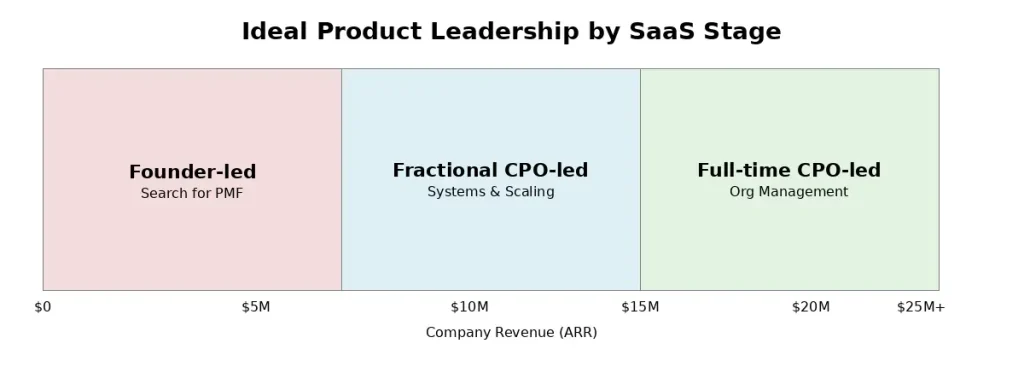
Fractional leadership makes economic sense in the $5M to $15M ARR band because you buy senior product judgment without buying a full-time seat. A full-time CPO runs $250K+ all-in before equity and recruitment. A fractional engagement delivers the same strategic direction for typically 40 to 60 percent less, and preserves the cap table.
I hold this seat part time for B2B SaaS founders. If your product calls still route through you, that is the part I take over.
See how the fractional CPO seat works →You are about to make a $250,000+ mistake.
You’ve hit $5M ARR. Your investors are whispering about professionalizing the C-suite and your engineering team is starting to feel like a feature factory without a blueprint. You think the solution is a heavyweight Chief Product Officer, someone with a shiny resume from a Tier-1 tech giant.
But at $5M ARR, you don’t need a full-time strategist. You need high-level direction and ruthless execution. Hiring a heavyweight CPO too early won’t just bloat your burn rate; it will bore your new hire to death and stall your momentum.
Here is the cold, economic truth about why fractional leadership is the superior play for the $5M to $15M climb.
Key takeaways
- The Cost Gap: A full-time CPO costs ~$400k annually in cash and equity, while a fractional leader provides the same strategic value for typically 40 to 60 percent less.
- The Boredom Trap: Experienced CPOs are managers of managers. At $5M ARR, there isn’t enough organizational work to keep them engaged, leading to high turnover.
- Equity Preservation: Hiring fractional allows you to save 1 to 2 percent of your cap table for the scale-up leader you will actually need at $20M ARR.
- The Hybrid Model: The winning play is a Fractional CPO for strategy paired with a Senior PM for daily execution.
Why do heavyweight CPOs quit or fail at $5M ARR?
Most founders hire for the company they want in three years rather than the one they have. A CPO who managed fifty people at a $100M company is a manager of managers. At $5M ARR the product team is two PMs and a handful of engineers, so there is not enough organizational work to hold them.
“At $5M ARR you do not need a full-time strategist. You need someone who has already made the mistakes you are about to make.”
Sivan Kadosh, Fractional CPO
Most founders hire for where they want to be in three years instead of where they are today.
When you hire a CPO who managed a team of 50 at a $100M company, you aren’t hiring a builder; you’re hiring a manager of managers. At $5M ARR, your product team is likely two PMs and a handful of engineers.
There isn’t enough high-level strategy to fill 40 hours a week. Within six months, one of two things happens:
1. Strategic overkill
They spend $300k of your capital building complex frameworks and vision decks while the actual product velocity slows to a crawl. They are trying to fly a 747 when you are still operating a Cessna.
2. The boredom exit
They realize they are back to writing JIRA tickets and doing QA. They burn out, realize they miss having a VP of Product reporting to them, and leave. Worse, they take 1.5 percent of your equity with them on the way out.
What does the wrong executive hire actually cost?
Cash discipline decides early-stage outcomes, and misallocating it on a role you are not operationally ready for is a quiet way to run out. First Round Review makes the same point about hiring mistakes. What follows is a real engagement, told with the client’s name changed, where exactly that happened.
It’s no secret: in high-growth startups, Cash is King. As you scale, you watch dollars leave the account in piles, not trickles. As First Round Review warns in their analysis of hiring mistakes, misallocating this capital on roles you aren’t operationally ready for is a silent killer for early-stage ventures.
Years ago, I advised a 100% bootstrapped startup hitting $5M ARR. They made the classic move: they hired “Jessie” (alias), a top-tier Ex-Google CPO. The package? A $350k base salary and nearly 1% in restricted shares. Jessie was brilliant, but the founders quickly realized the burn rate was unsustainable.
The issue wasn’t just financial; it was structural. Jessie, accustomed to leading large teams at Google, found herself writing basic specs and arguing over JIRA tickets because there was no budget for the mid-level PMs she needed. As SaaStr emphasizes regarding VP hires, placing a strategic leader in a role that requires 100% tactical grind creates a “mismatch of expectations.”
Within eight months, they parted ways. Sadly, this outcome was statistically probable. According to a study published by Harvard Business Review, nearly 40% of new executive hires fail within their first 18 months. The “divorce” cost them over $200k in cash, but the true damage was higher. Topgrading research estimates the cost of a C-level mis-hire can soar to 27x the base salary when factoring in lost momentum and opportunity costs.
Had they utilized the flexible fractional leadership model, they could have leveraged Jessie’s strategy for typically 40 to 60 percent less than a full-time hire while hiring a Senior PM for execution. Instead, they learned the expensive lesson: the right person at the wrong time is the most expensive mistake you can make.
What does a full-time CPO actually cost in year one?
The seat has a literal price. In 2026 a competent full-time CPO for a growth-stage SaaS company carries a base salary, bonus and benefits, one to two percent of equity, and a recruitment fee at the standard quarter of base. The itemization below sets out what that adds up to. Published pricing is rare in this market: our review of 1,127 provider sites found fewer than 1 in 5 publishing a price at all (the Fractional Rates Index).
Let’s look at the literal cost of the seat. In 2026, a competent, full-time CPO for a growth-stage SaaS will cost you:
- Base Salary: $250,000 to $325,000
- Bonus and Benefits: $50,000+
- Equity: 1 to 2 percent (The most expensive part of the deal)
- Recruitment Fee: $60,000 (standard 25 percent of base)
Total Year 1 Cash Outlay: ~$400,000. A full-time product leader starts at $250K+ all-in and can reach ~$400K fully loaded.
Compare that to a fractional CPO service. For a high-impact engagement, you might pay within the published band of $5,000 to $15,000 a month. Across the wider market the median sits at $5,000 a month, with the middle half between $2,000 and $10,000, so a high-impact engagement sits at the upper end of what gets published.
Total Year 1 Cash Outlay: that band annualized, $60,000 to $180,000.
By choosing a fractional model, you instantly keep over $200,000 in the bank. That is the cost of two senior engineers or a massive increase in your ad spend. At $5M ARR, that cash is lifeblood. On a full-time CPO, it is just overhead.
What is the Product Engine strategy?
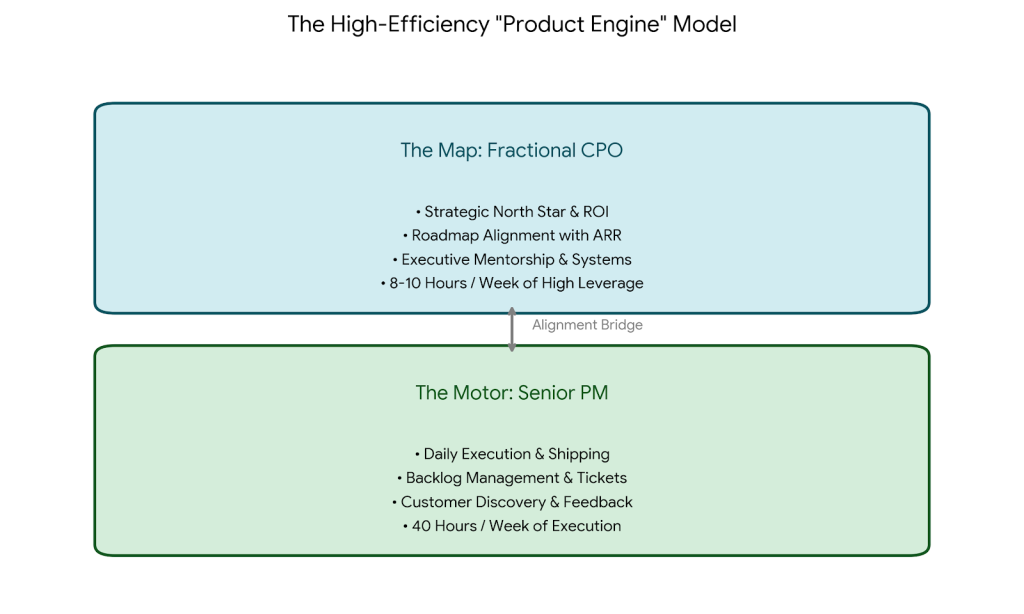
A fractional CPO does not replace a full-time leader one for one. The successful pattern at this stage is different: use the saving to build a product engine, where the fractional CPO sets direction and governance while a senior PM owns day-to-day execution. Two roles, each doing the work it is suited to.
The mistake competitors make is assuming a Fractional CPO replaces a full-time leader 1 to 1. They don’t. They optimize the engine.
The most successful $5M ARR founders don’t hire one expensive leader. They use the savings from a fractional hire to build a “Product Engine” that actually ships:
- The Fractional CPO: Sets the North Star, coaches the team, and aligns the roadmap with ARR goals. (8 hours a week of high-leverage work).
- The Senior PM: Owns the daily stand-ups, talks to customers, and keeps the devs shipping. (40 hours a week of execution).
This duo costs less than one heavyweight CPO but produces triple the output because the fractional leader focuses only on the high-leverage 20 percent of the work.
How does fractional leadership preserve your equity?
Equity is the most expensive currency you have. Giving one and a half percent to a CPO at $5M ARR is a large bet on a person fitting a stage you have not reached. A fractional engagement is fee-for-service and takes none of your cap table, which keeps those chips for the scale-up hire. 72% of published prices are floors with no ceiling, which is why a quoted “from” number tells you less than it appears to.
“Hiring for the company you want in three years is the most expensive way to run the company you have today.”
Sivan Kadosh, Fractional CPO
Equity is your most valuable currency. Giving 1.5 percent to a CPO at $5M ARR is a massive bet. If they aren’t the right fit for the $20M+ stage, you have just diluted yourself for a bridge hire.
A fractional CPO for B2B SaaS doesn’t take 1.5 percent of your cap table. They are a fee-for-service partner. You save your equity for the Scale-Up CPO you will need at $20M ARR. That is the person who has actually taken a company to an IPO or a massive exit.
When should you actually hire full-time?
There is a point where a full-time CPO is the right hire. It arrives at specific milestones rather than a feeling: four or more distinct product squads needing daily organizational management, multiple products or a complex platform ecosystem, and revenue north of $15M to $20M. Before those, the seat outruns the work. The full breakdown is in what a fractional CPO costs.
We aren’t saying you never need an FTE CPO. You do. But usually not until you hit these specific milestones:
- Team Size: You have four or more distinct product squads that require daily organizational management.
- Complexity: You are managing multiple products or a complex platform ecosystem.
- Revenue: You are north of $15M to $20M ARR and the CEO can no longer be the primary vision holder.
Until then, an FTE CPO is a luxury that your P&L cannot justify.
How do you bring order without the $400k price tag?
Your product already works, which is how you reached $5M. The problem now is scaling it without breaking what got you here, and that needs a system rather than a savior. A fractional engagement brings the frameworks of a much larger company without the executive overhead or the burn. That is the shape of a fractional CPO engagement.
Your product is already working. That is how you got to $5M. The problem now is scaling without breaking. You need a system, not a savior.
At SaaS Fractional CPO, we specialize in turning roadmaps into growth engines. We bring the frameworks of a $50M company to your $5M company, without the executive ego or the massive burn rate.
Hire a top fractional CPO and stop the $250k mistake before it starts.
For founders debating between a fractional CPO and a VP Product hire, the comparison page breaks down cost, seniority, and stage fit side by side: Fractional CPO vs VP Product.
Weighing a full-time CPO against a fractional engagement?
Get a senior, ex-CPO read on your biggest product bottleneck in 30 focused minutes. No pitch, no obligation.
Book a Product Strategy SessionI hold this seat part time for B2B SaaS founders. You have read the theory. Owning it week to week is the job.
See how the fractional CPO seat works →What clients say
Read all 18 references“As a product manager, I can say that Sivan is very professional – always looking deeply on the discussed feature to understand end to end its effect on the whole product, and as well the eager to understand what would be the added value to the strategy of the company. Nothing was added without a clear scope of development, a clear understanding of the business owner and a clear way to measure the success or failure of this feature.”
“Leading by example, empowering, mentoring, and growing his product teams, he created great product culture and set us Product Managers up for success. His vision and strategic direction enabled us to create successful products that brought millions of dollars of revenue to the company and its clients.”
“As part of his role as VP Product, he identified creative ideas, developed sharp strategies and built the road map while focusing on customer experience and business needs.”
