
Roadmaps stop working at 20 to 50 employees because the informal coordination that carried a small team disappears. Everyone no longer sits in every meeting, so context has to be written down. Sales and success arrive with their own incentives, and the founder can no longer personally review every decision.
I am the one who decides what gets cut. If everything on your list is a priority, the strategy has not been made yet.
See how a product strategy engagement runs →In the early days of a startup, the “product roadmap” is usually a shared hallucination between the founder and the first two engineers. It exists in Slack snippets, late-night Zoom calls, and perhaps a chaotic Trello board. Communication is high-bandwidth, and the distance between a customer request and a code commit is measured in hours.
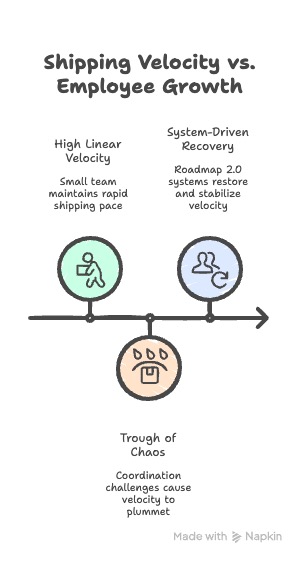
But as a company scales past the 20-employee mark and moves toward the 50-employee “danger zone”, this informal system collapses. Suddenly, the roadmap feels like a list of broken promises. Sales is frustrated that “Feature X” is late; Engineering is burned out by shifting priorities; and the CEO feels like they’ve lost the steering wheel.
This isn’t a failure of talent. It is a fundamental shift in the physics of organization. At 20–50 employees, you are no longer building a product; you are building a machine that builds a product.
Why does informal coordination stop working?
In a five-person team everyone sits in every meeting, so everyone knows why a decision was made without anyone writing it down. By thirty people the number of connections has exploded and that shared context is gone. What replaced it has to be deliberate, because nothing replaces it by default.
“In a 5-person team, everyone is in every meeting. Everyone knows why a decision was made. This is high-bandwidth telepathy.”
Sivan Kadosh, Fractional CPO
In a 5-person team, everyone is in every meeting. Everyone knows why a decision was made. This is “High-Bandwidth Telepathy.”
By the time you hit 30 employees, the “Nodes of Communication” have exploded. According to Metcalfe’s Law, the complexity of a network grows with the square of the number of users. At 10 people, there are 45 potential lines of communication. At 50 people, there are 1,225.
The Roadmap Failure: When you are small, the roadmap is a reminder. When you are medium-sized, the roadmap must be a translator. If your roadmap still looks like a list of features without the “Why” (the strategic intent), the 1,225 lines of communication will fill that void with assumptions, leading to misalignment.
What is the feature factory trap?
Between twenty and fifty employees a company usually hires its first dedicated sales and success teams, and both are compensated on closing and retaining. Their asks arrive as specific features attached to specific deals. Without a filter the roadmap becomes a queue of promises rather than a statement of direction.
Between 20 and 50 employees, companies often hire their first dedicated Sales and Success teams. These teams are incentivized by “Closing” and “Retention.” Consequently, the roadmap stops being a strategic document and starts being a negotiation ledger.
The roadmap becomes a graveyard of “one-off” requests promised to land a specific $50k ACV deal.
- The Result: You aren’t building a cohesive product; you are building a collection of plugins for your loudest customers.
- The Technical Debt: Engineering velocity slows because they are maintaining a fragmented codebase.
- The Roadmap Symptom: Items on the roadmap start sliding “Right” every single month because the team is bogged down by the “unplanned work” of these bespoke requests.
The 1M ARR dilemma: The stats behind “Tuesday Afternoon”
Let’s try a quick honesty exercise: Close your eyes and imagine the scenario. You’ve hit $1M ARR, raised your Series A, and are now managing an operation of 35 people. On paper, the choice seems obvious: invest in building a ‘machine’ that generates consistent MRR growth, or derail everything to chase ad-hoc features. But the real test isn’t theoretical – it’s a Tuesday afternoon in the office. It happens when your VP of Sales bursts into the room, demanding urgent development for a ‘Whale’ client, warning you that ‘the deal will die’ without it.
This is the critical juncture where many startups lose their way, devolving from a scalable Product Company into a glorified Custom Dev Shop, constantly chasing its own tail. Why is this so destructive? The data doesn’t lie. A Pendo report reveals that 80% of features in cloud products are rarely or never used. When you build under pressure for a single client, you are statistically building ‘dead code.’ Furthermore, the real cost is future velocity. According to a study by Stripe, developers waste approximately 42% of their time on ‘bad code’ and technical debt. As explained in an MIT Sloan article on managing technical debt, that ‘Tuesday decision’ is a high-interest loan that will drag your velocity down for years.
The difference between a surviving company and a scaling powerhouse, as SVPG‘s Marty Cagan emphasizes, is the ability to serve a market, not a single customer. To run the marathon, you must adopt the Harvard Business Review mindset: Strategy is primarily about knowing what to say ‘No’ to. Don’t sacrifice the system. Build a roadmap with a defined buffer for the unexpected, but protect the engine that will actually get you to the finish line.
What happens when the founder stops being CPO?
This is the stage where the founder can no longer be the chief product officer. At twenty people a founder can still review every design and every pull request. At fifty that same habit becomes the bottleneck, and the gap between founder and team needs someone in it who can decide.
This is the stage where the Founder/CEO can no longer be the Chief Product Officer.
At 20 employees, a founder can still review every PR or design mockup. At 50, if the founder is still the sole arbiter of the roadmap, they become the ultimate bottleneck. This leads to “The Freeze.” Because the team is waiting for the founder’s “vision,” they stop making autonomous decisions. The roadmap stops working because it requires a single human brain to process more information than is biologically possible. Without a fractional CPO for SaaS or a Head of Product to build a system of prioritization, the roadmap becomes a wish list that no one actually believes in.
How do you shift from output to outcomes?
The deeper reason roadmaps fail at this size is that they still track output: features shipped, integrations built, screens redesigned. None of those say whether anything changed for the business. An outcome-framed roadmap names the result first and leaves the team to work out which feature gets there.
The biggest reason roadmaps fail at 40 employees is that they are still focused on output (features, UI changes, Integrations) rather than outcomes (increasing ARR by 10%, reducing Churn, shortening time-to-value).
When a roadmap is a list of features, it is fragile. If feature A turns out to be harder than expected, the roadmap “fails.” When a roadmap is a list of outcomes, it is resilient. If the team discovers that “Feature A” won’t move the needle on churn, they have the autonomy to pivot to “Feature B” without the roadmap being considered “broken.”
Additional resource: read our case study “From Ad Hoc Features to Strategy-Led Roadmaps“
The framework shift:
- Old way (the roadmap of lies): “We will ship the Salesforce Integration in Q3.”
- New way (the strategic roadmap): “Q3 Focus: Remove friction for Enterprise buyers (target: reduce onboarding time by 30%). Potential levers: Salesforce integration, SSO, improved permissions.”
What are the three tiers of roadmap evolution?
Surviving the transition means replacing one document with three. A strategic north star, updated quarterly and owned by the CEO or CPO, defines the small number of bets. Beneath it sits the outcome roadmap for the next two quarters, and beneath that the delivery detail teams actually work from. One format that suits this stage is the Now-Next-Later roadmap.
“To survive the 20-50 employee transition, you must move from a single document to a three-tier system.”
Sivan Kadosh, Fractional CPO
To survive the 20-50 employee transition, you must move from a single document to a three-tier system:
Tier 1: The strategic North Star (the “why”)
Updated quarterly. Owned by the CEO/CPO. This defines the 2-3 big bets the company is making. If an item doesn’t serve these bets, it doesn’t get on the roadmap.
Tier 2: The tactical roadmap (the “what”)
Updated monthly. Owned by Product Managers. This translates the North Star into specific themes and epics. It uses a “Now / Next / Later” framework rather than specific dates to manage expectations.
Tier 3: The execution backlog (the “how”)
Updated weekly. Owned by Engineering/Design. This is the Jira/Linear world.
Why this fixes the 50-person problem: It allows different departments to engage with the product at the level of detail they need. Sales needs the North Star; Engineering needs the Backlog. When you try to force everyone into one spreadsheet, you get chaos.
What does invisible work cost?
Maintenance, security and bug fixing scale with the product, and none of it appears on a roadmap built for new features. That is the invisible work. A plan that allocates all available capacity to new development is not ambitious, it is arithmetic that ignores the work already committed.
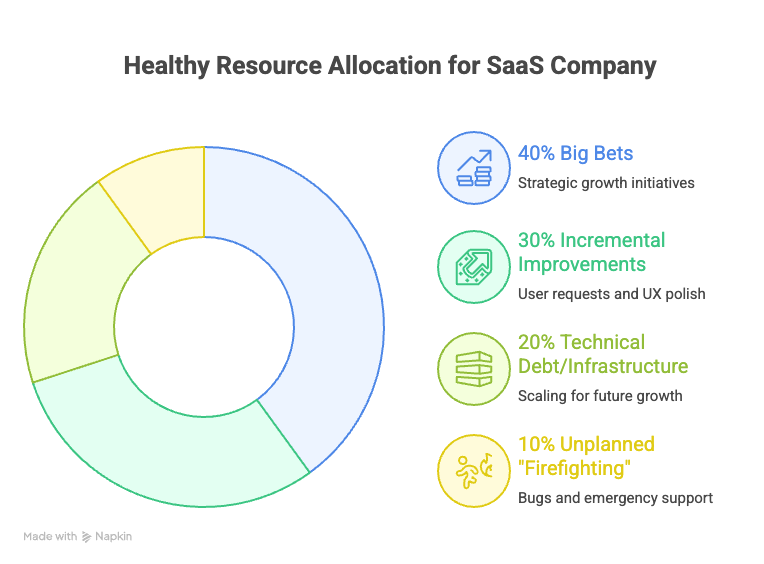
At 20-50 employees, the “Cost of Keeping the Lights On” (maintenance, security, bug fixes) scales. In the early days, this was 10% of your time. Now, it’s 30-40%.
Roadmaps fail because they often account for 100% of the team’s capacity for new features. When the reality of “Invisible Work” hits, the roadmap is the first thing to burn.
The Guideline: At this stage, you must “budget for reality.” Only allocate 60% of your roadmap to new features. The rest is a buffer for technical debt and tactical pivots.
Why is the roadmap a communication product?
At fifty people the roadmap stops being a planning tool and becomes an internal communication product. It has an audience, a message and a release cadence. If people cannot find it, read it, or explain it to someone else, it does not matter how good the underlying prioritization was.
At 50 employees, the Roadmap is no longer a planning tool, it is a marketing tool for your internal team.
You need to “sell” the roadmap to your employees as much as you sell your product to customers. If the team doesn’t understand the “Story” of the roadmap, they will feel like cogs in a machine.
- The Ritual: Implement a monthly “Roadmap All-Hands.”
- The Transparency: Share not just what is being added, but what was cut and why. Information Gain for the team comes from understanding the trade-offs, not just the winners.
Conclusion
If your roadmap stopped working once you hired your 30th employee, congratulations: You have a successful, growing business. The tools that got you to $1M ARR will not get you to $10M.
The roadmap is the “Product Engine’s” dashboard. If the dashboard is flickering or showing “Error,” it’s not because the engine is broken; it’s because the sensors (your processes) haven’t been upgraded to handle the new speed.
Stop trying to fix the roadmap. Start fixing the prioritization system that feeds it. Transition from dates to themes, from features to outcomes, and from founder-intuition to structured strategy. That is how you cross the chasm from a “scrappy startup” to a “scaling powerhouse.”
Most founders at the 20-50 employee stage feel like they are “stuck in the weeds.” You know you need to think bigger, but you’re too busy arbitrating Jira tickets or explaining the vision for the fifth time this week.
You don’t need a $250k full-time CPO yet, you need a product system that runs without you.
Our fractional CPO service is designed specifically for SaaS companies in the “Scaling Chasm.” We help you:
- Build a resilient roadmap: Move from “Feature Factory” to “Outcome-Driven” growth.
- Install governance: Implement the rituals (All-Hands, Prioritization Frameworks) that keep 50+ people aligned.
- Mentor your leads: Level up your existing PMs and Engineers so they can make executive-level decisions.
- Bridge the Sales-Eng gap: Turn the roadmap from a source of conflict into a source of confidence for your sales and success teams.
Ready to stop the roadmap sliding and start shipping with intent?
Stop trying to fix the roadmap. Start fixing the prioritization system that feeds it.
Roadmap stopped working somewhere past thirty people?
Get a senior, ex-CPO read on your biggest product bottleneck in 30 focused minutes. No pitch, no obligation.
Book a Product Strategy SessionFAQs
When roadmaps break at this stage, companies often benefit from bringing in a fractional product manager to bridge the gap between ad-hoc planning and formal product management.
I am the one who decides what gets cut. Frameworks rank the list. Someone still has to say no out loud.
See how a product strategy engagement runs →Why do product roadmaps stop working around 20-50 employees?
Product roadmaps fail at this stage because communication complexity explodes while decision systems stay informal. What worked with 10 people breaks down when priorities must travel across sales, engineering, and leadership without a shared strategic framework.
What is the “coordination tax” in growing SaaS teams?
The coordination tax is the hidden cost of aligning more people across more teams. As headcount grows, decision making slows, meetings multiply, and misalignment increases unless the roadmap evolves from a reminder into a strategic translation layer.
How can a roadmap turn into a Feature Factory?
A roadmap becomes a Feature Factory when it is driven by individual sales requests or internal pressure instead of outcomes. This leads to one off features, low adoption, growing technical debt, and a product that serves loud customers rather than the market.
Why does founder led roadmap decision making become a bottleneck?
At 20-50 employees, a founder can no longer personally arbitrate every roadmap decision. When all prioritization flows through one person, teams slow down, autonomy disappears, and the roadmap becomes unrealistic and constantly delayed.
What is the difference between an output driven roadmap and an outcome driven roadmap?
An output driven roadmap lists features and delivery dates. An outcome driven roadmap defines the business results to achieve, such as reducing churn or increasing activation, and gives teams flexibility to choose the best solution to reach those goals.
Why do roadmaps fail to account for “invisible work”?
Many roadmaps assume 100% of team capacity can go toward new features. In reality, 30–40% of time is consumed by maintenance, bugs, and technical debt. When this work is ignored, roadmap commitments inevitably slip.
What is the three tier roadmap model?
The three tier model separates strategy, planning, and execution. Leadership owns the strategic direction, product managers translate it into themes, and engineering manages delivery details. This prevents overload and keeps each team aligned at the right level.
Do companies at 20-50 employees need a full time CPO?
Most do not. At this stage, companies need product systems, not heavy management layers. A Fractional CPO focuses on installing prioritization frameworks, roadmap governance, and decision rituals that allow teams to scale without founder dependency.
What clients say
Read all 18 references“As a product manager, I can say that Sivan is very professional – always looking deeply on the discussed feature to understand end to end its effect on the whole product, and as well the eager to understand what would be the added value to the strategy of the company. Nothing was added without a clear scope of development, a clear understanding of the business owner and a clear way to measure the success or failure of this feature.”
“Leading by example, empowering, mentoring, and growing his product teams, he created great product culture and set us Product Managers up for success. His vision and strategic direction enabled us to create successful products that brought millions of dollars of revenue to the company and its clients.”
“As part of his role as VP Product, he identified creative ideas, developed sharp strategies and built the road map while focusing on customer experience and business needs.”
