
Escaping the feature factory means changing what the company measures and rewards, not just what it builds. Audit the existing surface and sunset what nobody uses. Tie every initiative to a business outcome before work starts, and give teams problems to solve rather than feature requests to build.
I am the one who decides what gets cut. If everything on your list is a priority, the strategy has not been made yet.
See how a product strategy engagement runs →Let’s be brutally honest: You are wrong.
Yes, you – reading these lines right now. You are falling into the exact same trap as everyone else. The truth? It’s not your fault. For years, we’ve been sold the lie that “activity” equals “progress.”
When I started in tech, I was naive. I thought that the more code I shipped and the more specs I wrote, the more the product would soar. It took time to learn the most expensive lesson of my career: Activity ≠ Progress. The data is shocking: A comprehensive report by Pendo reveals that 80% of features in SaaS products are rarely or never used. Think about that for a second – odds are, four out of five things your team is building right now are simply waste.
Your shareholders don’t care how “hard you worked” or how many features you jammed into the release. They care about one thing: Net MRR. They know how to read the Harvard Business Review studies proving that focusing on Retention is the real engine of growth, and that increasing customer retention rates by just 5% increases profits by 25% to 95%.
That’s why companies that truly understand the game don’t just “ship releases”:
- They hold a KPI gun to the head of every single feature.
- They don’t dare call a feature DONE until it has generated revenue or improved a key metric.
- They stopped measuring Output and started measuring Outcome.
This topic burns inside me, which is why I wrote this article. If you’re tired of running full speed in neutral, keep reading.
Key takeaways
- The maintenance tax: Every new feature increases the complexity of your codebase and the cognitive load of your users.
- The sales-led death spiral: Building bespoke features for specific prospects often leads to a disjointed product that serves no one well.
- The paradox of choice: A product with too many options creates decision paralysis, leading to lower engagement and higher churn.
- Sunsetting as a strategy: Removing low-value features is just as important for growth as launching new ones.
- Outcome over output: Success should be measured by the problems solved for the user, not the number of tickets moved to the “done” column.
Why do teams believe more features is better?
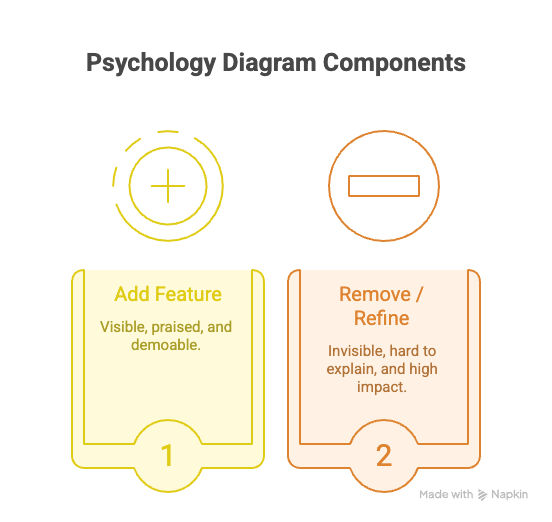
Because adding is visible and subtracting is not. Humans reach for addition when solving problems, and in a company that instinct is rewarded, because a new feature can be demoed, badged in a marketing email, and ticked off a competitive comparison chart. Refining or removing something produces nothing to show.
The “Feature Factory” is a term popularized to describe teams that prioritize the output of features over the outcome of user value. Why do smart teams fall into this trap? It usually starts with a psychological bias. Humans are naturally inclined to solve problems by adding things rather than taking them away. In a professional setting, “adding” is visible and easy to measure. You can demo a new feature to stakeholders. You can put a “new” badge on a marketing email. You can check a box on a competitive comparison chart.
Removing a feature or refining an existing one feels like invisible work. It is harder to explain to a board of directors that you spent three months making the login flow three seconds faster or removing a redundant reporting tool. Yet, these are the improvements that actually drive long-term retention. When a team is incentivized by “shipping,” they stop being problem solvers and start being order takers. The result is a product that feels like a Swiss Army knife where every blade is slightly dull.
What does product sprawl actually cost?
A permanent tax on engineering capacity. Every feature has to be tested against every other one, so ten features are manageable and fifty are not, and a change in billing starts breaking the profile screen. The cost is paid every sprint after the launch, not once at build time.
“Every time you add a feature, you aren’t just adding code. You are adding a permanent tax on your company’s resources.”
Sivan Kadosh, Fractional CPO
Every time you add a feature, you aren’t just adding code. You are adding a permanent tax on your company’s resources. This “maintenance tax” manifests in several ways that eventually grind your innovation to a halt.
Technical debt and complexity
Each new feature must be tested against every existing feature. If you have ten features, the number of potential interactions is manageable. If you have fifty, the complexity grows exponentially. This leads to a situation where a change in the billing module somehow breaks the user profile settings. Your developers spend 80% of their time fixing regressions caused by niche features that only a fraction of your user base actually uses.
Our tip: Take a look at our Product-Dev alignment scorecard
The support and documentation burden
New features require documentation, tutorials, and training for the support staff. When a product becomes “feature soup,” the support volume increases not because the product is broken, but because it is confusing. Users can’t find what they need, so they open tickets. This creates a feedback loop where your support team is overwhelmed, and your product team is too busy building “the next big thing” to fix the underlying UX issues.
The cognitive load on the user
This is the most dangerous cost of all. Every button, menu item, and toggle you add to your interface requires a micro-decision from the user. When a user opens your app, they have a goal in mind. If your interface is cluttered with “helpful” extra features, you are forcing the user to filter out noise to find the signal. Over time, this friction becomes exhausting. Users don’t quit because of a single bug; they quit because the product has become “too much work” to use.
How does sales-led building damage the product?
A large prospect promises to sign if one custom feature gets built, and the revenue is real enough that it looks like a win. The feature arrives outside the product vision, less polished than the core, and serving one account. The company keeps paying for it long after that deal closed.
One of the primary engines of the Feature Factory is the sales department. In many B2B organizations, a “whale” client will promise to sign a massive contract on the condition that the product team builds one specific, custom feature. On the surface, this looks like a win. The revenue is real, and the growth looks good on a spreadsheet.
However, this is a “debt” that is rarely paid off. These bespoke features are often built in a vacuum. They don’t align with the broader product vision, and they usually lack the polish of the core features. Because they were built for one client, they often fail to solve problems for the rest of the market. The same failure seen from the metrics side is covered in why feature velocity hides product failure.
Over time, your product becomes a collection of “one-offs” that make the codebase fragile. More importantly, it signals to your product team that their job is to serve the loudest voice in the room rather than the needs of the average user. When sales leads the product, you lose the ability to build a scalable, cohesive experience. You are no longer building a product; you are running a software consultancy masquerading as a SaaS company.
Why does feature soup kill retention?
Through product dilution. A focused product solves one problem so well that the user reaches a clear moment of understanding. Add enough features and that moment blurs. Someone signs up for one thing, gets pulled into three others they never needed, and leaves without ever seeing what they came for.
Retention is the ultimate metric of product health. It tells you if people actually find value in what you have built. Paradoxically, adding more features often leads to lower retention rates. This happens because of a phenomenon known as “product dilution.”
When a product is focused, it solves a specific problem exceptionally well. This creates a strong “aha moment” for the user. When you add too many features, that “aha moment” gets diluted. The user might sign up for Feature A, but they get distracted by Features B, C, and D, which they don’t need and don’t understand. If they can’t find the value they came for within the first few minutes, they will churn.
Furthermore, “feature soup” makes it impossible to build a community or a brand. If your product does everything for everyone, it eventually stands for nothing. Think of the most successful apps on your phone or desktop. Most of them do one or two things incredibly well. They have resisted the urge to bloat. They understand that a simple tool that works perfectly every time is more valuable than a complex tool that works intermittently.
How do you audit and sunset features?
Start with usage data rather than opinion. Find the long tail nobody opens, and treat anything used by under five percent of daily active users while generating a high share of bug reports as a candidate for removal. Sunsetting is then communicated, given alternatives, and done deliberately.
To escape the Feature Factory, you must learn the art of pruning. Just as a gardener cuts away dead or overgrown branches to allow the rest of the plant to thrive, a product manager must remove features to allow the core product to shine. Pruning works only against a stated direction, which is what a product strategy sets.
Perform a usage audit
The first step is to look at the data. Most products follow the 80/20 rule: 80% of your users spend 90% of their time in 20% of your features. Identify the “long tail” of features that are rarely used. If a feature is used by less than 5% of your daily active users but accounts for a high percentage of your bug reports, it is a prime candidate for the chopping block.
The “red dot” method
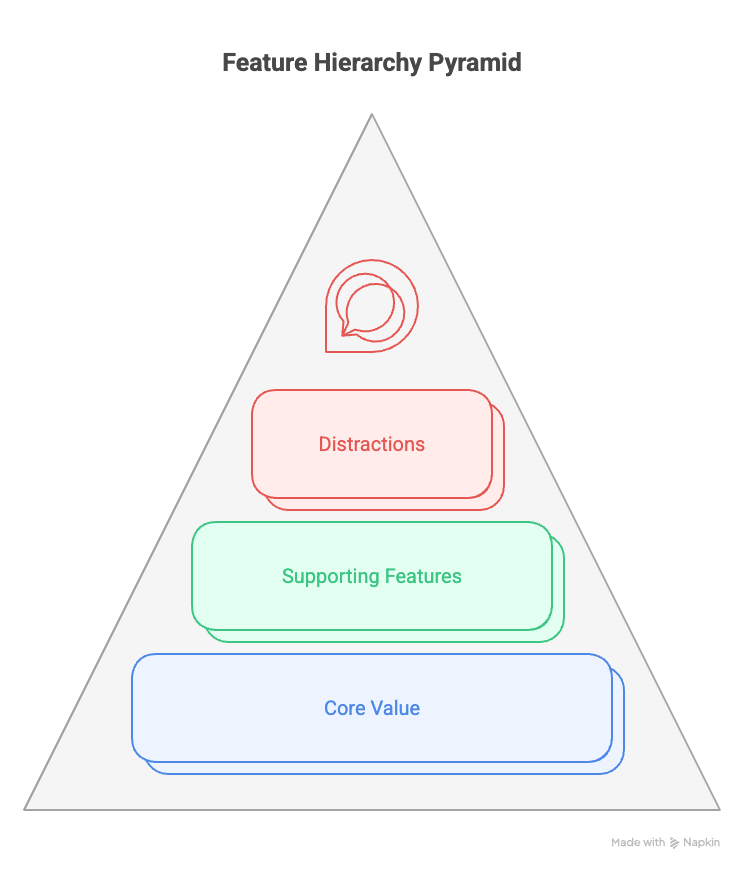
Categorize every feature in your product into three buckets:
- Core: Features that provide the primary value.
- Supporting: Features that make the core features better.
- Distractions: Features that are niche, outdated, or redundant.
Once you have identified the distractions, you need a plan to sunset them. This is not about deleting code overnight. It is a process of communicating with the users who do use those features, providing alternatives, and eventually removing the clutter to simplify the experience for the 95% of users who will benefit from a cleaner UI.
Metric-driven sunsetting
Don’t just remove a feature because you “feel” it is bad. Use metrics. Look at the “return on investment” for each feature. If the cost of maintaining a feature (in developer hours and support tickets) exceeds the revenue generated or the retention it drives, it must go. Making this a data-driven process helps remove the emotion and the internal politics from the decision.
How do you build a culture of outcomes?
Change what counts as finished. In a feature factory a project ends when the code ships. In an outcome-led team it ends when a metric moves, whether that is churn falling, task completion speeding up, or Net Promoter Score rising. A shipped feature nobody uses is a failed project.
“Escaping the factory requires a fundamental shift in company culture. You have to change how you measure and reward success.”
Sivan Kadosh, Fractional CPO
Escaping the factory requires a fundamental shift in company culture. You have to change how you measure and reward success.
Redefine “done”
In a Feature Factory, a project is “done” when the code is shipped. In an outcome-focused organization, a project is “done” when the needle moves on a key metric, such as a reduction in churn, an increase in task completion speed, or a rise in Net Promoter Score. If you ship a feature and no one uses it, the project was a failure, regardless of how “on time” it was delivered.
Reward the “No”
Product leaders should be rewarded for the features they decide not to build. Saying no to a lucrative but distracting request is a brave act that protects the long-term health of the company. Encourage your team to ask: “Does this make our core experience better, or is it just more noise?”
Focus on “Jobs to be Done”
Instead of asking “What feature should we build?” ask “What job is the user trying to do, and where are they struggling?” Often, the answer isn’t a new feature. It might be a clearer label on a button, a faster page load time, or a better onboarding video. These improvements are less flashy than a new module, but they are the secret to high retention.
What does an outside perspective change?
Authority and distance. The chief executive wants growth, sales wants features, and product sits between them without the standing to say stop. Someone brought in from outside did not build any of it, so they can read the data without defending past decisions and mediate rather than take sides.
Often, the “Feature Factory” is a result of organizational inertia. The CEO wants growth, Sales wants features, and Product is caught in the middle. Internal teams often lack the authority or the objective distance to say “stop.” This is where fractional leadership becomes a game changer for scaling SaaS companies.
A fractional CPO (Chief Product Officer) provides the high-level strategy needed to audit a product roadmap without the internal bias that comes from having built those features. They can look at the data objectively, mediate between Sales and Engineering, and implement the processes necessary to shift from an output-focused team to an outcome-focused one. They bring the “pruning shears” that internal teams are often too afraid to use.
Feature factory syndrome often stems from a lack of dedicated product management discipline. A fractional product manager can introduce proper prioritization and discovery processes without a full-time hire.
Conclusion
Pressure to ship more comes from competitors, from sales, and from wanting to feel productive. Shipping for its own sake produces a bloated product and a churning user base. Leadership here means keeping the product simple, pruning what does not earn its place, and solving problems with less friction.
The pressure to ship more is constant. It comes from competitors, from sales, and from an internal desire to feel productive. But shipping for the sake of shipping is a trap that leads to a bloated, confusing product and a frustrated, churn-heavy user base. Real product leadership is about focus. It is about having the courage to keep the product simple, to prune the unnecessary, and to double down on the features that truly matter.
Your users don’t want more features; they want their problems solved with the least amount of friction possible. Stop building a factory and start building a solution. When you stop “running in place” by churning out widgets, you finally gain the traction needed for real, sustainable growth.
Take a hard look at your product’s navigation menu today. Identify the three least-used items and find the data on how many support tickets they have generated in the last six months. Use this data to start a conversation with your stakeholders about “sunsetting” at least one feature this quarter to clear the path for core improvements.
Is your product team stuck in the Feature Factory? It is time to stop the cycle of bloat and start building for retention. At SaaS Fractional CPO, we help SaaS founders and leadership teams move from “shipping features” to “solving problems.”
Book a free consultation to learn how a fractional product leader can help you audit your roadmap, prune your “feature soup,” and implement a strategy that drives real user adoption and long-term growth. Don’t let your core product rot while you chase the next widget. Let’s get your roadmap back on track.
Product bloated and the roadmap still full?
Get a senior, ex-CPO read on your biggest product bottleneck in 30 focused minutes. No pitch, no obligation.
Book a strategy callI am the one who decides what gets cut. Frameworks rank the list. Someone still has to say no out loud.
See how a product strategy engagement runs →What clients say
Read all 18 references“As a product manager, I can say that Sivan is very professional – always looking deeply on the discussed feature to understand end to end its effect on the whole product, and as well the eager to understand what would be the added value to the strategy of the company. Nothing was added without a clear scope of development, a clear understanding of the business owner and a clear way to measure the success or failure of this feature.”
“Leading by example, empowering, mentoring, and growing his product teams, he created great product culture and set us Product Managers up for success. His vision and strategic direction enabled us to create successful products that brought millions of dollars of revenue to the company and its clients.”
“As part of his role as VP Product, he identified creative ideas, developed sharp strategies and built the road map while focusing on customer experience and business needs.”
