
A product operating model is the set of organizational structures and behavioral norms that let a company solve customer problems in ways that also work for the business. It defines how strategy, discovery and delivery connect, who owns outcomes, and how teams are measured. It is the system, not a process.
I do this work inside B2B SaaS product teams. If your team ships every week and the numbers barely move, this is where I start.
See how product management consulting works →For those who haven’t noticed, we are in 2026. If you’ve been operating with your eyes closed until now, let me paint the picture for you: AI is ubiquitous. Today, your customers can use tools like Claude Code to develop almost any software they can imagine in mere minutes. Technological barriers to entry have completely collapsed, competition for every customer is fierce, and Customer Acquisition Cost (CAC) has skyrocketed by 222% in recent years, making every strategic misstep excruciatingly expensive. Simultaneously, smaller companies are vanishing or slashing headcount just to survive, as median SaaS growth rates have plummeted to a low of just 26%, according to the 2025 Benchmarkit Performance Report.
Now that I’ve laid out this reality, you tell me, yes, you, the one reading this article right now: Do you honestly believe this will pass you by? Do you think you are stronger, smarter, or hungrier than the tsunami that has only just begun to sweep through the market? I have one piece of good news and one piece of bad news for you. The bad news is that you are not immune. Recent McKinsey analyses clearly show that AI integration is rewriting the rules of the game, necessitating a shift to autonomous growth models where mediocre products simply will not survive. The good news is that there is a way to handle this, but it will require you and your team to fundamentally shift your State of Mind.
Before diving into the article, let me give you a real-world example. For the past two years, I have been consulting for a SaaS company that developed a Content Management System (CMS) for a highly specific customer segment. Like most startups over the last decade, this company was obsessed with constant motion, churning out feature after feature. But today, when growth no longer happens “by accident,” they hit a wall. My role was to help them shift gears.
This starts with defining the mission and ends with rewriting the organization’s DNA. Instead of the CEO handing down a mandate to the engineering team: “Add an AI button for post writing by the end of the quarter” (a task measuring Output), we shifted the conversation to: “We must reduce the customer’s campaign creation time by 40% to prevent churn” (a mission measuring Outcome).
Why is this critical in 2026? Because your competitors, and even your own customers, can generate the code for that “AI button” with a single click. Code has become a commodity. The true value, the kind that cannot be copied, lies in a deep understanding of the problem and cracking the business solution. This is exactly what the Product Operating Model does: it transforms you from a company selling lines of code into a company selling business success.
Key takeaways
- Shift from Output to Outcomes: Success is no longer measured by shipping features on time (output), but by the measurable impact those features have on customer behavior and business KPIs (outcomes).
- Risk Mitigation at the Source: The POM is designed to address Value, Usability, Feasibility, and Viability risks before expensive engineering resources are committed to development.
- Discovery is a Continuous Track: Product discovery is not a one-off phase; it runs in parallel with delivery to ensure the team is always building the right thing while building the thing right.
- The “Problem” Roadmap: High-performing SaaS organizations replace feature-based roadmaps with a sequence of strategic problems to solve, giving teams the autonomy to find the most efficient solution.
- Executive Alignment is Critical: A successful transition requires the C-suite to shift from “requesting features” to “defining constraints,” treating the product team as a strategic partner rather than an internal service provider.
- The Pilot Squad Approach: Avoid organizational shock by testing the model with a single, high-uncertainty squad before scaling the transformation across the entire company.
- Economic Efficiency: In the current SaaS landscape, the POM is a financial imperative, reducing R&D waste and increasing capital efficiency by focusing solely on high-value initiatives.
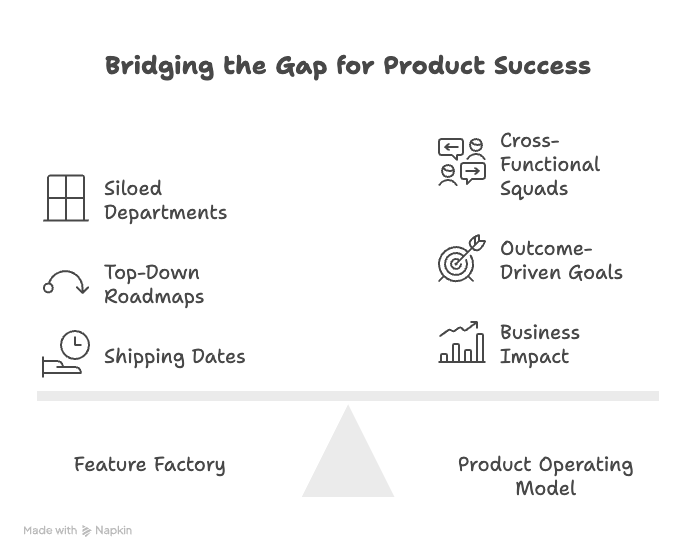
What is a product operating model, beyond the buzzwords?
A product operating model is the set of organizational structures and behavioral norms that let a company solve customer problems in ways that also work for the business. In a project model, teams receive requirements and ship them. In a product model, teams receive problems and own the outcome.
“Most roadmaps are just lists of features with arbitrary dates. In a Product Operating Model, the strategy is a sequence of problems to solve.”
Sivan Kadosh, Fractional CPO
At its core, a Product Operating Model is the set of organizational structures and behavioral norms that allow a company to solve customer problems in ways that work for the business.
In a traditional “Project” model, a business identifies a requirement, funds it, and asks an engineering team to build it. Success is measured by “on time” and “on budget.” In a Product Operating Model, we acknowledge that we cannot know for certain if a feature will work until it is in the hands of the user. Therefore, success is measured by outcomes, changes in human behavior that drive business value.
For the modern CPO, the POM is actually a Risk Mitigation Engine. Instead of taking a massive gamble on a six-month build, the model systematically addresses four key risks before a single line of production code is written:
- Value Risk: Will the customer actually buy or choose to use this?
- Usability Risk: Can the user figure out how to use it?
- Feasibility Risk: Can our engineers build this with the time and technology we have?
- Viability Risk: Does this solution support our business (legal, sales, ethical, and financial constraints)?
What are the three pillars of a mature model?
Three pillars carry the model: outcome-driven strategy, which sequences problems rather than features; continuous discovery, which tests assumptions before engineering time is committed; and technical excellence with continuous delivery, which makes shipping small and reversible. Weakness in any one of them collapses the other two.
To successfully transition to this model, a SaaS organization must rebuild its foundation upon three distinct but interconnected pillars: Strategy, Discovery, and Delivery.
1. Outcome-driven strategy
Most roadmaps are just lists of features with arbitrary dates. In a Product Operating Model, the strategy is a Sequence of Problems to Solve.
Instead of a directive like “Ship the HubSpot Integration by Q3,” a product-led strategy identifies a friction point: “Reduce data-siloing for Enterprise customers to improve expansion revenue.” This allows the team to find the best way to solve the problem, which might be an integration, but might also be an improved API or a better CSV import tool.
2. Continuous product discovery
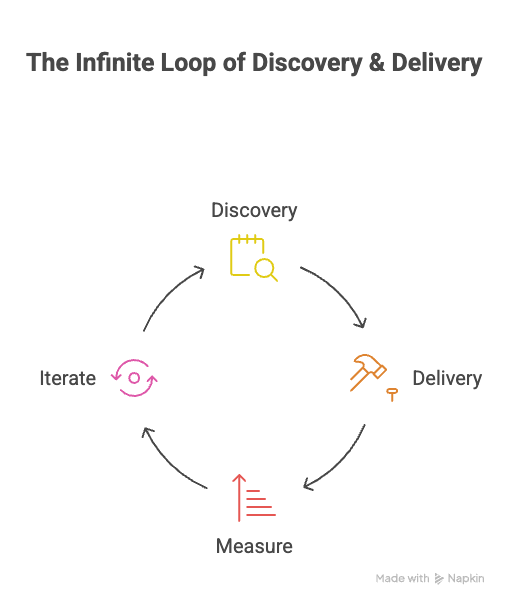
Discovery is the act of separating the “good ideas” from the “bad ideas” quickly and cheaply. In the POM, discovery is not a “phase” that happens before development; it is a parallel track.
While the team is building the current iteration of a feature, they are simultaneously running user interviews, building low-fidelity prototypes, and conducting “Wizard of Oz” tests to validate the next set of assumptions. This ensures the engineering team is never “fed” a requirement that hasn’t already been proven to have value.
3. Technical excellence and continuous delivery
You cannot have a product model if you release once a quarter. Technical agility is the “floor” for a POM. This includes CI/CD (Continuous Integration/Continuous Deployment), automated testing, and a “You build it, you run it” mentality. If the deployment process is painful, the team will naturally revert to large, risky “Big Bang” releases that undermine the entire model.
Why do product operating models fail at the executive layer?
The usual failure point is not the product team. In a traditional model, stakeholders hand down solutions and product delivers them. A product operating model requires the executive layer to hand down constraints and outcomes instead, then leave the solution to the team. That is a harder change than any process.
“The most common reason Product Operating Models fail in SaaS is not the product team. It is the executive layer.”
Sivan Kadosh, Fractional CPO
The most common reason Product Operating Models fail in SaaS is not because of the product team, it is because of the Executive Layer.
In a traditional model, stakeholders (Sales, Marketing, CEO) act as “customers” of the product team. They hand over a list of requirements, and the product team is expected to serve them. In a Product Operating Model, stakeholders are partners.
The “sales vs. product” friction
In B2B SaaS, Sales often feels they need a specific feature to close a specific deal. In a Feature Factory, the Product Manager says “Yes” to keep the peace, leading to a bloated, unmaintainable product.
In a POM, the CPO shifts the conversation from “What feature do you want?” to “What is the business constraint?” If the constraint is “Enterprise clients need better security reporting,” the product team can build a scalable solution that serves all enterprise clients, rather than a bespoke “one-off” for a single deal.
What does a four-stage implementation roadmap look like?
Transition is a marathon rather than a sprint, and a phased approach avoids organizational shock. It begins with a waste audit that establishes how much current effort produces no measurable outcome, then moves through a pilot squad, a widened rollout, and finally the governance cadence that keeps the model in place without a champion.
Transitioning to a Product Operating Model is a marathon, not a sprint. For a scaling SaaS company, we recommend a phased approach to avoid organizational shock.
Phase 1: The “waste” audit
Before changing the structure, change the perspective. Audit the last 12 months of releases. What percentage of those features reached their intended adoption targets? Usually, the “feature bloat” is visible here. Use this data to get executive buy-in for a new way of working.
Phase 2: The pilot squad
Do not attempt a “Big Bang” reorganization. Select one high-priority, high-uncertainty area of the product. Transform this single team into an “Empowered Squad.” Give them a clear business outcome (e.g., “Increase 14-day retention by 15%”) and the autonomy to discover the solution.
Phase 3: Redefining product leadership
As the pilot squad proves the model, the role of Product Directors and VPs must shift. They move from “Roadmap Managers” to “Coaches.” Their primary responsibility becomes providing Context, not Control. They must ensure every team member understands the company’s “North Star” metric and the current strategic constraints.
Our tip: if you want this operating model installed with your team, that is what product management consulting covers.
Phase 4: Scaling with product operations
As you grow to 5+ squads, the “friction of coordination” increases. This is where a Product Operations (ProdOps) function becomes vital. ProdOps doesn’t dictate how to work; instead, they provide the data infrastructure, tooling, and standardized research templates that allow squads to move fast without reinventing the wheel.
What is the economic case for a product operating model?
Growth at all costs is over, and modern SaaS valuation is tied to capital efficiency. A product operating model is structurally more efficient than a project-based one: it validates before it builds, it shortens time to value by shipping smaller increments, and it stops paying for features nobody adopts.
The era of “Growth at All Costs” is over. Modern SaaS valuation is tied to capital efficiency. A Product Operating Model is fundamentally more efficient than a project-based one for three reasons:
- Reduced R&D Waste: You stop spending engineering salaries on features almost nobody uses.
- Faster “Time to Value”: By shipping smaller increments and validating early, you realize revenue from new improvements faster.
- Talent Retention: Top-tier engineers and designers do not want to be “order takers.” They want to solve problems. The POM is the single best tool for attracting and keeping “A-player” talent.
The checklist: Are you actually using a Product Operating Model?
Adopting the vocabulary of a product operating model while keeping feature-factory habits is common and easy to miss from inside. The checklist below tests the real thing: whether teams are measured on outcomes rather than output, whether discovery happens before commitment, and whether executives supply constraints rather than solutions.
It is easy to adopt the terminology of a POM while keeping the old habits of a Feature Factory. Use this checklist to evaluate your true status:
- Outcomes over Output: Are teams measured by “number of features shipped” or “improvement in a business KPI”?
- Engineer Involvement: Are your engineers involved in discovery and user research, or do they only see a ticket once the design is finished?
- Strategy as Problems: Does your roadmap look like a list of dates, or a sequence of customer problems?
- Direct Access: Do product teams have direct access to users and data, or must they go through “gatekeepers” in Sales or Support?
Final thoughts
The transition to a Product Operating Model is often uncomfortable. It requires a high degree of trust and a willingness to be wrong. However, for companies looking to lead their category, it is the only way to build a product that is truly “un-copyable.”
When your team is empowered to solve problems rather than just execute tasks, you unlock a level of innovation that no top-down roadmap can ever match.
How can a fractional CPO build your outcome engine?
The transition is uncomfortable because it asks for trust and a willingness to be wrong in public. Most founders can see the shift is needed and have no one inside who has run it before. A fractional CPO installs the model and then hands it over rather than holding it.
Transitioning to a Product Operating Model is often uncomfortable. It requires a high degree of trust, a cultural overhaul, and a willingness to be wrong. Most founders and CEOs know they need this shift, but they lack the internal bandwidth or specialized expertise to navigate the transition while simultaneously hitting growth targets.
This is where SaaS Fractional CPO comes in. We provide the strategic leadership and “on-the-ground” execution needed to transform your product organization without the overhead of a full-time executive hire.
We help you:
- Audit your current product engine to identify “waste” and bottlenecks.
- Design and launch your first “Empowered Pilot Squads.”
- Coach your existing team members into high-performing product leaders.
- Align your executive stakeholders behind an outcome-driven roadmap.
Stop shipping features and start driving outcomes.
Still shipping features instead of outcomes?
Get a senior, ex-CPO read on your biggest product bottleneck in 30 focused minutes. No pitch, no obligation.
Book a Product Strategy SessionI do this work inside B2B SaaS product teams. Knowing the model is one thing. Someone has to own it every week.
See how product management consulting works →FAQs
What is a product operating model?
A product operating model is the organizational system that defines how a company identifies customer problems, validates solutions, and delivers measurable business outcomes. It connects strategy, discovery, delivery, and executive alignment into one coherent framework. Unlike a project-based model, success is measured by outcomes, not feature completion.
Why is a product operating model important in 2026?
In 2026, AI has reduced technical barriers to entry and made feature replication easy. A product operating model ensures competitive advantage comes from solving meaningful problems and improving business metrics such as retention, expansion revenue, and capital efficiency. It reduces waste and increases return on R&D investment.
What is the difference between a product operating model and a project model?
A project model focuses on delivering predefined requirements on time and on budget. A product operating model focuses on achieving measurable outcomes and reducing risk before committing resources. In a POM, teams are empowered to discover the best solution instead of executing a fixed feature request.
What are the core components of a product operating model?
A mature product operating model typically includes: Outcome-driven strategy, continuous product discovery, technical excellence and continuous delivery, clear executive constraints and alignment and empowered cross-functional product squads. Together, these components transform a company from a feature factory into an outcome engine.
How does a product operating model improve capital efficiency?
A product operating model reduces R&D waste by validating ideas early and continuously. Instead of investing months in building features that fail to drive adoption, teams test assumptions quickly and cheaply. This improves time to value, retention, and overall ROI on product investment.
When should a SaaS company adopt a product operating model?
Most SaaS companies hit a breaking point between $1M and $20M ARR, when feature velocity slows and roadmap chaos increases. If your organization feels heavy, reactive to sales requests, or misaligned around strategy, it is likely time to adopt a product operating model.
Why does a product operating model matter?
It is what lets product scale past the founder. Without it, roadmaps break down around 20 to 50 employees.
How do you implement a product operating model?
Start with clear outcomes and ownership, then align team structure, cadence, and metrics to them.
What clients say
Read all 18 references“As a product manager, I can say that Sivan is very professional – always looking deeply on the discussed feature to understand end to end its effect on the whole product, and as well the eager to understand what would be the added value to the strategy of the company. Nothing was added without a clear scope of development, a clear understanding of the business owner and a clear way to measure the success or failure of this feature.”
“Leading by example, empowering, mentoring, and growing his product teams, he created great product culture and set us Product Managers up for success. His vision and strategic direction enabled us to create successful products that brought millions of dollars of revenue to the company and its clients.”
“As part of his role as VP Product, he identified creative ideas, developed sharp strategies and built the road map while focusing on customer experience and business needs.”
