
Product operations is the function that lets product teams decide faster by fixing the plumbing around them, the data, the tooling and the recurring processes. It does not choose what to build. It makes sure the people choosing have clean information and are not spending their week maintaining spreadsheets.
I do this work inside B2B SaaS product teams. If your team ships every week and the numbers barely move, this is where I start.
See how product management consulting works →The Power of Product Operations: From Data Bureaucracy to High Velocity
Most product organizations do not slow down because people stop caring. They slow down because the information needed to decide is scattered across four tools and three spreadsheets, and assembling it costs a day. Product ops exists to take that day back and give it to the decision.
Anyone who knows me knows I always say this: the product department is the beating heart of the organization. If the product department does low-quality work or is simply too slow, the entire organization suffers. I know this topic can be a bit sensitive for some companies, but for those who can afford it, there is one function that provides a massive force multiplier: the Product Operations (or Product Ops) function.
The primary role of this function is to create a supportive work environment for all product managers in the organization. When I talk about a supportive environment, I mean consolidating data from various systems, connecting management reports, and aggressively removing operational roadblocks.
Before writing any article, I conduct in-depth research. This time, I visited the Product Management community on Reddit, where a recurring complaint is clearly visible: product managers feel they are drowning in “data bureaucracy.” A prominent case recently published there described a growing SaaS company where PMs wasted over 15 hours a week manually collecting data from Jira, Salesforce, and Mixpanel just to prepare a single quarterly report.
This is exactly where Product Ops changes the game. Instead of the product manager acting as a “data secretary,” the Ops function creates a Single Source of Truth. According to industry research and analyses by entities like Reforge that examine product infrastructure, in companies that implemented this model, we saw a 30% decrease in the time spent on process “maintenance” and a direct increase in team Velocity, simply because someone finally removed the operational roadblocks for them.
The conclusion from the field is clear: Product Ops is not just another bureaucratic management layer; it is the “lubricating oil” that keeps the machine from burning out. In this article, I will review in depth the roles and responsibilities of the Product Ops function so you can understand exactly how it can upgrade your product organization.
What does product operations actually do?
It owns the systems around product work rather than the product decisions themselves. Feedback collection, analytics hygiene, release coordination and the rituals that keep teams aligned all sit here, which is why a good product ops function is invisible until it is removed.
“Product Operations, often called Product Ops, is the function that helps product teams work more effectively by improving processes, data visibility, and alignment.”
Sivan Kadosh, Fractional CPO
Product Operations is the function responsible for improving how product teams operate. While product managers focus on what to build and why, Product Ops focuses on how decisions are made, how information flows, and how teams stay aligned.
At its core, Product Ops is about enabling product teams to do their best work. This includes structuring processes, organizing data, and ensuring that insights are accessible when decisions need to be made. Without it, teams often rely on scattered tools, inconsistent workflows, and fragmented communication.
In early stage companies, Product Ops is usually informal. Founders and product leaders handle these responsibilities naturally. As the company grows, however, these tasks become too complex to manage without dedicated ownership.
What makes Product Ops valuable is not that it adds new work, but that it removes inefficiencies that slow teams down. When implemented well, it becomes almost invisible, yet its impact is felt across every part of the product organization.
Why does product operations matter in SaaS?
Because SaaS teams generate more signal than they can process. Every release, experiment and support ticket produces data, and without someone accountable for making that usable it turns into noise that product managers either ignore or spend their week wrangling by hand.
SaaS companies scale differently from traditional businesses. As the product evolves, the number of decisions increases, the number of stakeholders grows, and the volume of data expands. This creates a level of complexity that is easy to underestimate.
At first, everything feels manageable. Teams are small, communication is direct, and decisions are made quickly. Over time, however, things start to slow down. Meetings multiply, priorities become less clear, and teams begin to work in parallel without full alignment.
This is usually the point where companies start feeling the need for structure.
Common issues begin to surface. Product teams may struggle to prioritize effectively because data is scattered across tools. Stakeholders may push conflicting initiatives without a clear framework for decision making. Execution slows down not because teams lack capability, but because they lack clarity.
I have seen teams where talented product managers spent more time gathering information than actually making decisions. In those situations, the problem was not skill, it was the lack of a system that made information easy to access and interpret.
Product Ops addresses these problems by creating structure around how teams operate. It ensures that the right information is available at the right time and that teams are aligned around shared priorities. This is what allows product organizations to scale without losing speed.
What does product ops own?
Insight, process and tooling, in roughly that order of value. Insight means feedback and usage data arriving somewhere findable. Process means the cadence for planning and release actually runs. Tooling means the stack is instrumented consistently enough that two people asking the same question get the same answer.
Product Ops touches several areas of the product organization, all of which are connected to how effectively teams operate.
One of the main responsibilities is improving product processes. This involves standardizing workflows such as roadmap planning, prioritization, and feedback collection. Without consistent processes, teams often reinvent the same workflows repeatedly, leading to inefficiencies and confusion.
Another important area is managing product data and insights. Product teams rely heavily on data, but having data is not the same as using it effectively. Product Ops ensures that data is organized, accessible, and meaningful. This allows product managers to focus on interpretation rather than data collection.
Supporting decision making is closely tied to this. Product Ops helps create clarity by providing context, frameworks, and structured inputs. Instead of decisions being driven by opinions or incomplete information, they become more consistent and aligned with strategy.
Tooling and systems management is another key responsibility. As companies grow, the number of tools used across product, analytics, and communication increases. Without coordination, this leads to fragmentation. Product Ops helps streamline the tool stack and ensure systems work together rather than creating silos.
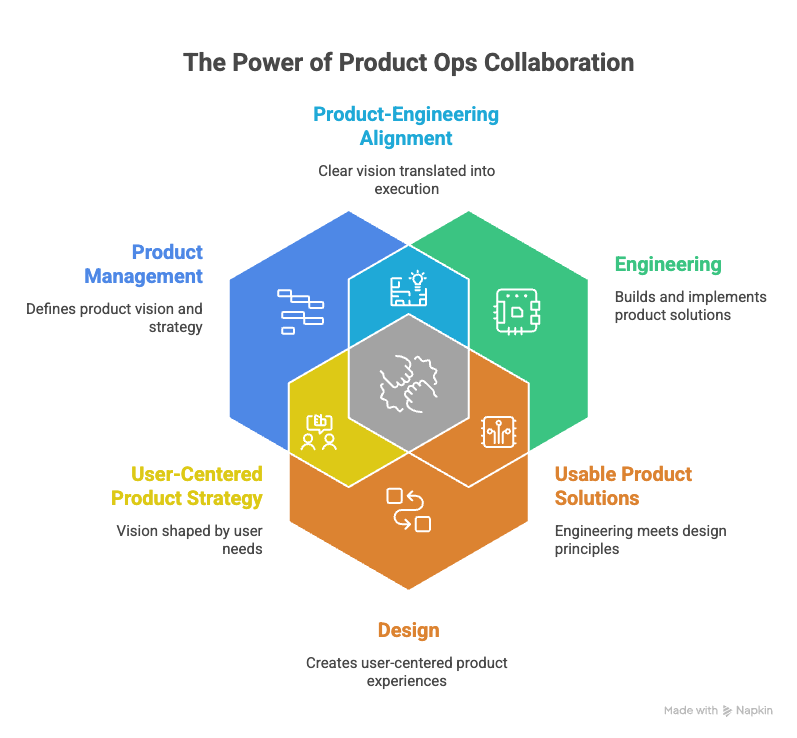
Finally, cross-functional alignment is a central part of the role. Product does not operate in isolation. It interacts with engineering, design, marketing, and customer success. Product Ops helps ensure that these teams are aligned, reducing misunderstandings and improving collaboration.
Where does product ops end and product management begin?
Product management decides what to build and why. Product operations makes sure that decision can be made quickly and revisited honestly. When the two blur, the usual symptom is a product ops team quietly setting priorities because it controls what data anyone sees.
“It does not decide what to build, but it makes sure product teams can make better decisions, faster.”
Sivan Kadosh, Fractional CPO
Understanding the difference between Product Ops and Product Management helps clarify why both functions are needed.
| Area | Product management | Product operations |
|---|---|---|
| Focus | What to build | How teams operate |
| Scope | Product decisions | Processes and systems |
| Goal | Deliver value to users | Enable efficient execution |
Product managers are responsible for identifying problems, defining solutions, and prioritizing work. Product Ops supports them by making sure the environment in which they operate allows them to do this effectively.
In practice, the two functions complement each other. Without Product Management, there is no direction. Without Product Ops, execution becomes inefficient and inconsistent.
When do you need product operations?
Usually once there is more than one product manager, or once insights start scattering across tools nobody has agreed on. Below that a single person can hold it all in their head. Above it, the cost of not having product ops shows up as PMs doing administration.
Not every company needs Product Ops from day one. In early stages, the organization is small enough that coordination happens naturally. As the company grows, however, certain signals start to appear.
One of the clearest signs is a slowdown in decision making. Teams spend more time aligning than executing. Priorities become harder to define, and discussions take longer to reach conclusions.
Another signal is duplication of work. Different teams may solve similar problems independently because information is not shared effectively. This often leads to inconsistent user experiences and wasted effort.
Lack of clarity is another common indicator. When teams are unsure about priorities or how decisions are made, progress becomes uneven.
I have worked with teams that felt overwhelmed not because they had too much work, but because they lacked structure. Once processes and systems were introduced, the same teams were able to move significantly faster without increasing workload.
Product Ops becomes valuable when complexity starts slowing down progress.
How do you implement product ops?
Start with one painful, recurring task and remove it. Pick the report that gets rebuilt by hand every month, or the feedback that lives in four inboxes. Fixing one visible thing buys the credibility to standardize the rest, which is a much easier sell than a reorganization.
Implementing Product Ops does not require building a complex function from the start. It usually begins by identifying where friction exists.
The first step is identifying operational gaps. This involves understanding where teams are struggling, whether it is in prioritization, data access, or alignment. These gaps often become clear through observation rather than formal analysis.
Once gaps are identified, responsibilities need to be defined. Product Ops should have a clear scope, focusing on enabling teams rather than duplicating the role of product managers.
Standardizing processes is the next step. This does not mean creating rigid frameworks, but rather establishing consistent ways of working that reduce confusion. Simple improvements in how roadmaps are structured or how feedback is collected can have a noticeable impact.
Improving data visibility is also essential. Product teams need access to reliable insights without spending excessive time gathering information. This often involves consolidating data sources and creating dashboards that highlight key metrics.
Finally, aligning tools and workflows helps reduce fragmentation. Ensuring that systems are connected and used consistently across teams improves efficiency and reduces friction.
What goes wrong with product ops?
Hiring product ops to fix a strategy problem, which it cannot. Letting it become a reporting layer that produces dashboards nobody acts on. And giving it process ownership without any authority, so it documents the way things go wrong rather than changing them.
One of the most common mistakes is overengineering processes. In an attempt to create structure, some teams introduce too many steps, approvals, or frameworks. This often slows down execution rather than improving it.
Another mistake is focusing too much on tools. While tools are important, they do not solve underlying problems on their own. Without clear processes and alignment, tools can actually add complexity.
Lack of ownership is another issue. Product Ops needs clear responsibility. When it is treated as a shared task, it often does not get the attention it requires.
A disconnect from product teams can also reduce effectiveness. Product Ops should work closely with product managers and understand their needs. If it operates in isolation, it risks becoming disconnected from real challenges.
How product operations evolves as companies scale
Early on it is a part of somebody’s job. In the middle it becomes a dedicated person focused on data and cadence. At scale it splits into specialties, and the risk shifts from having too little process to having process that exists to serve itself rather than the teams.
| Stage | Product Ops focus | Priority |
|---|---|---|
| Early stage | Ad hoc processes | Speed |
| Series A | Structure | Alignment |
| Series B | Optimization | Efficiency |
| Enterprise | Governance | Consistency |
In early stages, Product Ops is informal. As the company grows, structure becomes necessary to maintain alignment. At later stages, optimization and governance ensure consistency across teams.
The evolution of Product Ops reflects the increasing complexity of the organization. Each stage requires a different approach.
How product operations improves SaaS growth
Growth follows decision quality, and decision quality follows how quickly a team can tell whether the last thing worked. Product ops shortens that loop. Nothing it does appears on a roadmap, and the compounding effect on what does appear there is substantial.
Product Ops has a direct impact on growth, even though it does not build features itself. By improving how decisions are made and executed, it enables product teams to focus on what matters most.
Faster decision making allows teams to respond quickly to opportunities. Better prioritization ensures that resources are allocated effectively. Improved alignment reduces wasted effort and keeps teams moving in the same direction.
These improvements often lead to better outcomes in key metrics such as activation, retention, and expansion.
In practice, the impact of Product Ops is often seen in how smoothly teams operate. When processes are clear and information is accessible, teams spend less time navigating complexity and more time delivering value.
When to involve a fractional CPO
When the operating model is the problem rather than the people. Deciding what product ops should own, what it must not own, and how it connects to the roadmap is a leadership design question, and getting it wrong builds a bureaucracy that is hard to unwind later.
As product organizations grow, designing and scaling Product Ops becomes more complex. This is where a fractional Chief Product Officer can provide valuable guidance.
A part-time product leader helps define how Product Ops should function within the organization. This includes designing processes, aligning teams, and ensuring that product strategy is supported by effective operations.
One of the key benefits is perspective. When teams are deeply involved in day to day work, it can be difficult to step back and evaluate how systems are working. An external perspective often brings clarity and identifies areas for improvement.
This often results in faster alignment and more focused execution.
PMs doing administration instead of product?
Get a senior, ex-CPO read on your biggest product bottleneck in 30 focused minutes. No pitch, no obligation.
Book a strategy callBring structure and clarity to your product organization
The aim is not more process. It is less friction between a question and its answer. Every ritual that survives should exist because removing it would make decisions worse, and any that cannot pass that test is overhead wearing the language of rigor.
As SaaS companies scale, complexity increases faster than most teams anticipate. More products, more stakeholders, and more data create an environment where clarity can easily be lost. Without structure, even strong teams can struggle to maintain focus.
Product Operations provides that structure. It ensures that teams are aligned, decisions are informed, and processes support rather than slow down execution. When done well, it creates an environment where product teams can operate with confidence and speed.
A fractional CPO helps bring this structure into place. By connecting product strategy with operational systems, companies can scale more effectively without losing agility. Instead of reacting to complexity, teams can navigate it with clarity.
In many cases, the difference is not in how hard teams work, but in how well their work is organized. Product Ops is what makes that difference visible.
Key takeaways
- Product Operations enables product teams to work more effectively by improving processes, data, and alignment.
- It becomes essential as SaaS companies scale and complexity increases.
- Strong Product Ops improves decision making, prioritization, and execution.
- It complements Product Management rather than replacing it.
- Clear structure allows teams to move faster without adding unnecessary complexity.
I do this work inside B2B SaaS product teams. Knowing the model is one thing. Someone has to own it every week.
See how product management consulting works →FAQs
What is product operations?
Product Operations is the function that improves how product teams work by optimizing processes, data access, tools, and alignment. It enables product managers to make better decisions and execute more efficiently without directly deciding what features to build.
What does a product ops team do?
A Product Ops team manages product processes, organizes and distributes data, supports decision making, maintains tooling systems, and ensures alignment across teams. Its goal is to reduce friction and improve how product teams operate at scale.
When should you hire product ops?
You should consider Product Ops when product teams start slowing down due to complexity, misalignment, or lack of clarity. Common signals include slower decision making, duplicated work, and difficulty accessing reliable data.
How does product ops differ from product management?
Product Management focuses on defining what to build and why, while Product Operations focuses on how product teams work. Product Ops improves systems, processes, and data flow so product managers can operate more effectively.
Why is product operations important?
Product Operations is important because it helps product teams scale efficiently. By improving alignment, decision making, and execution, it allows companies to maintain speed and focus as they grow.
How does a company’s product affect operations?
A company’s product directly shapes its operational complexity, workflows, and decision-making processes. As the product evolves, it influences how teams collaborate, what tools are needed, how data is collected, and how priorities are set. More complex products typically require more structured operations to manage dependencies, align teams, and maintain efficiency. In SaaS, product changes can impact onboarding, customer support, analytics, and revenue processes, making Product Operations essential for maintaining clarity and consistency as the product scales.
What clients say
Read all 18 references“As a product manager, I can say that Sivan is very professional – always looking deeply on the discussed feature to understand end to end its effect on the whole product, and as well the eager to understand what would be the added value to the strategy of the company. Nothing was added without a clear scope of development, a clear understanding of the business owner and a clear way to measure the success or failure of this feature.”
“Leading by example, empowering, mentoring, and growing his product teams, he created great product culture and set us Product Managers up for success. His vision and strategic direction enabled us to create successful products that brought millions of dollars of revenue to the company and its clients.”
“As part of his role as VP Product, he identified creative ideas, developed sharp strategies and built the road map while focusing on customer experience and business needs.”