
SaaS product marketing is the bridge between what gets built and how customers find, adopt and keep using it. It owns positioning, messaging and launch, and it is measured on activation, retention and expansion rather than on leads, because in a subscription business the sale continues after signup.
I have taken products from nothing to launch. If the build is almost done and nobody owns the launch, that is where I come in.
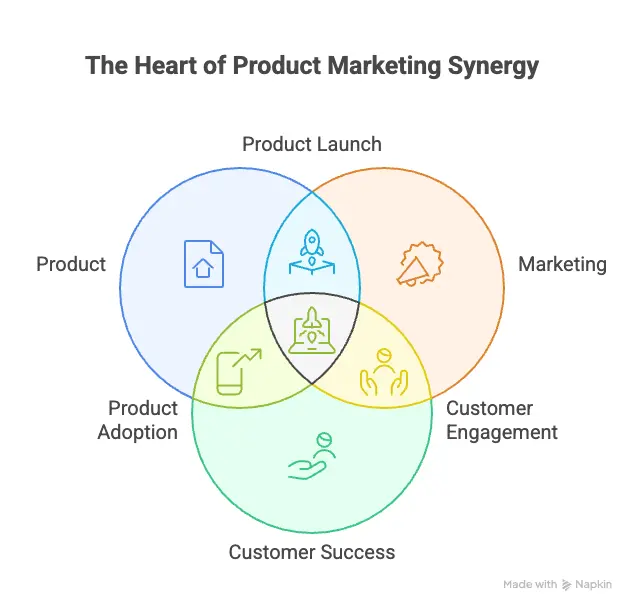
See how a product launch engagement runs →In the competitive world of software-as-a-service, building a great product is only half the battle. The real challenge lies in ensuring that customers find it, understand it, adopt it, and keep using it long-term. That’s where SaaS product marketing comes in, the bridge between product, marketing, and customer success that turns features into growth.
This guide goes beyond definitions and quick tips. It’s a strategic and practical framework that helps SaaS teams align product marketing with every stage of the customer lifecycle, from awareness and activation to retention and expansion.
Key takeaways
- SaaS product marketing connects product strategy, customer insights, and go-to-market execution.
- It extends beyond acquisition, driving activation, engagement, and retention.
- Metrics such as activation rate, churn, and NRR define success.
- Strategies evolve across company stages: early, growth, and expansion.
- A Fractional CPO can help align teams, define priorities, and accelerate outcomes.
What is SaaS product marketing?
The function that connects what engineering ships to what a customer understands. It owns positioning, messaging, launch and adoption, and in SaaS it does not stop at the sale, because a subscription has to be re-earned every month by a product people actually use.
“That’s where SaaS product marketing comes in, the bridge between product, marketing, and customer success that turns features into growth.”
Sivan Kadosh, Fractional CPO
SaaS product marketing is the function that communicates the value of your software to the right audience at every stage of their journey. Unlike traditional marketing, it doesn’t stop at acquisition. It influences how prospects perceive your product, how users adopt it, and how customers expand their usage over time.
In SaaS, the product itself is often the marketing engine. Free trials, freemium models, and in-app experiences drive conversions as much as paid campaigns. Product marketers define the story behind those experiences and ensure that messaging, positioning, and activation are consistent across touchpoints.
A strong SaaS product marketing team understands both the user’s problem and the product’s potential. They translate technical value into emotional and business outcomes that resonate with decision-makers and users alike.
Why does SaaS product marketing matter?
Because a good product nobody understands loses to a worse one that explains itself. Most SaaS churn is not a feature gap, it is a value gap, and closing that gap is marketing work done inside the product rather than around it.
Every SaaS company depends on recurring revenue. Growth doesn’t come from one-time purchases but from ongoing usage, renewals, and expansions. Product marketing sits at the heart of this engine.
A great product marketing function:
- Positions the product clearly in the market.
- Drives user activation and feature adoption.
- Aligns teams around shared metrics like retention and expansion revenue.
- Closes the gap between what the product does and how customers perceive its value.
Without a well-structured product marketing strategy, teams often focus too much on lead generation and not enough on what happens after signup. The result is high churn and stagnant growth.
What are the core pillars?
Research, positioning, messaging, launch and adoption. Research tells you which problem you are actually solving and for whom. Positioning decides what you are the obvious choice for. Everything downstream, from the launch email to the onboarding flow, expresses those two decisions.
“Product marketers define the story behind those experiences and ensure that messaging, positioning, and activation are consistent across touchpoints.”
Sivan Kadosh, Fractional CPO
Effective SaaS product marketing is built on a few key pillars that together shape how you attract, convert, and retain customers.
Positioning and messaging
Positioning defines why your product matters. It clarifies what problem you solve, who you solve it for, and why you’re different. Messaging is how you communicate that story across channels.
In SaaS, great positioning is grounded in real customer insight. Use customer interviews, churn surveys, and onboarding feedback to understand how users describe their pain points. Then build a message house that connects emotional, functional, and business value.
Key actions:
- Define primary personas (economic buyer, end user, technical evaluator).
- Craft a clear, benefit-oriented value proposition.
- Align messaging across landing pages, onboarding emails, and in-app prompts.
Acquisition and activation
Acquisition is about attracting the right users. Activation is about ensuring they experience the product’s value as soon as possible.
Product marketing bridges the two by crafting targeted campaigns and optimizing onboarding flows. In SaaS, your first impression often happens inside the product, not just on your website.
To improve acquisition and activation:
- Use product-led content that educates users about outcomes, not features.
- Map the “aha moment” – the point when users first experience core value.
- Streamline onboarding to reduce time-to-value.
- Align acquisition campaigns with in-product experiences.
Example: A user who signs up from an ad about “team collaboration” should immediately see how to invite teammates once inside the app.
Retention and expansion
Retention is where SaaS profitability is won or lost. Product marketers play a key role by keeping users engaged and uncovering opportunities for upsells or cross-sells.
Strong retention strategy includes:
- Targeted in-app messaging to encourage feature adoption.
- Customer education content that builds long-term value.
- Regular feedback loops to identify churn risks early.
- Campaigns that promote advanced features or higher tiers.
Expansion happens when customers grow with your product. Product marketing drives this through relevant messaging, segmented nurture flows, and success stories that highlight business impact.
Analytics and feedback loops
Product marketing decisions should be data-driven. Understanding what influences activation, engagement, and churn allows teams to act faster.
Essential SaaS metrics include:
- CAC (Customer Acquisition Cost)
- LTV (Lifetime Value)
- NRR (Net Revenue Retention)
- Activation rate
- Feature adoption rate
- Churn rate
Product marketers should build feedback loops with both analytics tools and qualitative data. For example, analyzing drop-offs during onboarding, running post-trial surveys, and reviewing win/loss data from sales.
| Metric | Definition | Primary Owner |
|---|---|---|
| CAC | The cost required to acquire one new customer. | Growth |
| LTV | Total revenue a customer generates over their entire lifecycle. | CS |
| NRR | Percentage of recurring revenue retained including upsells and expansions. | CS |
| Activation Rate | Percentage of users who reach the key actions that define early value. | Product |
| Feature Adoption Rate | Measure of how many users adopt a specific feature. | Product |
| Churn Rate | Percentage of customers who cancel or fail to renew. | CS |
How does product marketing change by stage?
Early on it is one person doing positioning and talking to users. In growth it becomes launch discipline and a repeatable message across channels. At expansion it splits by segment and geography, and the job shifts from explaining the product to defending a category position.
The focus of product marketing evolves as the company grows. What matters at an early stage isn’t the same at scale.
Early stage: finding product-market fit
At this stage, clarity beats complexity. Product marketing focuses on defining the ideal customer profile and crafting messaging that resonates.
- Run small-scale campaigns to test positioning.
- Collect direct feedback from early adopters.
- Measure activation and retention to validate product-market fit.
A strong PMM helps founders translate customer insights into better product decisions and prepares the foundation for scalable growth.
Growth stage: scaling retention and monetization
Once product-market fit is established, the challenge shifts to scale. Product marketing helps systematize user onboarding, feature adoption, and monetization.
- Build lifecycle campaigns to guide users through adoption stages.
- Collaborate with Customer Success to identify expansion opportunities.
- Optimize pricing and packaging based on usage data.
At this stage, the product marketer becomes the voice of the customer internally, ensuring that the roadmap aligns with business growth metrics.
Expansion stage: platform and portfolio growth
For mature SaaS companies, product marketing becomes more strategic. The focus moves from a single product to a multi-product ecosystem or enterprise offering.
- Develop consistent brand messaging across products and markets.
- Localize campaigns for international audiences.
- Enable sales teams with refined positioning and competitive insights.
- Drive cross-product adoption within existing accounts.
| Stage | Primary Focus | Key KPIs |
|---|---|---|
| Early Stage | Validating product market fit, solving the core problem, early activation | Activation rate, onboarding completion, early retention (D7, D30), user feedback volume |
| Growth Stage | Scaling usage, improving feature adoption, increasing conversion and revenue | Feature adoption rate, conversion to paid, CAC payback, MRR growth, churn rate |
| Expansion Stage | Increasing customer value, expanding accounts, improving long term retention | NRR, expansion MRR, upsell rate, customer health score, LTV |
What does a SaaS go-to-market strategy involve?
A plan for who hears about the thing, in what words, through which channel, and what happens in the product when they arrive. The last part is the one most teams skip, and it is the part that decides whether a launch produces signups or customers.
A structured go-to-market (GTM) plan ensures that every product or feature launch drives measurable outcomes.
The three phases of SaaS GTM
- Pre-launch:
- Define goals, audience, and key messages.
- Prepare enablement materials for sales and customer success.
- Test messaging internally before public release.
- Launch:
- Coordinate channels: email, in-app, social, and community.
- Focus on communicating value, not just availability.
- Track early adoption and collect qualitative feedback.
- Post-launch:
- Measure activation and retention of new features.
- Publish case studies or use cases that show ROI.
- Adjust messaging based on data and feedback.
Which trends are reshaping SaaS product marketing?
Product-led motions keep pushing marketing work into the product surface itself, where the trial does the explaining. Meanwhile buying committees have grown and the messaging has to survive being forwarded to someone who never saw the demo. Both trends reward clarity.
SaaS product marketing continues to evolve. New technologies, customer expectations, and regulations are shaping how teams operate.
Product-led and hybrid growth models
More SaaS companies are adopting product-led growth (PLG) strategies. Yet, many now blend PLG with marketing-led or sales-led approaches to reach enterprise buyers. Product marketing is the connector that ensures consistency across all models.
Community and ecosystem-led growth
Modern users trust peers more than ads. Communities and partner ecosystems have become critical channels for adoption and retention.
AI-driven personalization
Machine learning enables real-time personalization in emails, onboarding flows, and in-app prompts. Product marketers can now predict churn, suggest features, and tailor messaging at scale.
Privacy-first and localized marketing
With data regulations like GDPR and CCPA, SaaS companies must build transparent, consent-based engagement. Localizing messaging and offers for regional markets can significantly improve conversions and trust.
Which metrics should you track?
Activation rate first, because it tells you whether the promise and the product agree. Then retention and net revenue retention, which say whether the value held. Lead counts belong on a different dashboard, and treating them as the scoreboard is how product marketing drifts back into demand generation.
To make product marketing measurable, establish a clear set of KPIs and dashboards.
| Metric | What it measures | Why it matters | Owner |
|---|---|---|---|
| Activation rate | % of users reaching first value | Indicates onboarding success | Product Marketing |
| NRR | Revenue retained including expansion | Reflects customer value and satisfaction | Product + CS |
| CAC | Cost of acquiring a customer | Affects profitability | Growth/Marketing |
| LTV | Total revenue per customer | Helps evaluate marketing ROI | Product Marketing |
| Churn rate | % of customers lost | Core retention indicator | CS + PMM |
Tracking these metrics monthly allows teams to spot friction points early and adjust messaging or product strategy.
What are the common pitfalls?
Writing messaging for the buyer and forgetting the user who has to live with the product. Launching a feature and calling it done before anyone has adopted it. And describing capability rather than outcome, which reads well internally and means nothing to someone deciding whether to renew.
Even experienced SaaS teams make mistakes when it comes to product marketing. Recognizing them early can save time and budget.
- Treating product marketing as launch support only: PMMs should own the full customer lifecycle.
- Ignoring feedback loops: Neglecting customer input leads to poor retention.
- Over-focusing on acquisition: Growth comes from activation and engagement.
- Misaligned messaging: Inconsistent communication confuses prospects and teams.
- Undefined success metrics: Without KPIs, it’s impossible to measure progress.
How a Fractional CPO can accelerate your product marketing strategy
Product marketing fails most often at the seam between teams, where product owns the roadmap and marketing owns the message and nobody owns whether they agree. That seam is a leadership problem, and renting the judgment is usually cheaper than hiring a full-time executive.
Many SaaS teams struggle to connect product vision with go-to-market execution. A senior product leader bridges that gap by aligning product strategy, marketing priorities, and business metrics.
A Fractional CPO can:
- Define the strategic foundation of your product marketing efforts.
- Help build measurable go-to-market frameworks.
- Guide alignment between product, growth, and success teams.
- Introduce data-driven processes for prioritizing launches and measuring impact.
Working with one brings senior-level expertise without the cost of a full-time executive, ideal for SaaS companies between early and growth stages.
Ready to align your product and marketing strategy? Partner with a fractional CPO for SaaS to build a data-driven go-to-market engine and scale sustainable growth.Button: Book a Product Strategy Session
Great product, and nobody adopts it?
Get a senior, ex-CPO read on your biggest product bottleneck in 30 focused minutes. No pitch, no obligation.
Book a strategy callBefore wrapping up, I want to share a real example from the field that demonstrates how applying product-marketing principles and data-driven thinking can translate directly into measurable SaaS growth.
Case Study: How Optimizing Onboarding Increased SaaS Conversion by 30%
Not long ago, a SaaS company in the content-management space brought me in to optimize their user onboarding process. At the time, their trial-to-paid conversion rate hovered around 33%, a solid number by most standards, yet the team sensed there was still untapped potential.
Early in the analysis, we realized the “aha moment”, the instant when users truly grasp the product’s value, was taking too long to occur. Research from Gainsight shows that fast, guided onboarding directly correlates with lower churn and higher lifetime value.
To close that gap, we built a smart scraper that automatically pulled content from each customer’s website and converted it into ready-to-use assets inside the CMS. This meant new users didn’t have to start from a blank slate, they immediately saw their own content live within the platform, making the experience both familiar and rewarding.
Over a three-month period, we ran A/B tests, refined messaging, and continuously iterated on the flow. By the end of the cycle, the trial-to-paid conversion rate had climbed to 43%: a 30% improvement over baseline. This aligns with data from First Page Sage, which reports average SaaS trial-to-paid conversion rates of around 18-25% across the industry. Moreover, a Forbes Technology Council piece on client onboarding reports that resolving a customer’s issue on the first interaction can prevent 67% of churn, underscoring just how pivotal the onboarding phase really is.
That project reinforced a truth I see again and again: in SaaS, product marketing isn’t just about generating demand, it’s about designing customer experiences that deliver value as quickly as possible. When users feel that value early, everything else, retention, expansion, advocacy, follows naturally.
Conclusion
The work is not making the product sound better than it is. It is making sure the product, the promise and the first ten minutes of use tell the same story, so the customer who signs up is the customer who stays.
SaaS product marketing is not a single department or campaign. It’s the connective tissue between product, marketing, and customer success that ensures every customer interaction reinforces value.
By combining clear positioning, lifecycle engagement, data-driven insights, and cross-functional collaboration, SaaS companies can build predictable growth systems, not just sporadic wins.
If your team needs help aligning product and marketing around measurable outcomes, a Fractional CPO can provide the leadership and structure to make it happen.
I have taken products from nothing to launch. Plans read well. Launch weeks are where they break.
See how a product launch engagement runs →FAQs
What’s the difference between SaaS product marketing and growth marketing?
Product marketing focuses on positioning, messaging, and adoption, while growth marketing emphasizes experimentation and acquisition channels. Both overlap but serve different goals.
How do you measure SaaS product marketing success?
Track metrics like activation rate, retention, NRR, and LTV. These indicate whether product marketing is driving real business impact.
When should you hire a product marketing manager?
Usually once you have product-market fit and need to scale go-to-market efforts across multiple channels or customer segments.
How do freemium and trial models affect product marketing?
They make activation crucial. Product marketers must design experiences that convert free users into paying customers quickly.
Does localization matter in SaaS product marketing?
Yes. Localized messaging improves relevance and conversion rates in international markets, especially for pricing, onboarding, and support content.
What clients say
Read all 18 references“As a product manager, I can say that Sivan is very professional – always looking deeply on the discussed feature to understand end to end its effect on the whole product, and as well the eager to understand what would be the added value to the strategy of the company. Nothing was added without a clear scope of development, a clear understanding of the business owner and a clear way to measure the success or failure of this feature.”
“Leading by example, empowering, mentoring, and growing his product teams, he created great product culture and set us Product Managers up for success. His vision and strategic direction enabled us to create successful products that brought millions of dollars of revenue to the company and its clients.”
“As part of his role as VP Product, he identified creative ideas, developed sharp strategies and built the road map while focusing on customer experience and business needs.”