Crossing the Chasm to Enterprise: Why Your SMB Roadmap Will Fail Big Clients
January 7, 2026 • 7 min read
Last Updated on February 18, 2026 by Sivan Kadosh
You just lost a $100k contract.
The demo went perfectly. The champion loved the interface. The ROI case was undeniable. You even agreed on the pricing. Then, the deal was handed off to the “IT Security Review,” and it died a quiet, suffocating death.
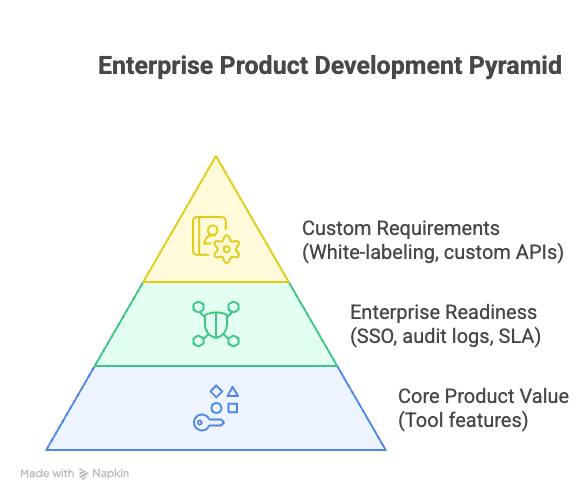
Why? Not because your AI isn’t smart enough. Not because your UX isn’t pretty enough. You lost because you lacked SSO (Single Sign-On), Audit Logs, and Granular Permissions.
Your “move fast and break things” roadmap, which worked perfectly for selling to 50-person startups, is now actively blocking your enterprise revenue. You have hit the Enterprise Chasm.
In the SMB world, features like “Change Management” are annoyances. In the Enterprise world, they are requirements. Here is why your current strategy is failing big clients, and how to pivot without stalling your entire company.
Key takeaways
- The Feature Gap: Enterprise buyers don’t just buy “value”; they buy “compliance.” If you can’t pass the audit, the value doesn’t matter.
- The “Boring Features” Tax: To win six-figure deals, you must allocate 30-40% of your engineering capacity to unsexy infrastructure like SCIM, RBAC, and SOC 2 controls.
- The Two-Speed Roadmap: You cannot stop building for SMBs to focus solely on Enterprise. You need a split-stream strategy that balances innovation with stability.
- The Service Trap: Beware of building “custom features” for one big client. It turns you into a dev shop, not a scalable SaaS.
The fundamental disconnect: Users vs. Buyers
Don’t tell me ‘it won’t happen to us.’ If you don’t prepare for it, it absolutely will. And not only will it happen, but it could also be the difference between dizzying success and a spectacular failure. If you want to start playing in the big leagues, you need a complete shift in your STATE OF MIND.
Your customer is no longer a single user. Large enterprises have multiple layers of management (personally, that’s exactly why I connect less with big corporates :)), and in every one of those layers, there is a stakeholder who needs to verify that your product meets their specific needs. This isn’t just a gut feeling. Research by Gartner clearly shows that the average B2B deal now involves 6 to 10 different decision-makers, each with veto power.
The CIO of the firm has responsibilities and bosses of their own. If you fail to meet their technical and product requirements, they simply won’t approve your tool, and just like that, your $100k check evaporates. Why? Because according to recent security reports, 45% of organizations have experienced a software supply chain attack in the last year, making compliance requirements a concrete wall for immature vendors.
When I prepare to write an article, I usually dive into Reddit. The reason is that I want to give you, the readers, examples from the field, not just theory. I found a discussion there that perfectly illustrates this tragedy, demonstrating what the Harvard Business Review calls ‘The New Sales Imperative’ regarding complex deals. A founder in r/SaaS described how his company fell into the ‘Service Trap,’ building a custom feature for months only to fail a security audit. They ignored the fact that high-customization SaaS companies suffer from significantly lower gross margins (often below 60%, compared to 80% for standard products), making them uninvestable. Don’t be that statistic.
Stop guessing. Start calculating.
Access our suite of calculators designed to help SaaS companies make data-driven decisions.
Free tool. No signup required.
Here is who you are actually selling to:
- The Economic Buyer (VP/C-Level): Cares about ROI. (“Will this save us money?”)
- The Technical Buyer (IT/CTO): Cares about integration and maintenance. (“Will this break my stack?”)
- The Security Buyer (CISO/InfoSec): Cares about risk. (“Will this leak our data?”)
Your current roadmap is likely optimized 100% for the User. But if you cannot satisfy the Technical and Security buyers, the deal never happens. You are building a Ferrari that the mechanic refuses to let on the track.
The “Boring Features” you must build right now
If you want to close six-figure deals in 2026, you need to stop building “exciting” features for a quarter and build the boring infrastructure that enterprises demand. We call this the “Enterprise Tax.”
1. Granular Permissions (RBAC)
A 20-person startup is fine with “Admin” and “Member” roles. A 5,000-person corporation is not. They need Role-Based Access Control (RBAC). They need to define custom roles where a “Regional Manager in EMEA” can see data for their region but not modify billing, and can only export 50 records a day.
- The Roadmap Pivot: You need to abstract your permission logic from “Boolean” (Yes/No) to “Policy-Based” (User X has Policy Y on Resource Z).
2. Identity Management (SSO & SCIM)
Enterprise IT departments will not manually create accounts for 500 users. It is a security risk and a waste of time.
- SSO (Single Sign-On): They demand integration with Okta, Azure AD, or Ping Identity.
- SCIM (System for Cross-domain Identity Management): This is the killer. When an employee is fired at 9:00 AM, IT expects their access to your tool to be revoked at 9:01 AM automatically via API. If you rely on manual removal, you are a security liability.
3. Comprehensive Audit Logs
Enterprises operate in a world of litigation and compliance (HIPAA, FINRA, SOC 2). They need to know who did what, and when.
- The Requirement: If a sensitive record is deleted, they need a verifiable, immutable log showing exactly which user performed the action, from what IP address, at what timestamp. This log must be exportable to their own SIEM (Security Information and Event Management) system.
4. Change Management (Sandboxes)
You push code on Friday afternoon. That terrifies an Enterprise. They need a “Sandbox Environment” to test your new update before it hits their live production data.
- The Roadmap Pivot: You need to architect your system to support multi-tenant environments where data can be cloned for testing.
| Feature | SMB Expectation | Enterprise Expectation |
| Authentication | Email/Password or Google Login | SAML 2.0 / OIDC (Okta, Azure AD) |
| User Mgmt | Manual Invite via Email | Auto-provisioning via SCIM |
| Roles | Admin / User | Custom RBAC (Read/Write/Delete per resource) |
| Support | Email / Chat | Dedicated CSM + SLA (99.9% Uptime guarantee) |
| Data | CSV Export | API Access + Data Residency (EU vs US) |
The danger of the pivot: The “Service Trap”
There is a massive trap waiting for you as you cross this chasm. A huge client (say, Coca-Cola or Nike) will say: “We will sign this $200k contract, BUT only if you build this one specific feature exactly how we want it.”
This is the Service Trap.
If you say yes, you are no longer a SaaS company; you are a custom dev shop for Coca-Cola. You will build a feature that is so specific to their workflow that no other customer can use it. Your codebase becomes forked, your maintenance costs explode, and your valuation multiple crashes (because investors hate service revenue).
The CPO Solution: A fractional CPO acts as the buffer. We negotiate the “Problem,” not the “Solution.” We find a way to build a generalized version of that feature that helps the big client but is also applicable to the rest of the market.
The solution: The “Two-Speed Roadmap”
How do you build all these boring compliance features without stopping the innovation that makes your product special? You cannot pause the company for six months.
You need a Two-Speed Roadmap.
Speed 1: The Innovation Track (60% of capacity)
This track is focused on your core differentiation and your SMB base. It’s about speed, UX, and AI features. This keeps your top-of-funnel marketing alive and ensures you don’t lose your product lead to faster competitors.
Speed 2: The Enterprise Track (40% of capacity)
This is a dedicated squad focused solely on “Enterprise Readiness.”
- Their Backlog: It is not driven by user ideas. It is driven by the “Security Questionnaires” and “RFPs” (Request for Proposals) that your sales team is failing.
- Their Metric: Their success is measured by “Unblocked Revenue” (deals that can now close because the feature exists).
By separating these streams, you ensure that the “boring” work gets done without suffocating the creativity of the rest of the team.
Bridging the gap without breaking the bank
Moving upmarket is the only way to build a $100M+ company. Churn is lower, LTV is higher, and the contracts are multi-year. But it requires a different type of product discipline.
You can no longer “wing it” based on intuition. You need a structured approach to requirements, compliance, and technical debt.
A fractional CPO provides the experience of someone who has already navigated this transition. We help you define the minimal viable set of enterprise features needed to close your next five big deals, so you don’t overbuild before you are ready.
At SaaS Fractional CPO, we turn your roadmap from an enterprise blocker into an enterprise enabler.
Stop losing deals to the security questionnaire.

Sivan Kadosh is a veteran Chief Product Officer (CPO) and CEO with a distinguished 18-year career in the tech industry. His expertise lies in driving product strategy from vision to execution, having launched multiple industry-disrupting SaaS platforms that have generated hundreds of millions in revenue. Complementing his product leadership, Sivan’s experience as a CEO involved leading companies of up to 300 employees, navigating post-acquisition transitions, and consistently achieving key business goals. He now shares his dual expertise in product and business leadership to help SaaS companies scale effectively.