Customer Discovery: A Strategic Guide for SaaS Founders and Product Leaders
February 24, 2026 • 11 min read
Last Updated on February 27, 2026 by Sivan Kadosh
TL;DR: Customer discovery is a structured process used to validate who your target customers are, what critical problems they experience, and whether they are willing to pay for a solution, before scaling product development or go to market efforts.
It focuses on testing assumptions through direct conversations and evidence, not opinions or feature requests.
I clearly remember the first time I fell in love. Her name was Keren. I was 16, and the feeling was so overwhelming that I was completely blind to all her flaws and shortcomings. This happens to many organizations as well: they have a strategy, and they fall in love with it. They fail to see its blind spots, they ignore where it’s falling short, and they force the entire organization to align with it.
But there is one thing that will never align with a bad strategy: the customers.
In the AI era, or rather, the AI tsunami currently crashing over us, the ‘secret sauce’ of winning organizations is the ability to conduct continuous, uncompromising Customer Discovery. If companies truly connect with their customers’ actual needs, not just going through the motions, and not convincing themselves and their users of what they ‘really’ want, their chances of success skyrocket.
In this article, I am going to peel back the layers of this ‘managerial romance’ and show you how to build a relationship based on facts, not fantasies. In the SaaS world, blind love for an unvalidated strategy quickly turns into a multi-million-dollar liability. The data backs this up: according to CB Insights, 42% of startups fail simply because there is ‘no market need,’ while product analytics firm Pendo found that a staggering 80% of SaaS features are rarely or never used.
When a CEO or Product Manager falls in love with a feature, they stop listening. Instead, they start ‘selling’ the problem to the customer. They believe they are doing discovery, but in reality, they are just seeking validation for what they have already decided to build, a phenomenon widely discussed in professional communities like Reddit and known in behavioral economics as the ‘Confirmation Bias.’
We are going to dive into a practical methodology that will help you take emotion out of the equation and replace it with hard data and real market signals. We will understand why most of your customer interviews are just ‘white noise,’ how to identify the critical pain points that actually make organizations open their wallets, and how AI can become your most powerful research tool, provided you know how to ask the right questions.
If you are ready to look the truth (and your customers) in the eye, let’s dive in.
What is customer discovery?
Customer discovery originated from the Customer Development model introduced by Steve Blank. The core idea is simple, do not build before you understand the customer.
In SaaS, customer discovery helps answer four strategic questions:
- Who is the real target segment?
- What urgent problem are they trying to solve?
- How are they solving it today?
- Would they switch and pay for a better solution?
Without disciplined discovery, teams optimize features instead of solving meaningful problems.
What customer discovery really means in practice
In theory, it sounds simple. In practice, most teams skip the hard parts.
Stop guessing. Start calculating.
Access our suite of calculators designed to help SaaS companies make data-driven decisions.
Free tool. No signup required.
In the companies I work with, customer discovery answers four critical questions:
- Are we targeting the right segment?
- Is the problem frequent and costly?
- Is it painful enough to trigger switching behavior?
- Is there budget attached to solving it?
If one of these is weak, scaling is premature.
Customer discovery vs product discovery vs market research
I regularly see teams confuse these concepts.
Here is how I differentiate them when advising leadership teams:
| Discipline | What it validates | When it happens | Primary output |
| Customer discovery | Problem and segment | Before scaling build | Evidence of demand |
| Product discovery | Solution direction | During feature design | Validated solution |
| Market research | Market opportunity | Strategic planning | Market sizing and positioning |
If you skip customer discovery and jump to product discovery, you risk optimizing the wrong solution.
How to run customer discovery in SaaS companies
Step 1: document assumptions explicitly
Most founders believe their assumptions are obvious. They are not.
Before interviews, I require teams to write:
- Who exactly we believe has the problem
- What triggers the pain
- How they solve it today
- What financial or operational impact exists
Vague assumptions produce vague interviews.
Clarity forces accountability.
Step 2: interview the right people, not the most available ones
In B2B SaaS, this is where teams fail.
I do not allow interviews with:
- Friends
- Existing fans
- Users who already bought
Instead, we prioritize:
- Decision makers
- Recently churned accounts
- Prospects who said no
- Companies actively using competitors
This produces uncomfortable but high value insights.
Step 3: focus on past behavior, not future hypotheticals
One rule I enforce:
Never ask, “Would you use this?”
Ask: “Tell me about the last time this problem caused measurable impact.”
When someone says: “We lost two deals last quarter because we could not track usage signals.”
That is signal.
When someone says: “That sounds interesting.”
That is noise.
Step 4: synthesize patterns, not quotes
A single passionate interview does not validate a segment.
I look for:
- Repeated language
- Shared switching triggers
- Consistent economic impact
- Clear urgency
If only 2 out of 15 interviews show strong pain, we are not ready to scale.
Frequency beats enthusiasm.
Customer discovery in B2B SaaS is different
Many articles assume a simple buyer user dynamic. That is rarely true.
In enterprise and mid market SaaS, I map stakeholders explicitly:
- Champion
- Economic buyer
- Technical gatekeeper
- End user
Each has different incentives. If you only interview users, you may validate usability but miss viability.
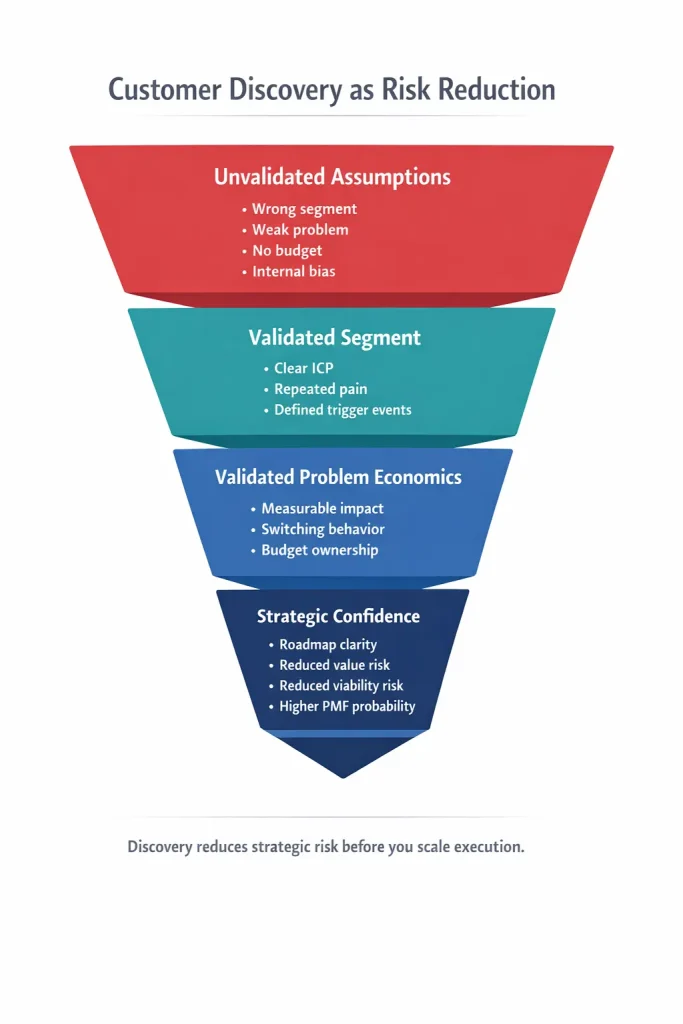
How customer discovery reduces product risk
In my advisory work, I frame discovery as risk reduction.
Borrowing from the product risk model discussed by Marty Cagan, discovery primarily reduces value and viability risk.
| Risk | How discovery addresses it |
| Value risk | Confirms the problem is urgent |
| Viability risk | Identifies budget and willingness to pay |
| Usability risk | Reveals workflow context |
| Feasibility risk | Surfaces integration constraints early |
When discovery is weak, roadmaps become guesswork.
Customer discovery for growth stage SaaS
Discovery is not just for pre product market fit.
I often reintroduce structured discovery in companies that already have revenue.
For churn reduction
Interview:
- Recently churned customers
- Downgraded accounts
- Accounts stuck in onboarding
You will often discover segment drift, not feature gaps.
Before pricing changes
I have seen companies increase pricing based on competitor benchmarks instead of customer insight.
Discovery before pricing changes should validate:
- Perceived differentiation
- Switching cost
- Budget ownership
Without this, price increases trigger silent churn.
Our tip: read more in our ultimate guide to usage based pricing or try out our free Pricing Impact Calculator
Before entering new verticals
Adjacent segments are rarely identical.
Discovery must validate:
- Regulatory differences
- Buying cycles
- Internal workflows
Assuming similarity is expensive.
AI in customer discovery
AI has meaningfully improved how I run synthesis, especially when volume increases.
In the past, interview analysis meant manually reviewing recordings, tagging notes, and trying to detect patterns across messy documents. That process was slow and highly dependent on individual interpretation.
Today, AI tools can:
- Transcribe interviews instantly with high accuracy
- Cluster themes across multiple conversations
- Detect recurring language patterns
- Highlight emotional signals and intensity
- Surface contradictions between segments
For example, when running 20 to 30 interviews within a defined ICP, AI can quickly reveal that certain phrases repeat consistently, such as “manual workaround,” “Excel export,” or “approval bottleneck.” That accelerates pattern recognition and reduces bias in early synthesis.
AI is particularly useful for:
- Comparing responses across roles, such as user vs economic buyer
- Identifying differences between churned and retained customers
- Quantifying how often specific pain points appear
However, AI improves processing. It does not generate signal.
Common customer discovery failures
After running customer discovery inside early stage and growth stage SaaS companies, these failure patterns repeat consistently. Discovery does not fail because teams lack intelligence. It fails because leadership systems are misaligned.
Here is what that looks like in practice.
Leadership already decided the solution
This is the most common failure.
A founder or executive has a strong belief about what should be built. Interviews are then conducted to validate that belief, not to test it.
You can spot this immediately in how questions are framed:
- “How useful would it be if we automated this?”
- “Would this feature help your workflow?”
These are not discovery questions. They are persuasion attempts.
When leadership has already committed emotionally to a solution, interviews become a formality. The team hears what supports the decision and ignores contradictory signals.
Real discovery requires leadership to suspend attachment to the solution and remain attached to the problem.
If the outcome of interviews cannot change the roadmap, discovery is not real.
Sales drives roadmap without validation
Sales conversations are valuable, but they are not structured discovery.
Sales incentives are tied to closing deals. That naturally biases feedback toward:
- Large prospects
- Custom feature requests
- One off enterprise demands
When roadmap decisions are driven by the loudest or highest value deal without segment validation, the product becomes fragmented.
I have seen companies accumulate dozens of features tied to specific deals that do not generalize across the broader ICP. This increases complexity and reduces product clarity.
Customer discovery asks a different question:
Is this pain repeated across a defined segment, or is this a single customer customization?
Without that discipline, sales influence can slowly erode product strategy.
PMs conduct interviews without hypothesis framing
Another common failure is “open ended interviewing” with no documented assumptions.
When PMs conduct interviews without clearly defined hypotheses, three problems emerge:
- Interviews drift into general feedback
- Data becomes hard to synthesize
- Insights feel subjective
Before interviews begin, assumptions must be written down:
- We believe Segment X experiences Problem Y at Frequency Z
- We believe current alternatives are insufficient because of A and B
This framing gives interviews direction and makes synthesis measurable.
Without hypotheses, teams collect stories. With hypotheses, teams test assumptions.
No structured synthesis
Many companies conduct interviews and stop at notes.
Synthesis is where discovery becomes strategic.
I look for structured clustering:
- Repeated phrases
- Similar trigger events
- Common economic impact
- Consistent switching drivers
If insights remain scattered across Notion pages or call recordings, they cannot influence decisions.
Synthesis should result in:
- Clear segment validation or rejection
- Confidence levels attached to assumptions
- Updated hypothesis statements
If there is no structured output, discovery becomes anecdotal.
Discovery disconnected from planning
This is the most subtle but damaging failure.
Teams may run interviews. Insights may even be strong. But quarterly planning proceeds independently.
Roadmap discussions revert to:
- Feature velocity
- Competitive pressure
- Internal stakeholder requests
Discovery must feed directly into prioritization.
In high performing teams, every major initiative is tied to validated insight. If discovery does not shape roadmap tradeoffs, it becomes a parallel activity with no leverage.
When discovery is disconnected from planning, it feels productive but changes nothing.
Discovery becomes theater
When any of these patterns exist, discovery becomes theater.
Interviews are conducted. Notes are shared. Leadership nods. The roadmap remains unchanged.
Real discovery must have the power to:
- Kill initiatives
- Refocus segments
- Delay launches
- Shift strategy
If discovery cannot alter direction, it is not discovery. It is performance.
Customer discovery is uncomfortable precisely because it challenges assumptions. When done properly, it reduces risk. When done superficially, it simply creates the illusion of rigor.
Embedding customer discovery into your operating model
In high performing SaaS companies, discovery is continuous.
Here is a simple operational model:
- 2 to 5 interviews per week
- Dedicated synthesis block
- Evidence reviewed before quarterly planning
- Hypotheses tracked and updated
Discovery should feed roadmap prioritization directly.
When to bring in a fractional CPO
I am typically brought in when growth has stalled despite strong execution.
Common signals include:
- Teams are shipping consistently but retention or expansion revenue is not improving
- Strategic decisions are driven by internal debate rather than validated customer insight
- The company is entering new segments or changing pricing without clear evidence
A fractional CPO brings three critical capabilities:
- A structured customer discovery system tied to clear hypotheses
- Senior level interviewing and synthesis that cuts through noise
- Direct alignment between discovery insights and revenue strategy
Customer discovery is simple in concept and difficult in execution.
If your organization lacks a disciplined discovery system, that gap will eventually show up as churn, stalled growth, or failed launches.
Structured discovery is not a startup ritual. It is a leadership discipline.
Key takeaways
- Customer discovery is a structured risk reduction process, not casual customer conversations. Its purpose is to validate segment, problem, and willingness to pay before scaling build or go to market.
- Strong discovery focuses on past behavior and measurable impact, not hypothetical interest in future features.
- In B2B SaaS, discovery must account for multiple stakeholders, including users, champions, and economic buyers.
- Discovery only creates value when it directly influences roadmap and strategic decisions. If it cannot change direction, it becomes theater.
- AI can accelerate synthesis and pattern recognition, but it cannot replace real conversations with real customers.
- Continuous discovery embedded into your operating model leads to better prioritization, stronger retention, and more predictable expansion revenue.
Frequently asked questions
What is customer discovery in simple terms?
Customer discovery is the structured process of validating who your customers are and what urgent problems they face before scaling product development. It focuses on real conversations and behavioral evidence, not assumptions.
How many interviews are enough for customer discovery?
You are looking for pattern repetition within a defined segment. In most B2B contexts, strong signal begins to appear after 10 to 20 focused interviews, but only if the segment is tightly defined.
Is customer discovery only for startups?
No, customer discovery is not only for startups. Growth stage SaaS companies use customer discovery to reduce churn, validate pricing, test new segments, and strengthen expansion strategy.
Can AI replace customer discovery interviews?
No. AI can accelerate transcription and synthesis, but it cannot replace direct human conversations that surface nuance, hesitation, and emotional signals.

Sivan Kadosh is a veteran Chief Product Officer (CPO) and CEO with a distinguished 18-year career in the tech industry. His expertise lies in driving product strategy from vision to execution, having launched multiple industry-disrupting SaaS platforms that have generated hundreds of millions in revenue. Complementing his product leadership, Sivan’s experience as a CEO involved leading companies of up to 300 employees, navigating post-acquisition transitions, and consistently achieving key business goals. He now shares his dual expertise in product and business leadership to help SaaS companies scale effectively.