Founder-Led to Product-Led: How to Step Back Without Crashing the Company
February 4, 2026 • 10 min read
Last Updated on February 27, 2026 by Sivan Kadosh
If you have found your way to this article, you likely already feel it in your gut, even if it is hard to admit out loud. You have transitioned from being the company’s engine to becoming its bottleneck. You are no longer the growth accelerator but the factor holding it back. If this company matters to you, and you want to break through your current ceiling, you must do the scariest thing for a founder: let go.
This is not just a matter of personal comfort; it is an existential threat to the business. The data proves that without this shift, your survival odds plummet. According to comprehensive research by Startup Genome, 74% of high-growth startups fail due to premature scaling, often because they attempt to grow before establishing the systems necessary to replace the founder’s centralization.
I know how difficult this is because I have been there myself. However, the statistics from the Harvard Business Review do not lie. By the time ventures reach their third round of financing, 52% of founders are replaced by professional CEOs because they failed to make this transition themselves. Your goal is to avoid becoming part of that statistic. You must build an organization where your DNA and vision are encoded into every line of code, even while you focus on strategy rather than execution. In the following article, I will provide the exact roadmap on how to achieve this.
Key takeaways
- The founder bottleneck: Understand why being the primary decision maker prevents your company from scaling past its current ceiling.
- Codifying the soul: How to document your product vision and principles so others can make decisions with your “intuition.”
- The hiring transition: Choosing between a Senior PM, a Head of Product, or a Fractional CPO based on your current stage.
- Systems over heroics: Transitioning from reactive feature requests to a systematic discovery and delivery process.
- The psychological shift: Moving from “The Decider” to “The Visionary” and learning to trust your team’s process.
The founder bottleneck: why your involvement is killing growth
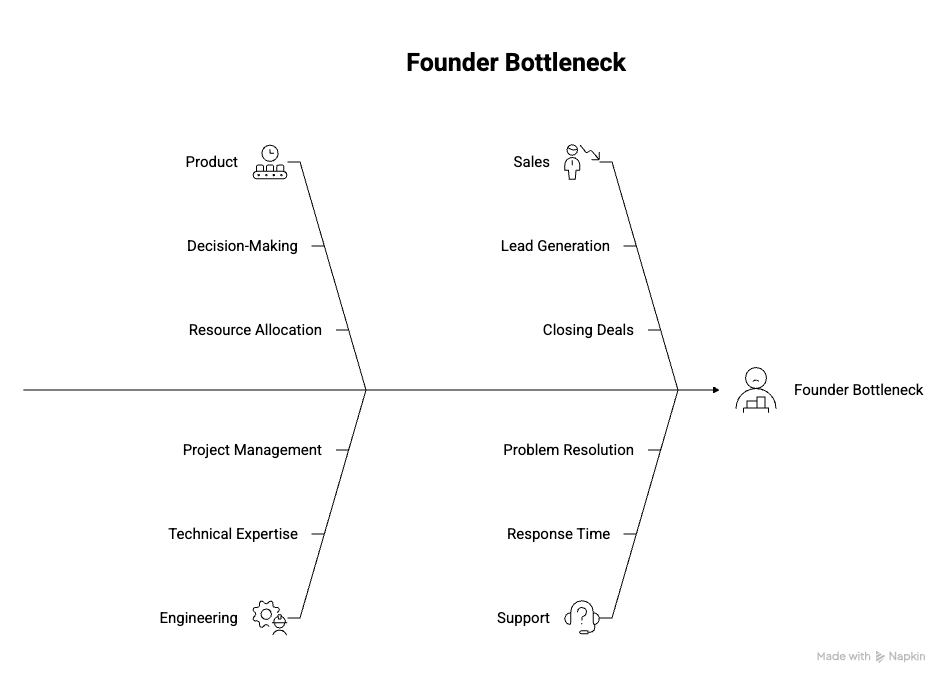
Every founder starts as the first Product Manager. It is a necessary phase of the startup lifecycle. You have the “secret sauce,” the vision that identified a gap in the market. In the beginning, speed of execution is your only advantage. Having one person (you) who holds the vision, the sales data, and the technical constraints allows for rapid-fire decision making.
However, as the organization grows, this centralized model begins to fracture. When you are the only one who can green-light a button change or a feature pivot, you create a queue. While you are busy raising a Series A or closing a marquee enterprise deal, the product team is idling. They become “order takers” rather than “problem solvers.”
The cost of being the bottleneck is not just measured in delayed tickets. It is measured in the loss of talent. High-performing product managers and engineers do not want to work in an environment where their expertise is secondary to the founder’s gut feeling. If you do not step back, you will eventually find yourself surrounded by “yes-men” who wait for your instructions, effectively capping your company’s intelligence at your own personal bandwidth.
Founder-led vs product-led operating model
Founder-led product development works because it compresses decision making into a single brain. In the early days, this speed is an advantage. There is no alignment tax, no prioritization theater, and no ambiguity about what matters. The founder’s intuition substitutes for process, and the company moves fast.
Stop guessing. Start calculating.
Access our suite of calculators designed to help SaaS companies make data-driven decisions.
Free tool. No signup required.
That same model breaks at scale.
As the company grows, every decision that still requires founder approval becomes a choke point. Product managers stop thinking independently. Engineers wait instead of experimenting. Roadmaps become reactive, shaped by whoever spoke to the founder most recently rather than by customer impact or strategy.
A product-led operating model does not remove the founder from the product. It removes the founder from day-to-day decisions.
In a product-led organization, decisions are made by teams using shared principles, clear success metrics, and repeatable discovery processes. The founder’s role shifts from deciding what gets built to defining why it should exist. Instead of answering every question, the founder provides context, constraints, and long-term direction.
This shift replaces heroics with leverage.
The result is a product organization that can move quickly without waiting, make better decisions with less noise, and scale its output without scaling dependency on a single person. The product keeps its soul because the soul has been codified, not because the founder is constantly present.
| Founder-Led | Product-Led |
| Decisions in Slack DMs | Decisions via principles |
| Intuition-driven | Evidence-driven |
| Reactive roadmap | Strategic roadmap |
| Founder approval | Team autonomy |
Codifying the product soul: moving from intuition to principles
Founders often fear that if they step away, the product will become a generic, corporate version of its former self. This is what we call “losing the soul.” To prevent this, you must transform your unspoken intuition into a set of documented Product Principles.
Product Principles are the guardrails that allow your team to make decisions in your absence. Instead of saying “I don’t like this feature,” you need to explain why it doesn’t fit the vision. If your product’s “soul” is simplicity, a principle might be: “We value a clean UI over a feature-rich one; no new feature shall be added without removing an equal amount of visual complexity.”
When you codify these values, you are essentially downloading your brain into the company’s operating system. You are teaching your team how to think, not what to do. This documentation should include:
- The North Star Metric: What is the one number that defines success for the user?
- The “Non-Negotiables”: What will we never do, even if it brings in short-term revenue?
- The Ideal Customer Profile (ICP): Who are we building for, and more importantly, who are we not building for?
Without these guideposts, your new Product Manager will be flying blind, and you will inevitably feel the urge to swoop in and “fix” things, undermining their authority and resetting the cycle of dependency.
The hiring roadmap: finding the right successor
One of the most common mistakes founders make is hiring a “Big Tech” Product Manager too early. Someone who excelled at Google or Meta often relies on massive data sets and established processes. In a scaling SaaS company, you need a “builder” who can operate with 20% of the data and 100% of the ambiguity.
There are three common paths for this transition:
The Senior PM hire
If you are at $1M to $2M ARR, you might just need someone to handle the day-to-day execution. This person manages the backlog, writes the requirements, and keeps engineering moving. You still own the “What” and the “Why,” but they own the “How” and “When.”
The Head of Product hire
At $5M+ ARR, you need someone who can own the strategy. This person doesn’t just execute your ideas; they challenge them. They look at the market, talk to customers, and present a roadmap that aligns with your high-level goals.
The Fractional CPO
For many founders, the leap from “Founder-led” to “Full-time Product Executive” is too expensive or too risky. A fractional CPO (Chief Product Officer) acts as a bridge. They spend 10 to 15 hours a week setting up the systems, hiring the junior PMs, and coaching the founder on how to delegate. This allows the company to gain executive-level product leadership without the $300k+ price tag of a full-time hire.
Establishing a repeatable discovery engine
To step back, you must replace your “gut feel” with a “system of truth.” In the founder-led stage, discovery usually happens in your head after a few sales calls. In a product-led stage, discovery must be a transparent, repeatable engine.
This engine consists of three main parts: customer feedback loops, data analytics, and market research.
Customer feedback loops should be democratized. Instead of all feedback living in your head or your Slack DMs, it should be centralized in a tool where the entire product team can see it. Whether it is a dedicated Slack channel for sales feedback or a sophisticated tool like Productboard, the goal is to make the “voice of the customer” accessible to the people building the product.
Data analytics provide the objective counterweight to anecdotal feedback. You might think a feature is vital because one loud customer asked for it, but the data might show that only 2% of your user base ever clicks that button. By making data the “source of truth,” you remove the emotion from the decision-making process.
Market research ensures the product is not just reacting to current users but is also positioned for future growth. Your product team should be looking at competitors and adjacent industries to find opportunities you might miss while you are focused on the CEO role.
The psychological transition: learning to be wrong
The hardest part of moving from founder-led to product-led is not the systems or the hiring; it is the ego. For years, your identity has been tied to being the “product visionary.” When you hire a professional to take over, they will eventually make a decision that you disagree with.
You have to let them.
If you override every decision you dislike, you are telling the team that their process doesn’t matter and that your whim is still the law. This leads to “learned helplessness” within your staff. To successfully step back, you must move from a “Command and Control” style to a “Context, Not Control” style.
Your role as CEO is to provide the context: “We need to expand into the enterprise market because our churn in the SMB sector is too high.” It is the Product Manager’s job to decide which features will solve that problem. If they choose a path you wouldn’t have chosen, wait for the results. If they are wrong, use it as a coaching moment to refine the Product Principles. If they are right, celebrate the fact that the company is now smarter than you are.
Common failure modes: why transitions crash
Many founders attempt to step back, fail, and then declare “I just haven’t found the right person yet.” Usually, the failure is in the process, not the person.
One major failure mode is the “Shadow Roadmap.” This happens when the founder agrees to a roadmap in a meeting but then goes directly to a lead engineer and says, “Hey, can we just squeeze this one small thing in?” This destroys the Product Manager’s credibility and throws the engineering sprint into chaos.
Another failure mode is “The Vacuum.” This occurs when a founder steps back too abruptly without leaving any guidance or principles behind. The product team, fearing they will make the “wrong” move, becomes paralyzed or builds generic features that don’t move the needle. You cannot go from 100% involvement to 0% overnight. It is a gradual handover of responsibilities.
Finally, there is “The Vision Gap.” This happens when the founder stops being the PM but also stops being the Visionary. They stop communicating where the company is going in three years. Without a long-term vision from the top, the product team will naturally focus on short-term fixes and incremental improvements, causing the product to stagnate.
Conclusion: your path to freedom
Transitioning from founder-led to product-led is the “Great Filter” of SaaS companies. Those who can make the shift go on to scale to $10M, $50M, and beyond. Those who cannot remain stuck in the low millions, with a tired founder and a frustrated team.
By codifying your vision, hiring the right leaders, and building a system of discovery, you aren’t just “stepping back.” You are building an asset that can grow independently of your personal output. You are moving from being the engine of the car to being the navigator. The car will go faster, the engine will be more specialized, and you will finally have the headspace to look at the horizon.
Stepping back is not an admission that you are no longer needed; it is an evolution of your leadership. It is the only way to ensure that your product’s soul survives the scale of its success.
Ready to scale without the stress?
If you are feeling like the bottleneck in your own company, you don’t have to navigate this transition alone. Moving from a founder-centric model to a scalable product organization requires a roadmap of its own.
At saasfractionalcpo.com, we help founders install the systems, the people, and the processes needed to step back from the day-to-day product decisions while keeping the vision intact. Whether you need a bridge to your first full-time Head of Product or a strategic partner to fix your discovery engine, we provide the executive-level expertise you need to scale to $10M ARR and beyond.

Sivan Kadosh is a veteran Chief Product Officer (CPO) and CEO with a distinguished 18-year career in the tech industry. His expertise lies in driving product strategy from vision to execution, having launched multiple industry-disrupting SaaS platforms that have generated hundreds of millions in revenue. Complementing his product leadership, Sivan’s experience as a CEO involved leading companies of up to 300 employees, navigating post-acquisition transitions, and consistently achieving key business goals. He now shares his dual expertise in product and business leadership to help SaaS companies scale effectively.