Modern Consumer Services Examples: Why Product Leadership Is the New Competitive Edge
February 19, 2026 • 9 min read
Last Updated on February 27, 2026 by Sivan Kadosh
TL;DR: The consumer services landscape has been fundamentally transformed by technology. Today, success isn’t just about the quality of the service itself, but the excellence of the digital products that deliver, enhance, and support it. From fintech to fitness, businesses are now software companies at their core. This article explores modern consumer service examples and argues that dedicated product leadership, like that provided by a Fractional CPO, is no longer a luxury, but a critical competitive advantage for growth and scale.
The AI Wake-Up Call: Why Code Is No Longer a Competitive Advantage
In recent weeks, my mind, like most people in my sector, has been preoccupied with the AI tsunami that we are only just beginning to see. While most of this revolution’s implications are hard to predict, there is one thing I am 100% certain of: the barrier to writing code has been completely dismantled. With recent data from McKinsey showing that generative AI can speed up software development tasks by up to 56%, the implications are clear. Instead of 3-4 competitors per category, we are going to see 300-400. Customer Acquisition Costs (CAC) will skyrocket, and only the strongest and most efficient will survive.
When I realized this, I decided to write this article. This is essentially a wake-up call for you, the founder. You might think that by simply “developing the product” and pushing out more features, you are in motion and making progress… Think again. In the hyper-competitive world we are entering, the only thing that will matter is the deep value and Product-Market Fit (PMF) your product delivers to its target audience.
I can already hear you saying: “Yes, yes, it’s always been like this.” Actually, no. Customer impatience and their demand for a flawless User Experience (UX) have reached unprecedented levels. When a customer has dozens of alternatives created overnight, any unnecessary click or cumbersome onboarding process will lead to immediate abandonment. In fact, according to PwC research, 32% of customers will walk away from a brand they love after just one bad experience. They won’t give you a second chance; they will simply leave for a competitor who is just a click away.
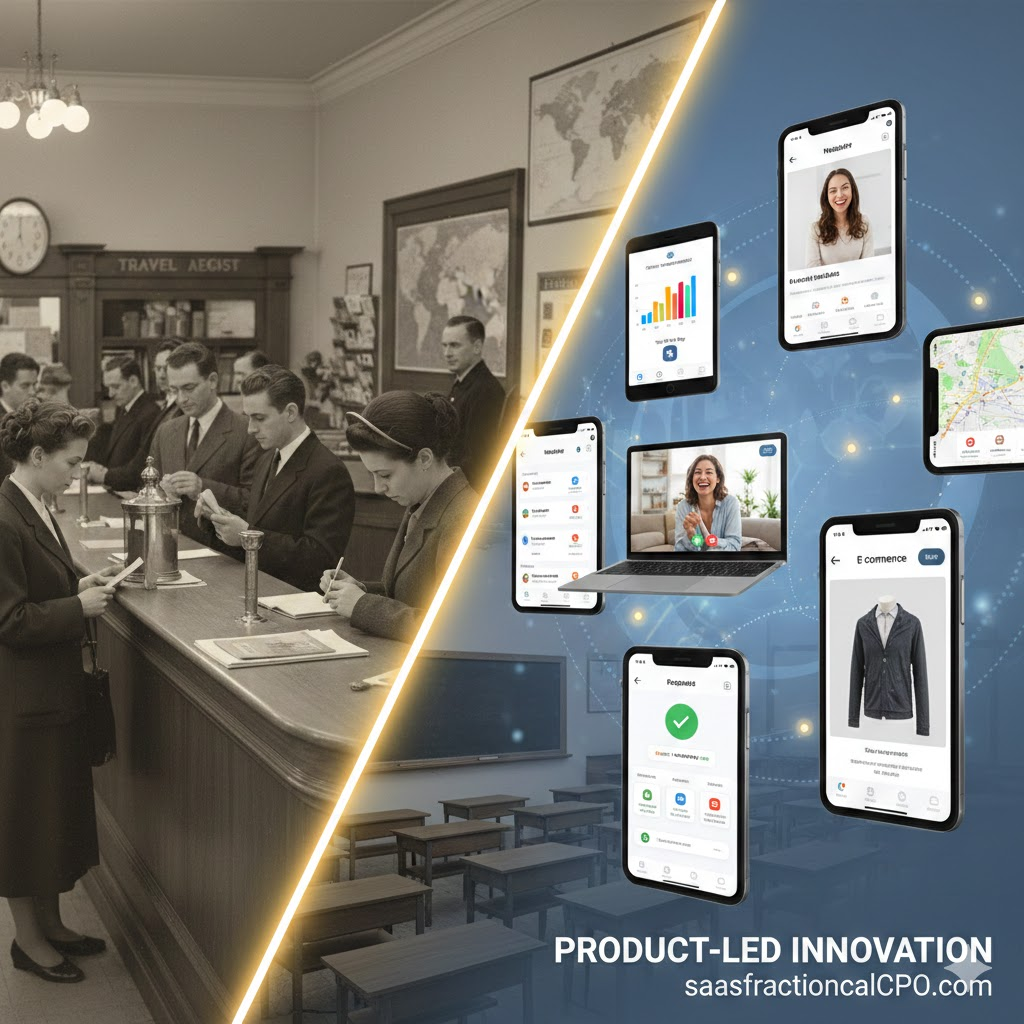
Remember when a “consumer service” meant walking into a bank, calling a travel agent, or visiting a brick-and-mortar store? While those still exist, the very definition has exploded, driven by rapid technological advancements and evolving consumer expectations. Today, virtually every interaction, transaction, and experience in the service sector is mediated, managed, or enhanced by software.
This shift means that the digital products, the apps, websites, platforms, and integrated systems, are now as vital as the service itself. For businesses in this new era, excelling requires more than just great customer service; it demands outstanding product strategy and execution.
Understanding modern consumer services: More than just transactions
In the old world of consumer services, the “product” was often just the outcome, the haircut you received, the flight you took, or the loan that hit your bank account. The interaction was purely transactional. As experts in the SaaS and product-led growth space, we see a fundamental shift: The delivery mechanism has become the product.
If you are a service provider today, your customer doesn’t just judge you on the final result; they judge you on the friction (or lack thereof) in your digital ecosystem.
The “Service-as-a-Product” mindset
From my perspective as a Fractional CPO, I often see companies treat their app or website as a “utility” rather than a “value driver.” This is a mistake. In modern consumer services, the software is the primary touchpoint for building trust.
- Trust is built in the UI: In FinTech, a clunky interface doesn’t just feel “old”, it feels unsafe.
- Retention is built in the data: In HealthTech, if your app doesn’t proactively remind a user of their goals based on their specific behavior, you’re just a digital file cabinet, not a service.
Our opinion: The most successful consumer services today don’t just ‘solve a problem’; they occupy a space in the user’s daily habit loop. If your service requires a user to ‘log in’ to perform a chore, you’ve already lost. If your service provides an insight that makes their life easier before they even ask, you’ve won.”
Stop guessing. Start calculating.
Access our suite of calculators designed to help SaaS companies make data-driven decisions.
Free tool. No signup required.
The shift from support to self-service
In the traditional model, “good service” meant having a friendly person answer the phone. In the modern model, good service means the customer never has to call you. Product leadership flips the script by moving “service” upstream into the product design itself. We look at support tickets not as a metric for the customer service team to handle, but as a roadmap for the product team to fix. If 20% of your customers call about onboarding, that’s not a “service” issue, it’s a product failure.
How we help bridge this gap
At saasfractionalcpo.com, we don’t just look at your features; we look at your Customer Lifetime Value (CLV) through the lens of product friction. Our advice is grounded in two core pillars:
- Eliminating “Value Lag”: The time between a customer paying for your service and actually experiencing its benefit. We help you shorten this window through better UX and automated onboarding.
- Monetizing Engagement: We identify which service features are “sticky” and help you build a roadmap that encourages those behaviors, turning one-time users into lifelong subscribers.
Examples of modern consumer services
1. Financial services (FinTech)
Old way: Visiting a bank branch, mailing checks, buying insurance from an agent.
Modern example: Neobanks like Chime, investment apps like Robinhood, peer-to-peer payment platforms like Venmo, and digital-first insurance providers.
The product edge: These services thrive on intuitive UX/UI, robust security features, real-time data insights, and seamless integration with other financial tools. The app is the bank.
2. Health & Wellness (HealthTech / FitTech)
Old way: Doctor’s visits, gym memberships, physical therapy.
Modern example: Telemedicine platforms (e.g., Teladoc, BetterHelp), personalized fitness apps (e.g., Peloton, Strava), mental wellness apps (e.g., Calm, Headspace), and wearable health trackers.
The product edge: User engagement, data-driven health insights, personalized coaching algorithms, and seamless scheduling and communication functionalities are paramount.
3. Education & Learning (EdTech)
Old way: Traditional classrooms, in-person tutors.
Modern example: Online course platforms (e.g., Coursera, MasterClass), language learning apps (e.g., Duolingo), virtual tutoring services, and interactive learning management systems (LMS).
The product edge: Gamification, adaptive learning paths, engaging multimedia content delivery, and community features drive completion rates and learning outcomes.
4. Travel & Hospitality
Old way: Travel agents, hotel check-in desks.
Modern example: Accommodation booking platforms (e.g., Airbnb, Booking.com), ride-sharing services (e.g., Uber, Lyft), digital concierge apps, and personalized travel itinerary builders.
The Product edge: Smooth booking flows, reliable matching algorithms, dynamic pricing, and features that enhance the traveler’s entire journey from planning to post-trip.
5. Retail & E-commerce enhancements
Old way: In-store shopping, catalog orders.
Modern example: Personalized styling services (e.g., Stitch Fix), subscription box services, augmented reality (AR) shopping experiences, and advanced e-commerce platforms with intelligent recommendations.
The product edge: Predictive analytics for personalization, efficient logistics integration, seamless checkout processes, and engaging visual product discovery.
Why Product leadership is the new competitive edge
In this product-led world, simply having an app isn’t enough. The quality, functionality, and user experience of your digital product are what differentiate you in a crowded market. This is precisely where strong product leadership becomes indispensable.
Many scaling consumer service companies, particularly those transitioning from traditional models or early-stage startups, often have brilliant founders and talented engineers. However, they frequently lack dedicated, experienced product leadership that can:
- Define and prioritize a Product Vision: Translate business goals into a clear, actionable product roadmap. What features truly matter? What should be built next, and why?
- Understand the user deeply: Go beyond surface-level feedback to uncover user needs, pain points, and desires through robust research and analytics.
- Optimize for Growth & Retention: Implement strategies to attract new users, reduce churn, and increase customer lifetime value through thoughtful product design and feature development.
- Bridge the gap between Business & Engineering: Ensure that technology investments align with market opportunities and business objectives, preventing wasted resources.
- Drive Innovation: Keep the company ahead of competitors by identifying emerging trends and integrating cutting-edge technologies.
Without this specialized product guidance, companies risk building the wrong features, alienating users with poor UX, or simply failing to capitalize on their market potential.
How a fractional CPO provides this edge
For high-growth SaaS companies and product-led consumer service businesses, hiring a full-time, seasoned Chief Product Officer (CPO) might be out of reach or not yet necessary. This is where saasfractionalcpo.com steps in.
A fractional CPO or a product management consultant offers all the strategic benefits of an experienced product leader without the full-time commitment or cost. We integrate with your team to:
- Audit your existing product strategy and execution: Identify gaps and opportunities.
- Develop a scalable product roadmap: Aligning your digital product with your business vision.
- Mentor your internal product team: Empowering them with best practices and strategic guidance.
- Implement data-driven decision-making: Ensuring every product choice is backed by insights.
- Accelerate your market entry or expansion: By optimizing your product for rapid growth and user adoption.
We help you navigate the complexities of modern consumer services, ensuring your digital products are not just functional, but truly transformative for your users and your bottom line.
Ready to transform your consumer service product strategy?
Don’t let your digital product be an afterthought. Elevate your consumer service offering with strategic product leadership that drives growth and defines your competitive edge.
Contact saasfractionalcpo.com today for a consultation and discover how a fractional CPO can unlock your product’s full potential.
Key Takeaways
- Consumer services are now product-led: Digital platforms are critical to service delivery and customer experience.
- Product excellence drives competitive advantage: Superior UX, functionality, and data integration are non-negotiable for success.
- Product leadership is essential for scale: Strategic guidance ensures resources are invested wisely in features that matter.
- A Fractional CPO offers expert leadership: Providing seasoned product strategy and execution guidance without the overhead of a full-time hire, ideal for high-growth SaaS and product-led service companies.
Frequently Asked Questions (FAQs)
What is the main difference between traditional and modern consumer services?
The main difference is the heavy reliance on technology and digital platforms. Modern consumer services are often delivered, managed, and enhanced through apps, websites, and integrated software, transforming the customer experience.
Why do modern consumer service companies need product leadership?
Product leadership is crucial to define a clear product vision, prioritize features, understand user needs through data, optimize for growth and retention, and bridge the gap between business goals and technical development in a highly competitive digital landscape.
Is a Fractional CPO only for tech companies?
No. While highly relevant for SaaS companies, a Fractional CPO is ideal for any business where the digital product (app, platform, website) is a core component of service delivery, regardless of their primary industry (e.g., healthcare, education, finance, hospitality).
How does a Fractional CPO help with growth and retention?
A Fractional CPO uses data analytics to identify user pain points, develops features that improve user engagement, streamlines onboarding, and implements strategies to reduce churn, ultimately increasing customer lifetime value and fostering organic growth.
What are some signs that a consumer service business needs product leadership?
Signs include inconsistent product vision, low user engagement or high churn, difficulty prioritizing feature development, a lack of data-driven decision-making, or a feeling that the product isn’t keeping pace with market demands or competitors.

Sivan Kadosh is a veteran Chief Product Officer (CPO) and CEO with a distinguished 18-year career in the tech industry. His expertise lies in driving product strategy from vision to execution, having launched multiple industry-disrupting SaaS platforms that have generated hundreds of millions in revenue. Complementing his product leadership, Sivan’s experience as a CEO involved leading companies of up to 300 employees, navigating post-acquisition transitions, and consistently achieving key business goals. He now shares his dual expertise in product and business leadership to help SaaS companies scale effectively.