Now Next Later Roadmap: How to Design, Operationalize and Scale It in Modern SaaS
February 26, 2026 • 10 min read
Last Updated on February 26, 2026 by Sivan Kadosh
TL;DR: A Now Next Later roadmap prioritizes initiatives by confidence and strategic sequencing instead of fixed delivery dates. It works best in environments with high uncertainty and continuous discovery.
The Now Next Later roadmap is one of the most misunderstood frameworks in product management.
Most articles explain it as a simple way to avoid deadlines.
Few explain how to run a serious product organization with it.
Used well, it creates clarity under uncertainty.
Used poorly, it becomes a vague list that hides weak prioritization.
This guide goes beyond the format. It shows how to design, govern, and scale a Now Next Later roadmap inside a modern SaaS company.
What is a now next later roadmap?
A Now Next Later roadmap is a horizon based planning framework that organizes product initiatives into three buckets:
- Now, work currently in progress or fully committed
- Next, high confidence priorities that follow current work
- Later, strategic themes or bets that may evolve
Unlike date driven roadmaps, it communicates direction and sequencing without pretending certainty.
It is not anti planning. It is anti-false precision.
Why teams are moving away from date driven roadmaps
Traditional roadmap formats assume stable environments. Modern SaaS rarely operates in one.
Stop guessing. Start calculating.
Access our suite of calculators designed to help SaaS companies make data-driven decisions.
Free tool. No signup required.
Today’s reality:
- AI accelerates iteration cycles
- Customer expectations shift quickly
- Discovery uncovers new risks mid cycle
- CAC pressure demands rapid experimentation
- Product led growth requires constant optimization
Date based roadmaps often create:
- False promises to sales
- Scope rigidity
- Reduced adaptability
- Misalignment between discovery and delivery
Now Next Later emerged as a response to uncertainty, not as a trendy alternative.
The three horizons explained
The framework is simple. Execution is not. Let’s dive deeper.
Now
This is committed, in progress work.
Characteristics:
- High confidence
- Discovery completed or substantially reduced risk
- Clear metric alignment
- Team capacity allocated
If something is in Now, it should have:
- A defined outcome
- Owner accountability
- Clear exit criteria
Now should not represent six months of locked scope. If it does, you are running through a hidden waterfall.
Next
Next represents prioritized initiatives that are highly likely to move into Now.
Characteristics:
- Strong strategic alignment
- Partial validation
- Clear problem definition
- Sequenced behind current work
Next is not a wishlist. It reflects decisions already made about priority.
A strong product organization can explain why each item is Next and not Now.
Later
Later captures directional intent.
It includes:
- Strategic bets
- Emerging opportunities
- Thematic investments
- Areas requiring further discovery
Later is not a backlog dump. It is a signal of where the company may invest next.
If your Later column never changes, your strategy is stagnant.
When to use a now next later roadmap
This format works best when:
- You operate in high uncertainty
- You practice continuous discovery
- You are Seed to Series C SaaS
- You run product led growth
- You iterate based on customer feedback
- You prioritize outcomes over output
It is especially powerful when you want to communicate strategy to executives without overcommitting timelines.
When not to use it
There are contexts where Now Next Later creates more problems than clarity.
Avoid using it as your primary roadmap if:
- You have contractual enterprise delivery deadlines
- You operate in regulated compliance environments
- You ship hardware with fixed release cycles
- You must publicly commit to specific release dates
- Your go to market team relies heavily on date promises
In these cases, you may still use Now Next Later internally, but external communication may require time based overlays.
Common failure modes and how to avoid them
This is where most teams fail. Let’s explore the common mistakes.
The ambiguity trap
Symptoms:
- Vague initiatives in Next
- Lack of movement between columns
- Political prioritization
Root cause: No explicit movement criteria.
Fix: Define evidence thresholds for moving from Later to Next and Next to Now.
The graveyard Later
Symptoms:
- Items never leave Later
- No discovery allocated
- Strategic drift
Root cause: No capacity reserved for exploration.
Fix: Allocate explicit discovery bandwidth to Later themes.
Hidden waterfall in Now
Symptoms:
- Six month locked plan
- No room for learning
- Delivery masquerading as agility
Root cause: Overconfidence in initial scoping.
Fix: Limit Now to 4 to 8 weeks of committed work.
Executive reintroduction of dates
Symptoms:
- Sales pushes for deadlines
- Board demands release quarters
- Now Next Later becomes quarterly waterfall
Root cause: Lack of education around uncertainty management.
Fix: Communicate risk levels, not just horizons.
Field insights: What really happens when you try to implement Now-Next-Later?
When I was doing the research for this article, I wanted to see what practitioners were saying about this topic on Reddit, specifically within the r/ProductManagement community. I found dozens of heated discussions surrounding the ‘date trap.’ The recurring complaint was that executives and sales teams tend to interpret the ‘Next’ column as a binding commitment for the upcoming quarter, creating constant friction when plans inevitably change. Industry data backs this frustration completely: according to Airfocus, 56.4% of product managers struggle with conflicting priorities within their organization, and a recent Airtable report reveals that 1 in 5 product managers say their roadmap frequently gets ‘derailed’ due to reactive decisions by leadership.
In one of the most fascinating cases shared, a Product Manager at a growing SaaS company described how they solved this problem. Instead of fighting the demand for dates, they added a ‘Confidence Score’ to every item on the roadmap. They explained to leadership that an item in ‘Next’ with a 50% confidence score is merely a potential bet, and only when it moves to ‘Now’ with 90% confidence can they discuss a delivery window.
This approach, supported by academic research on designing agile and data-driven product roadmaps (SSRN) and integrating Product Discovery into roadmapping (ResearchGate), transforms the roadmap from a ‘when will it be ready?’ tracking document into a strategic risk management tool. This is exactly the role of senior product leadership: to create a shared language between technological realities and business expectations.
No movement rules
Without governance, horizons become cosmetic.
Define:
- What evidence qualifies an initiative for Next
- What validation qualifies it for Now
- Who decides movement
- How often horizons are reviewed
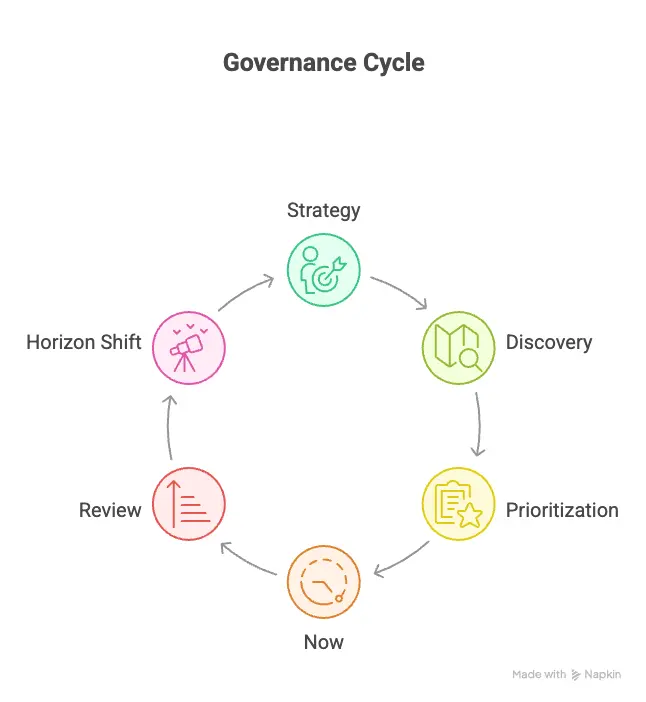
How to operationalize it inside a product operating model
The roadmap is not a document. It is an operating decision.
If Now Next Later lives only in a slide deck, it will slowly degrade into a political artifact.
To make it effective, you must embed it into your operating model. That means defining cadence, ownership, decision rights, and movement criteria.
Without governance, horizons become cosmetic.
Governance cadence
Now Next Later works when it is continuously revalidated through structured reviews.
Here is a practical operating rhythm for a modern SaaS team.
Weekly: delivery progress review
Purpose: Ensure “Now” stays real.
Focus areas:
- Progress against committed initiatives
- Risks and blockers
- Scope creep detection
- Evidence generated from shipped work
Key questions:
- Are we still confident in the expected outcome?
- Has new information changed priority?
- Is anything in Now drifting into hidden waterfall?
Owner: Head of Product or Product Lead
Output:
- Updated status of Now initiatives
- Flagged risks for potential horizon re evaluation
This is not a feature status meeting. It is a confidence check on current commitments.
Biweekly: discovery insights review
Purpose: Feed evidence into Next and Later.
Focus areas:
- Customer interviews
- Experiment results
- Prototype testing outcomes
- Market signals
- Competitive shifts
Key questions:
- What assumptions were validated?
- What was invalidated?
- Which Later initiatives gained stronger evidence?
- Should anything move from Later to Next?
Owner: Discovery lead or Senior PM
Output:
- Evidence summaries
- Updated confidence levels per initiative
- Recommendations for horizon movement
This ensures that Later does not become a graveyard.
Monthly: horizon movement discussion
Purpose: Explicitly decide what moves.
This is the most important governance layer.
Focus areas:
- Capacity outlook
- Evidence thresholds
- Strategic alignment
- Risk reduction progress
Key questions:
- Does any Next initiative meet the criteria to enter Now?
- Should any Later initiative be promoted to Next?
- Is anything in Next losing priority?
- Are we overloading Now beyond execution capacity?
Owner: Product leadership with executive visibility
Output:
- Official horizon adjustments
- Documented rationale for changes
- Updated roadmap artifact
Movement must be intentional. If items drift between columns informally, governance is weak.
Quarterly: strategic theme reset
Purpose: Re anchor horizons to company strategy.
This is where Now Next Later connects to long term direction.
Focus areas:
- Company level objectives
- North Star metric trajectory
- Revenue and retention performance
- Competitive positioning
- Investment allocation across Core, Growth, and Bets
Key questions:
- Do our Later themes still reflect strategy?
- Are we underinvesting in key growth levers?
- Does the roadmap align with board level expectations?
- Are we reacting too much instead of executing strategy?
Owner: CEO, Fractional CPO or VP Product
Output:
- Refined strategic themes
- Rebalanced investment allocation
- Clear narrative for stakeholders
Quarterly reset prevents short term noise from hijacking long term direction.
Defining movement rules between horizons
Cadence alone is not enough.
You must define what qualifies an initiative to move.
Example criteria:
To move from Later to Next:
- Clear problem validation
- Evidence of demand
- Strategic alignment confirmed
- Preliminary solution hypothesis defined
To move from Next to Now:
- Key assumptions tested
- Risk significantly reduced
- Delivery capacity available
- Executive buy in secured
If these thresholds are not explicit, movement becomes political.
Linking to OKRs
Strong alignment model:
- Now initiatives map to committed quarterly OKRs
- Next initiatives support upcoming objective themes
- Later initiatives reflect annual strategic direction
This prevents disconnect between roadmap and performance management.
Now Next Later vs other roadmap types
Not all roadmaps solve the same problem.
Each format optimizes for a different constraint: certainty, alignment, communication, or adaptability.
Understanding tradeoffs prevents misuse.
| Criteria | Date Based Roadmap | Outcome Based Roadmap | Theme Based Roadmap | OKR Roadmap | Now Next Later |
| Flexibility | Low. Dates create rigidity once communicated. | High. Outcomes allow solution flexibility. | Moderate. Themes allow interpretation but may lack sequencing clarity. | Moderate to High. Flexible within objective cycles. | High. Horizons allow sequencing without fixed delivery commitments. |
| Predictability | High short term predictability, often false long term precision. | Lower delivery predictability, higher impact predictability. | Moderate. Depends on theme granularity. | Moderate. Predictable at objective level, not feature level. | Moderate. Sequencing is clear, exact timing is not. |
| Executive Clarity | Very clear when stakeholders expect timelines. | Clear on impact, less clear on timing. | Clear on strategic direction, vague on execution timing. | Clear on performance goals, less clear on feature sequencing. | Clear on priority order, less clear on exact release dates. |
| Risk of Misuse | High risk of hidden waterfall and overcommitment. | High risk of vague execution without measurable success criteria. | High risk of becoming abstract or disconnected from delivery. | High risk of becoming quarterly feature lists disguised as objectives. | High risk of ambiguity and political prioritization without governance rules. |
| Best Company Stage | Late stage, enterprise, compliance heavy, contractual commitments. | Growth stage companies optimizing metrics and experimentation. | Early to mid stage companies defining direction. | Scaling SaaS with strong OKR discipline. | Seed to Series C SaaS operating in high uncertainty environments. |
Need help implementing a strategic roadmap?
Many teams adopt a Now Next Later roadmap but struggle with governance, prioritization, and executive alignment.
If your roadmap feels reactive, political, or disconnected from strategy, the issue is rarely formatting.
It is usually an operating model problem.
We at SaaS Fractional CPO can:
- Design a roadmap aligned with company strategy
- Introduce evidence based movement rules
- Integrate discovery into planning
- Align roadmap with OKRs and portfolio allocation
- Coach product leaders and founders
If you want your roadmap to drive growth rather than manage chaos, consider bringing in experienced product leadership on a fractional basis.
Key takeaways
- The Now Next Later roadmap is a sequencing framework, not a formatting trick. It prioritizes by confidence and strategic order instead of relying on artificial delivery dates.
- It works best in high uncertainty SaaS environments where discovery, experimentation, and iteration drive growth. It is less suitable for compliance heavy, contract driven, or hardware based contexts.
- Without governance, it fails. Clear movement rules, defined evidence thresholds, and structured cadence reviews are essential to prevent ambiguity and political prioritization.
- Now should contain validated, committed work. Next should reflect high confidence priorities. Later should represent strategic intent, not a dumping ground backlog.
- It must integrate with your product operating model. Strong teams align Now with OKRs, review horizons monthly, reset strategy quarterly, and protect discovery capacity.
- Not all roadmaps solve the same problem. Date based roadmaps optimize for predictability, outcome based for impact, OKR roadmaps for alignment, and Now Next Later for adaptive sequencing.
- If your roadmap feels reactive, overloaded, or politically driven, the issue is rarely the format. It is usually a strategy and operating model gap. In scaling SaaS companies, hiring a Fractional CPO can bring the structure, governance, and strategic alignment needed to turn a Now Next Later roadmap into a real growth engine rather than a planning artifact.

Sivan Kadosh is a veteran Chief Product Officer (CPO) and CEO with a distinguished 18-year career in the tech industry. His expertise lies in driving product strategy from vision to execution, having launched multiple industry-disrupting SaaS platforms that have generated hundreds of millions in revenue. Complementing his product leadership, Sivan’s experience as a CEO involved leading companies of up to 300 employees, navigating post-acquisition transitions, and consistently achieving key business goals. He now shares his dual expertise in product and business leadership to help SaaS companies scale effectively.