Product Risk Management: How Modern Product Teams Reduce Uncertainty And Build Better Products
November 28, 2025 • 14 min read
Last Updated on December 1, 2025 by Sivan Kadosh
Product risk management is not a theoretical discipline. It is a practical way to reduce uncertainty, make better decisions, and avoid building the wrong things. Most product failures do not happen because teams ship bad code. They happen because teams ship something users do not adopt, cannot understand, or do not trust.
Strong risk management helps modern SaaS teams reach value faster, avoid waste, and scale with confidence. It also creates alignment across product, engineering, design, and leadership. When done well, it becomes a natural part of how teams operate rather than a documentation exercise that collects dust.
Before you dive into the details, here are the key takeaways from this guide.
Key takeaways
- Product risk management helps teams reduce uncertainty and avoid building features that fail after launch.
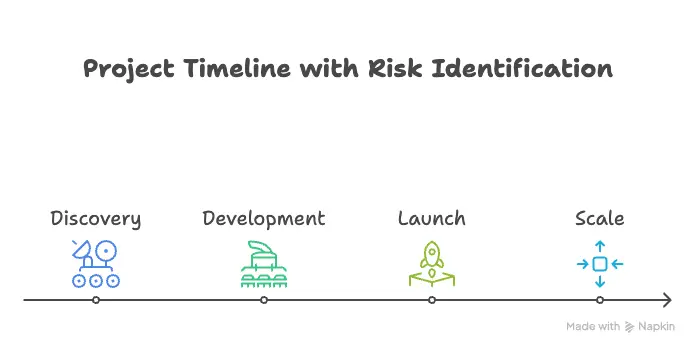
- Risks exist at every stage of the product lifecycle and change as the product moves from discovery to scale.
- Modern risk management covers value, usability, technical, regulatory, operational, and market risks.
- Tools like risk registers, assumption mapping, and risk matrices help teams turn unknowns into actionable decisions.
- Embedding risk thinking into your workflow increases predictability and strengthens product outcomes.
- Fractional CPO support can accelerate your organisation’s ability to identify, assess, and manage risks effectively.
What product risk management means today
Product risk management is the discipline of identifying, assessing, and reducing anything that could prevent your product from delivering the expected value. In modern SaaS companies, the biggest risks are rarely bugs or defects. They are incorrect assumptions, weak validation, misaligned expectations, and hidden dependencies.
Many products fail even though they work technically. They fail because users do not understand the value, onboarding is confusing, performance does not scale, or compliance issues slow down adoption. This is what makes risk management a strategic capability rather than a hygiene task. Product teams must regularly look for gaps between what they believe to be true and what actually happens in the market.
Effective risk management is a continuous effort. It begins in discovery, strengthens during development, becomes essential at launch, and remains critical as the product scales.
| Product risk | Project risk | Business risk |
|---|---|---|
| Wrong assumptions | Missed deadlines | Pricing misalignment |
| Low adoption | Capacity constraints | Competitive pressure |
| Confusing onboarding | Scope creep | Regulatory changes |
| Poor UX | Poor communication | Market shifts |
| Misaligned features | Vendor delays | GTM failures |
The mindset of uncertainty: Humility over hubris
However, identifying these gaps requires more than just tools; it demands the right mindset. True risk management starts with a simple yet painful realization: the unexpected is inevitable. No matter how experienced we are, we tend to prepare for what we foresee, not for what surprises us. As product leaders, one of our most critical traits is professional humility, the understanding that the only thing we know for certain is that we operate under constant uncertainty. In fact, research highlights that the importance of intellectual humility in leadership is not a weakness, but a strategic asset for better decision-making and rapid error detection.
Stop guessing. Start calculating.
Access our suite of calculators designed to help SaaS companies make data-driven decisions.
Free tool. No signup required.
To illuminate these blind spots, I often advise teams to look beyond standard risk registers and adopt the Project Pre-Mortem methodology. Unlike a retrospective that looks back at a failure, a pre-mortem asks us to imagine a future where a feature has already failed and work backward to determine the cause. This approach succeeds because it actively neutralizes confirmation bias, the psychological trap that blinds us to warning signs when we fall in love with our solution. It forces us to break our own misconceptions and uncover risks we would otherwise miss entirely.
I saw the power of this recently while helping a client integrate Stripe, a task I’ve overseen dozens of times which is usually accompanied by predictable scope creep and frustration. Before writing a single line of code, we ran a rigorous Pre-Mortem, brainstorming exactly how the integration “failed.” The impact was tangible: while the project still encountered hurdles, our proactive planning reduced scope creep and delays by 80% compared to typical benchmarks. That single win transformed the client into a strong advocate for running Pre-Mortems on every major initiative.
Types of risks product teams must manage
Modern products face a wide range of risks. Each risk category influences decisions differently and should be understood as part of a single system. When teams see only technical risks, they miss the larger picture. When teams focus only on market risks, they overlook the operational issues that slow execution.
Value risk
Value risk appears when teams assume that users want a feature or product without enough evidence. You face value risk when you rely on opinions rather than data, or when you design a solution around an imagined workflow rather than a real one.
It includes incorrect assumptions about demand, pricing misalignment, unclear segmentation, or misunderstanding of the jobs users are trying to get done. Strong discovery helps reduce value risk before a single line of code is written.
Usability and adoption risk
Even when users want something, they may not be able to understand or adopt it. Usability risk shows up when onboarding is unclear, workflows feel complex, or the product fails to guide users to the moment of value.
Adoption risk is particularly dangerous because teams often interpret low usage as a lack of demand. In reality, the issue may be unclear UX, poor timing, or the wrong entry point in the user journey.
Technical and scalability risk
Technical risk is more than defects. It includes architectural choices, performance constraints, untested integrations, and long term maintainability. Scalability risk grows as the product reaches more users and demands increase.
Teams often delay addressing technical risk until it becomes urgent. A small performance issue during MVP might become a major incident at scale. Proactive load testing, architecture reviews, and technical spikes reduce these problems early.
Regulatory and compliance risk
SaaS products face increasing regulatory pressure. Data residency, GDPR, consent requirements, and industry specific rules influence how products are designed, launched, and operated.
Compliance risk grows when the team collects data without clear governance, expands into new markets, or integrates with third party systems.
Operational and organisational risk
Risk also emerges from how teams work internally. Limited capacity, unclear ownership, and slow decision making can block progress. Misalignment between product, engineering, design, and GTM teams leads to delays, rework, and duplicated effort.
Operational risk is often underestimated, yet it is one of the largest contributors to slow execution.
External and market risk
Market dynamics shift quickly. Competitors launch new features, pricing pressure increases, economic conditions change, and dependency on third party APIs introduces fragility.
External risk requires teams to stay connected to the ecosystem and adapt roadmap decisions as conditions evolve.
| Risk category | Short description | Examples |
|---|---|---|
| Value risk | The risk that users do not want or need the feature or product. | Wrong assumptions about demand, pricing misalignment, unclear segmentation. |
| Usability and adoption risk | Users want the solution but cannot understand it or adopt it easily. | Confusing onboarding, complex workflows, low feature discovery. |
| Technical and scalability risk | Technical decisions that limit future growth or create instability. | Poor architecture, performance issues, integration failures, technical debt. |
| Regulatory and compliance risk | Risks created by legal requirements, data handling, and industry rules. | GDPR gaps, missing consent flows, data residency issues, integration compliance gaps. |
| Operational and organisational risk | Internal workflow issues that slow execution or cause misalignment. | Limited capacity, unclear ownership, poor communication, slow decision making. |
| External and market risk | Risks created by shifts outside the product team’s control. | Competitive launches, pricing pressure, economic changes, third party API changes. |
How to identify product risks early
Teams can avoid many failures by identifying risks long before development begins. Early identification keeps cost low and improves confidence.
Run assumption mapping
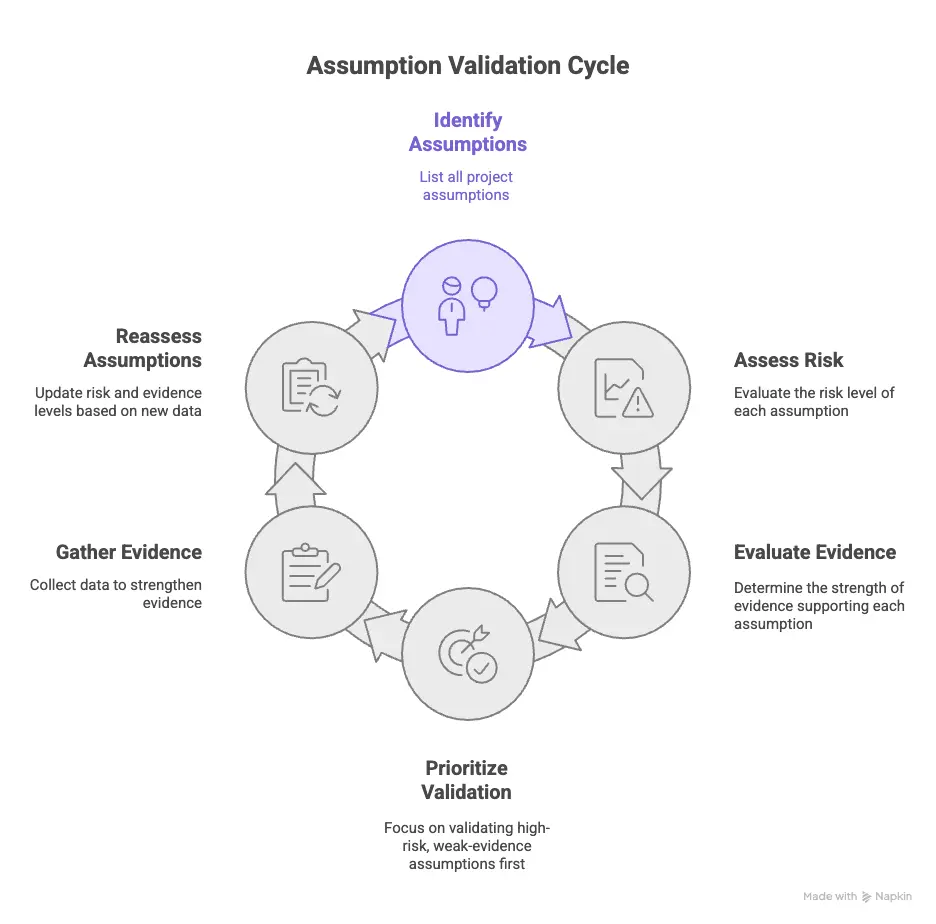
Assumption mapping is one of the most effective ways to surface risks. It forces teams to list what must be true for a product or feature to succeed. Once assumptions are mapped, teams can test the riskiest ones first.
This simple exercise often reveals blind spots in user behaviour, technical feasibility, or business viability.
Use structured discovery
Discovery techniques like problem interviews, shadowing sessions, competitor analysis, and cheap prototypes reduce guesswork. They help teams understand what users are trying to accomplish and what is likely to block them.
Discovery is not a separate phase. It should be a continuous habit embedded in the workflow.
Run early technical spikes
Small technical experiments reveal feasibility issues early. They help teams understand integration limitations, performance expectations, and potential bottlenecks.
Use analytics insights to reveal risk
Missing data is a risk. Lack of onboarding metrics, activation metrics, or usage analytics makes it difficult to spot failure patterns. Adding measurement to early prototypes significantly improves risk visibility.
How to assess product risks
Risk assessment is the process of evaluating the likelihood and impact of each risk. Good assessment turns vague concerns into actionable decisions.
Likelihood and impact scoring
A classic risk matrix helps teams decide which risks require immediate attention. High likelihood and high impact risks need mitigation. Low likelihood and low impact risks can be monitored.
Evidence versus confidence analysis
Some risks are unknown because they have never been tested. The evidence versus confidence grid helps teams prioritise what needs validation. It separates opinions from facts and guides investment in learning activities.
Quantitative and qualitative scoring
Some risks can be measured using metrics and data. Others require qualitative judgement from experienced practitioners. A balanced approach ensures that decisions are both informed and realistic.
Value, viability, and feasibility scoring
This approach blends user value, business logic, and technical feasibility. It works well for new products, market expansion, and major architectural changes.
How to mitigate and manage product risks
Mitigation strategies vary by risk type, but the principles remain consistent: reduce uncertainty early, validate assumptions fast, and ensure the product is moving in the right direction.
Prototype and validate
Low fidelity prototypes, mockups, or interactive demos help test value and usability before development. They save time and reduce the chance of building something that fails at launch.
Test with real users
Usability testing uncovers confusion, friction, and adoption blockers. Simple changes in onboarding often remove a large portion of adoption risk.
Strengthen technical foundations
Investing in architecture reviews, performance testing, and integration testing early pays off during scale. Technical health is a form of risk reduction.
Run experiments
A B tests, fake door tests, and pilot releases help validate ideas safely. Experiments reduce the cost of learning and improve confidence.
Improve compliance posture
Review data flows, permissions, legal requirements, and external dependencies. Compliance checks should be part of the release readiness workflow.
Use a risk budget
Allocating a small portion of each sprint to de risk activities keeps the product healthy over time. This includes technical spikes, research sessions, and documentation updates.
Product risk management across the product lifecycle
Risks shift as products mature. A strong strategy adapts to each stage:
During discovery: This is where the largest unknowns appear. Focus on value and usability. Use assumption mapping, interviews, and prototypes.
During development: Scope can drift, dependencies break, and estimates change. Technical reviews and cross functional communication reduce friction.
During launch: This phase introduces go-to-market risks. Prepare positioning, messaging, onboarding, analytics, and support. Confirm compliance and data handling.
Post launch and scale: Performance issues, user churn, new regulations, and growing technical debt create new risks. Monitoring and feedback loops become essential.
Tools and templates to operationalise risk management
Practical tools make risk management easy to adopt:
Risk register: A simple table that captures risk type, description, likelihood, impact, owner, mitigation, and status. This creates transparency and accountability.
Risk log: Used during development and launches. Helps track new risks and update status.
Release readiness checklist: Ensures the team has considered value, UX, analytics, compliance, performance, and GTM before launch.
Risk dashboard: Visualises top risks for leadership. Makes discussions clear and grounded in facts.
How to embed risk management into your team culture
Culture is what determines whether risk management becomes a practical habit or a forgotten checklist. When teams see risk management as part of their craft, they make better decisions, reduce waste, and move faster with more confidence. Embedding this mindset requires intentional rituals, clear ownership, and consistent communication. It should feel lightweight, natural, and useful to everyone involved.
Add risk thinking to planning rituals
Risk discussions should be a normal part of the team’s operating rhythm. During sprint planning, highlight the most uncertain work items and discuss what evidence is missing. In backlog refinement, mark stories that depend on assumptions and consider adding validation tasks. During roadmap reviews, identify upcoming initiatives with unclear demand or high technical uncertainty. Short but consistent conversations prevent surprises later and make the team more proactive.
Clarify ownership
Unowned risks are ignored risks. Assigning a clear owner ensures accountability and faster decision making. Product may lead the overall process, but individual risks should belong to the right function. Engineering owns technical and architectural risks. Design owns usability and adoption risks. Compliance owns regulatory and data risks. GTM teams own pricing and market related risks. Shared ownership promotes alignment and prevents blind spots.
Establish a review cadence
Regular reviews keep risk management alive and relevant. Monthly reviews work well for active teams that ship frequently. Quarterly reviews help align risks with strategic planning, OKRs, and major company milestones. These sessions should feel practical, not bureaucratic. Focus on what changed, what became more or less risky, and which new risks should be added. This cadence also helps leadership stay informed without slowing down execution.
Integrate with OKRs
OKRs often hide assumptions. When an objective depends on uncertain behaviour or untested workflows, it carries inherent risk. Make those assumptions visible. Add learning or validation tasks directly into key results or project plans. For example, if a monetisation OKR relies on a new pricing tier, the team should validate demand and usability early. This reduces rushed fixes at the end of the quarter and increases the chance of hitting targets.
Strengthen communication habits
Teams that communicate openly about risks make better choices. Encourage short updates on newly discovered risks during standups or async channels. Provide a simple template for reporting risks so information stays clear and consistent. Share changes in risk status with relevant stakeholders. Visible communication builds trust and prevents issues from escalating silently.
Create lightweight documentation
A simple risk register or risk log helps teams track the top items without overwhelming them. Document only what matters: the description, owner, likelihood, impact, mitigation, and status. Keep it predictable and easy to update. When documentation feels simple, teams use it. When it feels heavy, they abandon it.
Celebrate good risk decisions
Healthy cultures reward thoughtful choices, not just successful outcomes. When teams catch a risky assumption early or validate an idea before investing heavily, highlight it. Recognising good risk behaviour reinforces the mindset and builds confidence in the process.
When to accept a risk instead of mitigating it
Managing risks does not mean eliminating all of them. Some risks are acceptable based on stage, strategy, or resource constraints.
Teams should accept a risk when:
- the impact is small
- the cost of mitigation outweighs the value
- the risk is temporary and time sensitive
- the organisation defines it as within its risk appetite
What matters is clarity. Accepted risks must be tracked and revisited rather than ignored.
Reduce product risk with expert support
Strong product risk management transforms how teams make decisions. It reduces waste, improves execution, and increases confidence across the organisation.
If you lack senior product leadership or need support establishing a risk management process, a fractional CPO can help. Fractional CPOs bring hands on experience, structured frameworks, and clear guidance. They help teams identify risks early, validate assumptions, create governance, and scale responsibly.
You can learn more about how a fractional CPO strengthens product risk management across your organisation on our services page.
Conclusion
Product risk management is not a separate process or a formal document. It is a mindset that runs through every stage of the product lifecycle. When teams identify risks early, validate assumptions quickly, and communicate openly, they reduce uncertainty and build products that deliver real value. Strong risk management also strengthens alignment between product, engineering, design, and leadership. It gives teams the confidence to move fast without losing control.
For SaaS companies navigating growth, regulatory shifts, or complex technical decisions, a structured approach to risk can be the difference between scaling smoothly and facing costly setbacks. It is a discipline that improves decision making, raises the quality of execution, and helps teams stay focused on outcomes instead of opinions.
If your organisation needs support embedding risk management into its workflow, a fractional CPO can help you build a reliable process, create governance, and guide teams through uncertainty. It is one of the most effective ways to raise product maturity without slowing down momentum.
FAQ’s
What is product risk management in product teams?
Product risk management is the practice of identifying, assessing, and reducing anything that could prevent your product from delivering value. It covers risks related to usability, technical feasibility, compliance, market fit, scaling, and internal execution. The goal is to reduce uncertainty and increase confidence in product decisions.
Why is product risk management important for SaaS companies?
SaaS products evolve quickly. New features, integrations, traffic growth, and regulatory changes all introduce risk. Without a structured approach, teams often ship features that users do not adopt or run into performance and compliance issues later. Risk management helps teams stay ahead of these challenges and scale more predictably.
What are the most common types of product risks?
The most common risks are value risk, usability and adoption risk, technical and scalability risk, regulatory and compliance risk, operational risk, and external market risk. Each category influences product decisions differently and must be managed throughout the product lifecycle.
How do you identify product risks early?
Teams can surface risks early through assumption mapping, discovery interviews, validation tests, technical spikes, and analytics review. The earlier risks are identified, the cheaper and easier they are to manage.
What tools help with product risk management?
Useful tools include a risk register, risk matrix, assumption mapping canvas, release readiness checklist, and risk dashboards. These tools create clarity, make ownership explicit, and help teams communicate risks effectively.
How often should product teams review risks?
Most teams benefit from monthly reviews, especially during active development or growth. Quarterly reviews work well for strategic alignment and planning cycles. The key is consistency and cross functional participation.
Does every risk need to be mitigated?
No. Some risks are acceptable based on impact, cost, and the organisation’s appetite. Teams should document accepted risks, revisit them during reviews, and make sure they do not grow unnoticed.

Sivan Kadosh is a veteran Chief Product Officer (CPO) and CEO with a distinguished 18-year career in the tech industry. His expertise lies in driving product strategy from vision to execution, having launched multiple industry-disrupting SaaS platforms that have generated hundreds of millions in revenue. Complementing his product leadership, Sivan’s experience as a CEO involved leading companies of up to 300 employees, navigating post-acquisition transitions, and consistently achieving key business goals. He now shares his dual expertise in product and business leadership to help SaaS companies scale effectively.