
SaaS financial metrics show whether a subscription business actually scales. The set that matters covers recurring revenue such as MRR and ARR, customer economics such as CAC and LTV, and retention such as churn and net revenue retention. Read together rather than separately, they explain where growth is really coming from.
I do this work inside B2B SaaS product teams. If your team ships every week and the numbers barely move, this is where I start.
See how product management consulting works →I hope you never need one, but if you do, I hope you encounter the kind of doctor who knows how to piece together the puzzle of your physical metrics into a single, coherent story. I recently met a doctor exactly like that. He looked at the mountain of lab results I had recently done and saw how every individual metric blended into one crystal-clear picture. His deep understanding of how each metric influences the others allowed him to quickly diagnose the root cause and point exactly to the problem.
Sometimes, when I work with SaaS companies, I feel exactly like that doctor. Too often, a company’s approach to its performance metrics is so superficial that leadership ends up looking in completely the wrong direction. Business performance metrics are essentially the company’s vital signs, just like heart rate, blood pressure, and body temperature are the vital signs of the human body.
These metrics tell a story. Examining any of them in isolation, disconnected from the broader context, can tell a misleading story that might ultimately lead to the company’s demise. In fact, the data backs this up: according to a classic study published in the Harvard Business Review, merely a 5% improvement in customer retention can lead to a 25% to 95% surge in profitability, proving that you cannot just focus on acquiring new customers (the “pulse”) while ignoring churn.
Furthermore, ignoring growth efficiency is equally dangerous; according to data from venture capital firm Bessemer Venture Partners, healthy SaaS companies that survive long-term maintain an LTV to CAC ratio of at least 3:1. Companies that ignore this ratio to blindly chase top-line ARR growth will eventually experience a systemic collapse due to unsustainable cash burn.
In the following guide, we will walk through these different metrics and explore how they interlock to create a single, coherent picture. Just as a specialist wouldn’t make a life-or-death medical decision based solely on a temperature reading without checking the patient’s blood pressure and heart rate, we cannot look solely at top-line revenue and declare a company ‘healthy.’ Here are the essential ‘blood tests’ for every SaaS company, and how they combine to reveal the true health of your business.
What are SaaS financial metrics?
They measure the performance and sustainability of a subscription business. Together they show how efficiently a company acquires customers, how long those customers stay, and how much revenue each one produces over a lifetime. Unlike one-off sales, the revenue accumulates across months and years, so the metrics compound too.
SaaS financial metrics measure the performance and sustainability of subscription based businesses. They reveal how efficiently a company acquires customers, how long those customers stay, and how much revenue they generate over time.
Unlike traditional businesses where revenue is recognized at the moment of purchase, SaaS companies rely on recurring revenue streams that accumulate across months and years.
These metrics help answer several fundamental questions:
- Is the business growing at a sustainable rate?
- Are customers staying long enough to justify acquisition costs?
- Is expansion revenue offsetting churn?
- Is the company converting investment into predictable growth?
When interpreted correctly, SaaS metrics become the operating language used by founders, investors, and product leaders to evaluate company performance.
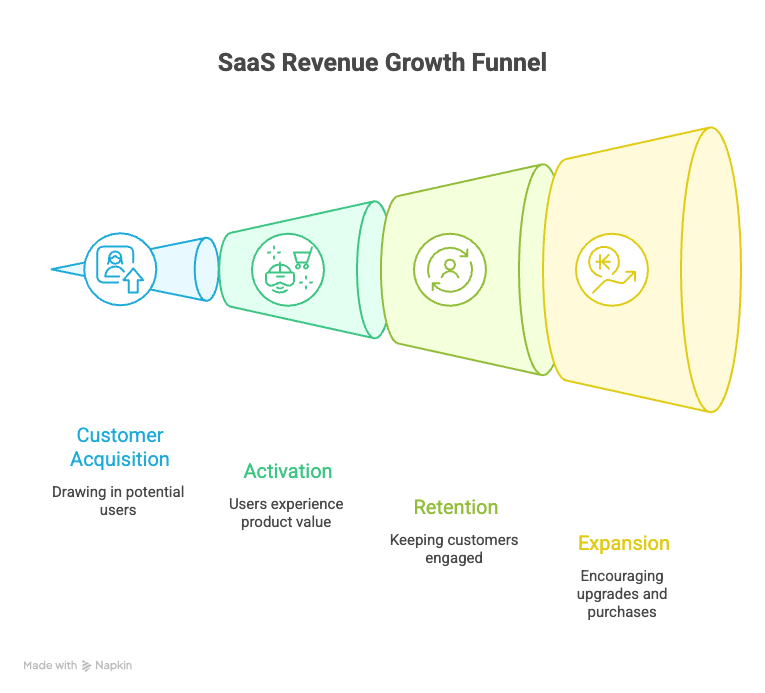
Which revenue metrics matter most?
Monthly and annual recurring revenue give the clearest view of the growth trajectory, because both measure predictable subscription income rather than one-off cash. Average revenue per user sits alongside them and reveals pricing power. Tracking new, expansion and churned revenue separately shows what is actually driving the movement.
“High ARR growth often signals strong product market fit, while stagnant ARR may reveal problems in pricing, onboarding, or customer value.”
Sivan Kadosh, Fractional CPO
Revenue metrics provide the clearest view of a SaaS company’s growth trajectory. They measure predictable income generated through subscriptions.
Monthly recurring revenue (MRR)
Monthly recurring revenue represents the predictable subscription revenue generated every month.
MRR typically includes several components:
- New MRR, generated from new customers
- Expansion MRR, generated from upgrades or additional usage
- Contraction MRR, revenue lost from downgrades
- Churned MRR, revenue lost from customer cancellations
Tracking these components separately allows leadership teams to understand the underlying drivers of revenue growth.
For example, rapid new customer growth may hide a retention problem if churn is simultaneously increasing. Conversely, strong expansion revenue can significantly accelerate growth without increasing acquisition spending.
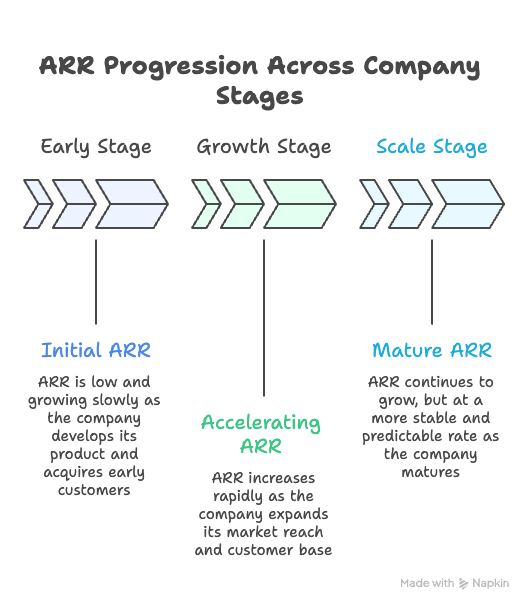
Annual recurring revenue (ARR)
Annual recurring revenue represents the yearly value of recurring subscriptions. ARR is commonly used by investors and boards to evaluate SaaS companies because it reflects long term predictable revenue.
ARR growth is one of the most widely tracked metrics in the SaaS industry. It indicates how effectively a company converts product adoption into recurring income.
High ARR growth often signals strong product market fit, while stagnant ARR may reveal problems in pricing, onboarding, or customer value.
Average revenue per user (ARPU)
Average revenue per user measures the average subscription revenue generated by each customer.
ARPU provides insight into pricing power and customer value. Higher ARPU often results from better packaging strategies, stronger product differentiation, or enterprise customer segments.
Companies frequently improve ARPU through product expansion strategies such as:
- Feature based pricing tiers
- Usage based pricing models
- Add on modules
- Premium enterprise plans
Improving ARPU can significantly accelerate revenue growth without increasing customer acquisition.
How do you know acquisition pays for itself?
By comparing what a customer costs to win against what they return. Customer acquisition cost, lifetime value and the payback period on that acquisition spend together decide whether growth is financially sustainable or simply expensive. A business can grow quickly and still lose money on every customer it adds.
SaaS businesses must balance the cost of acquiring customers with the revenue those customers generate over time. Customer economics metrics help determine whether growth is financially sustainable.
Customer acquisition cost (CAC)
Customer acquisition cost represents the total investment required to acquire a new customer.
CAC typically includes marketing expenses, sales team costs, advertising spend, and onboarding resources.
A rising CAC can signal increasing competition or declining marketing efficiency. If acquisition costs rise faster than customer value, growth eventually becomes unsustainable.
SaaS companies must continually evaluate CAC efficiency to ensure that marketing and sales investments translate into profitable growth.
Customer lifetime value (LTV)
Customer lifetime value measures the total revenue a company expects to generate from a customer over the duration of their relationship.
LTV increases when customers stay longer, upgrade plans, or expand product usage. This metric highlights the long term value of improving retention and customer success.
In SaaS businesses, improving retention by even a small margin can dramatically increase LTV because subscription revenue compounds over time.
LTV to CAC ratio
The relationship between customer lifetime value and acquisition cost is one of the most important indicators of SaaS sustainability.
A healthy SaaS business typically maintains an LTV to CAC ratio around three to one. This means each customer generates three times more revenue than the cost required to acquire them.
A ratio below one indicates that acquisition costs exceed the revenue generated from customers. On the other hand, an extremely high ratio may suggest the company is under investing in growth.
Which retention metrics matter?
Customer churn rate, revenue churn and net revenue retention. Retention is the strongest economic driver in a subscription business because revenue compounds, so losing customers early cuts lifetime value far more than the lost month suggests. Net revenue retention above one hundred percent means the existing base grows unaided.
Retention is the most powerful economic driver in subscription businesses. Because SaaS revenue compounds over time, losing customers early dramatically reduces lifetime value.
Customer churn rate
Customer churn rate measures the percentage of customers who cancel their subscriptions during a given period.
Even small increases in churn can have a significant impact on long term growth. High churn often indicates deeper problems related to product value, onboarding experience, or customer expectations.
Reducing churn typically requires improvements across product usability, support systems, and customer education.
Revenue churn
Revenue churn measures lost revenue rather than lost customers. This distinction is important because SaaS companies may lose smaller customers while retaining larger accounts.
Revenue churn provides a clearer picture of financial impact.
Two key forms are commonly tracked.
Gross revenue churn measures the percentage of recurring revenue lost through cancellations and downgrades.
Net revenue churn incorporates expansion revenue and reflects the overall revenue movement within existing customers.
Net revenue retention (NRR)
Net revenue retention measures how recurring revenue from existing customers changes over time after accounting for churn, downgrades, and expansions.
NRR above one hundred percent means expansion revenue exceeds losses from churn.
High performing SaaS companies often maintain NRR between one hundred ten and one hundred thirty percent, meaning existing customers generate more revenue each year without requiring additional acquisition.
Investors frequently view NRR as one of the strongest indicators of product value and customer satisfaction.
How efficiently is spending becoming revenue?
Revenue growth on its own says nothing about cost. Efficiency metrics measure how much revenue each unit of spending buys, which is what the magic number captures for sales and marketing investment. Two companies can post identical growth while one is buying it and the other is earning it.
Revenue growth alone does not guarantee a healthy SaaS business. Companies must also measure how efficiently they convert spending into revenue.
Magic number
The SaaS magic number measures how efficiently sales and marketing investments generate new revenue.
A high magic number indicates strong revenue generation from marketing spend, while a low number suggests inefficiencies in acquisition channels or sales processes.
This metric helps leadership teams determine when it is appropriate to increase marketing investment and accelerate growth.
Burn multiple
Burn multiple measures how efficiently a company converts cash burn into revenue growth.
It is calculated by dividing net burn by net new recurring revenue.
Lower burn multiples indicate more efficient growth. Companies with extremely high burn multiples may be investing heavily without generating proportional revenue expansion.
Investors increasingly use burn multiple to evaluate financial discipline in SaaS businesses.
Is the underlying model viable per customer?
Unit economics answer that at the customer level rather than the company level. Contribution margin shows what remains from a customer’s revenue after the direct costs of serving them. If the model does not work for one customer, adding more customers scales the problem rather than solving it.
Unit economics determine whether the underlying business model is financially viable. They analyze profitability at the customer level rather than the company level.
Contribution margin
Contribution margin represents the revenue remaining after subtracting direct costs associated with delivering the product.
These costs often include infrastructure, support services, and third party integrations.
A strong contribution margin indicates that each additional customer generates incremental profit.
CAC payback period
CAC payback period measures how long it takes for subscription revenue to recover the cost of acquiring a customer.
For most SaaS companies, a healthy payback period falls between twelve and eighteen months.
Shorter payback periods improve cash flow and allow companies to reinvest in growth more quickly.
How do these metrics work together?
No single number tells the story, because financial performance emerges from how they interact. Strong ARR growth can coexist with real long-term risk if churn is climbing underneath it. Expansion revenue can accelerate growth without any increase in acquisition spend. The relationships carry the meaning.
No single metric tells the full story of a SaaS business. Financial performance emerges from the interaction between multiple metrics.
For example, a company may experience strong ARR growth but still face long term risks if churn remains high. Similarly, low acquisition costs may not translate into sustainable growth if customers fail to expand their usage over time.
Successful SaaS companies analyze metrics together to understand the underlying dynamics of their business model.
What mistakes do companies make with metrics?
Tracking many metrics and extracting few insights. The common failure is watching vanity numbers such as traffic or free trial signups without connecting them to revenue. The second is reading each metric in isolation, which hides the interactions that actually explain what the business is doing.
Many SaaS companies track a large number of metrics but still struggle to extract meaningful insights.
One common mistake is focusing on vanity metrics such as website traffic or free trial signups without understanding how those activities translate into revenue.
Another frequent issue is ignoring retention until churn becomes severe. By the time churn becomes visible at the revenue level, deeper product problems may already exist.
Leadership teams also sometimes interpret metrics without considering strategic context. For example, CAC may appear high when a company intentionally invests in enterprise customers who generate significantly higher lifetime value.
In my experience working with SaaS companies, dashboards often contain dozens of metrics but very little strategic interpretation. Metrics should inform decisions about product strategy, pricing, and growth investments rather than simply reporting past performance.
Why do leadership teams misread metrics?
Because a metric only becomes useful once it is attached to a decision. Declining retention might point at onboarding, at product value or at expectations set during the sale. Rising acquisition cost might mean competition, or a channel losing efficiency. The number names the symptom, not the cause.
“When interpreted correctly, SaaS metrics become the operating language used by founders, investors, and product leaders to evaluate company performance.”
Sivan Kadosh, Fractional CPO
Metrics only become valuable when they are connected to decision making.
For example, declining retention may indicate problems in onboarding, product value, or customer expectations. Rising acquisition costs may signal increased competition or ineffective marketing channels.
Interpreting these signals requires cross functional alignment between product, finance, marketing, and leadership teams.
Without that alignment, metrics remain isolated data points rather than actionable insights.
Our tip: explore our product management consulting services.
How a fractional CPO uses SaaS financial metrics
Usually with companies that have strong engineering and active growth work but no clarity on which metrics should drive decisions. The metrics become a diagnostic, pointing at where the product is leaking value, and then a filter for which roadmap work is worth doing at all.
Fractional chief product officers frequently work with SaaS companies that have strong engineering teams and active growth initiatives but lack clarity around strategic metrics.
A fractional CPO uses financial metrics to diagnose growth constraints and prioritize product investments.
For example, churn analysis may reveal that customers fail to reach meaningful product value during onboarding. Expansion revenue data may indicate opportunities for new pricing tiers or enterprise features. CAC trends may highlight inefficient acquisition channels that require strategic adjustments.
By connecting product decisions with financial outcomes, a fractional CPO helps leadership teams translate metrics into sustainable growth strategies.
When should you bring in a fractional CPO?
When the numbers are collected but not translated. Many teams have extensive dashboards and still cannot say which product decision the data supports. The role connects the metrics to strategy and prioritization, so reporting stops being a ritual and starts changing what gets built next.
Many SaaS companies collect extensive financial metrics but still struggle to translate them into clear strategic decisions.
A fractional CPO helps leadership teams interpret these metrics and connect them to product strategy, pricing models, and growth initiatives. Instead of simply tracking numbers, companies can use financial insight to guide product roadmaps, retention strategies, and expansion opportunities.
If your SaaS company monitors dozens of metrics but growth remains unpredictable, working with an experienced fractional CPO can help transform financial data into strategic direction.
Dashboards full, decisions still unclear?
Get a senior, ex-CPO read on your biggest product bottleneck in 30 focused minutes. No pitch, no obligation.
Book a strategy callKey takeaways
- Understanding SaaS financial metrics is essential for evaluating the health and scalability of a subscription business.
- Recurring revenue metrics such as MRR and ARR provide visibility into predictable growth and revenue momentum.
- Customer economics metrics like CAC, LTV, and CAC payback period determine whether customer acquisition strategies are financially sustainable.
- Retention metrics including churn and net revenue retention are often the strongest indicators of long term SaaS success.
- Strong SaaS companies analyze metrics together rather than in isolation, connecting financial performance with product strategy and growth decisions.
- Many leadership teams track metrics but struggle to interpret them strategically, which is why companies often bring in a fractional CPO to translate financial signals into product and growth strategy.
I do this work inside B2B SaaS product teams. Knowing the model is one thing. Someone has to own it every week.
See how product management consulting works →FAQs
What are the most important SaaS financial metrics?
The most widely tracked SaaS financial metrics include MRR, ARR, customer acquisition cost, customer lifetime value, churn rate, and net revenue retention. Together these metrics reveal whether a company is growing efficiently and retaining customers over time.
What metrics do SaaS investors prioritize?
Investors often focus on ARR growth, net revenue retention, CAC efficiency, and burn multiple. These indicators provide insight into both growth potential and financial discipline.
What is a good CAC payback period in SaaS?
A typical benchmark for CAC payback falls between twelve and eighteen months, though this may vary depending on customer segment and pricing model.
What is considered strong net revenue retention?
Net revenue retention above one hundred ten percent is generally considered strong. Companies with retention above one hundred twenty percent often demonstrate strong expansion revenue and customer satisfaction.
Why is retention so important in SaaS?
Retention drives the compounding nature of subscription revenue. When customers remain longer and expand their usage, lifetime value increases significantly and acquisition investments become more efficient.
What clients say
Read all 18 references“As a product manager, I can say that Sivan is very professional – always looking deeply on the discussed feature to understand end to end its effect on the whole product, and as well the eager to understand what would be the added value to the strategy of the company. Nothing was added without a clear scope of development, a clear understanding of the business owner and a clear way to measure the success or failure of this feature.”
“Leading by example, empowering, mentoring, and growing his product teams, he created great product culture and set us Product Managers up for success. His vision and strategic direction enabled us to create successful products that brought millions of dollars of revenue to the company and its clients.”
“As part of his role as VP Product, he identified creative ideas, developed sharp strategies and built the road map while focusing on customer experience and business needs.”
