The Founder Bottleneck: Why the Visionary Becomes the Velocity Killer (And How to Scale Out of It)
January 21, 2026 • 9 min read
Last Updated on February 24, 2026 by Sivan Kadosh
In the early days of a startup, the founder is the ultimate “compression engine.” You hold the market insights, the customer pain points, the technical constraints, and the strategic vision in a single brain. Decisions are made at the speed of thought. This “Founder Telepathy” is your greatest competitive advantage; it allows for the rapid pivots and relentless execution that get a product to its first $1M in ARR.
But as the company scales toward $5M, $10M, and beyond, the very trait that birthed the company, the founder’s centralized control, becomes the single greatest inhibitor of growth.
You are no longer the engine. You are the bottleneck.
To scale, you must transition from being the Chief Decision Maker to the Chief System Architect. This article explores the systemic reasons why founders become bottlenecks, the psychological traps that keep them there, and the tactical framework required to decentralize product leadership without losing the vision.
Key Takeaways:
If you are feeling the “scaling friction,” keep these five core principles in mind to transition from the primary executor to a strategic leader:
- Founder Telepathy is a Liability at Scale: Proximity-based alignment works for 5 people but fails at 30. If your team can’t explain the “Why” behind a feature without calling you, your communication system is broken.
- Context over Control: Your job is no longer to make the “right” decision, but to ensure your team has the context (market data, vision, constraints) to make that decision themselves.
- Beware of Managerial Debt: Every time you “swoop in” to fix a product detail at the last minute, you weaken your team’s ownership. High-growth companies are built on the “problem-solving muscles” of the staff, not the heroics of the founder.
- The 80/20 Handover Rule: To scale, you must accept a temporary 20% drop in “perfection” to gain a 200% increase in organizational velocity. Use the Product Manifesto to define what “Great” looks like so the team can hit the mark without you.
- Hire a “Map Maker”: A fractional CPO acts as the bridge between your high-level vision and the engineering team’s daily output. They turn your intuition into a repeatable, scalable system.
The “Two-Month” test: Are you building a business or a job?
I recently had a candid conversation with the CEO of a Series A company I advise. I asked him two simple questions: “How many of your employees told you ‘No’ this week?” and “If you went offline for two months tomorrow (no Slack, no email) what happens to the organization?”
He started to stammer.
I told him, “You see? That silence is your problem.” The fact that your team is afraid to push back, and the reality that daily operations rely on your specific input, is a structural flaw. This isn’t just anecdotal anxiety; it is statistically dangerous. According to research by Noam Wasserman in The Founder’s Dilemmas, 65% of high-potential startups fail due to people problems, specifically the founders’ inability to adjust their leadership roles. Furthermore, data from Gallup indicates that employees who feel their voice is heard are 4.6x more likely to feel empowered to perform their best work. If they can’t say “no” to you, you aren’t getting their best work.
From bottleneck to architect If you set the strategic goals and OKRs at the start of the quarter, the organization must possess the infrastructure to execute them without you. To escape this trap, you must operationalize your exit from the daily grind. As highlighted in Forbes, moving from verbal decisions to documented systems is the only way to stop stalling your own growth. It is the practical application of the famous First Round Review framework: to scale, you must learn to “Give Away Your Legos” and trust the system you’ve built.
Stop guessing. Start calculating.
Access our suite of calculators designed to help SaaS companies make data-driven decisions.
Free tool. No signup required.
The death of “founder telepathy”
At 10 employees, everyone knows what “good” looks like because they talk to the founder every day. You share coffee, you sit in the same Slack channels, and the “why” behind every product decision is absorbed through proximity. This is Founder Telepathy.
As the team grows to 30, 50, or 100 people, proximity disappears. The founder can no longer be in every sprint planning meeting or every customer discovery call. When the founder remains the sole arbiter of “good,” several systemic failures occur:
1. The decision latency tax
When every non-trivial product decision requires the founder’s “green light,” the organization develops a high Decision Latency. Engineers wait for feedback on UI tweaks; Sales waits for a “yes” on a feature request to close a deal. In a high-growth environment, a 48-hour delay for a founder’s review, multiplied by twenty teams, results in months of lost velocity per year.
2. The “wait-and-see” culture
If a founder frequently overrides team decisions, the team stops making them. Why exert the mental energy to solve a complex product problem if “the boss” is just going to change it on Monday morning? This creates a culture of passivity where senior hires act like junior executors, waiting for instructions rather than taking ownership.
3. Contextual degradation
The founder is now spread across Fundraising, Sales, HR, and Operations. You are no longer “deep” in the product daily. Consequently, when you do jump in to make a decision, you are often doing so with degraded context. You are making “gut” decisions based on 2023 data in a 2026 market.
The three pillars of the bottleneck
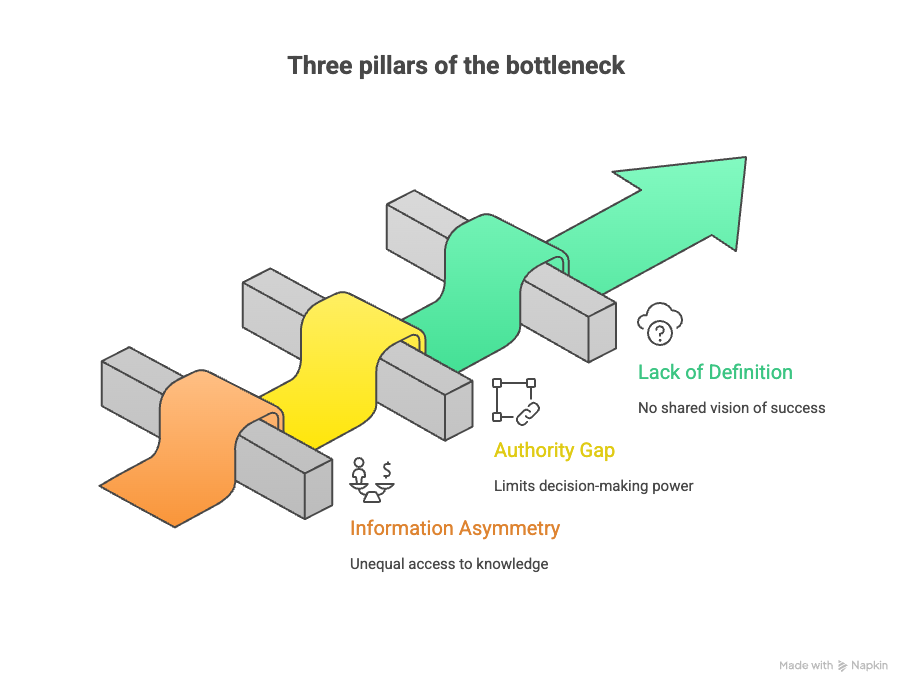
Why is this so hard to fix? It isn’t just a lack of “delegation”, it’s a structural misalignment of three critical areas: Information, Authority, and Standards.
Pillar 1: Information asymmetry
The founder often possesses “secret” knowledge, investor expectations, long-term M&A possibilities, or deep nuances of a specific large account, that the Product Management (PM) team doesn’t have. Because the team lacks the full picture, their proposals often miss the mark. Instead of sharing the context, the founder simply rejects the proposal and does it themselves.
The Fix: Over-communicate the “Strategic North Star.” If the team doesn’t have the context to make the “right” decision, that is a leadership failure, not a talent failure.
Pillar 2: The authority gap
Many founders delegate “tasks” but never “authority.” They hire a VP of Product but still message individual engineers about button colors. This creates a “Shadow Roadmap” where the team is working on what the PM said, but secretly trying to please the founder’s latest whim.
The Fix: Define “Hard Gates” vs. “Soft Input.” Clearly state which decisions you must be part of (e.g., pricing changes) and where you are merely an advisor.
Pillar 3: The lack of a “definition of great”
Founders often operate on “I’ll know it when I see it.” Without a documented product philosophy or a clear set of design principles, the team is forced to guess. This guessing leads to “Founder Review” becoming a source of anxiety rather than a source of alignment.
The Fix: Build a Product Manifesto. Document the trade-offs: Do we prioritize speed over polish? Do we build for the power user or the novice?
Our tip: read more about why feature velocity hides product failure
The psychological trap: The “savior” complex
Being the bottleneck often feels like being the hero. When a founder “swoops in” to fix a product requirement or redefine a feature at the last minute, they get an immediate hit of dopamine. They feel essential. They saved the day.
However, this “Savior Complex” is a form of Managerial Debt. Like Technical Debt, it allows for a quick release today at the expense of a catastrophic failure tomorrow. Every time you save the day, you weaken the organization’s “problem-solving muscles.” You are teaching your team that they don’t need to be excellent, because you will provide the excellence for them at the 11th hour.
To scale, you must be willing to let the team ship something that is “80% as good as you would have done it” so that they can eventually learn to do it 120% better than you.
Tactical framework: Transitioning to the “product engine”
To stop being the bottleneck, you must move from managing the product to managing the system that builds the product. This requires a three-tier approach:
Tier 1: The strategic North Star (the “what” and “why”)
The founder’s role is to define the Product Vision and the Target Outcomes.
- Instead of: “Build a dashboard that shows churn.”
- Try: “Our goal for Q3 is to reduce churn by 15% among mid-market customers. Here is the budget and the technical constraints. Show me your plan.”
Tier 2: The fractional/full-time CPO (the “how”)
As we discussed in previous articles, this is where a Product Leader (fractional or FT) acts as the “Map Maker.” They take your vision and translate it into a repeatable system: roadmaps, prioritization frameworks, and cross-functional loops between Sales and Engineering. They protect your time by handling 90% of the “Which feature comes next?” conversations.
Tier 3: High-leverage rituals
Stop the “ad-hoc” Slack pings. Implement structured rituals that provide you with oversight without requiring your constant presence:
- The Monthly Strategy Review: Deep dive into the “Why.” Are we still on track for the 3-year vision?
- The Weekly Tactical Sync: High-level blockers only. No “design by committee.”
- The “Async” Demo: Use tools like Loom. Let the team show you progress, and provide feedback in written form. This forces you to be more thoughtful and less reactive.
Signs you are successfully “un-bottlenecking”
How do you know if you are succeeding? Look for these “positive friction” indicators:
- The team disagrees with you (successfully): A PM presents a data-backed argument for why your latest idea won’t work, and they are right.
- Decision velocity increases: Features are moving from “Idea” to “Dev” without needing a meeting with you.
- Predictable shipping: The roadmap isn’t changing every time you have a “visionary” weekend.
- Talent retention: High-agency PMs and Engineers stay because they feel they have the autonomy to actually build, not just execute your tickets.
Conclusion: from founder to CEO
The transition from “Founder” to “CEO” is essentially the process of intentionally removing yourself from the critical path. Being the bottleneck isn’t a sign that you are a “hands-on” leader; it’s a sign that your organization lacks the systems to function without you.
By documenting your vision, hiring high-leverage product leadership, and shifting your focus from Outputs (the features) to Outcomes (the business results), you free yourself to do the only thing a founder must do: navigate the company toward the future.
If the company can’t ship a great product without your daily input, you don’t have a company, you have a very high-stress job. It’s time to build the system that makes you redundant in the day-to-day, so you can be essential in the decade-to-decade.
Ready to step out of the day-to-day?
If you recognized yourself in the descriptions above, you aren’t alone. Most founders reach a point where their “visionary” energy is being drained by ticket management, roadmap disputes, and the constant friction of being the ultimate decision-maker.
You don’t need to do it all, but you do need a system.
Our fractional CPO services are designed specifically for founders at the $2M-$15M ARR stage who are ready to stop being the bottleneck and start being the CEO. We provide the high-leverage leadership you need to:
- Establish a Product “Engine”: We bridge the gap between your vision and your engineering team’s execution, creating a repeatable process that doesn’t require your 24/7 oversight.
- End the “Shadow Roadmap”: We align Sales, Engineering, and Marketing around a single, ROI-driven strategy that prioritizes growth over “squeaky wheel” feature requests.
- Mentor Your Existing Team: We don’t just manage; we upskill your current PMs and Leads, turning executors into high-agency owners.
- Reduce Decision Latency: We implement the frameworks that allow your team to make “founder-level” decisions without needing to ask for permission.
Stop being the velocity killer. Start scaling the vision.

Sivan Kadosh is a veteran Chief Product Officer (CPO) and CEO with a distinguished 18-year career in the tech industry. His expertise lies in driving product strategy from vision to execution, having launched multiple industry-disrupting SaaS platforms that have generated hundreds of millions in revenue. Complementing his product leadership, Sivan’s experience as a CEO involved leading companies of up to 300 employees, navigating post-acquisition transitions, and consistently achieving key business goals. He now shares his dual expertise in product and business leadership to help SaaS companies scale effectively.