The Paradox of Success: Why Discovery Dies After Product-Market Fit
January 22, 2026 • 9 min read
Last Updated on February 6, 2026 by Sivan Kadosh
The ability of startups to find Product-Market Fit lies in their very definition: they are, quite simply, startups. This isn’t just wordplay. As Steve Blank famously noted in the Harvard Business Review, a startup is a temporary organization designed to search for a business model, not just execute one. It is an agile learning machine that lives and breathes hypothesis testing until it discovers a value proposition customers are willing to pay for.
But here lies the paradox: the moment success arrives, that magic tends to fade. As the company scales, the hunger to explore new territory is often replaced by bureaucratic process and an illusion of stability. The tempting thought is, “We’ve found our PMF, why keep risking it?” That is a dangerous fallacy. Reaching a temporary safe harbor doesn’t mean the ocean has calmed. In fact, succumbing to this stasis is exactly what Jeff Bezos described as the “Day 2” mentality, the prelude to irrelevance and decline.
I’ve seen countless startups believe they had won the war, only to be outmaneuvered by a hungrier competitor while they were resting on their laurels. In this article, we will dive into why discovery tends to die post-success, and how you can ensure your organization remains a “startup at heart” even as it shifts gears into high-growth execution.
Key Takeaways:
If you are short on time, here are the essential insights into why discovery atrophies after Product-Market Fit and how to prevent it:
- The Roadmap Trap: Post-PMF roadmaps often transform from a list of hypotheses into a “list of promises.” This shifts the team’s focus from achieving outcomes (solving problems) to merely hitting outputs (shipping features).
- Creation vs. Capture: Success shifts organizational gravity from Value Creation (finding new ways to help users) to Value Capture (optimizing current features to extract revenue). Optimization is necessary but is not a substitute for discovery.
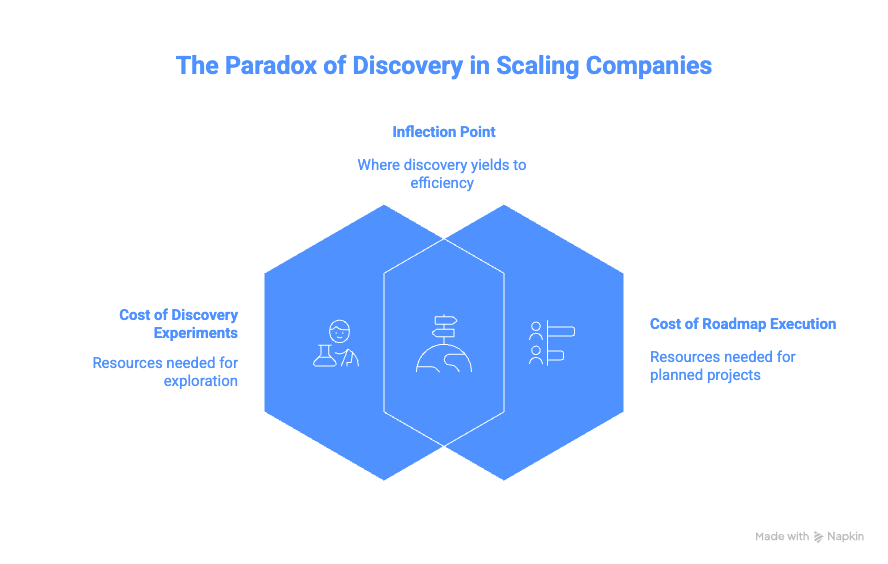
- The Complexity Tax: As a product grows, the technical and bureaucratic “friction” of running experiments increases. If the cost of curiosity becomes higher than the cost of simply following the backlog, discovery will stop.
- The Expert Fallacy: Product-Market Fit can breed intellectual arrogance. Teams stop being “students of the problem” and start assuming they already know what the customer wants, leading to a reliance on intuition over evidence.
- Metric-Driven Myopia: Leading indicators of scale (like MRR or DAU) are lagging indicators of discovery. Over-reliance on short-term growth metrics incentivizes safe, incremental changes rather than the bold bets required for future growth.
- Siloed Empathy: Scaling often creates “information silos” where Sales, Support, and Product stop sharing a unified view of the customer. When empathy is delegated to a specific department, the “why” behind the product disappears.
- The Path Forward: To keep discovery alive, companies must adopt Dual-Track Agile (separating discovery from delivery), reward “Learning Velocity” as much as “Shipping Velocity,” and protect small, autonomous “Search Units” from the core business’s bureaucracy.
The tyranny of the “proven” roadmap
Before Product-Market Fit, the roadmap is a series of questions. After PMF, the roadmap becomes a series of promises.
When a company finds fit, it suddenly has customers, often large, demanding enterprise customers or a massive, vocal user base. These stakeholders have “needs” (which are often just “wants” in disguise). Sales teams promise specific features to close deals; Customer Success demands fixes to reduce tickets; Marketing needs “big splashes” for the next conference.
In this environment, the certainty of the known outweighs the potential of the unknown. The organization shifts its focus to:
- Closing “feature gaps” compared to competitors.
- Servicing technical debt to keep up with scale.
- Building “requested” features that have immediate, quantifiable ROI.
Discovery, by its nature, is messy and unpredictable. It involves invalidating ideas, which feels like “wasted time” to an organization now optimized for throughput. When every developer hour is accounted for in a six-month roadmap designed to satisfy existing stakeholders, there is no room left to ask, “Is this still the right problem to solve?”
Stop guessing. Start calculating.
Access our suite of calculators designed to help SaaS companies make data-driven decisions.
Free tool. No signup required.
The shift from “value creation” to “value capture”
The pre-PMF era is defined by Value Creation. You are trying to find a way to make someone’s life significantly better so they will actually pay you or give you their time. This requires deep empathy, ethnographic research, and constant pivoting.
Post-PMF, the gravity shifts toward Value Capture. The board and investors now want to see the “unit economics” work. They want to see how you can extract more margin, increase the Average Contract Value (ACV), or optimize the conversion funnel.
While Value Capture is necessary for a sustainable business, it is the enemy of discovery. Optimization (A/B testing a button color or tweaking a pricing tier) is often mistaken for discovery. But optimization is about making the current model work better; discovery is about finding the next model. When a company becomes obsessed with the local maxima of its current product, it loses the ability to look at the horizon for the next mountain range.
| Dimension | Pre-PMF Discovery | Post-PMF Optimization |
| Primary goal | Find a real, painful problem worth solving | Extract more value from an already validated solution |
| Core question | “Is this the right problem?” | “How do we scale what already works?” |
| Roadmap nature | Hypothesis-driven, flexible, frequently rewritten | Commitment-driven, fixed, treated as promises |
| Success definition | Learning speed and insight quality | Predictable delivery and metric movement |
| Team mindset | Curious, humble, experimental | Confident, efficiency-focused, risk-averse |
| Customer interaction | Direct, frequent, qualitative (interviews, observation) | Indirect, filtered through metrics, Sales, or Support |
| Decision inputs | User pain, qualitative signals, rapid feedback | Dashboards, forecasts, revenue impact |
| Experiment cost | Low, fast, disposable | High, slow, politically expensive |
| Failure perception | Expected and valuable | Avoided and often punished |
| Typical outputs | Invalidated ideas, pivots, reframed problems | Feature improvements, optimizations, refinements |
| Dominant risk | Building something nobody wants | Missing the next wave of customer needs |
| Organizational gravity | Value creation | Value capture |
The “expert” trap and the death of humility
In the early days, founders and product teams are humble because they have to be. They know they don’t have the answers, so they talk to users constantly. They are “students of the problem.”
Once Product-Market Fit is achieved, a dangerous narrative takes root: “We know our users better than they know themselves.” Success breeds a sense of infallibility. The team begins to rely on their “intuition” or “industry experience” rather than fresh data. Internal meetings start to replace customer interviews. Decision-making moves from the “front lines” (those talking to users) to the “headquarters” (those looking at spreadsheets).
This “Expert Trap” creates a feedback loop of confirmation bias. The company only looks for data that proves their current strategy is working and dismisses “outlier” feedback that suggests the market is shifting. By the time the “outliers” become the majority, the company has lost the muscle memory required to pivot.
The complexity tax and scale
Discovery is fast when the codebase is small and the team is five people in a room. You can have an idea at 10:00 AM, mock it up by noon, and show it to a user at 2:00 PM.
Post-PMF, the complexity tax kicks in.
- Technical Complexity: Every new experiment must now integrate with a massive legacy codebase, pass security audits, and not break things for 100,000 existing users.
- Organizational Complexity: To test a new idea, you now need approval from Legal, Brand, Product Marketing, and the “Head of Growth.”
The friction of doing discovery becomes so high that teams simply stop trying. It becomes easier to just build what is on the jira backlog than to fight the internal battles required to run a clean experiment. The “Cost of Curiosity” becomes higher than the “Cost of Compliance.”
Metrics-driven myopia
“What gets measured gets managed,” and post-PMF companies love to measure. They live and die by North Star metrics like DAU (Daily Active Users), MRR (Monthly Recurring Revenue), or NRR (Net Revenue Retention).
While these are great lagging indicators of health, they are terrible leading indicators for discovery. Metrics-driven cultures tend to incentivize incrementalism. If a Product Manager is judged on moving a specific metric by 2% this quarter, they will never take the risk of exploring a new problem space that might show 0% movement for six months before potentially 10x-ing the business.
Discovery requires “Safe to Fail” spaces. Most post-PMF environments are “Fail-Safe”, designed entirely to prevent mistakes. In a Fail-Safe environment, discovery is the first thing to be sacrificed because discovery, by definition, involves a high failure rate of hypotheses.
The siloing of knowledge
In a startup, everyone knows why a customer bought (or didn’t buy) the product. Information flows freely.
As a company scales after Product-Market Fit, departments form. Sales owns the “What people want to buy” data. Support owns the “What is broken” data. Product owns the “What we are building” data.
Discovery dies in these silos. The Product team stops talking to users because they think “Sales handles that.” Sales stops relaying deep pain points because they are focused on “What do I need to close this specific deal?” The holistic view of the customer journey evaporates, replaced by fragmented data points that don’t tell a coherent story. Without a unified, empathetic view of the user, true discovery is impossible.
How to keep discovery alive
If discovery dies because of success, is it inevitable? Not necessarily. But keeping it alive requires a deliberate, often counter-cultural effort.
A. The “dual-track” mindset
Organizations must explicitly separate “Delivery” from “Discovery.” It is not enough to ask the same people to do both. You must protect the time and budget for discovery, ensuring that a portion of the team is always focused on “Problem Validation” rather than “Feature Shipping.”
B. Invest in “learning velocity,” not just “shipping velocity”
Celebrate the team that invalidated a bad idea just as much as the team that launched a new feature. If the only thing that gets celebrated in All-Hands meetings is “shipping,” the message to the org is clear: discovery is a hobby, delivery is the job.
C. Forced proximity to pain
Leaders must mandate that every person, from engineers to executives, spends time with users. Not just watching a research synthesis, but sitting in on support calls or watching a user struggle with the interface. Empathy cannot be outsourced to a “Research Department.”
D. Create “search” units
As the core business focuses on Value Capture, create small, autonomous units (often called “Special Projects” or “Labs”) whose sole job is to find the next Product-Market Fit. These teams must be shielded from the core business’s metrics and processes so they can operate with the speed and risk-tolerance of a seed-stage startup.
The bottom line
Product-Market Fit is a milestone, not a destination. The market is a moving target; customer expectations evolve, competitors emerge, and technology shifts.
The very processes that help you scale a product are often the same ones that prevent you from evolving it. Discovery dies when a company stops being afraid of being wrong and starts being afraid of being slow. To survive the long haul, a company must find a way to remain a “Day 1” company, one that values the search for truth more than the comfort of the roadmap.
The most dangerous moment for any company isn’t when they are struggling to find Product-Market Fit, it’s the moment they think they’ve finally found it and decide they can stop looking.
Don’t let your success become your ceiling
Many post-PMF companies find themselves stuck in a “growth plateau” or a “feature-parity war” because they’ve lost the ability to discover new value. If your team is spending 100% of their time on delivery and 0% on true discovery, you aren’t building a future, you’re just managing the past.
Our fractional CPO services are designed to bridge this exact gap. We help scaling organizations reinstall the “discovery engine” without breaking the delivery machine. Whether it’s implementing dual-track agile, coaching your PMs on advanced discovery techniques, or helping you identify your next market, we provide the strategic leadership you need to ensure Product-Market Fit is a foundation for the future, not a tombstone for your innovation.

Sivan Kadosh is a veteran Chief Product Officer (CPO) and CEO with a distinguished 18-year career in the tech industry. His expertise lies in driving product strategy from vision to execution, having launched multiple industry-disrupting SaaS platforms that have generated hundreds of millions in revenue. Complementing his product leadership, Sivan’s experience as a CEO involved leading companies of up to 300 employees, navigating post-acquisition transitions, and consistently achieving key business goals. He now shares his dual expertise in product and business leadership to help SaaS companies scale effectively.