
Product velocity is a vanity metric because it measures output, how much the team shipped, rather than outcome, what shipping changed for the business. Story points rise while activation, retention and revenue stay flat. The metric that matters ties every initiative to a business result before code is written.
I do this work inside B2B SaaS product teams. If your team ships every week and the numbers barely move, this is where I start.
See how product management consulting works →The hard truth must be stated: most organizations I encounter prioritize Output over Outcome. I don’t blame them; it is almost a basic human need to check a box, close as many Jira tickets as possible, and proudly show management: “Look how many features we delivered this quarter.” However, the reality on the ground is far grimmer than the optimistic charts of the engineering department. Extensive research by Pendo revealed a staggering statistic: 80% of features in the average SaaS product are rarely or never used. This means that most of the “Velocity” you are celebrating is simply burning cash on development that generates no value.
This phenomenon, which product expert Melissa Perri defined as “The Build Trap”, occurs when an organization measures success by the amount of code written rather than the business value created. This is the trap where Output becomes the goal itself. Conversely, there are organizations that, out of fear of producing “waste,” get stuck in paralysis, with releases taking months. Here lies the optimum point: finding the balance where we generate maximum Outcome with minimum unnecessary Output. It is not a 50:50 split; Outcome is always King, but Output is the vehicle that gets us there.
In the article below, we will analyze why “Velocity” has become a vanity metric used by mediocre managers to hide a lack of strategy, and how you can reset your organizational compass to measure true impact.
Key takeaways
- Velocity is an internal tool, not a KPI: It was designed for team capacity planning, not for measuring business value or executive success.
- Goodhart’s Law is in effect: When velocity becomes the target, teams inflate points and sacrifice quality to hit the numbers.
- Output vs. Outcome: High velocity measures how much “stuff” was built, but it ignores whether that “stuff” actually solved a customer problem or generated revenue.
- Operational Health > Point Totals: Leaders should pivot to DORA metrics and North Star business outcomes to get a true picture of engineering performance.
What is a story point and why is it seductive?
A story point is a unit Agile teams use to size work relative to other work. The original intent was narrow and sound: help a team plan its own capacity for the next sprint. Velocity is simply the number of points a team completes, which makes it a planning input rather than a result.
“The most dangerous aspect of velocity is that it measures Output, how much we did, rather than Outcome, what we achieved.”
Sivan Kadosh, Fractional CPO
To understand why velocity is failing you, we must first look at what it actually is. In the world of Agile development, Velocity is the amount of work a team tackles during a single sprint, usually measured in Story Points.
The original intent was noble. Story points were designed as a tool for internal team estimation, a way for developers to gauge their own capacity so they wouldn’t over-promise. It used relative sizing (this task is “twice as big” as that one) to avoid the pitfalls of estimating in hours, which humans are notoriously bad at doing. It was never intended to be a Key Performance Indicator (KPI) for business success.
However, because it produces a nice, quantifiable number, it was quickly co-opted by executives and project managers looking for a way to measure “productivity.” This is where the rot begins. When you turn an internal estimation tool into a performance metric, you trigger Goodhart’s Law: “When a measure becomes a target, it ceases to be a good measure.”
Once the team knows that “High Velocity = Good Performance,” they stop focusing on the software and start focusing on the points. They stop being engineers and start being bookkeepers.
How is velocity gamed?
Velocity is the easiest metric in the world to manipulate, because story points are subjective and relative with no external standard to keep them honest. Inflation is the obvious route: the same work is simply scored higher next quarter. The absence of a baseline is exactly what makes the number unfalsifiable. The same dynamic at feature level is covered in how feature velocity hides product failure.
“Once the team knows that high velocity means good performance, they stop being engineers and start being bookkeepers.”
Sivan Kadosh, Fractional CPO
Velocity is the easiest metric in the world to manipulate. Because story points are subjective and “relative,” there is no external standard to keep them honest. This lack of a baseline is exactly what incompetent managers use to shield themselves from accountability.
1. The art of Story Point inflation (gamification)
If you tell an engineering manager that their bonus or their standing in the company depends on increasing velocity, they will increase velocity. But they won’t do it by working harder or smarter; they will do it by inflating the points.
- The 3-point task becomes a 5-point task: Over time, the definition of a “point” drifts. A task that took two days last year is now estimated as double the points to show “growth.”
- The “Quick Fix” suddenly requires a formal ticket: Every minor bug or configuration change is now “pointed” to ensure no effort goes unrecorded in the velocity chart.
- The definition of “Done” is loosened: To ensure points are claimed before the sprint ends, teams will push code that isn’t fully tested or documented, claiming the “points” now and dealing with the “bugs” (which are conveniently unpointed) later.
This creates an illusion of growth. A team can show a 20% increase in velocity over six months while delivering the exact same amount of code, or worse, less code of lower quality. As a CEO, you see a “high-performing” team on a spreadsheet, while in reality, you are paying more for the same output.
Our tip: also read ab out Product Strategy Framework For Growth-Stage SaaS
2. The feature factory: Output/Outcome
The most dangerous aspect of velocity is that it measures Output (how much we did) rather than Outcome (what we achieved).
Imagine two construction crews.
- Crew A builds 100 yards of road per day.
- Crew B builds 50 yards of road per day.
Velocity says Crew A is “better.” But if Crew A is building a road into a swamp, and Crew B is building the final connection to a major trade port, who is more valuable?
When a team focuses solely on velocity, they become a Feature Factory. They prioritize “shipping” over “solving.” They will build the easiest features that offer the most story points, regardless of whether those features solve a customer pain point or drive revenue. This hides the incompetence of Product Management. If the Product Owner can’t articulate the why, they hide behind the how much.
Why do managers cling to velocity?
Managers hold on to velocity because it supplies plausible deniability. A rising chart creates a data-driven fog that stops an executive seeing a missing strategy or a skills gap underneath. The table below pairs each tactic with what it conceals and with what a CEO is actually looking at.
Why do managers cling to velocity even when it’s clearly not working? Because it provides plausible deniability. It creates a data-driven fog that prevents executives from seeing the underlying lack of skill or strategy.
| The Tactic | How it Hides Incompetence | The CEO’s Reality |
|---|---|---|
| The “Predictability” Trap | A manager claims the team is “highly predictable” because their velocity is a flat line. | The team is “sandbagging”, taking on only the easiest tasks to ensure they never miss a target. |
| Point Padding | Over-estimating simple tasks to create a “buffer.” | You are paying for 40 points of effort but only receiving 20 points of actual value. |
| Ignoring Technical Debt | Velocity only counts “new” features. Bugs and maintenance are ignored to keep the velocity high. | The system is becoming a “house of cards” that will eventually crash, halting all future progress. |
| Siloing | Managers refuse to let their team help other departments because it would “hurt their velocity.” | The company stays fragmented, and high-value cross-team projects are strangled in the cradle. |
| The Jira Shuffle | Moving unfinished tasks to the next sprint but claiming “partial points.” | The data is being cooked to ensure the monthly report to the Board looks positive. |
What does velocity obsession actually cost?
When velocity becomes the north star, the damage lands where a Jira dashboard cannot show it. Technical debt accumulates because speed is not health, and the interest compounds until the team can no longer build anything new. Morale follows, and the strongest engineers leave first.
When velocity becomes the North Star, the organization begins to suffer in ways that aren’t immediately visible on a Jira dashboard but are devastating to the bottom line.
1. Software bankruptcy (technical debt)
Velocity is a measure of speed, not health. In the rush to maintain a high point count, teams often take “shortcuts.” They skip unit tests, ignore documentation, and “hack” solutions together to ensure the ticket moves to the “Done” column before the sprint review.
This creates Technical Debt. Think of it like a high-interest credit card. You get the feature “now,” but you pay interest on it forever in the form of slower future development and more bugs. Eventually, the interest payments become so high that the team can no longer build anything new.
At this point, the incompetent manager will usually blame “legacy systems” or “unforeseen complexity,” conveniently forgetting that they sacrificed long-term stability for short-term velocity stats.
2. The talent exodus
High-performing engineers, the ones you actually want to keep, hate being treated like “story point printers.” They want to solve hard problems, innovate, and see their work move the needle for the company.
When the metric is velocity, the smartest person in the room is often incentivized to keep their mouth shut about a better, simpler way to do things because “we’ve already pointed the tickets for the original plan.” Velocity-focused cultures punish innovation and reward compliance. Your best people will leave for companies that value their brains, not just their typing speed, leaving you with a team of “point-chasers” who lack the initiative to actually improve your product.
Which metrics should replace velocity?
Breaking the motion-without-progress cycle means shifting the conversation from velocity to value. Ask for metrics that correlate with business health and technical excellence: DORA metrics for delivery health, activation and retention for whether the work landed, and cycle time for whether the system itself is getting easier to change. The organizational version of the fix is in escaping the feature factory.
If you want to stop the “motion without progress” cycle, you need to shift the conversation from Velocity to Value. As a CEO, you should demand metrics that correlate with business health and technical excellence.
1. Operational excellence: DORA metrics
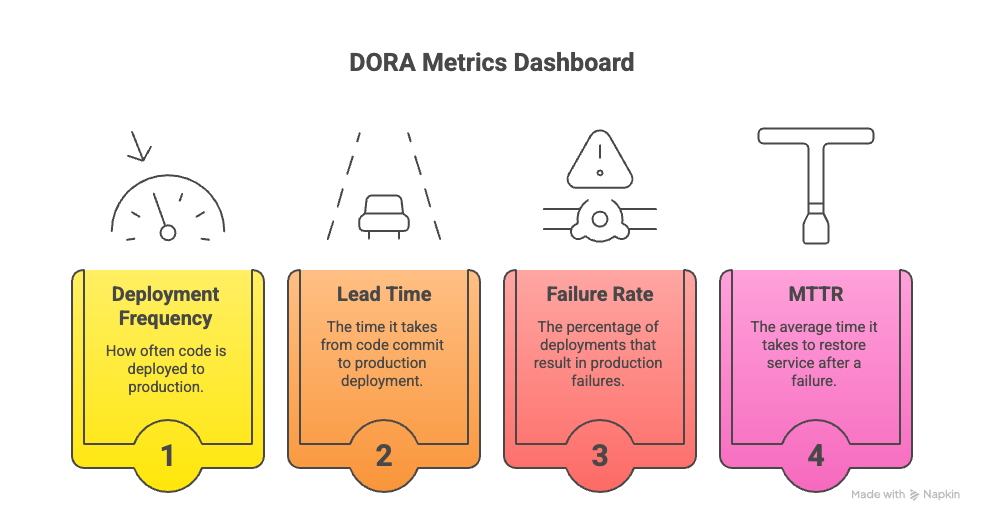
If you want to measure the “health” of your engineering engine without the fluff of story points, use the four DORA metrics. These are objectively measurable and correlate directly with high-performing organizations.
- Deployment Frequency: How often do we ship to production? (Elite teams ship daily; incompetent ones ship once a month).
- Lead Time for Changes: How long does it take from “code committed” to “code in front of customers”?
- Change Failure Rate: What percentage of our releases result in a bug? This is your “Quality Meter.”
- Time to Restore Service: How quickly can we fix things when they break? This is your “Resilience Meter.”
2. Strategic alignment: North Star metrics
Each product initiative should be tied to a specific business outcome. Before a single line of code is written, the Product and Engineering leads must answer:
- “What business metric will this move?” (e.g., Conversion rate, Churn reduction, Average Order Value).
- “How will we measure it?”
- “If this metric doesn’t move, was the project a failure, regardless of how many ‘points’ it cost?”
What should a CEO ask when shown a velocity chart?
The next time someone brings you a chart showing increased velocity, do not congratulate them. Ask four questions instead: what business outcome moved, what the change cost in quality, whether the cycle time improved, and what the team chose not to build in order to hit the number.
The next time your Head of Engineering or Product Lead brings you a chart showing “increased velocity,” don’t congratulate them. Instead, pull out this framework and ask these four questions:
- The Value Link: “Show me the direct correlation between this 20% increase in points and our growth in [Core Business Metric]. If we did 100 points but revenue is flat, why are we doing those points?”
- The Rework Audit: “What percentage of this velocity was spent on ‘rework’ or fixing things we broke last month? Are we actually moving forward, or just running on a treadmill?”
- The Simplicity Challenge: “If we could have achieved this same result by writing zero lines of code and just changing a process, would we have done it? Or are we incentivized to build complex things just to hit point targets?”
- The Technical Health Check: “How much of our capacity is being diverted to ‘Interest Payments’ on our technical debt? And what is the plan to pay down the principal?”
Stop applauding motion
It is easy to run fast. It is hard to run in the right direction. If your team is obsessed with their velocity, they have likely lost sight of the horizon. Your job as a leader is to take the stopwatch away and give them a compass.
Velocity is a comfort blanket for managers who are afraid to be judged on results. It’s a way to say, “We were busy,” even when the company is failing. True competence is the ability to identify the smallest possible amount of work that will result in the largest possible impact. That often means a lower velocity, because the team is spending more time thinking, planning, and simplifying rather than just typing.
The goal of a software company isn’t to produce “software.” The goal is to produce value. Software is just the expensive, complicated way we happen to do it. Measure the value, and the incompetence will have nowhere left to hide.
Conclusion
Product velocity is a comfort blanket for managers who are afraid to be judged on results. It is a metric of activity, not achievement. When you applaud a team for their velocity, you are essentially congratulating a treadmill for how many miles it has clocked, without ever asking if the person running on it is getting any closer to their destination.
The next time your Head of Engineering or Product Lead brings you a chart showing “increased velocity,” don’t congratulate them. Instead, ask about the value link.
Stop applauding motion. Start measuring impact. Software is just an expensive way to generate business value; make sure you’re getting what you paid for.
Don’t let vanity metrics sink your roadmap. If you suspect your engineering department is running in circles, it’s time to change the scorecard. Schedule a consultation with an experienced product leader to help your leadership team transition from tracking story points to tracking business impact.
Measuring motion instead of impact?
Get a senior, ex-CPO read on your biggest product bottleneck in 30 focused minutes. No pitch, no obligation.
Book a Product Strategy SessionI do this work inside B2B SaaS product teams. Knowing the model is one thing. Someone has to own it every week.
See how product management consulting works →What clients say
Read all 18 references“As a product manager, I can say that Sivan is very professional – always looking deeply on the discussed feature to understand end to end its effect on the whole product, and as well the eager to understand what would be the added value to the strategy of the company. Nothing was added without a clear scope of development, a clear understanding of the business owner and a clear way to measure the success or failure of this feature.”
“Leading by example, empowering, mentoring, and growing his product teams, he created great product culture and set us Product Managers up for success. His vision and strategic direction enabled us to create successful products that brought millions of dollars of revenue to the company and its clients.”
“As part of his role as VP Product, he identified creative ideas, developed sharp strategies and built the road map while focusing on customer experience and business needs.”