
A SaaS localization strategy is the plan for adapting product, pricing, payments, support and marketing to win in specific countries, not just translating the interface. It pays off once domestic growth slows, international traffic is already arriving, or enterprise buyers start asking about compliance and data residency.
I am the one who decides what gets cut. If everything on your list is a priority, the strategy has not been made yet.
See how a product strategy engagement runs →Localization is one of those things that inexperienced product professionals think is very, very simple, when in fact, it hides profound product complexity and touches the very heart of product management: PRODUCT MARKET FIT. Usually, when people talk about PMF, they think the MARKET is a constant, when in reality, it changes according to… yes, the MARKET. We are humans (not AI, it is important to emphasize that these days :)) and we come from different cultures with specific nuances. Product people need to adapt the product to the audience it serves.
I believe I mentioned this once here on the blog, the case of a company I consulted for that wanted to enter the German market. They did everything perfectly but made one fatal error: they did not talk to German customers and failed to realize that the German market operates on entirely different payment methods than the American market (by the way, so does the Dutch market).
This mistake is not accidental; it is a common strategic failure. Research by CSA Research highlights that 76% of consumers worldwide are more likely to purchase a product when information is provided in their own language, but language is only one layer. In communities like r/SaaS, founders repeatedly share stories about the “UI trap,” which is the misconception that translating text is the end of the journey. Recent data from Stripe shows that adapting local payment methods is a real game-changer. Across five European markets Stripe measured a 40 percent incremental increase in sales after businesses enabled local payment methods.
The complexity extends to deep cultural nuances. Discussions on Reddit reveal how B2B companies lost market share in Japan simply because the tone of the micro-copy or chatbot did not respect local business etiquette (Keigo), creating an immediate lack of trust. As noted in the Harvard Business Review, cultural and economic adaptation is a prerequisite for global success, not a “bonus.”
Real localization is essentially “recalibrating” the Product Market Fit for each individual market, while understanding the unique cultural and design barriers of each target audience. This is exactly where the value of a Fractional CPO comes in. Instead of a costly trial and error process that burns cash, strategic product leadership analyzes these gaps in advance, ensuring that your global expansion is not just a technical “translation,” but the building of a growth engine that truly understands the local customer and generates sustainable value.
Expanding internationally is one of the fastest ways for SaaS companies to unlock new growth. But many teams confuse translation with strategy. They translate their website, add a few languages to the UI, and expect revenue to follow.
It rarely does.
A true localization strategy is not about language. It is about aligning product, pricing, go to market, and operations to win in specific markets. Done well, it increases activation, improves retention, and expands net revenue retention across regions. Done poorly, it increases complexity and erodes margins.
This guide explains how to design and execute a localization strategy built specifically for SaaS companies.
What is a localization strategy?
A localization strategy defines how a company adapts its product and its go-to-market motion to win in new geographies. In SaaS it spans product, engineering, pricing, marketing and customer success at once. Treated as translation alone, expansion turns into a complexity trap rather than a growth accelerator.
At its core, a localization strategy defines how a company adapts its product and go to market motion to win in new geographic markets.
For SaaS businesses, localization sits at the intersection of product, engineering, pricing, marketing, and customer success. It determines whether international expansion becomes a growth accelerator or a complexity trap.
Many articles define localization narrowly as translating content into another language. That definition is incomplete.
In SaaS, localization includes:
- Product interface adaptation
- Currency and pricing alignment
- Regulatory and compliance readiness
- Payment method support
- Marketing messaging and channel strategy
- Regional support coverage
Localization becomes strategic when it is tied directly to measurable growth outcomes.
Why does localization strategy matter for SaaS growth?
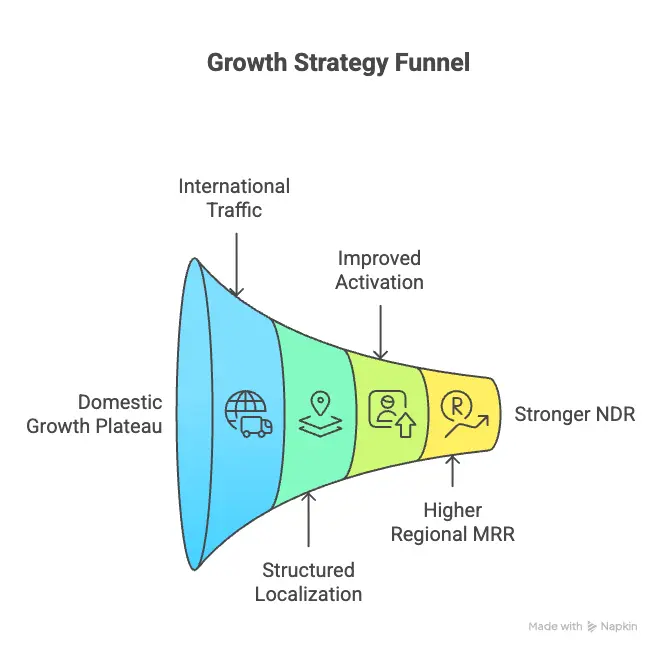
Domestic growth slows as a SaaS company scales, acquisition costs climb and competition sharpens, so international markets become the obvious next move. Without structured localization that move produces weak activation abroad, higher churn outside the core market, pricing friction, failed payments and support queues nobody staffed for.
As SaaS companies scale, domestic growth often slows. Customer acquisition costs rise. Competition intensifies. Expansion revenue becomes harder to sustain.
International markets represent a natural next step, but they introduce complexity.
Without structured localization, companies often experience:
- Low activation in international regions
- Higher churn outside their core market
- Pricing friction
- Payment failures
- Support bottlenecks
Localization reduces friction at every stage of the funnel.
It directly impacts:
- Activation rates
- Trial to paid conversion
- Net revenue retention
- Expansion revenue
- Customer lifetime value
When users can pay in their currency, understand onboarding clearly, and receive support in their language, trust increases. Trust translates into retention.
How does localization differ from translation?
Translation is one part of localization. It fixes readability, while localization decides whether the product is viable in that market at all. A fully translated interface still feels foreign when the pricing is wrong for local incomes, the payment methods are missing, and support does not cover the timezone.
“If a product is translated but pricing remains misaligned, local payment methods are unsupported, and support coverage is limited, the experience still feels foreign.”
Sivan Kadosh, Fractional CPO
Translation is a subset of localization. It solves one problem, readability. Localization solves viability.
If a product is translated but pricing remains misaligned, local payment methods are unsupported, and support coverage is limited, the experience still feels foreign.
Here is how they differ conceptually:
| Translation | Localization Strategy |
|---|---|
| Language only | Product, pricing, support, marketing |
| Tactical | Strategic |
| Marketing owned | Cross functional |
| Cost center | Revenue driver |
| Reactive | Planned and validated |
When SaaS companies treat localization as a marketing initiative, they create silos. Engineering remains uninvolved. Pricing stays global. Customer success reacts rather than prepares.
That is why international expansion often underperforms expectations.
What are the core components of a localization strategy?
Market selection, product adaptation, pricing and payments, compliance, and regional support coverage. Each one leans on the others, so skipping a single component usually weakens the whole initiative. The most common failure is choosing markets last, after the translation budget has already been committed somewhere.
“Not all markets are equally attractive. Some may offer large TAM but high regulatory complexity. Others may show organic demand but limited purchasing power.”
Sivan Kadosh, Fractional CPO
Localization strategy must be broken down into structured components. Each element reinforces the others. Skipping one often weakens the entire initiative.
Market selection and prioritization
The biggest mistake SaaS companies make is expanding everywhere at once.
Not all markets are equally attractive. Some may offer large TAM but high regulatory complexity. Others may show organic demand but limited purchasing power.
Market prioritization should consider:
- Size of SaaS adoption
- Competitive landscape
- Regulatory requirements
- Infrastructure readiness
- Existing inbound demand
Data such as traffic by region, signup distribution, and revenue by country can reveal where early localization investment is justified.
Product localization
Product localization is where strategy meets engineering.
If the product architecture was not designed with internationalization in mind, scaling globally becomes expensive.
Consider:
- Language support infrastructure
- Currency and tax handling
- Date, number, and formatting standards
- Data residency requirements
- Infrastructure latency by region
Engineering involvement early prevents costly refactors later. Internationalization readiness should be part of your technical roadmap long before expansion begins.
Pricing adaptation
Pricing communicates value. It must align with local economic conditions and competitive benchmarks.
Simply converting USD to local currency may create psychological friction or pricing misalignment.
Strong localization strategy evaluates:
- Purchasing power differences
- Currency stability
- Local competitor pricing
- VAT and tax implications
- Entry tier accessibility
Localized pricing experiments can significantly improve conversion rates without lowering overall margin.
Our tip: read more about Usage Based Pricing or try out our free Pricing Impact Simulator
Marketing and acquisition localization
Search behavior differs across markets. Cultural tone differs. Value propositions resonate differently.
Localization strategy requires adapting:
- SEO strategy per language
- Messaging hierarchy
- Ad copy and creative
- Channel mix
- Partnerships and affiliates
Effective localized acquisition requires experimentation, not duplication.
Customer support and success localization
Retention often reveals whether localization is working.
Customers expect support availability aligned with their time zone and cultural expectations.
Localization should address:
- Language coverage
- Regional onboarding materials
- Support hours
- Escalation processes
- Knowledge base adaptation
Failure in this area often increases churn even if acquisition succeeds.
What does a localization framework look like step by step?
Treat it as a phased roadmap rather than a reaction. Define what success means first, whether that is revenue diversification, a larger addressable market or enterprise readiness. Validate demand against traffic and conversion by geography before translating anything, then sequence product, pricing and support work behind that decision.
Rather than approaching localization reactively, SaaS leaders should treat it as a phased roadmap:
Step 1: Define strategic objectives
Start by clarifying what success looks like.
Are you diversifying revenue risk? Increasing TAM? Preparing for enterprise expansion?
Clear objectives prevent scattered execution.
Step 2: Conduct market opportunity analysis
Before translating anything, validate demand.
Review:
- Traffic by geography
- Conversion rates by region
- Revenue distribution
- Competitive presence
- Regulatory environment
This step ensures investment follows data.
Step 3: Align Product and Engineering
Assess product readiness realistically.
- Is the platform internationalization ready
- Can pricing adapt per region
- Are taxes automated
- Is infrastructure scalable globally
Engineering alignment ensures scalability.
Step 4: Localize Go To Market
With product readiness confirmed, adapt:
- Pricing experiments
- Messaging
- Sales enablement
- Channel strategy
Launch in one prioritized market before scaling further.
Step 5: Measure and iterate
Localization is iterative. Track performance carefully.
Monitor:
- Activation rate by region
- Conversion by language
- CAC by geography
- Net revenue retention by country
- Regional churn
Continuous measurement prevents blind expansion.
Which localization metrics actually matter?
Not page views or the count of translated pages. Activation rate per region, paid conversion by currency, net revenue retention by country, expansion revenue growth, payback on acquisition cost by geography, and support resolution time by language. Those show whether localization produced durable growth or only output.
To evaluate success, avoid vanity metrics such as page views or translated pages count.
Focus instead on:
- Activation rate per region
- Paid conversion rate by currency
- Net revenue retention by country
- Expansion revenue growth
- CAC payback by geography
- Support resolution time by language
These metrics reveal whether localization drives durable growth.
What are the most common localization mistakes?
Translating before demand is validated, ignoring pricing adaptation, underestimating the engineering work, opening too many markets at once, and treating localization as a project that finishes. Most international expansion fails on execution rather than intent, and each of these raises operating complexity while lowering return.
International expansion often fails due to execution gaps rather than strategic intent.
Frequent mistakes include:
- Translating without validating demand
- Ignoring pricing adaptation
- Underestimating engineering complexity
- Expanding into too many markets simultaneously
- Treating localization as a one time initiative
These errors increase operational complexity and reduce ROI.
When should you invest in localization?
When the business signals it, not on a calendar. Meaningful international traffic already arriving, domestic growth flattening, enterprise deals raising compliance and data residency questions, global support requests climbing, or investors asking about geographic expansion. Sequencing matters as much as the execution that follows.
Localization should not begin randomly. It should align with business maturity signals.
Indicators include:
- Significant international traffic
- Slowing domestic growth
- Enterprise compliance requirements
- Rising global support requests
- Investor pressure for geographic expansion
Timing and sequencing matter as much as execution.
What does product leadership contribute to localization?
Localization needs decisions made across product, engineering, marketing, finance and customer success at the same time. Without someone owning that, pricing experiments drift from what the product can support and engineering priorities collide with marketing dates. Strong product leadership supplies prioritization, coordination and an ROI model people believe.
Localization requires coordinated decision making across product, engineering, marketing, finance, and customer success.
Without strong product leadership, localization becomes fragmented. Pricing experiments misalign with product capabilities. Engineering priorities conflict with marketing deadlines.
Experienced product leadership ensures:
- Strategic prioritization
- Cross functional coordination
- Clear ROI modeling
- Execution discipline
For many growth stage SaaS companies, hiring a full time CPO may not be immediately feasible. In such cases, working with an experienced product management consultant can provide structured guidance without long term overhead.
A fractional CPO service can support:
- Localization roadmap design
- Product readiness audits
- Pricing localization experiments
- Market prioritization frameworks
- KPI tracking systems
This reduces expansion risk while accelerating execution speed.
Need help designing your SaaS localization strategy?
International expansion adds complexity across product, pricing, engineering and go-to-market at the same moment. Without structured leadership the work fragments and margin erodes. A fractional CPO can design and run the strategy, covering market prioritization, internationalization audits, pricing models and coordination across the functions involved.
International expansion introduces complexity across product, pricing, engineering, and go to market. Without structured leadership, companies risk fragmented execution and margin erosion.
A fractional CPO can help design and execute a localization strategy aligned with sustainable SaaS growth.
Support may include:
- Market expansion prioritization
- Product internationalization audits
- Pricing localization modeling
- Cross functional roadmap alignment
- Regional KPI design and tracking
If your SaaS company is preparing for international growth or underperforming in key regions, structured product leadership can reduce risk and accelerate measurable results.
Book a strategic consultation to evaluate your localization roadmap and unlock global SaaS growth.
Planning international expansion this year?
Get a senior, ex-CPO read on your biggest product bottleneck in 30 focused minutes. No pitch, no obligation.
Book a strategy callPrioritizing markets and regional playbooks
The sections below cover market prioritization and regional, culture-specific execution – the operational layer of a localization strategy.
How do you prioritize markets strategically?
By weighing market potential against localization difficulty rather than translating into ten languages at once. Look at where organic signups already appear, how close the market is culturally and linguistically, what competitors have localized, and how much engineering and compliance work each market would actually demand.
Expanding globally doesn’t mean translating everything into ten languages at once. The smartest SaaS teams prioritize markets where localization has the highest impact. That requires balancing market potential with localization complexity.
Factors to evaluate
- Market size and growth potential: Focus on where your product already sees organic signups or demand.
- English proficiency and cultural proximity: Markets with moderate English skills may benefit most from localized UX.
- Competition and saturation: Look for underserved regions with strong SaaS adoption.
- Regulatory requirements: Some countries (like France or Japan) have local language laws or compliance barriers.
- Payment and infrastructure fit: Ensure you can support local gateways, taxes, and currencies.
Building your market scoring matrix
Create a simple table scoring each market from 1 to 5 based on opportunity and complexity. Multiply the two to get a priority index.
For example:
| Market | Opportunity | Complexity | Score |
|---|---|---|---|
| Germany | 4 | 3 | 12 |
| Japan | 5 | 5 | 25 |
| Brazil | 4 | 2 | 8 |
This helps you decide where to launch first and which markets to plan for later stages.
What changes region by region?
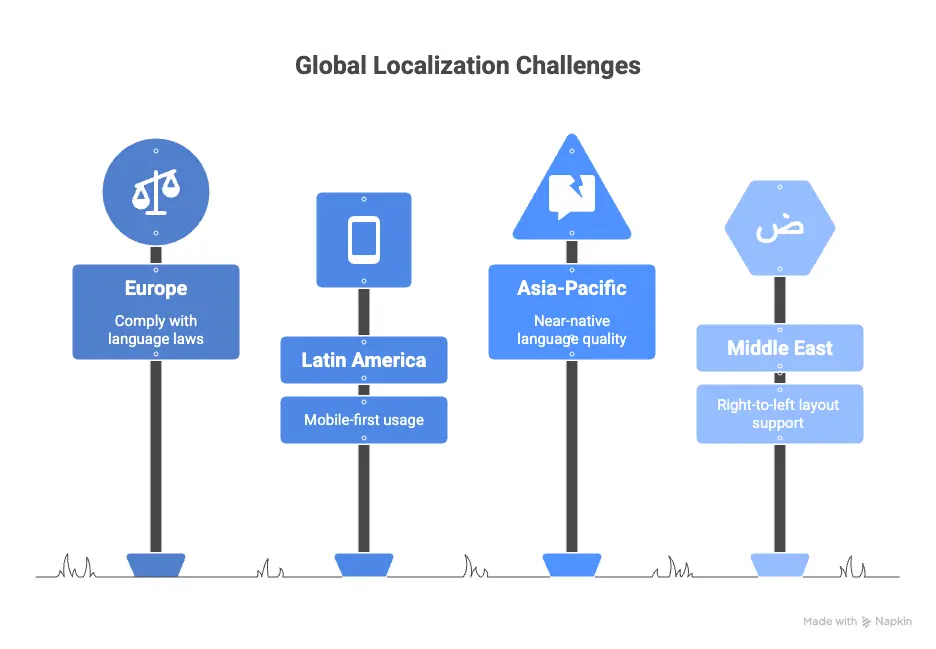
The specifics that decide whether a market accepts the product. Europe brings language law, GDPR and data residency, plus SEPA and card payments. Latin America is mobile first and expects Pix, OXXO or Boleto. Each region carries its own payment habits, compliance load and tone expectations.
Each region presents its own mix of opportunity and challenge. Localization success depends on knowing the details that matter locally.
Europe
- Comply with language laws (especially in France).
- Focus on GDPR and data residency.
- Offer major EU payment options: SEPA, PayPal, and credit cards.
Latin America
- Mobile-first usage.
- Offer alternative payments (Pix, OXXO, Boleto).
- Translate support content clearly, as local slang and idioms differ.
Asia-Pacific
- Japan and Korea require near-native language quality.
- India prefers English with localized examples.
- Adapt color, spacing, and typography to cultural expectations.
Middle East
- Ensure right-to-left layout support.
- Localize forms, date formats, and address inputs.
- Provide localized hosting or data centers for trust and compliance.
A few years ago, I advised a Fintech SaaS company preparing to expand into the German market. The team did everything right, translated the website, launched localized campaigns, and hired German-speaking sales reps. But one critical detail slipped through the cracks: localizing the payment experience.
Key takeaways
- Localization strategy in SaaS is not about translating your website.
- It is about building a structured growth system that aligns product, pricing, engineering, marketing, and customer success around international expansion.
- Localization is a growth strategy, not a marketing task. It directly impacts activation, retention, net revenue retention, and expansion revenue across regions.
- Translation alone is insufficient. Successful localization includes product adaptation, pricing alignment, payment methods, compliance readiness, and regional support coverage.
- Market prioritization must be data driven. Use traffic distribution, conversion rates, revenue by geography, and competitive analysis to select initial target markets.
- Engineering readiness is critical. Internationalization infrastructure, currency handling, tax automation, and scalable architecture should be validated before expansion.
- Pricing localization can materially improve conversion. Adjusting currency display, entry tiers, and purchasing power alignment can significantly increase paid adoption.
- Measure performance by region, not globally. Track activation, CAC, churn, and net revenue retention at the country level to assess real impact.
- Strong product leadership reduces expansion risk. A structured roadmap and cross functional coordination, often supported by a fractional CPO, increases the likelihood of sustainable international growth.
A well designed localization strategy transforms international traffic into durable, high retention revenue instead of operational complexity.
I am the one who decides what gets cut. Frameworks rank the list. Someone still has to say no out loud.
See how a product strategy engagement runs →FAQs
What is a localization strategy in SaaS?
A localization strategy in SaaS is a structured approach to adapting your product, pricing, marketing, and customer experience for specific international markets. It goes beyond translating content and includes currency handling, payment methods, compliance, support coverage, and regional acquisition strategy to drive activation, retention, and revenue growth.
How is localization different from translation?
Translation focuses only on converting text from one language to another. Localization adapts the entire product and business model to fit a market. In SaaS, this includes pricing alignment, local payment methods, regulatory compliance, onboarding flows, and customer support expectations, not just language.
When should a SaaS company invest in localization?
A SaaS company should invest in localization when it sees meaningful international traffic, slowing domestic growth, rising support requests from specific regions, or enterprise expansion opportunities abroad. A good signal is when 15 to 20 percent of traffic or signups come from a non core market.
What are the most important metrics to track in a localization strategy?
The most important localization metrics in SaaS are activation rate by region, paid conversion rate by currency, net revenue retention by country, CAC payback by geography, churn by region, and expansion revenue growth. These metrics show whether localization is driving sustainable revenue rather than just traffic.
Should pricing be different in each country?
In many cases, yes. Pricing often needs adjustment based on purchasing power, competitive landscape, taxes, and currency expectations. Simply converting USD pricing to another currency may reduce conversion rates. Testing localized pricing tiers can significantly improve adoption while protecting margins.
Does localization require engineering changes?
Yes. Effective localization usually requires engineering support. Internationalization infrastructure, multi currency billing, tax handling, formatting standards, and regional performance optimization often require backend changes. Engineering alignment early prevents costly refactors later.
What is the role of product leadership in localization?
Product leadership ensures localization is executed as a coordinated growth initiative rather than a fragmented marketing effort. A strong product leader aligns engineering, pricing, marketing, and customer success around clear regional objectives and measurable outcomes. Many growth stage SaaS companies use a fractional CPO to provide this strategic oversight without hiring a full time executive.
How long does it take to see results from localization?
Results vary depending on market size and execution quality, but most SaaS companies begin to see measurable impact within 3 to 9 months after structured rollout. Early improvements typically appear in activation and conversion rates, followed by retention and expansion revenue gains.
Can early stage SaaS companies implement localization?
Yes, but it should be staged carefully. Early stage SaaS companies can begin with demand validation and selective market testing before fully localizing the product. A focused pilot in one high potential region is often more effective than broad global expansion.
Is hiring a fractional CPO helpful for localization strategy?
For many SaaS companies, yes. A fractional CPO can design the localization roadmap, align cross functional teams, prioritize engineering investments, model ROI, and establish regional KPIs. This structured approach reduces risk and accelerates international growth without the overhead of a full time executive hire.
What clients say
Read all 18 references“As a product manager, I can say that Sivan is very professional – always looking deeply on the discussed feature to understand end to end its effect on the whole product, and as well the eager to understand what would be the added value to the strategy of the company. Nothing was added without a clear scope of development, a clear understanding of the business owner and a clear way to measure the success or failure of this feature.”
“Leading by example, empowering, mentoring, and growing his product teams, he created great product culture and set us Product Managers up for success. His vision and strategic direction enabled us to create successful products that brought millions of dollars of revenue to the company and its clients.”
“As part of his role as VP Product, he identified creative ideas, developed sharp strategies and built the road map while focusing on customer experience and business needs.”
