
The product management process in SaaS is the decision system that connects strategy, discovery, prioritization, roadmap, delivery and measurement into one loop. It is not a backlog workflow. When a team ships steadily while retention and expansion stay flat, the missing piece is usually decision discipline rather than velocity.
I do this work inside B2B SaaS product teams. If your team ships every week and the numbers barely move, this is where I start.
See how product management consulting works →Most SaaS teams think they have a product management process.
They have sprint planning.
They have a backlog.
They ship features every two weeks.
But when you ask a simple question, why is this initiative prioritized right now, the answers become vague.
The modern product management process is not backlog grooming. It is not writing PRDs. It is not running standups.
It is the structured decision system that connects customer problems, business strategy, roadmap priorities, delivery execution, AI leverage, and measurable revenue outcomes.
In SaaS, where CAC is rising and competition is accelerated by AI, weak product management does not show up immediately. It shows up as flat retention, inconsistent expansion revenue, and roadmap chaos.
This guide explains how the product management process should work in modern SaaS, how AI is changing it, and how to design it as a scalable operating system.
What is the product management process in SaaS?
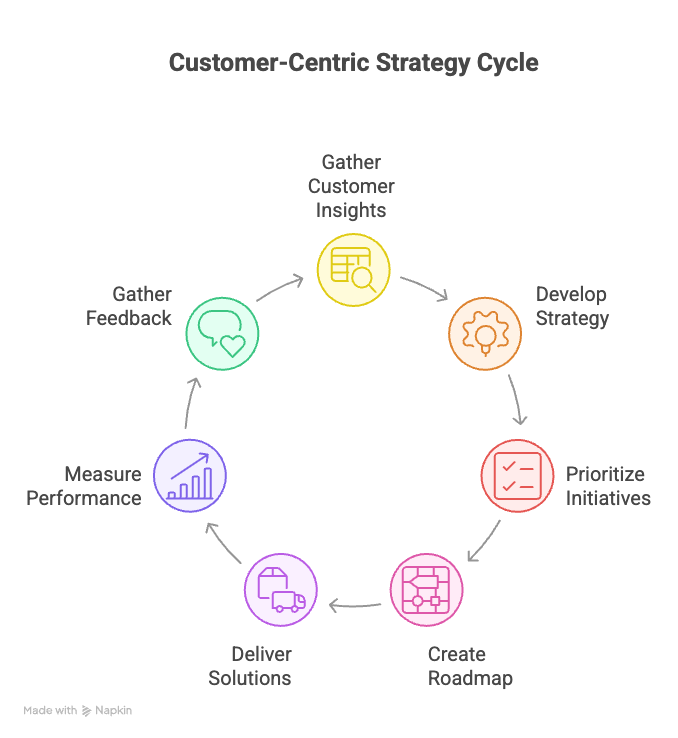
The structured system that aligns product vision with company strategy, validates customer opportunities, prioritizes on economic impact, communicates a roadmap and orchestrates delivery. It is a decision system rather than a backlog workflow, and it runs as one continuous loop instead of a sequence that finishes.
“But when you ask a simple question, why is this initiative prioritized right now, the answers become vague.”
Sivan Kadosh, Fractional CPO
The product management process in SaaS is the structured system used to:
- Align product vision with company strategy
- Identify and validate customer opportunities
- Prioritize initiatives based on economic impact
- Design and communicate a roadmap
- Orchestrate delivery across teams
- Measure outcomes and recalibrate decisions
It is a continuous loop, not a linear sequence.
Unlike product development, which focuses on building and shipping, product management governs the decisions behind what gets built and why.
If product development is execution, product management is judgment.
Why most product management processes break in SaaS
Most breakdowns are not technical. They are structural.
Common failure patterns include:
- Roadmaps driven by the loudest stakeholder
- Sales feature requests bypassing validation
- Discovery insights not influencing prioritization
- Metrics reviewed but not tied to roadmap decisions
- AI tools adopted without a clear economic use case
- Product managers functioning as project coordinators
The output looks productive. The outcome does not move.
Velocity without alignment creates complexity, not growth.
When governance is weak, the roadmap becomes reactive. Reactive roadmaps create feature sprawl. Feature sprawl increases cognitive load. Cognitive load reduces velocity. Teams become frustrated.
What are the six core stages?
Strategic alignment, opportunity discovery, prioritization, roadmap communication, delivery orchestration and measurement. They run continuously rather than as checkpoints, so a team is usually in several at once. The first is the one everything else depends on, because prioritization without a stated strategy is just triage.
These stages operate continuously. They are not checkpoints.
1. Strategic alignment
Everything begins with clarity.
Product strategy must answer:
- What problem space are we competing in?
- What is our differentiation?
- What revenue levers matter most right now?
- Which customer segment is priority?
In SaaS, strategy should tie directly to metrics such as:
- Activation rate
- Retention
- Net dollar retention
- CAC payback
- Expansion revenue
Without strategic clarity, prioritization becomes political.
2. Opportunity discovery
Discovery is not idea collection. It is structured evidence gathering.
Sources include:
- Customer interviews
- Behavioral analytics
- Churn analysis
- Support ticket clustering
- Competitive shifts
- AI-driven pattern recognition
Strong discovery includes hypothesis framing:
“We believe [persona] struggles with [problem], which results in [economic impact].”
AI now accelerates interview transcription, clustering themes, and identifying recurring patterns. But AI cannot determine whether the opportunity is economically meaningful.
Discovery must filter signal from noise.
3. Validation and prioritization
Validation answers one question: Is this problem worth solving now?
Strong validation includes:
- Repeated qualitative evidence
- Quantified usage data
- Clear revenue linkage
- Defined risk profile
- Confidence scoring
Prioritization must move beyond simple impact vs effort grids.
Economic impact scoring is more useful:
- Revenue upside
- Retention impact
- Strategic positioning
- Engineering complexity
- Confidence level
4. Roadmap design
A roadmap communicates direction and sequencing, not guarantees.
Strong SaaS roadmaps:
- Are horizon-based, Now, Next, Later
- Are outcome-oriented, not feature lists
- Connect initiatives to metrics
- Reflect capacity constraints
- Balance short-term wins and long-term bets
Roadmaps should be living documents recalibrated monthly.
If your roadmap has not changed in six months, your discovery loop is weak.
5. Delivery orchestration
Product managers orchestrate, they do not micromanage.
Effective delivery orchestration includes:
- Clear initiative briefs tied to metrics
- Defined success criteria
- Cross-functional alignment
- Feedback loops during build
- AI-assisted execution workflows
AI has changed this stage dramatically.
Teams now use:
- AI coding assistants
- Automated test generation
- Predictive workload estimation
- Experiment simulation
Execution speed has increased.
Which makes decision quality even more critical.
6. Measurement and learning
Measurement closes the loop.
For each initiative, define:
- Primary success metric
- Leading indicators
- Failure thresholds
- Iteration triggers
Example metrics in SaaS:
- Activation completion rate
- Time to first value
- Weekly active usage
- Feature adoption
- NDR impact
SaaS initiative measurement framework
| Initiative | Primary metric | Leading indicator | Decision threshold | Action if below threshold |
|---|---|---|---|---|
| Onboarding redesign | Activation rate | Onboarding step completion | +15% activation in 30 days | Rework friction points in first 2 steps |
| New collaboration feature | Weekly active usage | % of users triggering feature in week 1 | 30% adoption within 60 days | Simplify UX and improve in-app prompts |
| Pricing tier expansion | Expansion revenue | Upgrade click-through rate | 10% increase in upgrades in 90 days | Re-evaluate value packaging |
| AI assistant feature | Task completion speed | % of sessions using AI | 40% usage among target segment | Improve prompt guidance and onboarding |
| Reporting dashboard | Retention impact | Weekly report exports | 8% improvement in 90-day retention | Conduct user interviews and iterate |
How is AI reshaping the process?
It has amplified product management rather than replacing it. Insight synthesis from interviews, backlog summarization, forecast modeling, experiment design and competitive monitoring all got faster. Strategic trade-offs, economic prioritization and organizational alignment did not, which is why weak thinking now produces wrong answers more quickly.
“AI now accelerates interview transcription, clustering themes, and identifying recurring patterns. But AI cannot determine whether the opportunity is economically meaningful.”
Sivan Kadosh, Fractional CPO
AI has not replaced product management. It has amplified it.
AI improves:
- Insight synthesis from interviews
- Backlog summarization
- Forecast modeling
- Experiment design
- Competitive monitoring
AI cannot replace:
- Strategic trade-offs
- Economic prioritization
- Organizational alignment
- Customer empathy
- Governance design
AI increases execution speed. It increases the cost of bad decisions.
If your prioritization is weak, AI will help you build the wrong feature faster.
How does the process differ from the operating model?
They are related but not the same. The process defines how decisions flow through the company. The operating model defines who holds which role, which governance rituals exist, how communication runs and where accountability sits. A sound process inside a vague operating model still produces reactive roadmaps.
These are related but distinct.
The product management process defines how decisions flow.
The product operating model defines:
- Roles and responsibilities
- Governance rituals
- Communication cadence
- Accountability structures
In early-stage SaaS:
- Founder-led decisions
- Informal discovery
- Rapid iteration
In growth-stage SaaS:
- Structured discovery
- Defined prioritization framework
- Monthly roadmap recalibration
- Cross-functional governance
In scale-stage SaaS:
- Portfolio management
- Platform strategy
- Dedicated product ops
- AI integration roadmap
SaaS product management maturity model
| Stage | Process characteristics | Governance depth | Decision quality | Primary risk | Recommended focus |
|---|---|---|---|---|---|
| Early stage | Founder-led prioritization, informal discovery, fast iteration | Minimal | Intuition-driven | Overbuilding before validation | Rapid validation and tight feedback loops |
| Early growth | Dedicated PMs, structured discovery emerging, roadmap themes | Light governance | Mixed, partially evidence-based | Sales-driven roadmap pressure | Formalize validation thresholds |
| Growth stage | Defined prioritization framework, monthly roadmap reviews, metric tracking | Structured | Evidence-based decisions | Feature sprawl and alignment gaps | Economic impact scoring and cross-functional rituals |
| Late growth | Portfolio thinking, segment-based initiatives, outcome-focused roadmaps | Strong | Strategic and data-informed | Bureaucracy slowing velocity | Balance innovation with process discipline |
| Scale stage | Product operating model defined, product ops support, AI integrated workflows | Advanced | Systematic and predictable | Organizational inertia | Portfolio optimization and strategic bets |
Personal insight from operating as a fractional CPO
The world is changing. I can already feel the ripples of the AI tsunami reaching me, and I realize that the product management of the past is not the product management of the future, or even the present. You see, in a traditional market (it’s funny to call it traditional, as it was just a short while ago), a company’s ability to stand out from its competitors was fairly simple because there weren’t that many competitors.
Now that the barrier to entry into the software world has dropped significantly, we are going to see many (really, many) more competitors in every category. In fact, McKinsey & Company research shows that GenAI tools can accelerate coding speeds by up to 50%, which explains the market flooding with new solutions.
As consumers, it’s an amazing world to live in, but as business owners, it means we absolutely must change our approach. The only thing that should drive product development is an economic OUTCOME, namely MRR. The financial revenue generated by each feature is what must guide and dictate the ROADMAP. Many organizations find it very hard to even think this way, let alone implement this approach.
I have already started making this SHIFT with several organizations I work with. The results on the ground speak for themselves. When we stop asking ‘how fast can we build this?’ and start asking ‘what economic impact (NDR/MRR) will this feature deliver within a quarter?’, the entire conversation within the organization changes. To understand just how critical this is, you only need to look at the data: Pendo’s Feature Adoption Report reveals that 80% of features developed in cloud products are rarely or never used.
Product and development teams stop being ‘feature factories‘ competing with automated coding tools, and instead become strategic growth engines. This transition requires discipline, a completely different operating model, and usually, an experienced figure who can hold up a mirror and build the right Governance mechanisms. Companies that are wise enough to adopt this decision-making model right now will not only survive the AI tsunami, they will ride it to leave their many competitors behind.
What governance cadence does this need?
Rhythm rather than documents. Weekly for delivery review and blocker removal. Biweekly for discovery synthesis and hypothesis review. Monthly to recalibrate the roadmap against evidence. Quarterly to reset strategic themes against company objectives. The cadence is what keeps decisions current instead of annual.
Strong product management requires rhythm.
Recommended cadence:
Weekly
Delivery review and blocker removal
Biweekly
Discovery synthesis and hypothesis review
Monthly
Roadmap recalibration based on evidence
Quarterly
Strategic theme reset aligned to company objectives
Governance rituals ensure that insights influence decisions, not just documentation.
When should you bring in a fractional CPO?
When retention stays flat despite high feature velocity, AI initiatives lack measurable return, roadmap debates run on opinion, or product and revenue strategy have drifted apart. Another signal is product managers spending more time coordinating than deciding, which means the process is absorbing the capacity meant for judgment.
Certain signals indicate that the product management process needs restructuring:
- Retention is flat despite high feature velocity
- AI initiatives lack measurable ROI
- Roadmap debates are opinion-driven
- Product and revenue strategy are misaligned
- PMs spend more time coordinating than deciding
A fractional CPO brings executive-level structure without full-time overhead:
- Product operating model design
- Governance framework implementation
- Strategic prioritization discipline
- AI roadmap integration
- Alignment between product and growth
Before scaling headcount, many SaaS companies benefit from strengthening the system.
Key takeaways
- Product management is a decision system, not a task list
- Strategy must precede prioritization
- AI accelerates execution but amplifies weak governance
- Governance cadence determines decision clarity
- A fractional CPO can formalize structure before scaling
- It connects strategy, discovery, prioritization, roadmap, delivery, and measurement into one continuous loop
- Strong governance prevents reactive, stakeholder-driven roadmaps
- Measurement must tie directly to the original hypothesis and revenue impact
- As SaaS companies scale, the process must evolve from informal to structured governance
Build a product management process that drives predictable growth
If your SaaS roadmap feels reactive or your team feels busy but not impactful, the issue may not be talent.
It may be process.
As a fractional CPO, I help SaaS founders design product management systems that connect strategy, AI leverage, governance, and measurable revenue outcomes.
If your roadmap conversations feel political or your growth feels unpredictable, it may be time to redesign the system behind it.
Explore fractional CPO services or request a strategic product review to evaluate where your product management process needs reinforcement.
Busy roadmap, flat retention?
Get a senior, ex-CPO read on your biggest product bottleneck in 30 focused minutes. No pitch, no obligation.
Book a strategy callI do this work inside B2B SaaS product teams. Knowing the model is one thing. Someone has to own it every week.
See how product management consulting works →FAQs
What is the product management process?
The product management process is the structured system that aligns customer insights, business strategy, prioritization decisions, roadmap planning, delivery execution, and measurable outcomes.
How is product management different from product development?
Product management governs decisions and prioritization, while product development focuses on building and shipping software.
How does AI impact product management?
AI improves data synthesis, forecasting, and experimentation speed, but it does not replace strategic trade-offs, economic validation, or governance discipline.
What is the role of a fractional CPO in product management?
A fractional CPO designs the product operating model, introduces governance rituals, aligns roadmap to revenue strategy, and strengthens decision-making systems in SaaS organizations.
What clients say
Read all 18 references“As a product manager, I can say that Sivan is very professional – always looking deeply on the discussed feature to understand end to end its effect on the whole product, and as well the eager to understand what would be the added value to the strategy of the company. Nothing was added without a clear scope of development, a clear understanding of the business owner and a clear way to measure the success or failure of this feature.”
“Leading by example, empowering, mentoring, and growing his product teams, he created great product culture and set us Product Managers up for success. His vision and strategic direction enabled us to create successful products that brought millions of dollars of revenue to the company and its clients.”
“As part of his role as VP Product, he identified creative ideas, developed sharp strategies and built the road map while focusing on customer experience and business needs.”