
Feature parity means matching the features buyers treat as table stakes, so you stay credible in an evaluation. It is necessary up to a point and dangerous past it, because a roadmap built from competitor screenshots produces a product with no reason to be chosen.
I am the one who decides what gets cut. If everything on your list is a priority, the strategy has not been made yet.
See how a product strategy engagement runs →The feature parity trap: Why copying competitors is killing your product
Copying the competitor’s feature list feels safe because every item can be justified in isolation. The trouble is what it adds up to. A year of matching produces a product that is never worse than the alternative and never a reason to switch, which is the harder position to recover from.
Two weeks ago, I visited a client we recently started working with. It does not happen to me often, but during the conversation with the product person at the company, I got annoyed. Yes, yes, again, it does not happen to me a lot, but I am human too. What got me annoyed? I was annoyed because I realized this product manager was busy with something he should not be busy with. He was busy copying the competitors.
Don’t get me wrong, your product must meet the standard in your niche. It is unacceptable to lack basic must have features that your competitors offer. If that is the case, it needs to be fixed fast. But, and this is a big but, turning this into an endless chase after competitors’ features is another story altogether. Where is your uniqueness? What do you offer customers that your competitors do not?
I understand that the easiest path for a product manager is to compare their product with the competitors and just close the gaps. However, if that same product manager took the time to talk to 5 to 10 users a week (yes, that is a lot, but it is necessary and part of the job), they would discover features their users actually need. They would not blindly follow what competitors have, which might not even be what their own users want.
The numbers back this up completely. According to a comprehensive Pendo feature adoption report, a staggering 80% of software product features are rarely or never used. This is painful evidence of resources being burned on competitor grocery lists instead of delivering real value. Furthermore, the famous CB Insights report on startup failure states that 43% of companies fail for one main reason: no market need for their product. This happens exactly when you develop for the competition instead of the customer.
Long story short, I decided to write this brief article to clear up this concept called Feature Parity once and for all. We will discuss when it is an absolute necessity (Table Stakes) without which customers will not even consider you, and when it becomes a dangerous trap that burns expensive development hours, complicates the product, and worst of all, erodes your differentiation. I will show you what the right balance looks like, how to stop being led by competitors, and how to start building a product that users truly need and love. Let’s dive in.
What does feature parity mean?
Matching the capabilities buyers expect any serious product in your category to have. Single sign-on, exports, permissions and audit trails are parity features. Nobody chooses you for them, and their absence ends evaluations before anyone sees what you are actually good at.
“Feature parity means matching the core features of competing products so you remain credible in the market.”
Sivan Kadosh, Fractional CPO
Feature parity refers to the state where a product offers the same or very similar functionality as its competitors. In SaaS, this usually shows up when product teams compare feature lists and aim to close perceived gaps.
At first glance, this seems logical. If a competitor has something your product does not, it can feel like a weakness. But feature parity is not simply about having the same features. It is about meeting user expectations at a minimum level so that your product remains a viable option.
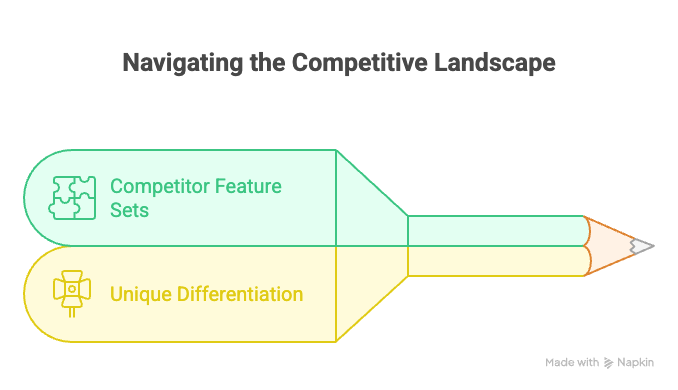
The nuance here is important. Parity ensures that users do not reject your product outright because something obvious is missing. Differentiation is what makes them choose you instead of someone else. Confusing these two often leads teams into building long lists of features without improving the actual product experience.
Why does feature parity matter in SaaS?
Because evaluations are run as checklists by people who have to justify a decision. A missing table-stakes feature is a disqualification rather than a debate, so parity is the cost of being considered at all. It buys the conversation; it does not win it.
SaaS markets are highly competitive, and users often evaluate multiple tools before making a decision. In that context, missing core features can create immediate friction. Even if your product is strong in other areas, the absence of expected functionality can disqualify you early in the evaluation process.
This is particularly true in more mature categories. When a market has been around for a while, certain features become standard. Users no longer see them as differentiators, they see them as requirements. Not having them raises questions about the product’s completeness or reliability.
At the same time, feature parity is not about keeping up appearances. It plays a practical role in sales conversations, onboarding experiences, and user retention. If users encounter gaps that prevent them from completing key tasks, they are unlikely to stay long enough to discover your product’s strengths.
The key is understanding which features are truly expected and which ones are simply nice to have.
When feature parity is necessary
When the gap is in something the buyer treats as a precondition rather than a preference. Security, compliance, integrations with whatever they already run. If losing deals keeps producing the same missing item in the notes, that item is parity work and arguing about it wastes quarters.
There are moments when pursuing feature parity is not just helpful, but essential. These usually involve what can be considered “table stakes” features, the basic capabilities users expect from any product in a given category.
For example, a project management tool without task assignment or a CRM without contact management would struggle to be taken seriously. These features do not differentiate the product, but their absence creates immediate dissatisfaction.
Parity is also important when selling to larger organizations. Enterprise customers often have stricter requirements, and missing features can block deals entirely. In these cases, parity becomes part of being considered a viable vendor.
Another situation where parity matters is during competitive evaluation. When users compare products side by side, they often look for gaps. Even if a missing feature is rarely used, its absence can influence perception.
The challenge is recognizing when a feature is truly essential versus when it is simply being requested because competitors offer it.
When feature parity becomes a problem
The moment the roadmap is being written from someone else’s release notes. That is a signal the strategy has been outsourced to a competitor who does not know your customers, and it usually shows up as a busy team, a growing product and a flat differentiation story.
While feature parity can be necessary, it becomes problematic when it turns into the default strategy. Chasing competitors feature by feature often leads to bloated products, unclear positioning, and slower development cycles.
One pattern that shows up frequently is teams reacting to competitor releases rather than focusing on their own users. A competitor launches a feature, and suddenly it becomes a priority internally, regardless of whether it aligns with the product’s direction. Over time, this creates a roadmap driven by external signals rather than customer value.
Another issue is opportunity cost. Every feature built consumes time and resources that could have been invested elsewhere. When teams focus heavily on parity, they often neglect areas where they could create real differentiation.
There is also a user experience cost. Adding features without a clear structure can make products harder to use. Complexity increases, onboarding becomes more difficult, and the core value becomes less obvious.
I have seen products that tried to match competitors feature by feature and ended up losing their identity. They became harder to explain, harder to use, and ultimately less competitive.
How does parity differ from differentiation?
Parity keeps you in the evaluation and differentiation gets you chosen. They compete for the same engineering capacity, which is the real decision. Splitting that capacity deliberately beats letting whichever deal is loudest this month decide the ratio for you.
“The strongest SaaS companies know where parity is required and where differentiation creates real advantage.”
Sivan Kadosh, Fractional CPO
| Aspect | Feature parity | Differentiation |
|---|---|---|
| Goal | Match competitors | Stand out in the market |
| Focus | Coverage of features | Unique value and experience |
| Impact | Avoid losing deals | Win customers |
| Risk | Overbuilding | Under-delivering basics |
Feature parity and differentiation are not opposing strategies, they are complementary. Parity ensures that your product is viable. Differentiation ensures that it is desirable.
The balance between the two depends on your stage and market position. Early-stage products often need to establish credibility first, which may require some level of parity. As the product matures, differentiation becomes more important.
The mistake many teams make is treating parity as the end goal rather than a baseline.
How do you approach parity strategically?
Decide which features are table stakes and cap what you will spend on them. Ship parity to adequate rather than excellent, because excellence there is invisible to the buyer, and spend the difference where you can be meaningfully better than everyone else in the category.
Approaching feature parity effectively requires a shift in mindset. Instead of asking “What features are we missing?”, it is more useful to ask “What prevents users from choosing or using our product?”
The first step is identifying must-have features. These are the capabilities that users expect by default. Without them, the product feels incomplete. These should be addressed early, but not overbuilt.
Understanding customer expectations is equally important. Not all feature requests carry the same weight. Some reflect real needs, while others are influenced by what users have seen elsewhere. Talking to users and observing behavior helps distinguish between the two.
Prioritization should be based on impact, not visibility. A feature that improves a core workflow is often more valuable than one that simply checks a box in a comparison table.
Avoiding feature bloat requires discipline. It is tempting to keep adding features, especially when competitors are doing the same. But every addition should be evaluated in terms of how it affects usability and clarity.
Finally, focus on unique value. Once the basics are covered, the real opportunity lies in building something that competitors do not offer or do not do well. This is where products create lasting advantage.
Our tip: If you want to learn more about prioritiazion check our RICE Model and KANO Model articles.
What does parity look like in practice?
The pattern is consistent. A prospect names a missing capability, sales escalates, the team builds it well, and the deal closes on price anyway. The feature was necessary to be considered and never sufficient to win, which is exactly what parity work is.
The role of feature parity changes depending on the stage of the company and the competitiveness of the market.
In early-stage products, parity is often limited. Teams focus on solving a specific problem well rather than matching every feature. This allows them to move faster and establish a clear value proposition.
As the product gains traction, gaps become more visible. Customers begin comparing alternatives, and certain features become necessary to stay competitive. This is where selective parity becomes important.
In more mature markets, parity becomes expected. Most products offer similar core features, and differentiation shifts toward user experience, performance, and ecosystem.
In these scenarios, simply adding features is not enough. The way features are implemented and integrated into the overall experience becomes the real differentiator.
How feature parity evolves over time
Today’s differentiator becomes tomorrow’s table stake. Anything valuable gets copied, and the half-life keeps shortening. Treating the parity list as something fixed is how teams end up defending capabilities the market quietly stopped paying for, while the expectations that replaced them go unmet.
One of the most important things to understand about feature parity is that it is constantly shifting. What feels like a competitive advantage today rarely stays that way for long. As soon as a feature proves valuable, competitors begin to adopt similar capabilities, and over time, user expectations adjust accordingly.
This creates a natural progression. Features often start as differentiators, something that makes a product stand out in the market. As more companies implement similar functionality, those features become part of the competitive landscape. Eventually, they turn into baseline expectations, something users assume will be present without even thinking about it.
You can see this pattern across almost every SaaS category. Integrations, real-time collaboration, automation, and analytics were all once considered advanced capabilities. Today, in many markets, they are simply expected. Their presence does not increase satisfaction, but their absence quickly creates doubt.
This evolution makes feature parity a moving target. Product teams cannot rely on a fixed list of “required features” because that list keeps changing. Instead, they need to continuously reassess what users consider essential and what still feels unique.
A common challenge here is holding on to past differentiators for too long. It is easy to assume that a feature which once drove growth will continue to do so, even when the market has already caught up. This often leads to overinvesting in areas that no longer influence customer decisions in a meaningful way.
Staying ahead requires a balance between awareness and intention. It is important to recognize when features are becoming standard, but it is equally important not to let that awareness dictate the entire roadmap. The goal is to maintain credibility through parity where necessary, while continuing to invest in areas that create real differentiation.
What goes wrong with feature parity?
Matching everything a competitor ships regardless of whether customers asked. Building parity features to the standard of a flagship capability. And never revisiting the list, so effort keeps going into things that stopped mattering two years ago and nobody noticed.
One of the most common mistakes teams make is copying competitors without understanding the context behind their decisions. It is easy to assume that if a feature exists elsewhere, it must be valuable. In reality, that feature may only make sense because of a different target audience, pricing model, or product structure. Without that context, copying it can introduce complexity without delivering meaningful benefit.
Another recurring issue is relying too heavily on feature comparison checklists. These lists often reduce products to a series of boxes to tick, which oversimplifies how users actually evaluate tools. Most users do not choose products based purely on feature count. They choose based on how well the product helps them achieve their goal. When teams optimize for checklists instead of outcomes, they risk building features that look good on paper but do not improve real usage.
Overbuilding is also a frequent consequence of chasing parity. As more features are added to match competitors, the product can become harder to navigate and understand. Instead of feeling more powerful, it starts to feel more complicated. This often shows up during onboarding, where new users struggle to understand where to start or what matters most.
Misaligned priorities tend to follow. When parity becomes the default direction, teams spend less time asking whether a feature is worth building and more time asking how quickly it can be delivered. Over time, this shifts focus away from solving meaningful problems and toward reacting to external signals.
How feature parity influences product strategy
Parity decisions quietly set your strategy, because capacity is finite. Every quarter spent matching is a quarter not spent being different, and a company that never writes that trade down explicitly makes it by accident, repeatedly, in favor of whatever closed last week.
Feature parity inevitably plays a role in shaping product strategy, but the way it is used makes all the difference. When treated as a baseline, it helps ensure the product remains competitive and credible. When treated as a roadmap, it can pull the product away from its core value.
A strong product strategy acknowledges where parity is required while clearly defining where the product should lead. This requires making deliberate choices about what not to build, which is often more important than deciding what to build. Without these boundaries, parity can quietly expand until it dominates the roadmap.
In practice, this often comes down to understanding what drives customer decisions. Some features are essential because they enable key workflows. Others are secondary and have little impact on whether users adopt or stay with the product. Product strategy should prioritize the former while being selective about the latter.
Another important aspect is how parity interacts with positioning. If a product tries to match competitors across all areas, it becomes harder to explain what makes it different. Clear positioning requires focus, and focus requires tradeoffs. Parity should support that focus, not dilute it.
When to involve a fractional CPO
When sales-driven parity requests have become the roadmap and nobody has the standing to decline one. Drawing the line between table stakes and differentiation is a leadership judgment, and it holds only if the person making it can defend it to the people asking.
Deciding how to balance feature parity and differentiation is rarely straightforward, especially as companies scale and more stakeholders become involved in product decisions. What may seem like a simple feature request often connects to broader questions about positioning, customer segments, and long term direction.
This is where a fractional Chief Product Officer can bring value. By stepping back from day-to-day execution, a fractional CPO can evaluate feature decisions in the context of overall product strategy. Instead of reacting to competitor moves, teams can make more deliberate choices about where to invest and why.
Another advantage is prioritization clarity. As the number of potential initiatives grows, it becomes harder to distinguish between what is necessary, what is useful, and what is simply noise. A structured approach helps filter these inputs and keep the roadmap focused on high-impact work.
There is also a benefit in having an external perspective. Teams that work closely on a product every day can sometimes lose sight of how it is perceived from the outside. A fractional CPO can help challenge assumptions, highlight blind spots, and ensure that decisions align with both market realities and customer needs.
Build a product strategy that goes beyond feature parity
Name the parity list, cap it, and protect the remaining capacity for the two or three things you intend to be known for. That allocation, revisited each quarter and written down, is most of what separates a product with a position from one with a long feature list.
At some point, every SaaS company faces pressure to match competitors. It can come from customers, sales teams, or internal discussions. Responding to that pressure is part of operating in a competitive market, but it should not define the entire direction of the product.
The products that stand out are not the ones that have the most features, but the ones that make sense quickly and deliver value consistently. They cover the basics well enough to be credible, then focus their energy on what truly differentiates them.
Building that kind of product requires discipline. It requires understanding which features are essential, which ones can be deferred, and which ones should not be built at all. More importantly, it requires a clear vision of what the product is trying to achieve and for whom.
A fractional CPO can help bring that clarity into the process. By connecting feature decisions with broader strategic goals, teams can move away from reactive development and toward intentional product building. Instead of chasing parity, they can use it as a reference point while focusing on what actually drives growth.
In the end, feature parity is not the goal. It is a constraint. The real goal is building a product that users choose not because it matches competitors, but because it works better for them.
Roadmap written from competitor release notes?
Get a senior, ex-CPO read on your biggest product bottleneck in 30 focused minutes. No pitch, no obligation.
Book a strategy callKey takeaways
- Feature parity helps ensure your product meets baseline expectations, but it should not become the main driver of your roadmap.
- Matching competitors is necessary in some areas, especially for core functionality, but differentiation is what ultimately drives growth and retention.
- Teams that balance these two effectively are able to stay competitive without losing focus.
I am the one who decides what gets cut. Frameworks rank the list. Someone still has to say no out loud.
See how a product strategy engagement runs →FAQs
What is feature parity?
Feature parity refers to a product offering the same or similar functionality as its competitors so that it meets basic user expectations and remains competitive in the market.
Is feature parity important?
Feature parity is important for core features that users expect by default. Without it, products may be rejected early, but it should be balanced with differentiation to remain competitive.
What is the difference between feature parity and differentiation?
Feature parity focuses on matching competitors’ capabilities, while differentiation focuses on offering unique value that makes a product stand out.
How do you achieve feature parity?
Feature parity is achieved by identifying essential features, understanding user expectations, and prioritizing high-impact gaps without overbuilding unnecessary functionality.
Should startups focus on feature parity?
Startups should focus first on solving a core problem effectively. Feature parity becomes more important later, once the product is validated and competing more directly in the market.
What clients say
Read all 18 references“As a product manager, I can say that Sivan is very professional – always looking deeply on the discussed feature to understand end to end its effect on the whole product, and as well the eager to understand what would be the added value to the strategy of the company. Nothing was added without a clear scope of development, a clear understanding of the business owner and a clear way to measure the success or failure of this feature.”
“Leading by example, empowering, mentoring, and growing his product teams, he created great product culture and set us Product Managers up for success. His vision and strategic direction enabled us to create successful products that brought millions of dollars of revenue to the company and its clients.”
“As part of his role as VP Product, he identified creative ideas, developed sharp strategies and built the road map while focusing on customer experience and business needs.”