
The Kano model sorts features by how they affect satisfaction rather than by score. Some are expected and only hurt when missing, some improve satisfaction in proportion to how well they work, and a few create delight. Scoring frameworks rank effort; Kano explains why users care.
I am the one who decides what gets cut. If everything on your list is a priority, the strategy has not been made yet.
See how a product strategy engagement runs →In SaaS, this distinction is critical. Building more features does not automatically improve retention or growth. The right features, implemented at the right time, are what move the needle. From experience, many product teams struggle not because they lack ideas, but because they invest in the wrong type of features at the wrong stage. Using the Kano model helps bring structure to these decisions and aligns product development with real customer expectations.
Beyond ICE and RICE: Why the Kano model is the secret to SaaS growth
Scoring frameworks answer which item is cheapest to build for the value claimed. They do not answer why a user would care, and two features with identical scores can have opposite effects on satisfaction. Kano supplies the missing half by sorting features by the reaction they produce.
Over the years, I’ve seen all sorts of frameworks people have developed to prioritize development requests, such as ICE, RICE, and more. But there is one method that is my absolute favorite, and that’s what I want to talk to you about today: the Kano Model. This method wins in my book because it forces us to prioritize features from the customer’s perspective: what is considered a baseline that cannot be skipped, and what is a “nice-to-have” luxury feature that can be set aside for now because it only appeals to a small segment of users.
In one of the (highly successful) SaaS startups I recently advised, a one-off project focused entirely on pricing strategy, we used the Kano model to build the pricing tiers themselves. For each tier, we defined its ICP (Ideal Customer Profile), and then we applied the model to decide exactly which content and features would go into each package. It proved to be incredibly accurate.
And why did it work so well?
Because instead of guessing what customers would be willing to pay more for, or relying on management’s gut feelings, we knew how to align the user’s perception of value with the monetization strategy. We discovered that for a specific ICP, a certain group of features was considered a “baseline” (Must-haves) that had to be included in the entry-level package to prevent frustration and churn. On the other hand, for a completely different segment, advanced capabilities were perceived as “Delighters” or clear performance enhancers, which easily justified a tier upgrade to a premium package.
When companies try to build a packaging model without a customer-centric framework, they often lock fundamental capabilities behind a paywall (which causes churn) or give away value-add features for free (leaving a lot of money on the table). This is a common but costly trap, and the companies that avoid it are the ones that treat packaging as a question about customer value rather than a spreadsheet exercise.
Using the Kano model allowed us to engineer the customer experience to actually support business growth, resulting in an organic increase in ARPU (Average Revenue Per User). In fact, pricing is one of the highest-leverage adjustments available to a software business, because it moves profit without requiring a single additional customer. The real magic happens when you connect the Kano model to the company’s growth engines. So how exactly do you do it right and avoid costly mistakes when building your roadmap? In the article below, I will explore the model in-depth and show you step-by-step how to implement it.
What does the Kano model measure?
How satisfaction responds to a feature being present, absent or done well. Some capabilities are expected and generate no goodwill when delivered while causing real damage when missing. Others scale with quality. A few delight precisely because nobody asked for them.
“The Kano model is a product prioritization framework that helps teams understand how different features impact customer satisfaction.”
Sivan Kadosh, Fractional CPO
The Kano model is a framework developed by Noriaki Kano to analyze how product features influence customer satisfaction. It is based on a simple but powerful idea: not all features contribute equally to how users perceive a product.
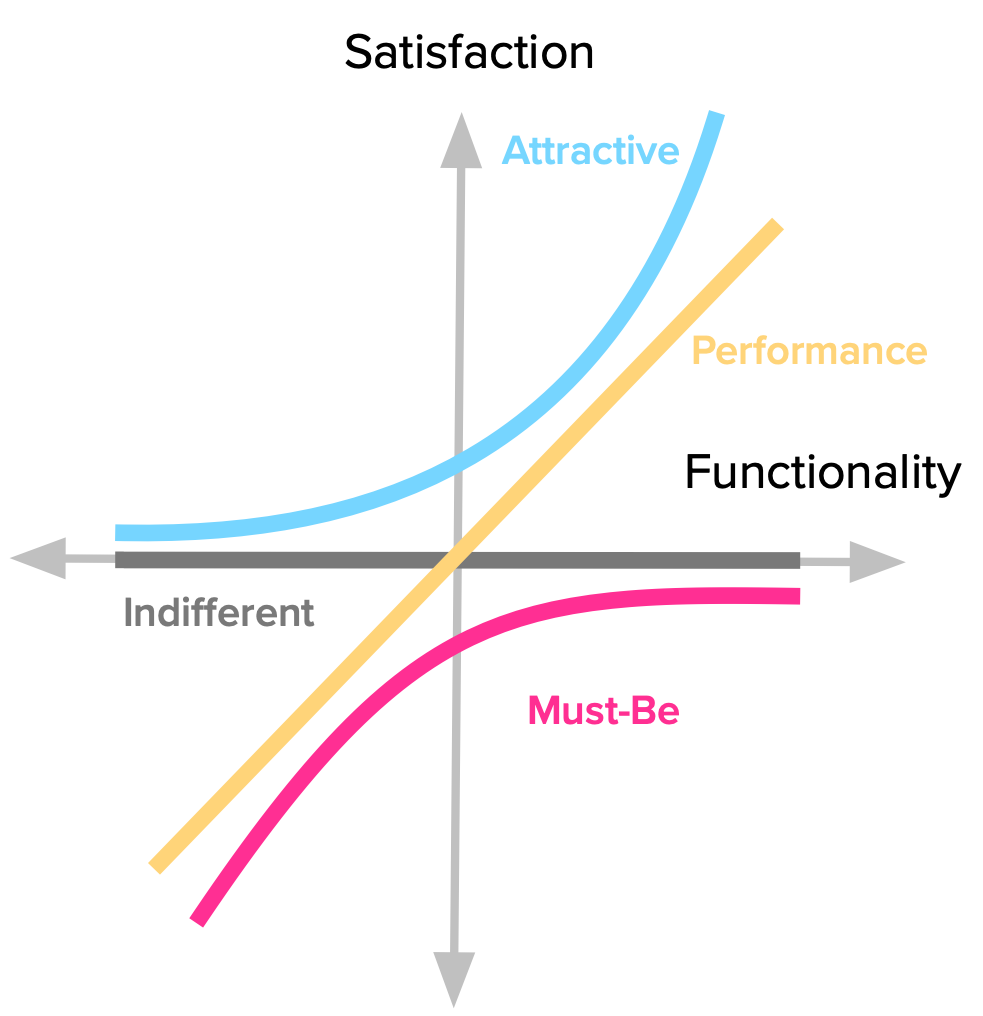
Some features are expected by default. Others improve satisfaction as they improve in quality. A few create unexpected delight. Understanding the difference between these categories helps teams prioritize more effectively.
In SaaS, where products evolve continuously, this distinction becomes even more important. Teams are constantly deciding what to build next. Without a clear framework, prioritization often becomes driven by internal opinions, customer requests taken at face value, or short term pressure.
The Kano model introduces a structured way to evaluate feature impact, allowing teams to move from reactive decisions to intentional product strategy.
Why does the Kano model matter in SaaS?
Because SaaS retention turns on expectation rather than feature count. A missing basic quietly erodes trust in a way no amount of clever work compensates for, and a delighter aimed at an audience that wanted reliability is effort spent buying nothing at all.
SaaS companies operate in an environment of continuous development. Unlike traditional products, there is no fixed release cycle after which development stops. This creates both opportunity and risk.
The opportunity lies in constantly improving the product. The risk lies in building features that do not meaningfully improve customer experience.
From experience, one of the most common issues in SaaS product teams is overbuilding. Teams ship features because customers asked for them, competitors have them, or stakeholders believe they are important. However, many of these features have little impact on retention or engagement.
The Kano model helps address this by reframing how teams think about value.
Instead of asking “Should we build this feature?”, teams begin asking “What kind of impact will this feature have on satisfaction?”
This shift is important because SaaS growth depends heavily on retention and expansion. Features that fail to improve satisfaction often fail to improve these metrics as well.
In several cases I have seen, improving a single onboarding experience or core workflow had a greater impact on retention than launching multiple new features. The Kano model helps surface these priorities earlier.
What are the Kano feature categories?
Basics that are simply expected, performance features where more is better, delighters that surprise, plus the indifferent ones nobody notices and the reverse ones some users actively dislike. The last two are the most useful in practice, because they are where roadmap capacity usually disappears unnoticed.
“Instead of treating all features equally, it highlights that some are expected, some improve satisfaction proportionally, and others create delight.”
Sivan Kadosh, Fractional CPO
The strength of the Kano model lies in how it categorizes features based on their impact.
Basic needs (must have features)
Basic features are the foundation of the product. Users expect them to exist. If they are missing, customers become frustrated and may leave.
However, delivering these features does not significantly increase satisfaction. It simply prevents dissatisfaction.
In SaaS, examples include reliability, login functionality, data security, and core product functionality.
From experience, teams sometimes underestimate how important these basics are until something breaks. A small reliability issue can create disproportionate frustration because users assume these features should “just work.”
Performance needs
Performance features improve satisfaction in a linear way. The better these features perform, the more satisfied customers become.
Examples include speed, integrations, reporting capabilities, and automation efficiency.
These features are often where competition happens. Customers compare products based on how well these capabilities perform.
In SaaS, improving performance features often leads to measurable improvements in engagement and retention.
Delighters (excitement features)
Delighters are features users do not expect but greatly appreciate when they encounter them.
These features often differentiate products and create memorable experiences.
Examples include smart automation, intuitive UX improvements, or AI driven insights.
From experience, delighters often generate strong initial reactions, but their impact depends on context. A delighter without strong basics will not compensate for core issues.
Indifferent features
Indifferent features do not significantly impact satisfaction.
Users may not notice or care about them.
These features often consume development resources without delivering meaningful value.
Identifying and avoiding these features can improve product focus.
Reverse features
Reverse features are those that some users may dislike.
This often happens when features introduce complexity or change workflows in ways that certain segments do not prefer.
Understanding user segments helps avoid introducing features that negatively impact parts of the user base.
What does Kano look like in practice?
Single sign-on is a basic: nobody renews because of it and its absence ends evaluations. Search speed is a performance feature where every improvement is felt. A genuinely helpful empty state is a delighter, right up until competitors ship one and it quietly becomes a basic instead.
Applying the Kano model becomes clearer with real product examples.
Basic features in SaaS often include uptime, authentication, and core workflows. Users rarely praise these features, but they quickly complain when something fails.
Performance features include integrations with other tools, speed of data processing, and customization capabilities. These directly influence how useful the product feels.
Delighters often come from thoughtful design decisions. For example, a feature that automatically surfaces insights or reduces manual work can create strong positive reactions.
One important insight is that features do not remain in the same category forever.
A feature that was once a delighter can become a basic expectation over time. For example, integrations with major platforms were once considered advanced capabilities. Today, they are often expected.
From experience, teams that fail to recognize this shift often fall behind competitors because they continue treating outdated differentiators as strengths.
How do you apply the Kano model?
Ask users two questions per feature, how they would feel with it and how they would feel without it, then read the pattern of answers rather than the averages. The value is in the disagreement between segments, which is precisely what an averaged priority score destroys.
The Kano model becomes valuable when applied systematically.
Collect customer feedback
Start by gathering feedback from users through interviews, surveys, and product usage data.
Understanding how customers perceive features is essential.
Ask Kano style questions
Kano analysis typically involves asking two types of questions:
How do you feel if this feature exists?
How do you feel if this feature does not exist?
These responses help categorize features into Kano categories.
Analyze responses
Responses are grouped to determine how users perceive each feature.
Patterns often emerge that reveal which features are essential and which create differentiation.
Prioritize roadmap decisions
Once features are categorized, prioritization becomes clearer.
Basic features must be reliable.
Performance features should be optimized.
Delighters should be introduced strategically.
From experience, this step often leads to surprising insights. Features that teams assumed were critical may turn out to be indifferent, while overlooked improvements may have strong impact.
How does Kano compare with RICE and ICE?
RICE and ICE rank what to do next given what you already believe. Kano tests the belief itself. Used together they answer different questions, and teams that adopt only the scoring half end up prioritizing confidently in a direction nobody validated.
The Kano model is one of several prioritization frameworks.
| Framework | Focus | When to use |
|---|---|---|
| Kano model | customer satisfaction impact | understanding user perception |
| RICE model | impact vs effort | prioritizing initiatives quantitatively |
| MoSCoW | requirement categorization | project planning |
| Value vs effort | efficiency tradeoffs | quick prioritization decisions |
From experience, the Kano model works best when combined with other frameworks.
Kano helps understand what matters. RICE helps decide what to build first.
Our tip: Try out our RICE Score Calculator
What are the limits of the Kano model?
It depends on asking users, so it inherits everything users are bad at, particularly predicting their own reaction to something they have never actually experienced. It is also only a snapshot, and the categories move underneath you as the market shifts, which means a classification is worth roughly as much as it is recent.
While useful, the Kano model has limitations.
It relies on customer feedback, which can be subjective. Users may not always articulate what they truly value.
Feature categorization can change over time, requiring regular reassessment.
Collecting and analyzing data can also be time consuming.
Because of these factors, the Kano model should be used as a guide rather than a strict rule.
How the Kano model evolves over time
Delighters decay into basics. Anything valuable gets copied, expectations reset, and the feature that won deals two years ago now only loses them when absent. A Kano classification that is never refreshed slowly becomes a description of a market that has moved on.
One of the most important, and often overlooked, aspects of the Kano model is that feature categories are not static. What delights users today will not necessarily differentiate your product tomorrow. As customer expectations evolve and competitors catch up, features naturally move across categories.
Delighters are the first to shift. Features that initially surprise and impress users gradually become expected as they become more common across the market. What once felt innovative starts to feel standard. Over time, these same features transition into performance features, where users begin to compare quality rather than react with excitement. Eventually, many of them become basic expectations, where their absence creates frustration rather than their presence creating satisfaction.
This progression reflects a broader pattern in SaaS. As products mature and markets become more competitive, the baseline for what is considered “good enough” continues to rise. Users become less impressed by novelty and more focused on reliability, efficiency, and consistency.
From experience, this is where many SaaS companies lose momentum. Teams continue investing in features they once believed were differentiators, without realizing that those features no longer influence customer perception in the same way. As a result, effort is spent maintaining parity rather than creating new advantages.
Continuous reassessment is essential. Teams need to regularly revisit how users perceive their product and how expectations have shifted. The Kano model is most valuable when treated as a dynamic framework that evolves alongside the product and the market.
How the Kano model influences product strategy
Knowing which category a feature falls into changes how much you should spend on it. Basics need to be adequate and no more. Performance features deserve sustained investment. Delighters are bets, and treating all three with the same standard of polish is how roadmaps get expensive without getting better.
The Kano model influences product strategy by clarifying where real value is created. Instead of treating all feature ideas equally, teams begin to understand which improvements actually change how users feel about the product and which ones simply add complexity without meaningful impact.
In practice, this often leads to a shift in how roadmaps are built. Teams start prioritizing improvements to core workflows rather than expanding feature sets indiscriminately. For example, improving onboarding or simplifying a key action may have a greater impact on retention than introducing entirely new capabilities. The Kano model helps surface these opportunities by highlighting where satisfaction can actually move.
It also influences how teams think about differentiation. Many SaaS products compete on features, but differentiation often comes from how those features are experienced rather than how many exist. Delighters, when used strategically, can create memorable experiences, but they only work when the basics are solid and performance features meet expectations.
From experience, applying the Kano model often exposes a gap between what teams believe customers want and what actually drives satisfaction. Closing that gap usually leads to clearer prioritization, better resource allocation, and stronger alignment between product decisions and business outcomes.
Over time, the Kano model becomes less of a one time exercise and more of a way of thinking. Teams begin to evaluate ideas not just by effort or feasibility, but by their expected impact on user perception and long term engagement.
When to involve a fractional CPO in feature prioritization
When prioritization has become a negotiation rather than a decision, and whoever argues best wins the sprint. Introducing a model is the easy part; holding the line when a large customer wants a delighter built to flagship standard is the part that needs standing.
Feature prioritization is rarely just a product decision. It sits at the intersection of customer feedback, business goals, and technical constraints.
A fractional Chief Product Officer helps bring structure to these decisions by connecting frameworks like the Kano model with broader product strategy.
From experience, the biggest challenge is not identifying feature ideas but choosing which ones truly matter.
SaaS fractional CPO support helps teams:
- interpret customer feedback correctly
- prioritize high impact features
- align roadmap with business outcomes
- avoid building low value features
This often leads to more focused product development and stronger long term growth.
Prioritize the right features with product strategy leadership
The goal is not a better-ranked backlog. It is knowing which items are obligations, which are investments, and which are genuine experiments, then funding each of them accordingly. That distinction does more for a roadmap than any further refinement of the scoring formula ever will.
Many SaaS teams collect large amounts of feedback but struggle to translate it into clear product decisions. Over time, this leads to crowded roadmaps and diluted focus, where teams try to address everything instead of solving the most important problems well.
Applying a framework like the Kano model helps, but the real impact comes from how those insights are used. The goal is not just to categorize features, but to make better decisions about what to build, what to improve, and what to ignore.
From experience, the most effective product teams are not the ones building the most features, but the ones building the right features at the right time. They understand which improvements will move activation, retention, or expansion, and they focus their efforts there.
This is where structured product leadership makes a difference. A fractional CPO helps translate customer insights into actionable priorities, ensuring that feature decisions support long term product strategy rather than short term reactions. By aligning customer satisfaction with business outcomes, teams can build products that grow more predictably and sustainably.
Ranking features without knowing why users care?
Get a senior, ex-CPO read on your biggest product bottleneck in 30 focused minutes. No pitch, no obligation.
Book a strategy callKey takeaways
- The Kano model helps teams understand how features impact customer satisfaction.
- Basic features prevent dissatisfaction, performance features improve satisfaction, and delighters create differentiation.
- Applying the Kano model improves prioritization and product strategy alignment.
I am the one who decides what gets cut. Frameworks rank the list. Someone still has to say no out loud.
See how a product strategy engagement runs →FAQs
What is the Kano model?
The Kano model is a framework used to categorize product features based on their impact on customer satisfaction.
What are the Kano model categories?
The main categories are basic needs, performance needs, and delighters, along with indifferent and reverse features.
How do you use the Kano model?
Teams collect customer feedback, categorize features, and use these insights to prioritize product development.
What is a Kano analysis?
A Kano analysis evaluates how different features affect customer satisfaction to guide prioritization.
What are examples of the Kano model?
Examples include reliability as a basic feature, speed as a performance feature, and unexpected UX improvements as delighters.
What clients say
Read all 18 references“As a product manager, I can say that Sivan is very professional – always looking deeply on the discussed feature to understand end to end its effect on the whole product, and as well the eager to understand what would be the added value to the strategy of the company. Nothing was added without a clear scope of development, a clear understanding of the business owner and a clear way to measure the success or failure of this feature.”
“Leading by example, empowering, mentoring, and growing his product teams, he created great product culture and set us Product Managers up for success. His vision and strategic direction enabled us to create successful products that brought millions of dollars of revenue to the company and its clients.”
“As part of his role as VP Product, he identified creative ideas, developed sharp strategies and built the road map while focusing on customer experience and business needs.”