Capital Efficiency in Product: How to Implement the “Rule of 40” in Your Roadmap
February 5, 2026 • 13 min read

Last Updated on February 6, 2026 by Sivan Kadosh
Founders, let’s be honest: The party is over.
AI is here, interest rates have shifted, and investors are no longer eager to fund SaaS companies that only promise profits in the distant future. Everyone demands efficiency and profitability right now. While five or ten years ago VCs banked on quick exits and pushed the system for maximum growth with zero regard for EBITDA, today the reality has flipped.
This is not just a gut feeling because the numbers scream it. According to the State of the Cloud report by Bessemer Venture Partners, companies demonstrating “Efficient Growth” now trade at multiples 2 to 3 times higher than those burning cash for growth. Furthermore, analysis from McKinsey shows that companies meeting the Rule of 40 generate double the shareholder returns compared to those that do not. The bad news (or good, depending on your perspective) is that this is not a passing trend. We have returned to an era where Cash is King.
I am writing this article with a meeting I had earlier this week still echoing in my mind. I sat down with a talented founder who is two years into the business. He has proven Product-Market Fit and impressive growth, yet his EBITDA is bleeding. We had a difficult, deep conversation about the critical balance required right now. I tried my best to convince him that shifting to Capital Efficiency is the only way to survive and protect the company’s valuation. I am not sure I succeeded in convincing him. In this article, I will try to convince you. Whether I succeed or not, reality will not wait.
Key takeaways
- Financial literacy is non-negotiable: Product leaders must understand how roadmap items impact the balance sheet and income statement.
- The Rule of 40 is the North Star: Your product strategy must balance revenue growth with EBITDA margins to maintain a score of 40 or higher.
- Move from RICE to financial scoring: Traditional prioritization frameworks must be updated to include variables like CAC reduction and COGS optimization.
- Efficiency is a product feature: Reducing the “cost to serve” through automation and self-service is just as valuable as launching a new revenue-generating module.
- Collaboration with the CFO: High-performing product teams treat the finance department as a strategic partner, not a budget bottleneck.
- R&D as capital allocation: View every sprint as a capital investment decision that must yield a measurable return on investment.
The shift from growth to capital efficiency
For much of the last decade, the mantra for SaaS companies was simple: grow as fast as possible, regardless of the burn. Venture capital was cheap, and interest rates were low. Success was measured by year-over-year revenue increases. However, the market landscape has fundamentally shifted. In the current economic climate, investors and boards are no longer subsidizing inefficient growth.
Today, the most highly valued companies are those that demonstrate high capital efficiency. This means they can generate significant revenue while maintaining a path to profitability or maintaining high margins. For a Product Manager or Chief Product Officer, this means every line of code written and every feature shipped must be viewed through a financial lens. You are no longer just building software; you are managing capital.
The concept of capital efficiency extends beyond just “spending less.” It is about “spending right.” It involves analyzing the unit economics of every feature. If a new module adds $1M in ARR but costs $2M in annual maintenance and support, it is a capital-inefficient project. Conversely, an infrastructure project that costs $500k to implement but saves $200k in annual AWS costs and reduces support tickets by 30% is a model of capital efficiency.
The product engine: Managing inputs and outputs for capital efficiency
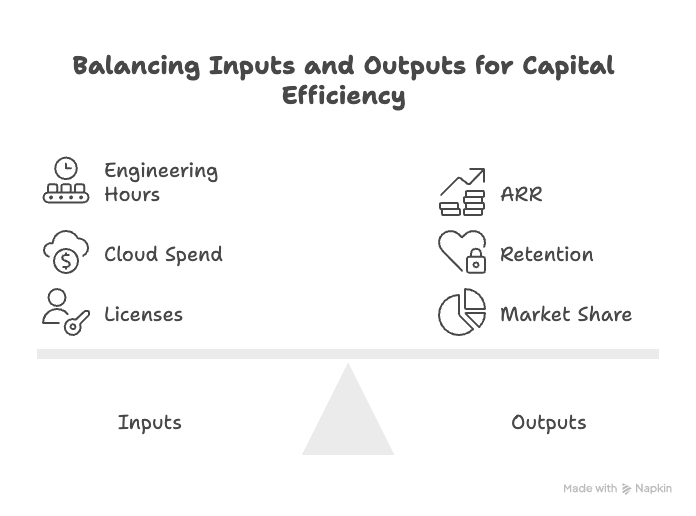
To master capital efficiency, you must view your entire product organization as a transformation engine. In this model, the inputs are the various forms of capital the company invests, and the outputs are the financial and strategic results those investments produce. When a product department is inefficient, it is usually because the ratio between these two is skewed: you are pouring in massive amounts of high-grade fuel (capital and talent) but getting very little mileage (revenue and margin) in return.
Stop guessing. Start calculating.
Access our suite of calculators designed to help SaaS companies make data-driven decisions.
Free tool. No signup required.
The inputs: What you are actually spending
Most product leaders think their primary input is “time.” In reality, from a capital efficiency perspective, you are managing three distinct types of investment:
- Financial Capital: This is the hard cash spent on cloud infrastructure (AWS/Azure), third-party API licenses (OpenAI, Stripe, Twilio), and the “SaaS sprawl” of tools used by the product team.
- Human Capital: This is the fully burdened cost of your engineering, design, and product talent. It is often the largest line item on the company’s OpEx. Every developer hour is a capital allocation decision.
- Opportunity Cost: This is the “hidden” input. By choosing to build Feature A, you are spending the potential revenue and efficiency gains you could have had by building Feature B.
The outputs: What the CFO cares about
The output of a product team is not “features.” Features are merely a medium. In a Rule of 40 framework, the outputs are measured by how they move the financial needle:
- Direct Revenue (The Growth Lever): This includes new logos acquired because of a specific capability and the expansion revenue generated when existing customers upgrade to higher tiers.
- Asset Value (The Balance Sheet Lever): This is the proprietary intellectual property (IP) you are creating. A robust, scalable, and defensible codebase increases the overall valuation of the company during an exit or funding round.
- Efficiency Gains (The Margin Lever): This is the “yield” of your product. High-efficiency outputs include features that allow one Customer Success Manager to handle 50 accounts instead of 20, or code optimizations that slash your monthly hosting bill.
Optimizing the ratio
To implement the Rule of 40, you must constantly monitor the Product Yield. If your inputs (R&D spend) are increasing at a faster rate than your outputs (ARR growth + Margin expansion), your capital efficiency is declining.
A “Rule of 40 roadmap” focuses on high-yield initiatives. For example, if you spend $200k in engineering salaries (Input) to build an automated billing module that recovers $50k in failed payments every month (Output), you have created a high-yield asset. The “payback” on that capital investment is only four months. Comparing every roadmap item using this Input/Output ratio is the fastest way to align with the finance department and ensure your product is driving sustainable company growth.
Understanding the rule of 40 math
The Rule of 40 is a high-level metric used by private equity firms and venture capitalists to measure the health of a SaaS business. It suggests that a company’s combined growth rate and profit margin should exceed 40%. This creates a balancing act: you can be a high-growth company with low profits, or a low-growth company with high profits, as long as the sum meets the threshold.
The formula is expressed as:
Growth Rate + Profit Margin ≥ 40%
In this equation:
- Growth Rate usually refers to the year-over-year percentage increase in Annual Recurring Revenue (ARR) or total revenue.
- Profit Margin usually refers to the EBITDA (Earnings Before Interest, Taxes, Depreciation, and Amortization) margin.
If your company is growing at 30% but has a -10% margin, your score is 20, which is below the efficiency threshold. If you are growing at 50% with a -5% margin, your score is 45, which represents a healthy, high-growth, efficient business.
As a product leader, your roadmap is the primary lever to move these numbers. You can either build things that accelerate growth (the left side of the equation) or build things that improve margins (the right side of the equation). Understanding where your company sits on this spectrum determines your product strategy. If your score is 20, your roadmap should likely focus on profitability and COGS reduction. If your score is 60, you have the “permission” to spend capital more aggressively on experimental growth features.
Auditing your roadmap for financial impact
To implement the Rule of 40, you must first audit your existing roadmap. Most roadmaps are a collection of customer requests, competitive parity features, and “gut-feel” innovations. To align with the CFO, you must categorize every initiative based on its financial contribution.
Categorizing features by financial lever
| Category | Financial Impact | Example Feature |
| New Business Growth | Increases ARR (Top-line growth) | New market expansion modules or integrations. |
| Retention/Expansion | Increases NRR (Net Revenue Retention) | Advanced reporting for enterprise upsells. |
| COGS Reduction | Increases Gross Margin | Optimizing cloud infrastructure or API usage. |
| OpEx Efficiency | Increases EBITDA Margin | Automated onboarding to reduce CS headcount. |
Any item on your roadmap that does not clearly fit into one of these four buckets should be questioned. If a feature is “nice to have” but doesn’t lower costs or drive revenue, it is a drain on capital efficiency. This audit often reveals “zombie features” (initiatives that have been on the roadmap for months but offer little financial upside) that should be purged immediately to free up R&D capacity.
Prioritizing for gross margin and COGS
Product leaders often overlook the “Cost of Goods Sold” (COGS). In SaaS, COGS includes hosting costs, third-party licensing fees, and the human cost of keeping the software running (DevOps and Support). While Sales and Marketing (S&M) often take the blame for low margins, the product architecture itself is often the culprit.
If your gross margin is 70%, but the industry standard is 80%, your product is “expensive” to run. By dedicating a portion of your roadmap to “Technical Excellence” or “Infrastructure Optimization,” you are directly contributing to the Rule of 40 by increasing the profit margin. This is often more effective than trying to squeeze another 2% of growth out of a saturated market.
The hidden cost of manual intervention
Every time a customer needs to contact support to reset a password, provision a new user, or export data, it costs the company money. This is “human-powered software.” A capital-efficient roadmap prioritizes self-service tools.
If you build a feature that reduces support tickets by 20%, you have effectively lowered the operating expenses of the company. This allows the business to scale without hiring more support staff at the same rate as revenue growth. This “operating leverage” is exactly what the CFO is looking for. In the Rule of 40 calculation, this manifests as an improvement in the EBITDA margin.
Beyond RICE: The capital efficiency score
The RICE framework (Reach, Impact, Confidence, Effort) is a staple in product management, but it lacks financial rigor. To implement the Rule of 40, you should introduce a “Capital Efficiency Score” (CES) to your prioritization process. This forces product managers to quantify their assumptions in dollars and cents.
Instead of just “Impact,” ask the following questions:
- Will this feature reduce our Customer Acquisition Cost (CAC)?
- Will this feature shorten our sales cycle?
- Will this feature allow us to increase our average contract value (ACV)?
- Will this feature reduce our churn rate (improving LTV)?
A feature that has a high “Reach” but no clear path to revenue or cost reduction should be deprioritized in favor of a feature that directly moves the needle on the Rule of 40. For example, building a public API might have high effort, but if it enables a partner ecosystem that lowers your CAC, its Capital Efficiency Score is massive.
Pro tip: use our free RICE calculator
Product-led growth as an efficiency engine
Product-Led Growth (PLG) is perhaps the most powerful tool for capital efficiency. In a traditional sales-led model, you have to spend a significant amount of money on sales and marketing (S&M) before you see a dime of revenue. This increases your CAC and hurts your profit margin.
In a PLG model, the product does the selling. By building frictionless onboarding, “viral” loops within the app, and self-service upgrades, you lower the burden on the sales team. This allows the company to grow revenue (the growth side of the Rule of 40) without a linear increase in S&M expenses (protecting the profit side).
Shortening the CAC payback period
The “CAC Payback Period” is the number of months it takes to earn back the money spent to acquire a customer. Efficient companies aim for a payback period of under 12 months. The product roadmap can influence this by:
- Improving conversion rates: Lowering the cost per lead by making the product easier to trial.
- In-app expansion: Growing the account value without human sales intervention.
- Time to value (TTV): The faster a customer gets value, the less likely they are to churn in the early, expensive months of their lifecycle.
The role of technical debt in capital efficiency
Technical debt is often framed as a “developer problem,” but it is actually a financial liability. High technical debt acts like high-interest debt on a balance sheet. It slows down the “velocity” of your engineering team, meaning every new feature costs more to build than it should. This is a direct drain on capital.
If your team spends 50% of their time fixing bugs and managing legacy code, your R&D efficiency is 50%. This means you are paying 100% of the salaries for 50% of the output. In a capital-efficient organization, this is unacceptable.
A roadmap that ignores technical debt is inherently capital inefficient. By strategically “refactoring” and paying down debt, you increase the future ROI of your engineering spend. This is a long-term play for the Rule of 40, as it ensures that your growth remains sustainable and your margins do not erode as the codebase grows. The CFO will support technical debt reduction if you present it as “increasing R&D output efficiency.”
Measuring what matters to the board
To successfully implement this strategy, you must change how you report progress. Moving away from “velocity charts” and “feature completion percentages,” you should start reporting on “Financial Outcomes.” Board members and executives do not care how many story points you completed; they care how those points translated into enterprise value.
Instead of saying, “We shipped the new dashboard,” say, “We shipped the new dashboard which is expected to increase NRR by 2% and reduce support inquiries related to data reporting by 15%.” This language bridges the gap between the product team and the executive suite.
Key metrics for the product-finance alignment
- R&D as a % of Revenue: How much are you spending on building compared to what you are making? High-efficiency companies typically keep this between 15% and 25%.
- Feature ROI: The revenue generated by a specific module divided by the cost to build and maintain it.
- Customer Lifetime Value (LTV) to CAC Ratio: Aim for 3:1 or higher. The product influences LTV through retention and CAC through PLG.
- Gross Margin by Product Line: Which parts of your software are the most profitable to run? This helps you decide which products to invest in and which to sunset.
Implementing the Rule of 40 is not about cutting all spending; it is about making better trade-offs. There will be times when you intentionally sacrifice margin to capture a once-in-a-decade market opportunity. Conversely, there will be times when you slow down growth to fix a leaky bucket (churn) and improve profitability.
The key is intentionality. A capital-efficient product leader knows exactly which lever they are pulling at any given time. They can explain to the CEO and CFO why they are prioritizing a “boring” infrastructure project over a “flashy” new feature by pointing to the long-term impact on EBITDA. This level of strategic thinking turns the product department from a cost center into a value driver.
Conclusion
The era of “Growth at all costs” has been replaced by the era of “Sustainable, Efficient Growth.” As a product leader, your role is no longer just about user experience or technical innovation; it is about financial stewardship. By adopting the Rule of 40 as your roadmap’s North Star, you align your team with the goals of the CFO and the Board of Directors.
Implementing these changes requires a shift in mindset. It requires you to treat your engineering hours as a precious capital resource. When you filter every roadmap decision through the lens of growth and profitability, you stop building features and start building a high-value business. This is how you ensure your product remains competitive and your company remains resilient in 2026 and beyond.
If you need help auditing your roadmap for capital efficiency or aligning your product strategy with your financial goals, we can help.
Ready to build a capital-efficient product engine? Book a free strategy call with us to learn how we help SaaS companies balance growth and profitability through strategic product leadership.

Sivan Kadosh is a veteran Chief Product Officer (CPO) and CEO with a distinguished 18-year career in the tech industry. His expertise lies in driving product strategy from vision to execution, having launched multiple industry-disrupting SaaS platforms that have generated hundreds of millions in revenue. Complementing his product leadership, Sivan’s experience as a CEO involved leading companies of up to 300 employees, navigating post-acquisition transitions, and consistently achieving key business goals. He now shares his dual expertise in product and business leadership to help SaaS companies scale effectively.