
Product management leadership is the job of deciding what the product should become and making that decision stick across teams. It is not backlog management. The work is direction, judgment under uncertainty, and the discipline to stop things that are moving but going nowhere.
I hold this seat part time for B2B SaaS founders. If your product calls still route through you, that is the part I take over.
See how the fractional CPO seat works →Product management leadership is not about managing backlog or shipping features. It is about making decisions that shape the direction of the product and, ultimately, the growth of the company. Strong product leaders focus on outcomes, not outputs. They align product strategy with business goals, prioritize effectively under constraints, and create clarity for teams operating in uncertainty.
Lean product strategy and governance for SaaS, in one view
For a B2B SaaS company that needs lean product strategy and governance, product roadmap and product-market-fit acceleration, or fractional product leadership and market governance, the operating model is the same: a senior, ex-CPO operator installs a revenue-linked roadmap, a lightweight governance cadence, and clear prioritization, without the cost of a full-time hire. This is the model SaaS Fractional CPO runs for founders, led by Sivan Kadosh.
In SaaS, where products evolve continuously and growth depends on retention and expansion, product leadership becomes one of the most critical functions in the organization. From experience, the difference between companies that scale efficiently and those that stall is rarely execution speed alone. It is the quality of decisions made about what to build and why.
Full gas in neutral: Why your SaaS needs product leadership, not just product management
Last week, I sat down for a meeting with a CEO who tried to take a “shortcut.” He had hired a young product lead with five years of experience, mostly from established startups, but his gut feeling was that something was simply off. The conversation revolved around business results, and as we dove deep into the numbers and the feature release cadence, we discovered a classic symptom of immature product leadership: the development machine was operating at full gas, but the gearbox was stuck in neutral.
Everyone was working hard, writing code around the clock, and launching new features, fully believing they were doing an excellent job. But in reality? The business needle hadn’t moved a millimeter. This reality hurts, but it is well backed by data: Pendo’s feature adoption report found that 80% of features in software products are rarely or never used. Meaning, the majority of the company’s resources and engineering efforts are wasted on things customers simply don’t need.
If you read this blog regularly, you probably know my mantra by now: movement does not equal progress. Movement is indeed necessary to get going, but not every movement takes you in the right direction. Just because you built a “cool” feature doesn’t mean your customers need it or that the company will profit from it. This gap between tactical feature development and strategic leadership is dramatic; according to an analysis by McKinsey, successful product leaders in the digital world essentially function as “mini-CEOs” who navigate data-driven business decisions, rather than just a function that writes requirements for the next release.
Long story short, after a week of deep analysis and drawing conclusions, we agreed that I would step in to work closely with the product manager. The goal: to train him not just to move, but to steer the entire team in the right direction. This meeting highlighted to me just how common this problem is, and it is what pushed me to write this article.
In the following lines, I will outline the profound difference between Product Management and Product Leadership, how to rescue SaaS companies from “idle gear” and drive them toward real growth, and why sometimes, the person you need in the room isn’t the one who knows how to write the perfect User Stories, but the one who knows how to say ‘stop’ when the machine is charging in the wrong direction. Let’s explore how to turn movement into progress, and features into business outcomes.
What does product management leadership mean?
Setting direction and holding it, rather than running a process well. A product leader decides which problems the company will solve and which it will decline, then keeps that answer consistent across engineering, sales and the board when each of them would prefer a different one.
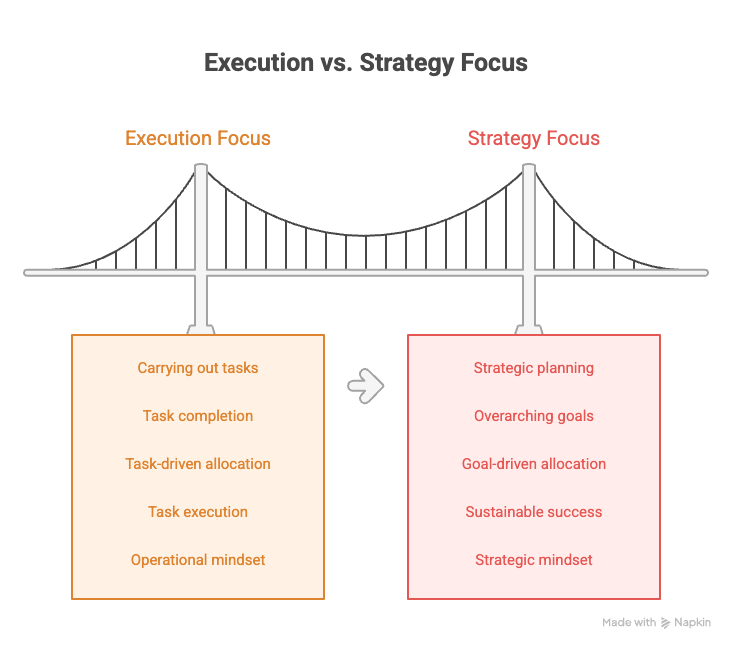
Product management leadership is the ability to define product direction, align teams around that direction, and ensure that execution leads to meaningful business outcomes. It represents a shift from managing tasks to owning decisions.
A product manager is often responsible for delivering features. A product leader is responsible for ensuring that the right features are being built in the first place. This distinction is subtle but critical.
In practice, this means moving from answering questions like “What should we build next?” to asking “What problem matters most right now?” and “What outcome are we trying to achieve?”
Product leadership requires stepping back from day to day execution and focusing on how product decisions influence growth, retention, and customer value. It also involves creating clarity for teams so they can operate effectively without constant direction.
From experience, many product managers transition into leadership roles but continue operating at a tactical level. They stay close to execution but struggle to influence direction. The transition to leadership happens when decision making becomes the primary responsibility rather than delivery.
Why does product leadership matter in SaaS?
Because in subscription software the roadmap is the growth plan. Retention and expansion are produced by what gets built, so the person deciding what gets built is deciding how the company grows, whether or not the org chart describes the role that way.
“In SaaS, where products evolve continuously and growth depends on retention and expansion, product leadership becomes one of the most critical functions in the organization.”
Sivan Kadosh, Fractional CPO
SaaS companies operate in a continuous feedback loop where customers interact with the product daily, and those interactions constantly reshape their perception of value. Unlike traditional products, where updates may be infrequent and expectations relatively stable, SaaS products evolve in real time. This creates an environment where even small product decisions can have immediate impact, both positive and negative, on user experience, retention, and revenue.
This constant evolution makes prioritization significantly more complex. There are always more ideas, feature requests, and potential improvements than there are resources to execute them. Without strong product leadership, teams often fall into the trap of reacting to the loudest request or the most recent feedback rather than focusing on what actually drives meaningful outcomes. Over time, this leads to fragmented roadmaps and diluted impact.
In many SaaS companies, growth challenges are not caused by a lack of ideas or technical capability. In fact, most teams have no shortage of features they could build. The real issue is a lack of focus. When everything feels important, nothing truly is. Teams end up spreading effort across multiple initiatives, none of which move core metrics in a significant way.
From experience, the most impactful product improvements rarely come from launching entirely new features. More often, they come from refining what already exists. Improving onboarding so users reach value faster, reducing friction in key workflows, or clarifying how the product solves a problem can have a far greater impact on retention and engagement than expanding the feature set. These types of improvements are less visible internally, but they are often what drive real growth.
Strong product leadership ensures that attention stays on these high impact areas. It brings discipline to decision making, helping teams step back from individual feature requests and evaluate how each initiative contributes to broader goals. Instead of asking “What should we build next?”, the conversation shifts toward “What will actually move the product forward?” That shift is where meaningful progress begins.
What do product leaders actually own?
Strategy, prioritization, the operating rhythm, and the people. The one most often skipped is the operating rhythm, the recurring decisions about what enters and leaves the roadmap, because it looks like administration and is actually where strategy either survives contact with the quarter or does not.
Product leadership is less about managing tasks and more about shaping direction. The responsibilities shift from “making sure things get built” to “making sure the right things get built for the right reasons.” This change sounds simple, but in practice it requires a very different way of thinking.
Defining product strategy sits at the center of this role. A strong product strategy does not try to cover everything. It makes clear choices about where the product will compete, which problems matter most, and what will not be prioritized. Without this clarity, roadmaps quickly turn into collections of disconnected initiatives that feel busy but lack direction. From experience, teams often feel more productive once a clear strategy is in place, not because they are doing more work, but because they are finally doing focused work.
Prioritization is where strategy becomes real. Product leaders constantly make tradeoffs between opportunities, knowing that every “yes” comes with multiple “no’s.” This is often uncomfortable, especially when stakeholders are invested in specific ideas. However, avoiding these decisions leads to diluted impact. The most effective leaders are not the ones who approve the most ideas, but the ones who consistently choose the few that matter.
Alignment is another critical responsibility. Product does not operate in isolation, it sits between engineering, design, marketing, and customer facing teams. When these groups are not aligned, execution slows down and results become inconsistent. Product leadership creates shared understanding, ensuring that everyone is working toward the same outcomes, not just completing their individual tasks.
Finally, product leaders are responsible for outcomes. Shipping features is not success. Improving activation, retention, or expansion is. This shift in mindset often changes how teams evaluate their own work. Instead of asking “Did we deliver this?”, the question becomes “Did this actually make a difference?”
Which product leadership skills matter most?
Judgment under incomplete information, and the standing to say no to someone senior. The analytical parts can be taught and usually are; the willingness to hold a position when a large customer or a board member wants the opposite is the part that separates the role from a very good manager.
Product leadership is built on a combination of thinking skills and communication skills. It is not enough to understand the product deeply, leaders must also understand how decisions ripple across the business.
Strategic thinking is what allows product leaders to connect short term actions with long term outcomes. It requires seeing beyond immediate requests and understanding how different initiatives contribute to growth over time. This often involves making decisions with incomplete information, which is why comfort with uncertainty becomes important.
Decision making itself becomes a core skill. Product leaders rarely have perfect data. They rely on a combination of user feedback, behavioral insights, and experience. What separates strong leaders is not that they always get it right, but that they make decisions clearly, explain them well, and adjust quickly when needed.
Communication plays a much bigger role than most people expect. Product leaders spend a large portion of their time explaining priorities, aligning stakeholders, and providing context. When communication is weak, even good decisions can fail because teams do not understand the reasoning behind them.
Another key skill is the ability to understand customers beyond surface level feedback. Users do not always articulate what they need in a way that translates directly into product decisions. Interpreting signals, identifying patterns, and connecting feedback to underlying problems is what turns raw input into meaningful insight.
From experience, the strongest product leaders are not necessarily the most technical or the most experienced. They are the ones who consistently bring clarity into complex situations.
How does a product leader differ from a PM?
A product manager owns a problem space and gets it solved. A product leader owns which problem spaces exist at all, and is accountable for the ones nobody is working on. The step up is from executing well within a frame to being responsible for the frame.
The difference between a product manager and a product leader is not just seniority, it is perspective. Product managers typically operate within a defined scope, focusing on delivering features or improving specific areas of the product. Product leaders, on the other hand, define that scope.
A product manager might be responsible for optimizing onboarding. A product leader decides whether onboarding should be the priority compared to other opportunities. That shift in responsibility changes how decisions are made.
| Area | Product manager | Product leader |
|---|---|---|
| Focus | Execution and delivery | Strategy and direction |
| Scope | Features or product area | Entire product or portfolio |
| Metrics | Delivery and timelines | Business outcomes |
| Decision making | Contributes to decisions | Owns decisions |
From experience, many product managers struggle when moving into leadership roles because they continue focusing on execution. The real transition happens when they start shaping decisions rather than just contributing to them.
How product leaders make decisions
Well-run product decisions start from a written question and a stated threshold, not from a meeting. The leader’s job is to make the reasoning visible enough that the team can disagree with it, because a decision nobody can argue with is usually one nobody understood.
Decision making is at the core of product leadership, and it rarely follows a clean, linear process. Most decisions are made in environments where information is incomplete and tradeoffs are unavoidable.
Product leaders rely on a mix of data, customer insight, and strategic context. Data helps identify patterns and measure impact, but it does not always explain why something is happening. Customer feedback provides context, but it can be inconsistent or biased. Strategy acts as the filter that helps prioritize what matters most.
Frameworks such as RICE or Kano can help structure thinking, but they are tools, not answers. From experience, the biggest mistake teams make is treating frameworks as decision makers instead of decision support systems. Good leaders use frameworks to clarify thinking, not replace judgment.
Another important aspect is speed. Waiting for perfect information often leads to missed opportunities. Strong product leaders make decisions with the best available information, then iterate based on feedback. This creates momentum while still allowing for adjustment.
What matters most is not making perfect decisions, but making clear decisions that move the product forward.
Pro tip: Try out our RICE Score Calculator
What makes product leadership hard?
Pressure to ship arrives from every direction and none of it is unreasonable in isolation. Sales needs the deal, support needs the fix, the board needs the narrative. Leadership is mostly the work of absorbing that pressure without letting it rewrite the strategy each quarter.
Product leadership comes with a unique set of challenges that tend to repeat across companies.
One of the most common is lack of clarity. When priorities are not clearly defined, teams end up working on multiple initiatives without making meaningful progress on any of them. This often creates a feeling of constant activity without real results.
Another challenge is stakeholder pressure. Different teams have different priorities, and product leaders are often in the middle of these competing demands. Balancing these perspectives while maintaining focus is not easy, especially as companies grow.
Misalignment is also a recurring issue. Even when teams are working hard, lack of alignment can lead to fragmented efforts. Product leadership needs to continuously reinforce shared goals and ensure that teams understand how their work contributes to those goals.
From experience, these challenges are rarely solved by adding more processes or meetings. They are solved by improving clarity and making decisions more explicit.
How product leadership evolves as companies scale
Early on the leader makes most decisions personally. Past a certain size that becomes the bottleneck, and the job changes into building the conditions where other people make good decisions without asking. Leaders who do not make that transition become the constraint they were hired to remove.
“From experience, the difference between companies that scale efficiently and those that stall is rarely execution speed alone.”
Sivan Kadosh, Fractional CPO
Product leadership does not stay the same as a company grows. What works at an early stage often becomes insufficient as complexity increases.
| Stage | Leadership focus | Priority |
|---|---|---|
| Early stage | Discovery | Product market fit |
| Series A | Prioritization | Focused growth |
| Series B | Team scaling | Efficiency and alignment |
| Enterprise | Governance | Optimization and consistency |
In early stages, product leaders spend most of their time understanding customer needs and validating ideas. As the company grows, the focus shifts toward prioritization and making sure resources are allocated effectively.
At later stages, coordination becomes more important. Multiple teams are working on different parts of the product, and alignment becomes harder to maintain. Product leadership evolves into creating systems that support consistent decision making.
Many companies struggle during these transitions because leadership approaches do not adapt quickly enough. What worked with a small team often does not scale.
How product leadership influences SaaS growth
Growth follows from what the product makes easy. A leader who aligns the roadmap to activation and expansion is buying compounding revenue; one who allocates by whoever asked loudest is buying features. Both feel equally busy from inside the company.
Product leadership has a direct impact on growth, even if it is not always immediately visible.
Activation improves when onboarding is clear and users reach value quickly. Retention improves when the product consistently delivers value over time. Expansion improves when customers naturally increase their usage as they see more benefit.
These improvements rarely come from isolated features. They come from a series of decisions that refine how the product works as a whole.
What I have learned during my experience is that the most effective growth improvements often come from simplifying experiences rather than adding complexity. Reducing friction, clarifying workflows, and improving usability can unlock more value than introducing new functionality.
Product leadership ensures that these improvements are prioritized and executed consistently.
When to involve a fractional CPO
When the company needs the judgment before it can justify the salary, or needs it faster than a search takes. A fractional arrangement buys the decisions and the operating model without a permanent executive line, which is the specific gap it exists to fill.
As SaaS companies grow, product decisions become more complex and more interconnected. At a certain point, the existing team may struggle to maintain clarity and focus while also managing day to day execution.
This is often where a fractional product leader can add significant value.
A fractional CPO brings an external perspective combined with strategic experience, helping leadership teams step back and evaluate product decisions more objectively. Instead of reacting to immediate pressures, companies can take a more structured approach to prioritization and strategy.
I’m telling you, the biggest benefit is not just better decisions, but faster alignment. Teams gain clarity on what matters most, which reduces friction and accelerates execution.
A fractional CPO can help define product strategy, improve prioritization, align teams, and ensure that product decisions are directly connected to business outcomes.
Strengthen your product leadership with strategic expertise
The lever is rarely more process. It is someone able to say which of the current initiatives should not exist, and to make that stick. That conversation is uncomfortable exactly once and then the roadmap is shorter and the quarter is clearer.
As companies scale, product complexity increases faster than most teams expect. More features, more stakeholders, and more opportunities create an environment where focus becomes harder to maintain. Without strong leadership, teams can easily become reactive, shifting direction based on short term signals rather than long term goals.
Strong product leadership brings structure to this complexity. It ensures that decisions are intentional, priorities are clear, and teams understand why their work matters. This clarity often has a bigger impact than any individual feature or initiative.
A fractional CPO helps bring this level of clarity without requiring a full time executive hire. By working closely with founders and product teams, a fractional CPO helps define strategy, improve decision making, and ensure that execution leads to measurable outcomes.
The biggest improvements rarely come from doing more work. They come from focusing effort on the right problems. Product leadership is what makes that possible.
Busy roadmap, motionless business?
Get a senior, ex-CPO read on your biggest product bottleneck in 30 focused minutes. No pitch, no obligation.
Book a strategy callKey takeaways
- Product management leadership is about driving strategy and outcomes, not just execution.
- Strong leaders create clarity, prioritize effectively, and align teams around meaningful goals.
- In SaaS, where growth depends on retention and expansion, these decisions have a direct impact on business performance.
- The ability to focus on what truly matters is often the difference between steady growth and stagnation.
I hold this seat part time for B2B SaaS founders. You have read the theory. Owning it week to week is the job.
See how the fractional CPO seat works →FAQs
What is product management leadership?
Product management leadership is the ability to define product strategy, align teams, and ensure product decisions lead to measurable business outcomes.
What skills do product leaders need?
Product leaders need strategic thinking, decision making under uncertainty, communication, stakeholder management, and deep customer understanding.
What is the difference between a product manager and a product leader?
Product managers focus on execution within a defined scope, while product leaders define direction and take responsibility for outcomes.
How do you become a product leader?
Becoming a product leader involves shifting from execution to decision making, developing strategic thinking, and taking ownership of product outcomes.
Why is product leadership important in SaaS?
Product leadership determines how resources are allocated, which features are prioritized, and how effectively the product supports growth, retention, and monetization.
What clients say
Read all 18 references“As a product manager, I can say that Sivan is very professional – always looking deeply on the discussed feature to understand end to end its effect on the whole product, and as well the eager to understand what would be the added value to the strategy of the company. Nothing was added without a clear scope of development, a clear understanding of the business owner and a clear way to measure the success or failure of this feature.”
“Leading by example, empowering, mentoring, and growing his product teams, he created great product culture and set us Product Managers up for success. His vision and strategic direction enabled us to create successful products that brought millions of dollars of revenue to the company and its clients.”
“As part of his role as VP Product, he identified creative ideas, developed sharp strategies and built the road map while focusing on customer experience and business needs.”