RICE Model: A Practical Framework for SaaS Product Prioritization
March 30, 2026 • 9 min read

Last Updated on March 30, 2026 by Sivan Kadosh
TL;DR: The RICE model is a prioritization framework used by product teams to evaluate initiatives based on four variables: reach, impact, confidence, and effort. By calculating a numerical score, SaaS teams can compare features objectively and prioritize initiatives that deliver the highest value relative to the resources required. When implemented correctly, the RICE model reduces opinion driven roadmap debates and helps align product investments with measurable business outcomes.
Product teams rarely struggle with ideas. They struggle with choosing what matters most.
As SaaS companies grow, product roadmaps quickly become crowded with feature requests, sales demands, customer feedback, and leadership ideas. Without a structured prioritization system, decisions often become driven by the loudest voice in the room rather than by evidence.
This is where the RICE model becomes valuable.
Originally introduced by Intercom, the RICE prioritization framework provides a structured way to evaluate competing initiatives. Instead of debating opinions, teams can score initiatives using consistent criteria and compare them quantitatively.
For SaaS companies managing continuous product development, the RICE model creates a repeatable way to decide which initiatives deserve investment.
What is the RICE model?
The RICE model is a product prioritization framework designed to help teams evaluate and rank initiatives using four variables:
- Reach
- Impact
- Confidence
- Effort
Each initiative receives a score based on these factors. The final score helps teams compare different opportunities and determine which ones should move forward.
The framework became widely adopted in product management because it offers several advantages. It provides a structured way to evaluate ideas, creates transparency around decisions, and reduces subjective prioritization debates.
In SaaS environments where product teams must constantly balance new features, improvements, and technical investments, having a consistent prioritization framework can significantly improve decision quality.
Stop guessing. Start calculating.
Access our suite of calculators designed to help SaaS companies make data-driven decisions.
Free tool. No signup required.
The RICE scoring formula explained
The RICE framework produces a score using the following formula.
RICE Score = (Reach × Impact × Confidence) / Effort
This formula captures the potential value of an initiative relative to the work required to deliver it.
Reach, impact, and confidence increase the score because they represent potential value. Effort reduces the score because larger initiatives consume more resources.
By quantifying these variables, teams can compare initiatives that would otherwise be difficult to evaluate side by side.
Our tip: Try our free RICE Score Calculator & Prioritization Matrix
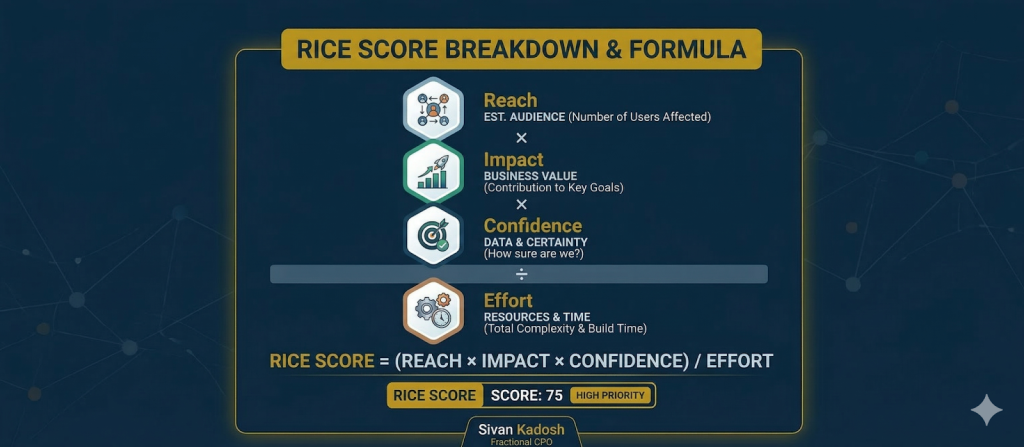
Understanding the four RICE variables
Reach
Reach measures how many users will be affected by an initiative within a specific timeframe.
For example, a feature that improves onboarding might affect thousands of new users each month, while an advanced reporting feature might only affect a smaller subset of power users.
Reach is typically measured using product analytics data.
Examples of reach metrics in SaaS products include:
- Number of active users affected
- Accounts impacted by the feature
- Transactions influenced by the change
- Customers interacting with a workflow
Impact
Impact estimates how strongly the initiative will affect user behavior or business outcomes.
Most teams use a simple scoring scale such as:
3 = massive impact
2 = high impact
1 = medium impact
0.5 = low impact
0.25 = minimal impact
Impact can relate to many product outcomes, including retention improvements, conversion increases, or expansion revenue opportunities.
For example, improving the onboarding experience may have a high impact on activation and retention, while cosmetic interface improvements might have a lower impact on core product metrics.
Estimating impact requires product judgment, but anchoring the score to measurable outcomes helps maintain consistency.
Confidence
Confidence measures how certain the team is about the assumptions behind the initiative.
Product teams rarely operate with perfect information. Many ideas are based on early research, qualitative feedback, or limited data.
The confidence score forces teams to acknowledge uncertainty.
A common scale is:
- 100 percent confidence for well validated initiatives
- 80 percent confidence for moderate evidence
- 50 percent confidence for weak assumptions
If an initiative is based on strong user research and historical data, the confidence score should be high. If the idea is speculative or lacks validation, the confidence score should be lower.
Confidence acts as a safeguard against over committing to ideas that sound promising but lack evidence.
Effort
Effort represents the total work required to deliver the initiative.
Effort usually includes contributions from multiple teams such as engineering, design, product management, and data.
In SaaS organizations, effort is often estimated in:
- Engineering months
- Team weeks
- Story points
- Sprint capacity
Effort sits in the denominator of the RICE formula because larger initiatives consume more resources. Even ideas with high potential value may rank lower if they require extensive development time.
By dividing value by effort, the RICE model highlights initiatives that deliver the highest return relative to investment.
Example of RICE prioritization in a SaaS roadmap
To understand how the framework works in practice, consider a SaaS product team evaluating several potential improvements.
| Feature | Reach | Impact | Confidence | Effort | RICE Score |
| New onboarding flow | 8,000 users | 2 | 80% | 3 months | 4266 |
| Advanced reporting | 2,500 users | 3 | 70% | 4 months | 1312 |
| Mobile UX improvements | 5,000 users | 1 | 90% | 2 months | 2250 |
In this example, improving onboarding receives the highest score because it affects a large number of users and has a strong expected impact relative to the effort required.
This type of scoring allows teams to quickly identify initiatives that deliver the greatest value.
Why the RICE model works well in SaaS companies
SaaS products evolve continuously. Teams must constantly evaluate feature requests, usability improvements, growth experiments, and infrastructure investments.
Without a structured prioritization framework, roadmap decisions often become reactive.
The RICE model works particularly well in SaaS environments because it introduces a common evaluation language across teams.
Product managers, engineers, and leadership can review initiatives using the same scoring criteria. This creates transparency and reduces subjective debates.
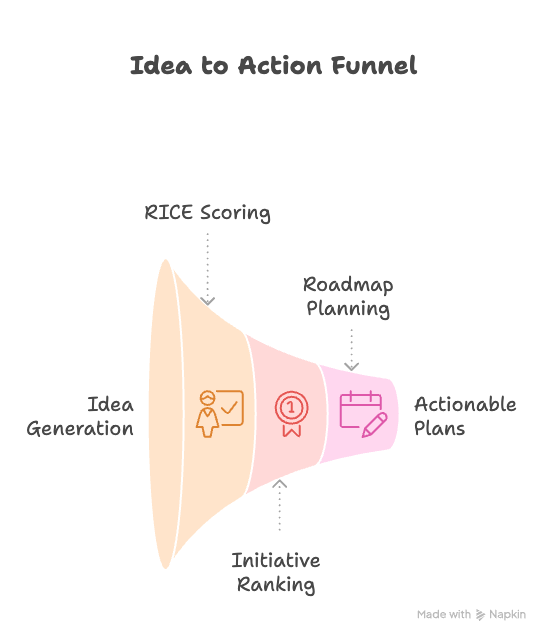
Common mistakes when using the RICE model
Despite its simplicity, the RICE framework can be misused if teams treat it as a purely mechanical formula.
One common mistake is inflating impact scores. Teams sometimes assign high impact values to initiatives they personally prefer, which undermines the objectivity of the framework.
Another frequent issue is ignoring the confidence variable. Some teams skip confidence scoring entirely, which removes the mechanism designed to account for uncertainty.
A third mistake is treating RICE as the final decision maker. While the framework provides useful guidance, it should support strategic decisions rather than replace them.
Some initiatives, such as long term platform investments or strategic repositioning efforts, may score lower in the model but remain critical for the company’s future.
RICE vs other prioritization frameworks
Product teams often compare RICE with other prioritization methods. Each framework solves a slightly different problem.
| Framework | Main focus | Best use case |
| RICE | Quantitative prioritization | Feature ranking and roadmap planning |
| ICE | Rapid scoring | Early stage startups |
| MoSCoW | Requirement classification | Project planning |
| Kano model | Customer satisfaction | UX and experience improvements |
| Value vs effort | Simple prioritization | Small product teams |
RICE is particularly useful when teams need a structured, repeatable method for comparing many competing initiatives.
When SaaS companies should use the RICE framework
The RICE model is most useful when teams face a large backlog of potential initiatives.
Common scenarios include roadmap planning cycles, feature backlog prioritization, and evaluation of product experiments.
Growth teams often use the framework to evaluate conversion improvements, onboarding optimizations, or expansion features.
Mid stage SaaS companies benefit especially from RICE because they typically operate with multiple product squads and need a consistent way to evaluate initiatives across teams.
As product organizations scale, structured prioritization frameworks become essential for maintaining focus.
Limitations of the RICE model
While the RICE model is powerful, it is not designed to solve every product decision.
The framework works best for incremental initiatives that can be evaluated using measurable assumptions.
It is less effective for evaluating long term strategic decisions such as entering new markets, investing in platform architecture, or repositioning the product.
These decisions require broader strategic analysis rather than simple scoring.
Product leaders should view RICE as a decision support tool rather than a replacement for strategy.
How a fractional CPO helps implement prioritization frameworks
Many SaaS companies struggle with prioritization not because frameworks are unavailable, but because decision processes are inconsistent.
Roadmaps become influenced by sales pressure, leadership opinions, or isolated customer requests.
A fractional Chief Product Officer helps introduce structured prioritization systems that align product investment with company strategy.
This often includes implementing frameworks such as the RICE model, establishing evaluation criteria for initiatives, and ensuring roadmap decisions connect directly to measurable business outcomes.
When prioritization becomes structured and transparent, product organizations move faster and avoid costly misalignment between teams.
Need help prioritizing your product roadmap?
If your product team constantly debates which initiatives deserve investment, the underlying issue is usually a lack of structured prioritization.
Implementing frameworks such as the RICE model can dramatically improve decision clarity and ensure resources are focused on the initiatives that drive growth.
As a fractional CPO, I help SaaS companies design product prioritization systems, align roadmaps with revenue strategy, and introduce frameworks that support disciplined product decision making.
A structured prioritization approach allows teams to move beyond opinion driven debates and focus on building the initiatives that create the greatest impact.
Key Takeaways
- The RICE model is a prioritization framework used by product teams to evaluate initiatives based on reach, impact, confidence, and effort.
- The formula produces a numerical score that allows SaaS teams to compare competing initiatives and rank them objectively.
- When used correctly, the framework reduces opinion driven roadmap debates and improves alignment between product investments and business outcomes.
- However, RICE should support strategy rather than replace it, particularly when evaluating long term strategic decisions.
- For SaaS organizations scaling their product teams, implementing structured prioritization frameworks can significantly improve decision quality and roadmap focus.
FAQs
What is the RICE model in product management?
The RICE model is a prioritization framework that scores product initiatives based on reach, impact, confidence, and effort. The score helps teams compare ideas and determine which initiatives should be prioritized in the product roadmap.
How do you calculate a RICE score?
The RICE score is calculated by multiplying reach, impact, and confidence, then dividing the result by effort. This produces a numerical score used to rank product initiatives.
Why is the RICE framework useful for SaaS companies?
SaaS companies frequently evaluate many competing product initiatives. The RICE framework provides a structured way to prioritize features, improvements, and experiments based on measurable assumptions.
How to use the RICE model?
To use the RICE model, product teams evaluate each initiative using four variables: reach, impact, confidence, and effort. Reach estimates how many users the initiative will affect within a defined timeframe. Impact measures how strongly the initiative is expected to influence key product or business metrics. Confidence reflects how certain the team is about the assumptions behind the initiative, while effort represents the total resources required to deliver it.
Once these values are estimated, the team calculates the score using the formula (Reach × Impact × Confidence) ÷ Effort. The resulting score allows initiatives to be ranked objectively. Product teams then compare scores across ideas and prioritize the initiatives that deliver the highest expected impact relative to the effort required.
What is the difference between RICE and ICE prioritization?
The ICE framework evaluates initiatives based on impact, confidence, and ease, while RICE adds reach as an additional variable. Including reach allows teams to account for how many users an initiative will affect.
Should product teams rely only on RICE scores?
No. The RICE framework should support product decision making but not replace strategy. Some strategic initiatives may score lower but still be essential for long term product success.

Sivan Kadosh is a veteran Chief Product Officer (CPO) and CEO with a distinguished 18-year career in the tech industry. His expertise lies in driving product strategy from vision to execution, having launched multiple industry-disrupting SaaS platforms that have generated hundreds of millions in revenue. Complementing his product leadership, Sivan’s experience as a CEO involved leading companies of up to 300 employees, navigating post-acquisition transitions, and consistently achieving key business goals. He now shares his dual expertise in product and business leadership to help SaaS companies scale effectively.