
SaaS KPIs are the metrics that show whether a subscription business is growing, keeping what it wins, and acquiring efficiently enough to be worth it. They fall into four families, growth, acquisition efficiency, retention and product engagement, and the useful ones are the few that actually change a decision.
I do this work inside B2B SaaS product teams. If your team ships every week and the numbers barely move, this is where I start.
See how product management consulting works →One of the most fascinating, yet frustrating, situations I encounter when working with startups (often led by young founders) is how they handle metrics. They look at exciting milestones and celebrate the numerical success. But when I zoom in on the numbers and look beyond the standard KPIs, I often realize it might be a bit too early to celebrate.
The MRR is growing, and that’s great (and don’t get me wrong, you absolutely should celebrate that!), but when we dig deeper, it turns out there are holes in the bucket. Sometimes the bucket isn’t even leaking right now, but there are clear early warning signs that it’s about to. For example, the current Churn Rate might look reasonable, but the growth trend in churn signals a problem that is about to blow up in our faces.
Ignoring these signals and the “leaky bucket” comes at a heavy price. According to Harvard Business Review, acquiring a new customer is anywhere from 5 to 25 times more expensive than retaining an existing one, while increasing customer retention rates by just 5% increases profits by 25% to 95%. Beyond immediate profitability, this directly impacts your company’s valuation: net revenue retention is one of the metrics investors weigh most heavily when pricing a SaaS business. McKinsey’s analysis of B2B SaaS companies sorted them by valuation multiple and found that the top quartile, at a median enterprise-value-to-revenue of roughly 24x against about 5x for the bottom quartile, carried median net revenue retention of 113% compared with 98%.
That is exactly why I wrote this article for you, to bring order to an area that some founders are genuinely terrified of: the world of data, and specifically, KPI management. As founders and CEOs, you simply don’t have the luxury of fearing these numbers. You must master them from every angle, because these are precisely the tools that will help you steer your business safely toward its true destination.
What are SaaS KPIs?
Measurable indicators of whether a subscription business is working. They differ from raw metrics by being the handful you are prepared to be judged on, and in SaaS they cluster into growth, acquisition efficiency, retention and engagement, because those four decide whether revenue compounds or leaks.
“While many companies track dozens of metrics, high performing SaaS organizations focus on a smaller set of indicators that directly influence revenue and long term profitability.”
Sivan Kadosh, Fractional CPO
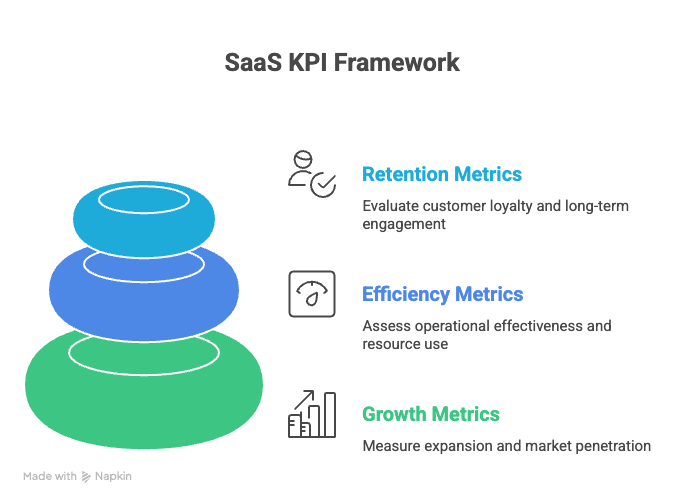
SaaS KPIs are measurable indicators used to evaluate the performance and sustainability of a SaaS business. These metrics help leadership teams understand whether their product is growing, whether customers are staying, and whether the company is acquiring users efficiently.
Unlike traditional businesses, SaaS companies rely heavily on recurring revenue. This means revenue growth depends not only on acquiring new customers but also on retaining and expanding existing ones. As a result, SaaS companies must track a broader set of metrics that capture the full lifecycle of a customer relationship.
KPIs in SaaS serve several critical functions. They help founders evaluate whether the company is achieving product market fit. They help investors understand whether the company is scaling efficiently. They help product leaders prioritize initiatives that improve retention and expansion revenue.
When implemented correctly, SaaS KPIs transform raw data into strategic insight.
Why do SaaS companies rely on KPIs?
Because subscription revenue is won slowly and lost quietly. A single bad month rarely shows up in the top line, and by the time it does the cohort that caused it is long gone. KPIs are the instruments that make a slow leak visible while there is still time to act on it.
Metrics play a central role in SaaS because the business model is fundamentally different from traditional software companies.
In a one time license model, revenue is recognized immediately when a product is sold. In SaaS, revenue accumulates over time as customers continue their subscriptions. This means the profitability of a customer often depends on how long they remain active and how much they expand their usage.
Because of this dynamic, SaaS companies must track indicators that measure not only revenue but also customer behavior.
KPIs guide decisions across multiple areas of the business. Product teams use engagement metrics to understand whether features deliver value. Marketing teams rely on acquisition metrics to evaluate campaign efficiency. Finance teams monitor unit economics to ensure the company can scale sustainably. The SaaS Unit Economics Calculator runs those numbers from your churn, ARPA and gross margin. For what those metrics imply about company value, the SaaS Valuation Calculator gives the ARR multiple.
When these metrics are aligned, they create a clear picture of how product decisions translate into revenue outcomes.
Which KPIs measure growth?
Recurring revenue and its rate of change, read together. The level tells you the size of the business and the rate tells you whether it is still compounding, and a healthy-looking level sitting on a decaying rate is the shape that most often surprises a board. The three below are the standard set.
Growth metrics measure the overall expansion of a SaaS business. They help leadership teams understand whether demand for the product is increasing and whether the company is capturing more revenue over time.
Monthly recurring revenue (MRR)
Monthly recurring revenue represents the predictable subscription revenue generated each month. It is one of the most widely used SaaS metrics because it provides a clear view of how the business is growing.
MRR is calculated by summing all active subscription revenue within a given month. This metric allows companies to track growth trends, forecast future revenue, and evaluate the impact of new customer acquisition or churn.
Because it updates monthly, MRR gives leaders a near real time indicator of business performance.
Annual recurring revenue (ARR)
Annual recurring revenue represents the yearly equivalent of subscription revenue. ARR is commonly used by larger SaaS companies and investors because it provides a more stable view of revenue growth.
ARR is particularly important for fundraising discussions, valuation models, and long term planning.
Many SaaS companies track both MRR and ARR, using MRR for operational monitoring and ARR for strategic reporting.
Revenue growth rate
Revenue growth rate measures how quickly recurring revenue is increasing over time. It is often evaluated month over month or year over year.
Investors frequently analyze growth rate to determine whether a company has strong market demand and scalable acquisition channels. Sustained high growth rates typically indicate strong product market alignment and expanding customer adoption.
Which KPIs measure acquisition efficiency?
Cost, payback and efficiency, which answer whether growth is affordable rather than merely present. A company can buy any growth rate it likes for long enough to run out of money, so these are the metrics that separate a working engine from an expensive one.
Acquiring new customers is essential for SaaS growth, but the efficiency of acquisition is equally important. Acquisition metrics help companies understand whether marketing and sales investments generate sustainable revenue.
Customer acquisition cost (CAC)
Customer acquisition cost represents the total cost required to acquire a new customer. It includes marketing spend, sales team expenses, advertising costs, and related operational expenses.
CAC is calculated by dividing the total acquisition cost by the number of new customers acquired during the same period.
A high CAC can indicate inefficient marketing channels or overly complex sales processes. Monitoring this metric helps companies optimize acquisition strategies and improve return on investment.
CAC payback period
CAC payback period measures how long it takes to recover the cost of acquiring a customer through subscription revenue.
For example, if it costs one thousand dollars to acquire a customer and the customer generates one hundred dollars in monthly revenue, the payback period would be ten months.
Shorter payback periods indicate healthier business economics because the company recovers its acquisition investment faster.
Typical benchmarks suggest that strong SaaS companies aim for a CAC payback period below twelve months.
Sales efficiency ratio
Sales efficiency measures how effectively sales and marketing spending converts into new revenue.
It compares the increase in revenue to the amount spent on acquiring customers. A high sales efficiency ratio suggests that acquisition investments generate strong returns.
Which KPIs measure retention?
What happens after the sale, measured two ways. Logo retention counts customers and revenue retention counts money, and they diverge exactly when small accounts churn while large ones expand. Reading only one of them is how a company misses the story its own numbers are telling.
Retention is one of the most important drivers of SaaS profitability. Because subscription revenue compounds over time, even small improvements in retention can dramatically increase long term revenue.
Churn rate
Churn rate measures the percentage of customers who cancel their subscriptions within a given period.
Customer churn focuses on the number of customers lost, while revenue churn measures the amount of revenue lost due to cancellations or downgrades.
High churn rates often indicate problems with product value, onboarding, pricing alignment, or customer success.
Reducing churn is one of the most effective ways to improve long term revenue growth.
Net revenue retention (NRR)
Net revenue retention measures how much recurring revenue is retained from existing customers after accounting for churn, upgrades, and expansion revenue.
An NRR above one hundred percent means that existing customers generate more revenue over time even after accounting for churn.
Many top SaaS companies achieve NRR rates above one hundred ten percent, driven by upselling, cross selling, and increased product usage.
Gross revenue retention (GRR)
Gross revenue retention measures how much revenue is retained from existing customers without including expansion revenue.
This metric isolates the impact of churn and downgrades. It provides a clear view of whether customers continue paying for the product at the same level.
Which KPIs measure unit economics?
The economics of a single customer, followed all the way through. Lifetime value against acquisition cost tells you whether the model works at one, and burn multiple tells you what the growth is costing at scale. If the unit does not work, volume makes it worse rather than better.
Unit economics determine whether a SaaS company can scale profitably. These metrics evaluate the relationship between customer acquisition costs and long term customer value.
Customer lifetime value (LTV)
Customer lifetime value estimates the total revenue a company expects to generate from a customer throughout their subscription lifecycle.
LTV depends on several factors, including average revenue per user, retention rate, and expansion potential.
Higher lifetime value allows companies to invest more aggressively in customer acquisition while maintaining profitability.
LTV to CAC ratio
The LTV to CAC ratio compares the long term value of a customer to the cost required to acquire that customer.
A commonly cited benchmark suggests that healthy SaaS companies maintain a ratio of approximately three to one. This means that the revenue generated by a customer should be roughly three times the cost of acquiring them.
Ratios below one to one indicate unsustainable economics, while extremely high ratios may signal underinvestment in growth.
Burn multiple
Burn multiple measures how efficiently a company converts capital into revenue growth. It compares the amount of money a company spends to the additional revenue generated during the same period.
Lower burn multiples indicate more efficient growth.
Which KPIs measure engagement?
Whether people actually use the thing they are paying for. Engagement is the earliest available signal of future retention, which makes it the most useful family for a product team specifically, because it moves months before revenue does and there is still time to change something.
Financial metrics often lag behind product behavior. Product engagement metrics help teams detect early signals of growth or retention problems.
Activation rate
Activation rate measures the percentage of new users who reach a meaningful product milestone. This milestone typically represents the moment when users first experience real value.
Examples might include creating a project, sending the first message, or integrating with another tool.
Improving activation often has a direct impact on conversion and retention.
Feature adoption rate
Feature adoption tracks how frequently users engage with specific product capabilities.
Low adoption may indicate poor onboarding, unclear value, or unnecessary complexity in the product experience.
Understanding feature adoption helps product teams prioritize improvements that increase customer engagement, and the RICE Score Calculator ranks them.
Daily and monthly active users
Active user metrics measure how frequently customers interact with the product.
A high ratio of daily active users to monthly active users often indicates strong product stickiness and consistent engagement.
Strategic KPI categories every SaaS leader should track
Above the individual metrics sit the questions a leadership team is actually asking. Is growth efficient, is the base durable, is the product being used, and is the model sound at one customer. Each category below rolls up to one of those, which is why tracking all of them beats tracking many.
“These metrics help leadership teams understand whether their product is growing, whether customers are staying, and whether the company is acquiring users efficiently.”
Sivan Kadosh, Fractional CPO
While SaaS companies may track dozens of metrics, most successful organizations organize them into a small set of strategic categories.
| Category | Example KPIs | Strategic purpose |
|---|---|---|
| Growth | MRR, ARR, revenue growth | Measure company momentum |
| Efficiency | CAC, CAC payback, sales efficiency | Ensure sustainable acquisition |
| Retention | Churn rate, NRR, GRR | Measure customer health |
| Product | Activation rate, engagement metrics | Predict future revenue |
This structured approach prevents teams from focusing on vanity metrics and ensures that each KPI supports a clear business objective.
How SaaS KPIs change as companies scale
Early on almost nothing is statistically meaningful except whether people come back, so retention and activation carry the weight. As the base grows, efficiency and expansion take over, and the metrics that mattered at twenty customers become noise at two thousand. The dashboard has to be rebuilt, not extended.
The metrics that matter most often change as a SaaS company matures.
Early stage startups focus heavily on product engagement and retention because these indicators signal whether the product solves a real problem.
As companies scale, acquisition efficiency and expansion revenue become more important.
| Stage | Primary KPI focus | Strategic priority |
|---|---|---|
| Early stage | Activation and retention | Achieve product market fit |
| Series A | Customer acquisition and growth | Build repeatable acquisition channels |
| Series B | Net revenue retention and expansion | Increase revenue efficiency |
| Late stage | Profitability metrics such as Rule of 40 | Balance growth and efficiency |
Understanding which metrics matter most at each stage helps leaders allocate resources more effectively.
What goes wrong when tracking KPIs?
Tracking everything and deciding nothing. Reading a snapshot where the cohort is the real story, which flatters any business still growing. And redefining a metric mid-year so the trend line describes the measurement rather than the company, a change that is nearly invisible a quarter later.
Many SaaS companies track metrics but fail to extract meaningful insight from them.
One common mistake is tracking too many metrics at once. This can create confusion and prevent teams from focusing on the indicators that truly drive business performance.
Another mistake is prioritizing vanity metrics such as signups or page views. These metrics may look impressive but often have little impact on long term revenue.
Companies also frequently overlook retention metrics, focusing too heavily on acquisition instead of improving the experience of existing customers.
The most effective KPI systems connect metrics directly to strategic decisions. When metrics influence product priorities, pricing experiments, and customer success initiatives, they become powerful tools for growth.
How to build a SaaS KPI dashboard
Start from the decisions the leadership team makes monthly and work backwards to the smallest set of numbers that would change them. Define each one in writing, name the owner, and fix the refresh cadence before anyone opens a charting tool. Instrumentation quality decides everything downstream.
A well designed dashboard allows leadership teams to monitor performance and detect emerging trends.
An effective SaaS dashboard typically includes four sections.
- Revenue metrics that track overall growth
- Acquisition metrics that measure marketing and sales efficiency
- Retention metrics that evaluate customer health
- Product metrics that predict engagement and long term value
The most useful dashboards focus on a small set of leading indicators rather than overwhelming teams with excessive data.
When to bring in a fractional CPO to improve SaaS KPI performance
When the numbers are all being collected and none of them is changing what gets built. That gap is not an analytics problem, it is a question of who has the authority to let a metric overrule a plan, and it is usually cheaper to rent that judgment than to hire it permanently.
Many SaaS companies track dozens of metrics but struggle to translate those numbers into meaningful strategic decisions.
Product teams may collect data on activation, churn, and engagement, yet still find it difficult to identify the underlying causes of performance problems. Leadership discussions can quickly become opinion driven rather than evidence driven.
This is often the stage where companies benefit from the support of a fractional Chief Product Officer.
A fractional CPO helps organizations define the right KPI framework, align product initiatives with revenue outcomes, and build a structured product operating model that connects customer insight with business strategy.
By combining product leadership experience with data driven analysis, a fractional CPO can help companies prioritize initiatives that improve retention, expand revenue from existing customers, and strengthen long term growth.
For SaaS companies that have strong engineering teams but inconsistent business results, strategic product leadership often becomes the missing piece that turns metrics into measurable growth.
If you need strategic guidance at a fraction of the cost, we offer the best fractional CPO services in the niche.
Tracking everything, deciding nothing?
Get a senior, ex-CPO read on your biggest product bottleneck in 30 focused minutes. No pitch, no obligation.
Book a strategy callKey takeaways
- SaaS KPIs measure the health, growth, and efficiency of subscription based businesses.
- The most important metrics typically fall into four categories: growth, acquisition efficiency, retention, and product engagement.
- Retention metrics such as churn and net revenue retention often have the greatest long term impact on revenue.
- Unit economics metrics like LTV to CAC determine whether growth is financially sustainable.
- Strong SaaS companies use KPI frameworks to guide product strategy and revenue decisions rather than simply tracking metrics for reporting purposes.
I do this work inside B2B SaaS product teams. Knowing the model is one thing. Someone has to own it every week.
See how product management consulting works →FAQs
What are the most important SaaS KPIs?
The most important SaaS KPIs typically include monthly recurring revenue, customer acquisition cost, churn rate, net revenue retention, and customer lifetime value. These metrics together provide insight into growth, acquisition efficiency, and long term profitability.
What KPI should SaaS startups focus on first?
Early stage SaaS startups should focus heavily on activation rate and customer retention. These metrics indicate whether the product delivers real value and whether users continue using it after onboarding.
How many KPIs should a SaaS company track?
Most SaaS companies benefit from focusing on a small set of strategic metrics rather than tracking dozens of indicators. A core dashboard typically includes revenue growth metrics, acquisition efficiency metrics, retention metrics, and product engagement metrics.
What is the difference between SaaS metrics and SaaS KPIs?
SaaS metrics refer to any measurable data point related to the business. KPIs are the subset of metrics that directly reflect strategic performance and guide decision making.
Why do investors care about net revenue retention?
Net revenue retention measures how much revenue existing customers generate over time after accounting for churn and expansion. High retention rates indicate strong product value and predictable long term revenue growth.
Which KPIs matter for SaaS user acquisition?
The most important SaaS KPIs for user acquisition are Customer Acquisition Cost (CAC), CAC payback period, conversion rate, and sales efficiency. CAC measures how much it costs to acquire a new customer. CAC payback period shows how long it takes to recover that cost through subscription revenue. Conversion rates across the funnel, such as visitor to signup and signup to paid, reveal how effectively users move toward becoming customers. Sales efficiency measures how well marketing and sales spending generates new recurring revenue. Together, these KPIs help SaaS companies evaluate whether their acquisition strategy is scalable and sustainable.
What are the key SaaS KPIs to measure growth?
The key SaaS KPIs for measuring growth include Monthly Recurring Revenue (MRR), Annual Recurring Revenue (ARR), revenue growth rate, and Net Revenue Retention (NRR). MRR and ARR track predictable subscription revenue, while revenue growth rate shows how quickly that revenue is increasing over time. Net Revenue Retention measures how much revenue existing customers generate after accounting for churn and expansion. These KPIs together provide a clear view of a SaaS company’s revenue momentum and long term growth potential.
What clients say
Read all 18 references“As a product manager, I can say that Sivan is very professional – always looking deeply on the discussed feature to understand end to end its effect on the whole product, and as well the eager to understand what would be the added value to the strategy of the company. Nothing was added without a clear scope of development, a clear understanding of the business owner and a clear way to measure the success or failure of this feature.”
“Leading by example, empowering, mentoring, and growing his product teams, he created great product culture and set us Product Managers up for success. His vision and strategic direction enabled us to create successful products that brought millions of dollars of revenue to the company and its clients.”
“As part of his role as VP Product, he identified creative ideas, developed sharp strategies and built the road map while focusing on customer experience and business needs.”