
SaaS spend management is the set of processes a company uses to track, control and optimize what it pays for software across the organization. It goes beyond cutting cost, aligning tool investment with how the product is built and customers are served, and it becomes urgent once the stack grows faster than anyone is tracking it.
This is a frustrating topic, which is exactly why I felt it was so important to write about it. If you are a regular reader of my blog, you already know I am a battle-scarred veteran, and I want to share a story about a startup I founded a few good years ago. I was an early-stage (and some might say, oblivious) founder, and we were developing a SaaS product for the real estate industry. It was an amazing product (truly!). We worked on development for about six months, and then, during one of our meetings, we reviewed our expenses and my jaw dropped.
Our burn rate was enormous. We were spending thousands of dollars a month on other SaaS products, which was simply draining all our cash. I suddenly realized we were simultaneously paying for three different task management platforms adopted independently by different teams, dozens of automation tool licenses that were barely used, and cloud environments we forgot to spin down after testing.
We weren’t alone in this. In fact, recent data shows that the average organization wastes about 32% of its total SaaS spend on unused licenses, and manages a sprawling stack of over 250 different applications. But back then, we were just so focused on running fast and building our product that we completely lost control over the very tools building it.
That mini-collapse was a defining moment for me. It taught me the hard way that SaaS Spend Management isn’t just a line item in the finance department’s quarterly Excel sheet. It is a critical, cross-organizational operational capability that determines whether your startup survives or bleeds to death.
Today, when I guide companies as a Fractional CPO, the first things I look for are these ‘black holes.’ Because from my experience, cleaning up this mess is exactly what enables high-growth companies to maintain their innovation and speed without torching their runway. And that is exactly what we are going to talk about today: how high-growth SaaS companies take control of this madness.
What does SaaS spend management cover?
The processes a company uses to track, control and optimize what it spends on software subscriptions across the whole organization. In practice that means maintaining visibility into every tool in use, knowing who owns each contract, watching license utilization, and deciding renewals deliberately rather than by default.
“Spend management is broader. It ensures that software investments align with how the company builds products, serves customers, and scales operations.”
Sivan Kadosh, Fractional CPO
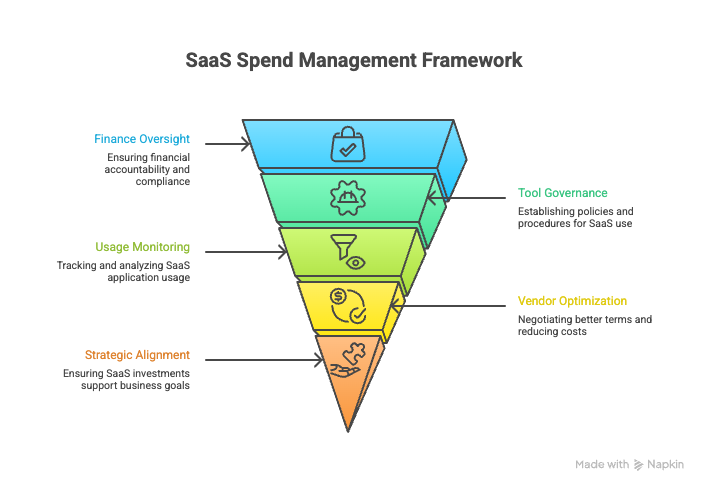
SaaS spend management refers to the processes used to track, control, and optimize spending on software subscriptions across an organization.
It includes several core activities.
Companies must maintain visibility into every SaaS tool used internally. They must understand who owns each subscription, how much it costs, how many users are active, and when contracts renew. Organizations must also evaluate whether tools deliver measurable value and whether cheaper or more efficient alternatives exist.
SaaS spend management therefore combines financial oversight with operational governance.
It differs from SaaS procurement, which focuses mainly on purchasing and contract negotiation. It also differs from SaaS cost optimization, which typically focuses only on reducing expenses.
Spend management is broader. It ensures that software investments align with how the company builds products, serves customers, and scales operations.
Why does SaaS spending grow out of control?
Because early on speed matters more than efficiency, and it should. Engineers pick development platforms, product managers add analytics, marketing launches automation, and every one of those choices is reasonable in isolation. The stack expands organically until different teams are solving the same problem with different tools.
“As the company grows, the stack expands organically. Different teams solve similar problems using different tools. Vendors are added without a clear evaluation framework. Renewal dates are rarely tracked centrally.”
Sivan Kadosh, Fractional CPO
In the early stages of a SaaS company, speed matters more than efficiency.
Teams adopt tools quickly because experimentation is essential. Engineers choose development platforms. Product managers implement analytics tools. Marketing launches new automation systems.
Few organizations establish governance during this phase.
As the company grows, the stack expands organically. Different teams solve similar problems using different tools. Vendors are added without a clear evaluation framework. Renewal dates are rarely tracked centrally.
This creates several structural issues.
First, duplicate tools emerge across departments. Multiple teams might pay for different survey platforms, project management systems, or customer analytics solutions.
Second, licenses are often over provisioned. Companies may purchase enterprise plans assuming future growth, even though many seats remain unused.
Third, tool ownership becomes unclear. When the original team that adopted a tool changes priorities, subscriptions continue renewing without evaluation.
These patterns explain why SaaS spending often accelerates rapidly after companies reach Series A or Series B.
What does unmanaged tool sprawl actually cost?
More than the invoices. Data fragments when teams run separate analytics platforms, so product decisions rest on partial pictures. Onboarding slows because nobody knows which tool is authoritative. Security and compliance exposure grows quietly with every unreviewed vendor. The subscription line is the smallest part of the bill.
The financial cost of SaaS subscriptions is only part of the problem.
Uncontrolled tool growth creates operational complexity across the organization.
Data becomes fragmented when different teams use separate analytics platforms. Product decisions may rely on conflicting datasets. Marketing teams may run automation campaigns based on different customer records than the product team.
Security risks also increase. Every SaaS platform introduces additional access points, permissions, and integration risks.
Operational efficiency suffers as well. Employees must learn multiple tools that perform similar tasks. Context switching slows down execution.
Finally, engineering teams often spend significant time integrating tools that were adopted without technical review.
These indirect costs frequently exceed the price of the subscriptions themselves.
What are the core components of a spend strategy?
A centralized inventory of every subscription in use, clear ownership for each contract, utilization data showing what is actually being used, a renewal calendar nobody has to remember, and an evaluation step before anything new is bought. Mature companies treat software spending as a governed system rather than a monthly surprise.
Mature SaaS companies treat software spending as a governed operational system. Several core capabilities enable effective spend management.
Centralized SaaS inventory
The foundation of spend management is visibility.
Every SaaS subscription used within the company must be tracked in a central inventory. This inventory should include the tool name, owner, department, number of users, monthly or annual cost, contract terms, and renewal date.
Without a centralized inventory, organizations cannot evaluate usage or negotiate vendor contracts effectively.
Many companies discover during their first audit that they are running significantly more tools than leadership realized.
Usage and license optimization
Even when companies track subscriptions, they often fail to monitor usage.
License optimization requires comparing the number of purchased seats with actual active users. Many organizations find that a large percentage of licenses are inactive or rarely used.
Reassigning licenses or downgrading subscription tiers can significantly reduce waste without affecting productivity.
Vendor negotiation and contract strategy
SaaS vendors structure contracts to encourage automatic renewals and long term commitments.
Organizations that review contracts only at renewal time often lose negotiation leverage. A structured vendor management process allows companies to review pricing regularly, evaluate alternatives, and negotiate discounts.
Large SaaS companies often run vendor review cycles several months before renewal dates.
Budget ownership and cost allocation
Spend governance improves when departments understand the cost of the tools they use.
Allocating SaaS costs to specific teams encourages leaders to evaluate whether tools deliver real value. When tool spending is invisible within a centralized finance budget, optimization rarely happens.
| Category | What to track | Why it matters |
|---|---|---|
| Tool inventory | All SaaS subscriptions used across the organization | Prevents shadow tools and ensures leadership has full visibility into the software stack |
| License usage | Active users compared to paid seats | Identifies unused licenses and helps reduce wasted subscription costs |
| Vendor contracts | Renewal dates, pricing tiers, and contract terms | Improves negotiation leverage and prevents automatic renewals at unfavorable pricing |
| Department budgets | SaaS cost allocated to each team or department | Increases accountability and encourages teams to evaluate the real value of the tools they use |
What does product leadership have to do with it?
Most organizations file this under finance, but most adoption decisions start in product and engineering. Product leaders choose the experimentation tools, the analytics platforms, the feature flag systems. Finance can see the invoices; only product can say whether the tool is still earning its place in the workflow.
Many organizations assume SaaS spend management belongs exclusively to finance.
However, most software adoption decisions originate in product and engineering teams.
Product leaders select experimentation tools, analytics platforms, feature flag systems, and user research platforms. Engineering teams choose infrastructure, monitoring systems, and development environments.
These tools shape how products are built and improved.
Without product leadership involvement, software adoption becomes fragmented. Different teams adopt overlapping tools that produce inconsistent insights. Integration complexity increases as engineering teams connect multiple platforms.
Product leaders therefore play a critical role in aligning tooling decisions with product strategy.
They evaluate whether tools improve product discovery, accelerate development, or support customer outcomes.
How do you implement spend governance?
As a structured process rather than a round of cost cutting. Audit every subscription first, usually from expense reports and corporate cards. Assign an owner to each. Measure actual usage against licenses paid for. Then set a standing review before renewal, so decisions happen on a schedule instead of under deadline.
Implementing SaaS spend management requires a structured process rather than ad hoc cost cutting.
Step 1: Audit all SaaS tools
Organizations begin by identifying every subscription used within the company. This often requires reviewing expense reports, corporate credit cards, engineering infrastructure accounts, and procurement records.
Step 2: Identify duplication
Once tools are cataloged, companies identify overlapping platforms.
For example, teams may discover multiple project management systems or analytics platforms serving similar functions.
Step 3: Evaluate tool ROI
Each tool should be evaluated based on its contribution to product outcomes, operational efficiency, or revenue generation.
If a tool does not provide measurable value, it becomes a candidate for replacement or cancellation.
Step 4: Establish governance processes
Finally, companies create policies that guide future tool adoption. These policies often include approval workflows for new subscriptions, renewal review cycles, and clear ownership for vendor relationships.
Which platforms help?
Tools such as Zylo, Vendr, Torii, Blissfully and Productiv track subscriptions, license usage and vendor contracts in one place. They make the inventory problem tractable and surface renewals before they pass. What they cannot do is decide which tools deserve to stay, which is a product and finance judgment.
Several software platforms help organizations track SaaS subscriptions and manage renewals.
Examples include Zylo, Vendr, Torii, Blissfully, and Productiv.
These platforms provide visibility into subscription data, license usage, and vendor contracts. They can detect new subscriptions created through expense reports or integrations.
However, software alone rarely solves the underlying problem.
Without governance processes and leadership alignment, organizations simply gain visibility into inefficiencies without fixing them.
What mistakes do companies make?
Chasing cost reduction instead of efficient spending, which slows experimentation and product work. Treating it as a finance-only exercise when the adoption decisions sit elsewhere. Running a one-off cleanup rather than a standing process, so the sprawl simply rebuilds over the following year.
Even companies that attempt to control SaaS spending often make structural mistakes.
- Focusing only on cost reduction: Aggressive cost cutting can limit experimentation and slow product development. The goal should be efficient spending, not minimal spending.
- Ignoring product and engineering input: Finance teams may cancel tools that engineering teams depend on, creating friction and slowing development.
- Lack of renewal governance: Many SaaS contracts renew automatically. If organizations review contracts too late, they lose the opportunity to renegotiate or switch vendors.
- No executive ownership: Spend management initiatives often fail when no senior leader owns the process. Governance requires cross functional authority.
When do companies bring in a fractional CPO?
When the spending is a symptom rather than the problem. Tool sprawl usually reflects fragmented decision-making between product, engineering and growth, and analytics platforms multiply because each team is chasing a different question. Fixing the invoice without fixing the decision structure buys a year at most.
In many SaaS companies, uncontrolled software spending is a symptom of deeper operational issues.
Tool sprawl often reflects fragmented decision making between product, engineering, and growth teams. Analytics platforms multiply because different teams pursue separate measurement frameworks. Experimentation tools duplicate because product teams lack a unified discovery process.
A fractional Chief Product Officer is often brought in to resolve these structural challenges.
Rather than focusing purely on cost reduction, a fractional CPO helps organizations align product strategy, tooling decisions, and operational governance.
This typically includes defining the company’s product operating model, establishing clear ownership for tooling decisions, and ensuring that software investments directly support product outcomes.
By aligning product leadership with financial oversight, companies can maintain the experimentation and speed that drive innovation while avoiding the uncontrolled software sprawl that erodes efficiency.
Lucky for you, we offer the best SaaS consulting services in the niche! Give us a call and let’s start optimizing your spending.
Tool sprawl hiding a decision problem?
Get a senior, ex-CPO read on your biggest product bottleneck in 30 focused minutes. No pitch, no obligation.
Book a strategy callKey takeaways
- SaaS spend management is not just about reducing software costs. It is about creating a structured system for governing how software tools are adopted and used across the organization.
- Uncontrolled SaaS spending typically emerges when teams adopt tools independently without centralized visibility or strategic alignment.
- Effective spend management requires several capabilities, including centralized tool inventories, license usage monitoring, vendor negotiation strategies, and clear budget ownership.
- Product leadership plays a critical role because many SaaS tools directly influence how products are built, analyzed, and improved.
- Organizations that implement structured governance can maintain innovation speed while controlling operational complexity and software costs.
FAQs
What is SaaS spend management?
SaaS spend management is the process of tracking, controlling, and optimizing spending on software subscriptions used across an organization. It includes monitoring license usage, managing vendor contracts, and aligning software investments with business priorities.
Why is SaaS spend management important?
Without governance, companies often accumulate duplicate tools, unused licenses, and unnecessary subscriptions. This increases operational complexity and reduces financial efficiency.
How do companies reduce SaaS spending?
Companies reduce SaaS spending by auditing all subscriptions, identifying duplicate tools, optimizing license usage, renegotiating vendor contracts, and implementing approval processes for new software purchases.
What tools help manage SaaS subscriptions?
Platforms such as Zylo, Vendr, Torii, Blissfully, and Productiv help organizations track subscriptions, monitor license usage, and manage vendor contracts.
Who is responsible for SaaS spend management?
While finance teams track spending, effective SaaS spend management typically involves collaboration between finance, product leadership, engineering, and operations.
What clients say
Read all 18 references“As a product manager, I can say that Sivan is very professional – always looking deeply on the discussed feature to understand end to end its effect on the whole product, and as well the eager to understand what would be the added value to the strategy of the company. Nothing was added without a clear scope of development, a clear understanding of the business owner and a clear way to measure the success or failure of this feature.”
“Leading by example, empowering, mentoring, and growing his product teams, he created great product culture and set us Product Managers up for success. His vision and strategic direction enabled us to create successful products that brought millions of dollars of revenue to the company and its clients.”
“As part of his role as VP Product, he identified creative ideas, developed sharp strategies and built the road map while focusing on customer experience and business needs.”