
SaaS forecasting predicts future recurring revenue from retention, expansion and pipeline rather than from last year plus a percentage. A forecast is only as honest as the product capability underneath it, which is why the ones that fail usually fail on strategy and alignment rather than on arithmetic.
I am the one who decides what gets cut. If everything on your list is a priority, the strategy has not been made yet.
See how a product strategy engagement runs →If I had a dollar for every time I sat down with a founder or CEO and told them that their forecasts need to be deeply rooted in the product’s ability to deliver, I might not be a multi-millionaire, but I’d certainly be able to treat a friend to a meal at a Michelin-star restaurant. 🙂
Optimism is a defining human trait, specifically for entrepreneurs and CEOs whose very job is to charge forward. When developing a prediction model for a company, it must consist of the core building blocks I’ll outline later, but more importantly, it must be backed by genuine engineering and product capabilities.
Why is this critical? Because when you’re deep in the day-to-day grind, it’s hard to see the full picture without the filter of wishful thinking. Sales teams tend to sell the ‘dream’ to hit their targets, often promising features that only exist on paper. A study by Harvard Business Review highlights the exact damage caused when there’s a disconnect between sales promises and organizational execution. This vacuum between the presentation and reality is a ‘silent killer’ of forecasts, and it is why so many leadership teams quietly distrust the numbers they publish.
This misalignment isn’t just a matter of ‘imprecision’, it carries a heavy financial price. Companies guilty of ‘over-selling’ without product backing carry materially higher churn rates than their peers, which shatters any future ARR model. This is exactly where the value of an objective fractional CPO for B2B SaaS comes in.
They don’t arrive with internal politics; they arrive with a mission to hold up a mirror: Does the roadmap truly support the growth targets? Is the infrastructure capable of sustaining the projected user count? As experts at AlixPartners explain, navigating ‘growth crises’ in the software industry requires stability and operational precision that goes beyond marketing slogans. Ultimately, a winning forecast is born when there is a stable, honest bridge between the spreadsheet and the reality on the ground.
What does SaaS forecasting involve?
Projecting recurring revenue from the behavior of the existing base plus what the pipeline is likely to add. It differs from budgeting because it is meant to be revised, and it differs from a target because nobody is supposed to be rewarded for hitting it.
SaaS forecasting is the practice of estimating future revenue, growth, and financial performance for a software as a service business. Unlike traditional companies that rely heavily on one time sales, SaaS companies generate predictable recurring revenue from subscriptions. This recurring structure allows companies to forecast future revenue using historical data and behavioral patterns.
At its core, SaaS forecasting combines signals from several sources. These include recurring revenue metrics, customer retention trends, sales pipeline data and expansion behavior. When these inputs are analyzed together, leadership teams can estimate how revenue will evolve in the coming months or years.
SaaS forecasting is not only a finance exercise. It sits at the intersection of finance, product strategy, sales execution, and customer success performance. Every decision that affects acquisition, retention, or expansion will ultimately influence forecast accuracy.
Why does forecasting matter for growth?
Because hiring, product investment and runway all get committed against it months before the revenue arrives. A forecast that is wrong by a quarter is an inconvenience; one that is wrong by a year has already been spent, and the spending cannot be recalled once the headcount is in place.
“Optimism is a defining human trait, specifically for entrepreneurs and CEOs whose very job is to charge forward.”
Sivan Kadosh, Fractional CPO
Forecasting plays a central role in the strategic planning of any SaaS company. Leaders must make decisions about hiring, product investment, infrastructure scaling, and marketing budgets long before revenue materializes. Without reliable forecasting, these decisions become guesswork.
Predictable revenue growth is also a major factor in how investors evaluate SaaS businesses. Companies that consistently meet or exceed their forecasts demonstrate operational maturity. This predictability increases investor confidence and often results in higher valuation multiples.
When forecasts are inaccurate, the consequences compound quickly. Hiring plans may exceed actual growth. Product investments may not deliver the expected return. Marketing budgets may become inefficient. Over time, unreliable forecasting erodes trust inside the leadership team and with external investors.
In contrast, companies that develop disciplined forecasting practices gain a major strategic advantage. They can allocate resources more effectively and respond to market changes with greater confidence.
Which metrics drive a SaaS forecast?
Recurring revenue and its components, retention split into logo and revenue, expansion, and weighted pipeline. Retention does most of the work, because in a subscription business the base you already have is the largest single input to next year and the one you can measure most confidently.
Reliable SaaS forecasts depend on understanding a small set of core metrics that determine recurring revenue behavior. These metrics provide insight into how customers are acquired, retained, and expanded over time.
| Metric | What it measures | Why it matters |
|---|---|---|
| MRR | Recurring monthly revenue | Foundation of SaaS revenue forecasting |
| ARR | Annual recurring revenue | Standard metric used for investor reporting |
| Churn rate | Customer or revenue loss over time | Determines revenue stability |
| Expansion revenue | Upsells and upgrades | Major driver of SaaS growth |
| Net revenue retention | Revenue retained including expansion | Measures long term product value |
| CAC | Customer acquisition cost | Determines sustainable growth efficiency |
These metrics interact with each other. For example, high customer acquisition combined with high churn can create the illusion of growth while underlying retention remains weak. Forecasting models must therefore incorporate both acquisition and retention dynamics.
What types of forecasting models are there?
Bottom-up from customer cohorts, top-down from market share, and weighted pipeline from open deals. Each is wrong in a different direction, which is the argument for running more than one. When the bottom-up and the pipeline models disagree sharply, the disagreement is the finding.
SaaS companies use several forecasting approaches depending on their maturity, sales model, and data availability. Most organizations eventually combine multiple models to increase forecast accuracy.
Historical trend forecasting
Historical forecasting projects future growth using past revenue trends. If revenue has grown consistently over time, this method assumes that similar growth patterns will continue.
This approach is simple to implement and works reasonably well for mature SaaS companies with stable growth trajectories. However, it often fails when the company experiences changes in pricing, sales strategy, or product expansion.
Because it relies heavily on past performance, historical forecasting is more descriptive than strategic.
Sales pipeline forecasting
Pipeline forecasting estimates future revenue based on deals currently moving through the sales pipeline.
Sales teams assign probabilities to each stage of the pipeline. The expected value of each opportunity is then calculated using its deal size and likelihood of closing.
For example, a deal worth $50,000 with a 40 percent closing probability contributes $20,000 to the forecast.
This approach is widely used by sales led SaaS companies where revenue is generated through structured sales processes.
However, pipeline forecasts can be distorted by overly optimistic probability assumptions or inconsistent deal qualification.
Cohort based forecasting
Cohort forecasting analyzes customer groups that joined during the same period and tracks how their behavior evolves over time.
By examining retention curves and expansion patterns within cohorts, companies can estimate how much revenue future customers will generate over their lifetime.
Cohort models are particularly useful for identifying long term revenue patterns. They reveal how customer segments behave differently and highlight structural changes in retention or expansion.
Bottom up product growth forecasting
Product led SaaS companies often rely on bottom up forecasting based on user behavior.
Instead of starting with revenue numbers, this method begins with product usage metrics such as user growth, activation rates, and upgrade conversions.
Revenue is then estimated by translating these behavioral signals into subscription upgrades and expansion revenue.
This approach is particularly valuable for companies with freemium models or product led growth strategies.
What does a practical framework look like?
Start from the cohorts you already have, layer expansion and churn onto them, then add new business last and least confidently. Write down the assumption behind every line. A forecast whose assumptions are not written down cannot be corrected later, only replaced.
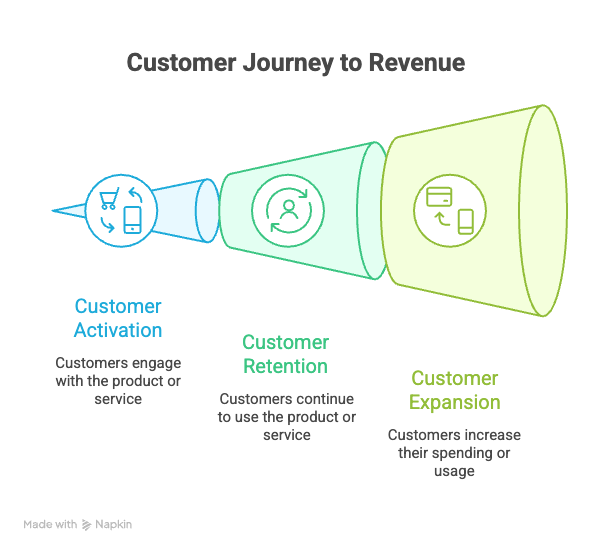
The most effective SaaS forecasting systems combine several data sources into a structured model. A practical forecasting framework typically includes five steps.
First, forecast acquisition. Estimate how many new customers will enter the funnel through marketing and sales efforts.
Second, forecast activation. Determine how many new users will successfully adopt the product and convert into paying customers.
Third, forecast retention. Analyze how long customers typically remain subscribed.
Fourth, forecast expansion. Estimate how much additional revenue will be generated through upgrades, add ons, or seat expansion.
Finally, combine these inputs to estimate total recurring revenue.
When structured correctly, this framework provides a clear view of how operational improvements translate into financial outcomes.
Why most SaaS forecasts are wrong
Rarely because the arithmetic is bad. They are wrong because the model assumes a product capability that does not exist yet, or a sales motion that has never been repeated. The spreadsheet is downstream of the roadmap, and it inherits whatever optimism the roadmap carries.
“Sales teams tend to sell the ‘dream’ to hit their targets, often promising features that only exist on paper.”
Sivan Kadosh, Fractional CPO
Despite having access to large amounts of data, many SaaS companies struggle to produce reliable forecasts.
One common problem is leadership optimism bias. Founders and executives often assume that growth will accelerate faster than historical data suggests.
Another issue is pipeline inflation. Sales teams may overestimate deal probabilities, which artificially inflates expected revenue.
Retention volatility also creates forecasting challenges. Small shifts in churn rates can significantly alter long term revenue projections.
Expansion revenue is another frequent source of error. Many companies assume aggressive upsell behavior without validating whether customers actually expand at those rates.
Finally, forecasting often becomes disconnected from product strategy. If product investments fail to improve retention or expansion, revenue projections quickly become unrealistic.
In many cases, forecasting failures are not mathematical problems. They are strategic alignment problems.
How product strategy influences SaaS forecasting
Every forecast line has a product precondition somewhere behind it. Expansion revenue assumes features that make expansion natural; retention assumes the value keeps landing. When the roadmap changes and the model does not, the two documents start describing different companies and only one of them is being funded.
Product strategy has a direct impact on forecasting accuracy. Every product decision influences the metrics that forecasting models depend on.
For example, improvements in onboarding can increase activation rates. Better feature adoption can improve retention. New pricing tiers can increase expansion revenue.
When product teams deliver meaningful improvements in these areas, the effects cascade through the forecasting model.
Conversely, if the product roadmap focuses on features that do not improve customer outcomes, forecasts become increasingly disconnected from reality.
For this reason, SaaS forecasting should never be treated purely as a financial exercise. It must remain tightly linked to product strategy and customer behavior.
How does forecasting change by stage?
Early on there is not enough history for cohorts to mean anything, so the forecast is mostly assumption and should be labeled as such. As the base grows, retention becomes the dominant input and confidence rises. At scale the question shifts from whether the model is right to how fast it can be corrected.
Forecasting practices evolve as SaaS companies mature. Early stage startups often operate with limited historical data, while mature companies can rely on statistical models.
| Stage | Forecasting approach | Main challenge |
|---|---|---|
| Seed | Founder intuition and early signals | Limited historical data |
| Series A | Pipeline and cohort forecasting | Unpredictable growth patterns |
| Series B | Multi model forecasting | Scaling operations |
| Mature SaaS | Statistical forecasting models | Optimization and efficiency |
Understanding these stages helps leadership teams choose forecasting methods that match their data maturity.
Which tools help with SaaS forecasting?
A spreadsheet is enough for longer than most founders expect, and it stays enough until several people need to change the model at once. Tooling helps with version control and cadence rather than accuracy, because the accuracy problem lives in the assumptions, not in the arithmetic.
Several tools can support forecasting efforts, but tools alone do not guarantee accurate predictions.
Many SaaS companies begin with spreadsheet models that combine revenue metrics, pipeline data, and cohort analysis. As companies grow, they often adopt financial planning platforms or business intelligence tools that automate data collection and modeling.
Product analytics platforms also play an important role. They help teams understand how user behavior influences retention and expansion, which improves forecasting accuracy.
The most effective forecasting systems integrate data across product, finance, sales, and customer success.
When SaaS companies should bring in a fractional CPO
When the model and the roadmap have stopped agreeing and nobody owns the reconciliation. That is not a finance gap; it is a question of whether the product can deliver what the spreadsheet already promised, and answering it honestly usually needs someone with no stake in the answer.
Forecasting challenges often emerge when product strategy and revenue expectations become misaligned.
Companies frequently bring in a fractional Chief Product Officer when growth forecasts consistently miss targets or when leadership teams cannot clearly explain the drivers behind revenue projections.
A fractional CPO helps connect product metrics with financial outcomes. By analyzing customer behavior, retention patterns, and expansion opportunities, they can build forecasting models that reflect the true dynamics of the business.
They also help align product roadmaps with revenue objectives. Instead of guessing how product changes will affect growth, leadership teams gain structured models that link product initiatives to measurable revenue impact.
For many SaaS companies, this strategic alignment dramatically improves forecast reliability.
Improve SaaS forecasting with fractional CPO leadership
The gain comes from tightening the link between what is planned and what is committed, not from a better model. A forecast built on capabilities that exist, with assumptions written down and revisited monthly, beats a more sophisticated one resting on wishes every time.
Many SaaS organizations struggle with forecasting not because they lack data, but because their product, growth, and revenue strategies are not aligned.
A fractional Chief Product Officer helps leadership teams build forecasting systems that connect operational metrics with financial outcomes.
This includes designing SaaS growth models, improving retention drivers, and aligning product roadmaps with revenue objectives. The result is a forecasting system that reflects the real dynamics of the business rather than optimistic assumptions.
If your company regularly misses its revenue forecasts or struggles to explain its growth drivers, fractional CPO leadership can provide the strategic clarity needed to build predictable SaaS growth.
Lucky for you, we offer the best fractional CPO services in the field.
Forecast built on features that do not exist yet?
Get a senior, ex-CPO read on your biggest product bottleneck in 30 focused minutes. No pitch, no obligation.
Book a strategy callKey takeaways
- SaaS forecasting predicts future revenue by analyzing recurring revenue metrics, customer retention, expansion patterns, and sales pipeline performance.
- Reliable forecasts allow SaaS companies to plan hiring, product investments, and growth strategies with confidence.
- The most effective forecasting systems combine financial modeling with product and customer insights.
- Many forecasting failures stem from strategic misalignment rather than insufficient data.
- Companies that connect product strategy with revenue forecasting significantly improve growth predictability.
I am the one who decides what gets cut. Frameworks rank the list. Someone still has to say no out loud.
See how a product strategy engagement runs →FAQs
What is SaaS forecasting?
SaaS forecasting is the process of predicting future revenue and growth using metrics such as recurring revenue, churn rate, expansion revenue, and sales pipeline performance.
Why is forecasting important for SaaS companies?
SaaS forecasting helps SaaS companies plan hiring, product investments, and growth strategies while providing investors with confidence in the company’s ability to generate predictable revenue.
What metrics are most important for SaaS forecasting?
Key metrics for SaaS forecasting include MRR, ARR, churn rate, expansion revenue, net revenue retention, and customer acquisition cost.
How accurate should SaaS forecasts be?
Well operated SaaS companies typically forecast within five to ten percent of actual revenue, although accuracy varies depending on company stage and data maturity.
Who is responsible for SaaS forecasting?
Forecasting is usually owned by finance or revenue operations teams, but product leadership plays a critical role because product decisions directly affect retention and expansion revenue.
What clients say
Read all 18 references“As a product manager, I can say that Sivan is very professional – always looking deeply on the discussed feature to understand end to end its effect on the whole product, and as well the eager to understand what would be the added value to the strategy of the company. Nothing was added without a clear scope of development, a clear understanding of the business owner and a clear way to measure the success or failure of this feature.”
“Leading by example, empowering, mentoring, and growing his product teams, he created great product culture and set us Product Managers up for success. His vision and strategic direction enabled us to create successful products that brought millions of dollars of revenue to the company and its clients.”
“As part of his role as VP Product, he identified creative ideas, developed sharp strategies and built the road map while focusing on customer experience and business needs.”