Why Churn Spikes After Early Growth (And How to Stop the Bleeding)
January 26, 2026 • 9 min read
Last Updated on February 18, 2026 by Sivan Kadosh
A few years ago, I advised a promising startup that had just crossed the $5M ARR mark and entered the ‘Hyper-Growth’ phase. On paper, everything looked incredible: a successful raise, dozens of new hires, and shiny new offices. But if you haven’t lived through this transition, it’s hard to grasp the hidden costs of rapid scaling. The abrupt shift from a chaotic, family-like ‘Startup Mode’ to a machine driven by rigid KPIs and aggressive revenue pressure fundamentally altered the company’s DNA.
This tension didn’t stay in the boardroom; it trickled down directly to the product. We saw the impact on the charts in the most painful way possible: Churn, which had been a negligible 2-3%, spiked to a dangerous 7-8% in just eight months. Back then, the founders blamed the market. Today, we know it was a classic example of why startups fail to scale. In this article, we’ll analyze exactly why this happened – from Persona Drift to sales pressure – and how you can stop your growth from killing your retention.
The uncomfortable truth is that the very strategies that fueled your early growth are the exact ones now poisoning your retention. To fix it, you have to stop looking at churn as a “leaky bucket” and start seeing it as a structural debt problem.
Key Takeaways
- The Founder Mirage: Early low churn is often “faked” by high-touch founder intervention and early-adopter patience, which doesn’t scale to the “Early Majority.”
- The Complexity Tax: Adding features for enterprise deals creates a “cognitive load” that drives away the core users who provided your initial growth.
- Incentive Misalignment: Aggressive sales quotas often lead to “Adjacent Persona Selling” – signing customers who don’t actually fit the product.
- The “Aha Moment” Atrophy: As products grow more complex, the time it takes for a new user to find value (TTV) increases, leading to a spike in Day-30 churn.
- Operational Debt: Replacing human relationships with automated processes creates a “transactional” feeling that lowers the barrier for a customer to switch to a competitor.
The Pioneer Fallacy: Why your early low churn was a mirage
Most founders believe their early low churn was a validation of their product-market fit. In many cases, it was actually a validation of their personal charisma.
In the “Seed to $1M” stage, your customers are Pioneers. These are people who take pride in finding “the next big thing.” They have a high tolerance for bugs because they feel like “partners” in your journey. If the product breaks, they don’t cancel; they Slack the founder.
During this phase, you are likely providing “Founder-Led Success.” You are doing things that don’t scale: manually migrating their data, building custom integrations on the fly, and giving them “insider” access to the roadmap.
Our tip: also read about the founder bottleneck.
Stop guessing. Start calculating.
Access our suite of calculators designed to help SaaS companies make data-driven decisions.
Free tool. No signup required.
The Spike: When you scale to the $5M ARR mark, you stop being a “partner” and start being a “vendor.” Your new customers aren’t Pioneers; they are Settlers. Settlers don’t care about your vision; they care about their Tuesday morning productivity. When the product breaks, they don’t Slack the founder, they look for a “Cancel” button.
The spike happens because you have transitioned from a “High-Touch/High-Tolerance” customer base to a “Low-Touch/Zero-Tolerance” customer base without adjusting your product’s “Self-Service” capabilities. You are trying to serve “Settlers” with a “Pioneer” product.
| Dimension | Pioneer customers (early adopters) | Settler customers (early majority) |
| Motivation | Want to discover “the next big thing” and influence how it is built | Want a reliable tool that solves a specific job with minimal effort |
| Tolerance for bugs | High tolerance, bugs are seen as part of the journey | Near zero tolerance, bugs are blockers, not inconveniences |
| Support expectations | Direct access, fast, informal, often founder-led | Predictable, documented, self-serve first, escalation only when needed |
| Buying reason | Belief in the vision and relationship with the team | Confidence that the product works out of the box today |
| Cancellation trigger | Loss of personal connection or perceived momentum | Any friction that slows down daily work or creates uncertainty |
The Persona Drift: The Silent Killer of Product Clarity
When a startup is small, the Ideal Customer Profile (ICP) is razor-sharp. You solve Problem X for User Y.
As you scale, the pressure to maintain a 3x growth rate forces you to widen the net. Marketing starts targeting “adjacent” personas. Sales starts saying “Yes” to feature requests from companies that are slightly outside your core focus.
This leads to Persona Drift. Suddenly, your product is being used by people for whom it wasn’t originally built. These users encounter “frictional churn.” They aren’t leaving because the product is bad; they are leaving because the product is confusing.
As shown in the “Crossing the Chasm” model, the gap between early adopters and the early majority is where most companies fail. The “Early Majority” (Settlers) requires a “Whole Product” experience, documentation, stability, and intuitive UI, whereas the early adopters only required the “Core Technology.” If you haven’t built the “Whole Product” by the time you start spending $100k/month on ads, your churn will explode.
The “Sales Quota” churn trap
If you want to find the root cause of your churn spike, don’t look at your product roadmap, look at your Sales Commission structure.
When you hire a professional sales team, their incentive is to “Close the Deal.” In the early days, the founder was the salesperson. If a prospect wasn’t a good fit, the founder would say “no,” because they knew a bad-fit customer would be a nightmare for the engineering team. A sales rep with a quarterly quota rarely has that luxury.
This creates the Sales-Success Gap:
- Sales: Sells the “Future State” (what the product will do in 6 months).
- Success: Inherits the “Current State” (what the product actually does today).
When the customer realizes they were sold a “vision” rather than a “utility,” they churn within the first 90 days. If your churn is spiking in the “Early Lifecycle” (Months 1-3), you don’t have a product problem; you have an Expectation Management problem at the point of sale.
The complexity tax and the death of the simple workflow
There is a dangerous myth in SaaS: The more features we have, the more reasons a customer has to stay. In reality, the more features you have, the more cognitive load you place on the user.
Early-stage growth is usually driven by a “Killer Feature”, one thing you do better than anyone else. As you scale, you begin to add “Supportive Features” to satisfy enterprise RFPs. Over time, these Supportive Features start to bury the Killer Feature.
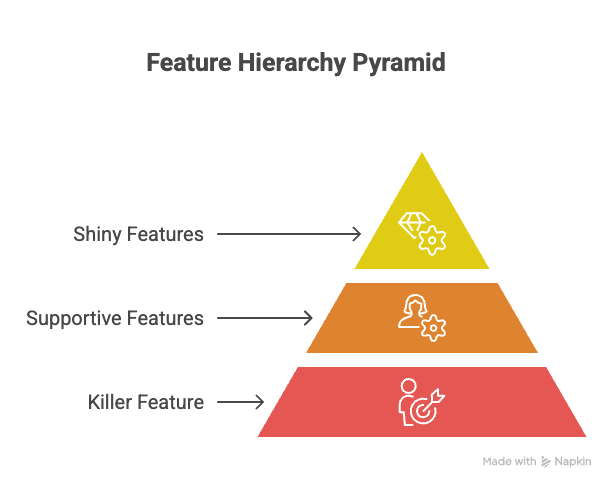
This is “Feature Fatigue.” New users log in and see a dashboard with 40+ buttons when they only came to use two. They feel overwhelmed, they don’t know where to start, and they never reach the “Aha! Moment.”
Furthermore, as you scale, your engineering team often shifts from “Value Creation” to “Value Maintenance” (fixing bugs, scaling infrastructure). This means the core workflows, the ones people actually pay for, often sit stagnant while the team chases “Shiny Objects” to appease the Board. When the core experience starts to feel “stale” compared to a new, nimble competitor, your “Late Stage” churn (Month 12+) will spike.
The operational debt of scaling support
In the early days, support was a competitive advantage. It was fast, personal, and human. As you scale, you implement “Systems.” You hire junior support reps. You use “Templates.” You implement “Ticket Deflection” bots.
While this is necessary for margins, it results in the Erosion of the Relationship. Customers who used to feel “seen” now feel like “Ticket #4852.”
As the graph above illustrates, there is a point where your acquisition rate (the blue line) is eventually neutralized by your churn rate (the red line). This is the Growth Ceiling. If your churn spikes because your support has become too transactional, you will hit this ceiling much sooner, regardless of how much you spend on marketing.
The Recovery Plan: How to reverse the spike
To fix a post-growth churn spike, you must stop “fighting” the churn and start “re-engineering” the growth engine.
Step 1: Segment churn by “Acquisition Cohort”
Stop looking at your “Blended Churn Rate.” It’s a vanity metric that hides the truth. Instead, look at churn by:
- Lead Source: Did they come from a LinkedIn Ad or a Referral? (Referrals usually have 50% lower churn).
- Sales Rep: Does one rep have a 20% higher churn rate than the others? If so, they are “overselling.”
- Product Version at Signup: Did users who joined after the “Big V3 Launch” churn faster? If so, your UI update likely broke a core workflow.
Step 2: Implement “Sales-to-Success” clawbacks
If a customer churns within the first 90 days, the sales rep should lose their commission. This sounds harsh, but it is the only way to align the incentives of the sales team with the long-term health of the company. It forces Sales to become “Guardians of the ICP” rather than “Closers of the Contract.”
Step 3: The “Minimum Viable Onboarding” (MVO) reset
Audit your onboarding process. If it takes more than 3 clicks to reach your “Aha! Moment,” it’s too long.
- Remove the “Tour”: Nobody reads tooltips. They click “Next” until they disappear.
- Focus on the “First Win”: What is the one thing the user can do in 60 seconds that makes them feel powerful?
- Hide Complexity: Use “Progressive Disclosure.” Keep the advanced features hidden until the user has mastered the basics.
Step 4: The “Success-Led” roadmap
Stop letting Sales or the Board dictate 100% of the roadmap. Give 30% of your engineering capacity to the Customer Success team. Let them prioritize the “Paper Cuts”, the small, annoying bugs that don’t make it into a Sales demo but make daily users want to pull their hair out.
Step 5: “Anti-Churn” pricing
Often, churn spikes because your pricing is “Flat.” If a user pays $100/month whether they use 1% or 100% of the product, the 1% user will always feel like they are overpaying. Move toward Value-Based Pricing (per seat, per lead, per GB). When the price scales with the value, the incentive to “Cancel” disappears because the cost is always proportional to the utility.
Conclusion
A spike in churn after a period of rapid growth is rarely a sign that your product has suddenly become “bad.” Instead, it is a signal that your company has outgrown its initial operating system. The “Founder-Led” magic that got you to $2M ARR is the very thing that creates a bottleneck at $10M ARR.
To survive the Scale Chasm, you must move from a culture of Acquisition at all costs to a culture of Retention by design. This means aligning your sales incentives with customer success, ruthlessly simplifying your user experience, and acknowledging that your “New” customers require a much higher standard of product excellence than your “Old” ones.
If you don’t fix the structural debt now, no amount of marketing spend will save you from the growth ceiling.
Ready to audit your retention?
If your churn is creeping up and you’re not sure if it’s a product, sales, or persona problem, our fractional CPO services can help you find the “leak.”

Sivan Kadosh is a veteran Chief Product Officer (CPO) and CEO with a distinguished 18-year career in the tech industry. His expertise lies in driving product strategy from vision to execution, having launched multiple industry-disrupting SaaS platforms that have generated hundreds of millions in revenue. Complementing his product leadership, Sivan’s experience as a CEO involved leading companies of up to 300 employees, navigating post-acquisition transitions, and consistently achieving key business goals. He now shares his dual expertise in product and business leadership to help SaaS companies scale effectively.