
PLG SaaS is a go-to-market strategy where the product does the selling, letting users reach value before anyone talks to them. In practice almost no company runs it alone. The versions that scale pair self-serve adoption with a sales motion that picks up where the product stops.
I have taken products from nothing to launch. If the build is almost done and nobody owns the launch, that is where I come in.
See how a product launch engagement runs →The illusion of 100% PLG: Why the human touch is the real secret to SaaS scale
Pure product-led growth makes a better conference talk than an operating model. Somewhere above a certain deal size a human has to answer the question the pricing page cannot, and the companies that scale are the ones that decided in advance where that handover happens rather than discovering it in a lost deal.
About 20 years ago (give or take), the cloud revolution began. I remember the exact moment it reached the organization I was working for at the time: we had just purchased data center equipment for about a million dollars, and then the consulting firm advising us on building the data center suggested we handle our DRP (Disaster Recovery Plan) in the cloud. That was the first time I encountered the term. Why am I telling you this? Because the shift to working in remote, leased data centers essentially brought the promise of scale. Suddenly, any organization could scale relatively easily, and scale is where the big money is.
We all aspire to build the next Slack or Airbnb, so the technical element is mostly solved. However, the element of acquiring customers at a massive scale remains an art that not many product managers have mastered. From frictionless registration, through onboarding that delivers an initial “WOW” and showcases early value, to the exact right moment to allow the customer to purchase a subscription, all of this is called PLG, or Product-Led Growth.
If I’m being honest, I have yet to see an organization where Product-Led Growth is responsible for 100% of customer acquisition, nor do I think that is a healthy state for a company. I believe there is a lot of money to be made with the human touch. The pattern in the field certainly backs this up: the most successful PLG companies almost all end up operating a hybrid model that includes sales teams. Companies that combine a self-serve product experience with proactive human interaction tend to grow faster than those relying on either alone. It is no coincidence that industry experts have already determined that to generate real growth and close significant deals, companies must adopt a combined strategy (Product-Led Sales) that translates product data into targeted human sales actions.
Right on this seam, the smart integration between a product that sells itself and the human touch that closes the big deals, lies the secret to success. In the following article, I will explore PLG in depth, break down the components that create a true growth engine for SaaS companies, and explain how to do it right.
What does product-led growth mean in SaaS?
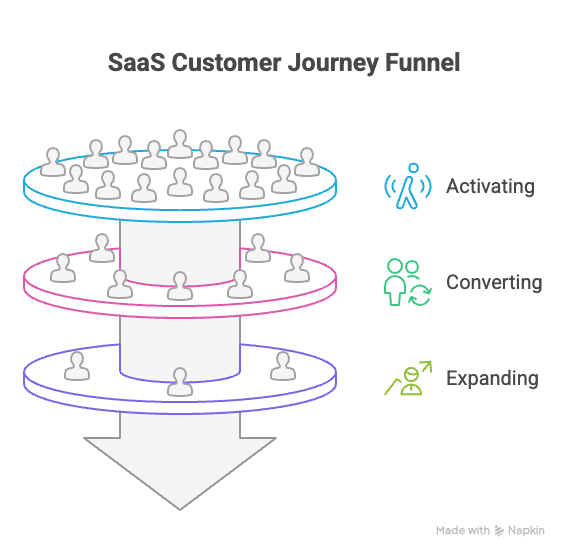
A go-to-market strategy where the product itself does the acquiring, activating and expanding. Users try before they talk to anyone, and the job of marketing and sales shifts from persuading to removing obstacles. The product has to be able to explain itself without a demo, which is a much higher bar than it sounds.
“Product-Led Growth, often referred to as PLG, is a go-to-market strategy where the product itself drives acquisition, activation, and expansion.”
Sivan Kadosh, Fractional CPO
PLG SaaS refers to software companies that use their product as the primary driver of growth. Instead of relying heavily on marketing campaigns or sales outreach, these companies allow users to discover, try, and adopt the product independently.
This does not mean that sales or marketing disappear. It means that the product becomes the central piece of the growth engine.
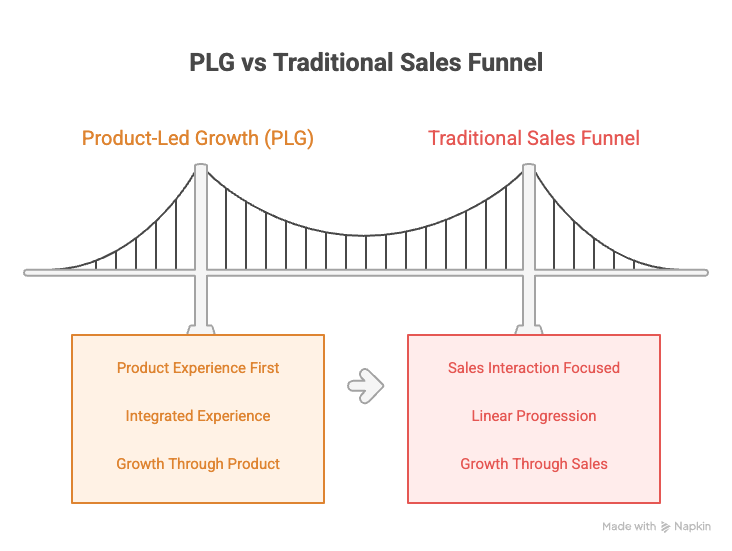
In traditional sales-led models, users often go through demos, calls, and negotiations before they can fully understand the product. In PLG, that process is reversed. Users interact with the product first, form an opinion based on real usage, and then decide whether it is worth paying for.
This shift changes how companies think about growth. The focus moves from convincing users to try the product to helping them experience value as quickly as possible.
In many cases, the biggest barrier to adoption is not awareness, it is friction. The easier it is for users to get started and understand what the product does for them, the more likely they are to continue using it.
Why does PLG work in SaaS?
Because buyers now prefer to evaluate software the way they evaluate everything else, by trying it. A product that proves its value in the first session shortens the sales cycle and lowers acquisition cost at the same time, which is the rare combination that actually compounds.
SaaS products are inherently well suited for PLG because they are accessible, scalable, and measurable. Users can sign up instantly, interact with the product in real time, and generate data that helps teams understand behavior.
One of the main advantages of PLG is efficiency. When the product drives acquisition and conversion, the cost of acquiring customers often decreases. Instead of investing heavily in outbound sales, companies can rely on product usage to generate demand.
Another advantage is speed. Users do not need to wait for demos or approvals. They can explore the product at their own pace and decide whether it fits their needs.
However, the biggest benefit is insight. When users interact with the product early, teams gain direct visibility into how people use it. This creates a feedback loop that helps improve both the product and the growth strategy.
In several projects I have worked on, the most valuable insights did not come from surveys or interviews, but from observing how users behaved during their first session. Where they hesitated, where they clicked, and where they dropped off often revealed more than anything they could articulate.
PLG works because it turns user behavior into the foundation of growth.
What are the core components?
A free entry point that reaches real value, an onboarding path that gets people there quickly, usage data good enough to see who is succeeding, and pricing that grows with adoption. Miss the data layer and the rest becomes guesswork, because you cannot follow up on a signal you never captured.
“It is about designing a product experience that clearly communicates value, reduces friction, and encourages users to move forward naturally.”
Sivan Kadosh, Fractional CPO
A strong PLG strategy is not built around a single tactic like a free trial or a freemium plan. It is the result of several elements working together to create a seamless experience where users can discover, understand, and realize value without external pressure. When these components are aligned, the product effectively becomes the primary driver of growth.
At the foundation is self-serve onboarding. Users need to be able to start using the product immediately, without waiting for approvals, demos, or support. This does not mean removing guidance entirely, but rather designing the experience so that users always know what to do next. The goal is to reduce hesitation and make the first interaction feel intuitive rather than overwhelming.
Closely connected to this is time to value. This is often the most critical moment in the entire journey. If users can quickly achieve something meaningful, even if it is a small win, they are far more likely to continue. If that moment is delayed or unclear, drop-off rates increase significantly. In practice, improving time to value usually comes down to simplifying onboarding flows and focusing on the one action that best demonstrates the product’s core benefit.
Most PLG companies also rely on some form of free access, whether that is a freemium model or a time-limited trial. The purpose is not simply to remove pricing friction, but to give users enough exposure to understand why the product matters. When done well, users reach a point where upgrading feels like a logical next step rather than a forced decision.
The product experience itself plays a central role in tying everything together. In a PLG model, the product must communicate value clearly without relying on external explanations. This includes how the interface is structured, how features are introduced, and how users are guided toward meaningful actions. If users need extensive documentation or support to understand the product, the experience is not yet optimized for PLG.
Finally, expansion needs to be designed intentionally. Growth does not stop at conversion. The most successful PLG companies create natural paths for users to deepen their usage over time, whether by adding more users, unlocking additional features, or increasing usage volume. When expansion aligns with how customers derive value, it feels like progress rather than upselling.
Taken together, these components form a system. If one part is weak, the entire experience suffers. But when they work together, the product becomes capable of driving growth on its own, without relying heavily on external push.
Which PLG metrics matter?
Activation rate first, then time to value, then the share of expansion that happens without anyone asking. Signup counts flatter a PLG motion more than any other model, so they are the number most worth distrusting when the dashboard looks healthy and revenue does not follow.
Understanding whether a PLG strategy is working requires more than tracking signups or traffic. The real signal comes from how users behave once they enter the product. Metrics in a PLG environment are closely tied to user progress, not just acquisition volume.
| Metric | What it measures | Why it matters |
|---|---|---|
| Activation rate | Percentage of users reaching first value | Shows onboarding effectiveness |
| Time to value | Speed of first meaningful outcome | Indicates friction in early experience |
| Retention rate | Continued product usage over time | Reflects sustained value |
| Net revenue retention | Expansion within existing accounts | Measures long term scalability |
| Conversion rate | Free to paid transition | Indicates monetization alignment |
Among these, activation tends to be the most overlooked and the most impactful. Many teams focus on conversion too early, trying to push users toward paid plans before those users have fully understood the product. In practice, conversion improves naturally once users reach a clear moment of value. When that moment is missing or delayed, no pricing tweak or sales effort will compensate for it.
Another pattern that becomes obvious over time is how interconnected these metrics are. Improving onboarding does not just affect activation, it influences retention, which in turn affects expansion. PLG works as a system, and metrics should be interpreted in that context rather than in isolation.
How does PLG compare with sales-led?
Sales-led puts a person in front of the buyer early and carries the cost of that from the first conversation. PLG defers the person until the product has done its work. The real question is not which to pick but where the handover sits, and that answer moves as deal sizes grow.
While PLG and sales-led approaches are often presented as opposites, in reality they represent different ways of guiding users toward value. The difference lies in where the primary momentum comes from.
| Aspect | PLG | Sales-led |
|---|---|---|
| Acquisition | Product-driven | Sales-driven |
| Conversion | Self-serve | Sales-assisted |
| Scalability | High | Moderate |
| CAC | Lower | Higher |
In a sales-led model, the company plays an active role in moving the customer forward through demos, calls, and negotiations. In a PLG model, the product takes on that role. Users explore at their own pace, forming their own understanding of value before engaging further.
That said, most SaaS companies do not operate at one extreme. Hybrid models are increasingly common. The product handles initial adoption, while sales teams support larger accounts or more complex use cases. This combination allows companies to maintain scalability while still capturing high-value opportunities.
In practice, the decision is less about choosing one model and more about deciding where human interaction adds the most value. For simple use cases, the product should lead. For more complex scenarios, sales can step in at the right moment.
How do you implement PLG?
Start by finding the moment users actually get value and shortening the path to it. Everything else follows from that measurement. Teams that begin with a free tier before knowing what value looks like end up giving away the product to people who were never going to convert.
Implementing PLG is less about introducing something new and more about removing what gets in the way. It requires looking at the product through the lens of a first-time user and asking where confusion or friction might exist.
The starting point is defining the activation moment. This is the point where users first experience real value. It might be completing a key action, seeing a result, or achieving a specific outcome. Without clarity on this moment, onboarding becomes generic and unfocused. Once it is defined, everything in the early experience should guide users toward it.
Onboarding itself often benefits more from simplification than expansion. It is tempting to explain every feature upfront, but that usually creates overload. A more effective approach is to focus on one clear path that leads to value quickly. Additional features can be introduced later, once users are more comfortable.
Pricing also needs to align with how users experience the product. If pricing introduces uncertainty or feels disconnected from usage, it can slow down adoption. Clear, predictable pricing helps users move forward with confidence. In many cases, small adjustments in how pricing is presented can remove hesitation without changing the underlying structure.
Behavioral data plays a central role in refining the strategy. Observing how users interact with the product often reveals where they struggle or drop off. These insights are more reliable than assumptions because they reflect actual usage. Iteration then becomes a continuous process, where small improvements compound over time.
What goes wrong with PLG?
Treating a free tier as a strategy rather than a mechanism. Instrumenting nothing and then wondering which users are worth a call. And refusing to add sales on principle, long after the deals being lost have grown large enough to pay for the people who would have won them.
One of the most common misconceptions is that PLG simply means offering a free trial or a freemium plan. While free access can support adoption, it does not guarantee that users will experience value. Without a clear path to activation, many users sign up and never return.
Another frequent issue is overcomplicating onboarding. When users are presented with too many choices too early, they often hesitate or abandon the process altogether. Clarity is more important than completeness in the early stages.
Pricing can also become a source of friction. If users cannot easily understand how they will be charged or what they gain from upgrading, they tend to delay decisions. This is particularly true for usage-based models without clear visibility into costs.
Some teams also assume that more features will naturally drive growth. In reality, adding features without improving usability often increases complexity and reduces clarity. Growth in PLG environments usually comes from refining the experience rather than expanding it.
How PLG evolves as companies scale
Early on the product carries almost everything and a small team handles the exceptions by hand. As deal sizes grow the exceptions become a segment, and that segment needs a defined motion rather than goodwill. What changes is not whether you have sales, but how deliberately the handover is designed.
PLG strategies are not static. As companies grow, both the product and the customer base become more complex, which requires adjustments in how growth is driven.
| Stage | PLG focus | Priority |
|---|---|---|
| Early stage | Onboarding | Activation |
| Series A | Conversion | Monetization |
| Series B | Expansion | Retention |
| Enterprise | Hybrid model | Optimization |
In the early stages, the primary focus is helping users reach value quickly. Once activation improves, attention shifts toward converting users into paying customers. As the company scales further, expansion and retention become more important, since existing customers represent a large share of revenue growth.
At later stages, many companies introduce hybrid elements, combining PLG with sales support for larger accounts. This allows them to maintain the efficiency of PLG while capturing more complex opportunities.
The key is recognizing that what works at one stage may not be sufficient at the next. Adapting the strategy over time is part of making PLG sustainable.
How PLG influences product strategy
PLG pushes work that used to sit with sales into the roadmap. Onboarding, empty states, in-product guidance and permissioning stop being polish and become revenue infrastructure. That reordering is the part organizations underestimate, because it changes what the product team is accountable for.
PLG fundamentally changes how product decisions are made. Instead of building features based primarily on requests or assumptions, teams begin to focus on how each change affects user behavior. The goal is not just to add functionality, but to help users move forward more easily within the product.
This often leads to a shift in priorities. Improving onboarding, simplifying workflows, and guiding users toward meaningful outcomes become more important than expanding the feature set. Features are evaluated based on whether they help users reach value faster or use the product more effectively.
It also changes how success is measured. Rather than tracking output, such as features released, teams focus on outcomes like activation rates, retention, and expansion. This creates a stronger connection between product work and business performance.
Over time, this approach leads to more focused development. Teams spend less effort on low-impact features and more on improvements that directly influence growth.
When to involve a fractional CPO in your PLG strategy
When the motion is half-built and nobody owns the seam between product and sales. Deciding where self-serve stops, what triggers a human, and who is measured on the handover is a leadership call rather than a feature, and it is usually cheaper to rent that judgment once than to hire for it.
As PLG becomes more central to growth, the need for alignment across teams increases. Product, growth, marketing, and customer success all influence the user journey, and misalignment between these functions can create friction.
A fractional Chief Product Officer can help bring structure to this complexity. By looking at the product from a strategic perspective, a fractional CPO helps define activation, align onboarding with value delivery, and ensure that pricing supports user behavior rather than blocking it.
Another benefit is objectivity. When teams work closely on a product, it can be difficult to see where users struggle. An external perspective often highlights gaps that were not obvious internally, especially in early user interactions.
In practice, this often leads to faster iteration cycles and more focused improvements. Instead of spreading effort across multiple initiatives, teams can concentrate on the areas that have the greatest impact.
Build a product-led growth engine that scales
A durable engine is not the free tier and not the sales team, it is the connection between them. Instrument what users do, define the moment that warrants a conversation, and let the product qualify people before anyone reaches out. That is the version that keeps working as the deals get larger.
PLG is often described as a growth model, but in reality, it reflects how clearly a product delivers value. When users can quickly understand what the product does and how it helps them, growth becomes a natural outcome rather than something that needs to be forced.
The challenge is designing that clarity into the experience. It requires understanding what matters most to users, removing friction from the journey, and guiding them toward meaningful outcomes. This is not something that happens by accident. It requires deliberate design and continuous refinement.
A senior product leader can help connect these elements, ensuring that product decisions support both user experience and business goals. By aligning onboarding, pricing, and expansion, companies can create growth systems that scale efficiently over time.
In the end, the strongest PLG companies are not the ones with the most features or the most aggressive acquisition strategies. They are the ones where the product simply makes sense from the first interaction.
Fortunately for you, we offer these exact services here at SaaS Fractional CPO.
Free tier busy, revenue flat?
Get a senior, ex-CPO read on your biggest product bottleneck in 30 focused minutes. No pitch, no obligation.
Book a strategy callKey takeaways
- PLG SaaS uses the product as the primary growth driver, reducing reliance on traditional sales processes.
- Activation and time to value are critical for success, as they determine whether users continue engaging with the product.
- Strong PLG strategies align onboarding, pricing, and product experience to support user progression.
- Growth typically comes from refining existing experiences rather than adding complexity.
- Continuous iteration based on real user behavior is essential for long term scalability.
I have taken products from nothing to launch. Plans read well. Launch weeks are where they break.
See how a product launch engagement runs →FAQs
What is PLG SaaS?
PLG SaaS, or Product-Led Growth SaaS, is a growth strategy where the product itself drives user acquisition, activation, conversion, and expansion. Users can sign up, use the product, and experience value without needing to interact with sales. The product becomes the primary channel for growth by guiding users from first use to paid adoption through its own experience.
What are examples of PLG companies?
Examples of PLG companies include tools like Slack, Notion, Dropbox, and Figma. These products allow users to start using the core functionality immediately, often through freemium or free trial models. Growth happens as users experience value, invite others, and expand usage within teams, rather than relying primarily on sales outreach.
How does PLG differ from sales-led SaaS?
PLG differs from sales-led SaaS in how users move through the buying process. In PLG, users explore and adopt the product independently, and conversion happens based on product experience. In sales-led models, users typically go through demos, calls, and negotiations before gaining full access. PLG is more scalable and lower cost, while sales-led is often better suited for complex or high-ticket products.
What metrics matter in PLG?
The most important PLG metrics are activation rate, time to value, retention rate, conversion rate, and net revenue retention. Activation measures how many users reach their first meaningful outcome. Time to value shows how quickly that happens. Retention indicates ongoing product value, while conversion and net revenue retention measure monetization and expansion within existing users.
Is PLG right for every SaaS?
PLG is not suitable for every SaaS product. It works best for products that can deliver value quickly, require minimal setup, and can be used without heavy customization or onboarding. Products that are complex, require deep integration, or depend on high-touch sales processes may benefit more from a hybrid or sales-led approach.
What clients say
Read all 18 references“As a product manager, I can say that Sivan is very professional – always looking deeply on the discussed feature to understand end to end its effect on the whole product, and as well the eager to understand what would be the added value to the strategy of the company. Nothing was added without a clear scope of development, a clear understanding of the business owner and a clear way to measure the success or failure of this feature.”
“Leading by example, empowering, mentoring, and growing his product teams, he created great product culture and set us Product Managers up for success. His vision and strategic direction enabled us to create successful products that brought millions of dollars of revenue to the company and its clients.”
“As part of his role as VP Product, he identified creative ideas, developed sharp strategies and built the road map while focusing on customer experience and business needs.”
