The Hostage Situation: Why Non-Technical CEOs Need a CPO to Challenge Engineering
January 6, 2026 • 7 min read
Last Updated on February 18, 2026 by Sivan Kadosh
Your CTO looks across the table and sighs. “The legacy code is a mess. We can’t build that feature until we do a total rewrite of the backend. It will take six months.”
Your Lead Developer chimes in on Zoom. “Actually, that specific request is technically impossible with our current stack. The API doesn’t support it.”
You nod along. You approve the delay. You accept the “no.” Why? Because you don’t have the technical authority to push back. You are effectively a hostage in your own company, writing checks for a roadmap you no longer control.
This is the “Black Box” problem. Money and requirements go in; excuses and delays come out. And because you can’t read the code, you can’t audit the reality.
It is time to bring in a negotiator who speaks their language.
Key takeaways
- The Power Imbalance: Without technical fluency, CEOs default to trusting engineers who naturally prioritize code aesthetics over business speed.
- Resume-Driven Development: Your team might be building with complex, trendy tools (like Kubernetes or Microservices) to pad their resumes, slowing your velocity.
- The “Rewrite” Bluff: Engineers love rewrites because they are “clean.” Business leaders should almost always reject them in favor of incremental refactoring.
- The Translation Layer: A CPO breaks the “hostage” dynamic by turning vague business goals into rigid technical specs, removing the room for interpretation.
It’s not malice, it’s misalignment
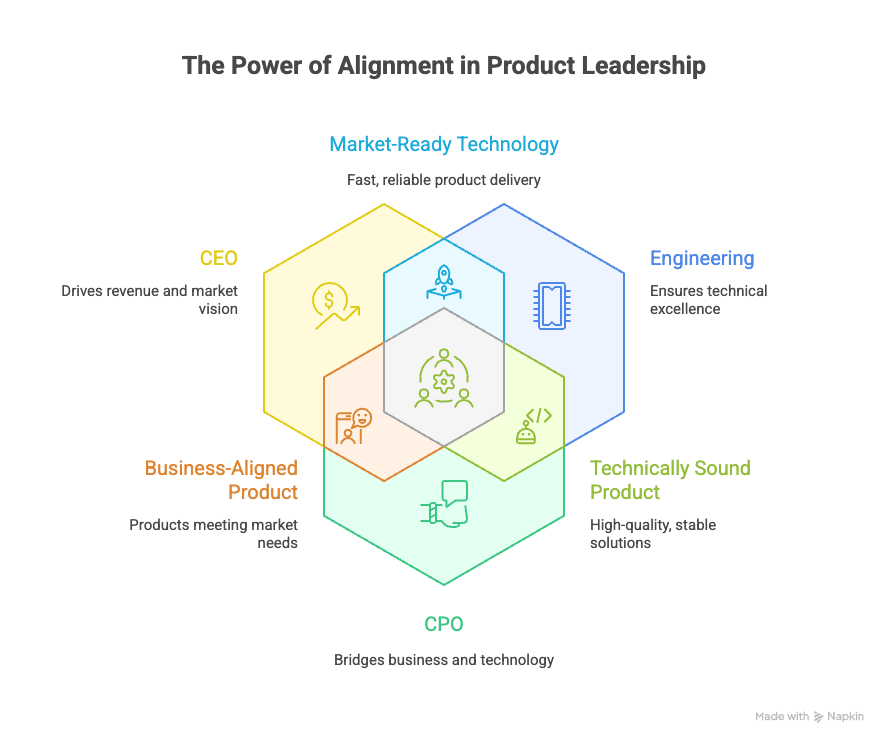
First, a reality check. Your engineering team is likely not trying to sabotage you. They aren’t lazy, and they aren’t evil. They are simply optimizing for a different variable than you are.
- You optimize for: Revenue, speed to market, and customer value.
- They optimize for: Stability, clean code, and minimizing 3 a.m. pager alerts.
When you ask for a “quick change,” they hear “instability.” When they ask for a “rewrite,” they are trying to buy insurance against future bugs.
The problem is that without a Product counter-weight, the engineering optimization wins every single time. The result is a beautifully written code base that no one buys because it shipped six months too late.
The silent killer: “Resume-Driven Development”
There is a hidden incentive structure in engineering that no one talks about.
Stop guessing. Start calculating.
Access our suite of calculators designed to help SaaS companies make data-driven decisions.
Free tool. No signup required.
If your developers build your product using standard, boring technology (like Ruby on Rails or PHP), it works great for the business. But it doesn’t look “cool” on their LinkedIn profile.
Engineers are incentivized to use the newest, most complex frameworks (Microservices, Kubernetes, Rust, AI Agents) because it increases their market value. But for a startup under $10M ARR, these tools are often overkill. They add massive complexity, slow down deployment, and make it harder to hire junior devs.
How a CPO fixes this: we act as the “Complexity Police.” We ask: “Why are we spinning up a microservice for a blog? Why are we using a graph database for a simple customer list?” We force the team to choose Boring Technology that ships fast, rather than Shiny Technology that builds their resume.
The “Startup Physics” Trap
A mentor once told me a line that stuck: “An ounce of experience is worth a pound of gold.” I cannot count the number of times I have seen this exact scenario play out. A group of friends comes up with a solid idea. But then, the friend appointed as CTO decides their life’s mission is to build the MVP using the absolute “bleeding edge” of technology. This is often technology they have never used before.
The non-technical founders are often too intimidated to challenge these choices. But in doing so, they ignore the fundamental Physics of Startups: Time is working against you. According to research by CB Insights, 38% of startups fail simply because they run out of cash. The only goal is to ship something functional to customers and iterate until you find Product-Market Fit.
This leads to the “Bored Developer Syndrome.” If you browse founder communities on Reddit, you will find a graveyard of companies that died because of it. In one case, a team spent 8 months migrating a functional MVP to a complex Microservices architecture just because the lead developer wanted to learn Go. This violates the cardinal rule of software explained by Joel Spolsky: never rewrite functioning code from scratch. The result was zero new features for a year and a competitor who captured the market.This is not just bad luck. It is a symptom of the Sunk Cost Fallacy.
Without a CPO to challenge these shifts, you are funding your employees’ education at the expense of your company’s survival. Data from McKinsey suggests that tech debt and unnecessary architectural complexity can amount to 40% of your total IT balance sheet. Furthermore, a report by Stripe indicates that developers spend nearly 17 hours a week dealing with maintenance and bad code rather than innovation. You cannot afford that tax when you are trying to survive.
The “total rewrite” bluff
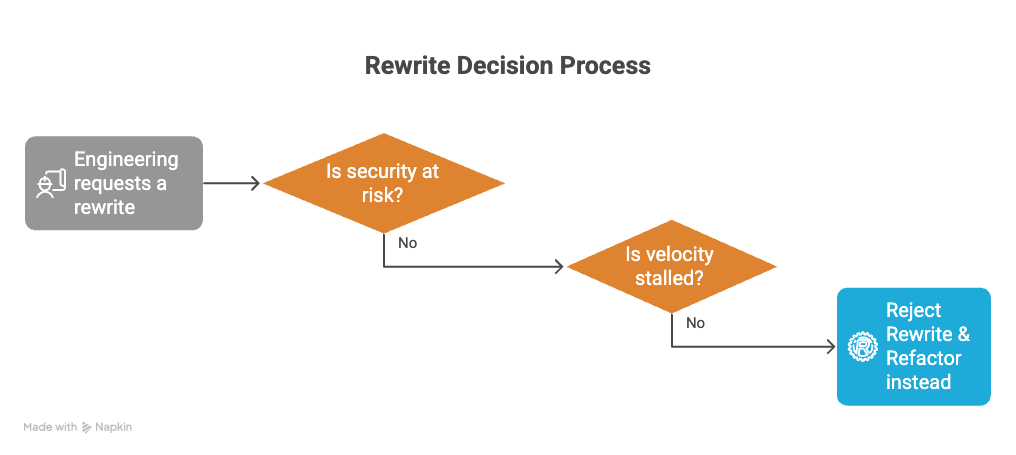
The most dangerous phrase in a startup is: “We need to rewrite it from scratch.”
To a non-technical founder, this sounds like a necessary evil. You think, “Well, they are the experts, I better let them fix the foundation.” To a seasoned CPO, this is a red flag.
Rewrites are the “Nuclear Option.” They pause all new feature development. They almost always take 3x longer than estimated. And usually, the “new” system has just as many bugs as the old one.
How a CPO handles this: We don’t just say no. We ask the “Translation Questions” that you might be afraid to ask:
- The Risk Assessment: “If we don’t rewrite this, will the system actually crash at 10k users, or is the code just ‘ugly’?”
- The Containment Strategy: “Can we refactor just the billing module (the part that hurts) instead of the whole app?”
- The ROI Check: “If we spend 6 months on this, will it reduce our server costs by 50%? If not, keep patching the old code.”
Usually, the “Total Rewrite” quickly turns into a “2-week refactor” once they realize they have to justify it with business metrics.
Converting “impossible” to “expensive”
When a developer says a feature is “impossible,” they almost never mean strictly impossible. (We put a man on the moon; we can definitely put a ‘Dark Mode’ in your SaaS).
What they usually mean is:
- “I don’t know how to do it yet.”
- “It will require messy code that I don’t want to write.”
- “It will take 3 weeks, and I think that’s too long.”
A non-technical CEO hears “Impossible” and kills the idea. A CPO hears “High Cost” and starts the negotiation.
The CPO approach: “Okay, so doing it exactly like the design is ‘impossible’ because of how our database is structured. But what if we removed the real-time sync requirement? What if it only updated once an hour? Could we ship it then?”
Suddenly, the feature is possible again.
This is the core value of a fractional CPO: Scope Negotiation. We slice the problem down until it fits the technical constraints without losing the business value.
The “Ambiguity Tax”
The root cause of most “hostage” situations isn’t actually the code. It’s the requirements.
If you tell an engineering team to “Improve the search bar,” they will disappear for a month and build a Google-level search engine. If you tell them to “Add a filter for ‘Date’ to the search bar,” they will do it in an afternoon.
The difference between those two outcomes is the Ambiguity Tax. When you aren’t specific, you pay with time.
A fractional CPO eliminates this tax by implementing a strict “Definition of Ready.” No ticket goes to engineering until it has:
- The User Story: (As a user, I want X, so that Y).
- The Happy Path: (What happens when it works).
- The Sad Path: (What happens when it fails/errors).
- The Mocks: (Exactly what it looks like).
When the inputs are precise, the estimates become accurate. The power dynamic shifts back to you because the “scope” is no longer up for interpretation.
Regain command of your ship
You don’t need to learn to code to lead a tech company. But you do need someone at your right hand who can look at a GitHub pull request and tell you if your team is actually working or just spinning its wheels.
At SaaS Fractional CPO, we act as your proxy. We respect the engineers, but we challenge the logic. We turn the “Black Box” of engineering into a transparent glass house.
Stop nodding along. Start leading.

Sivan Kadosh is a veteran Chief Product Officer (CPO) and CEO with a distinguished 18-year career in the tech industry. His expertise lies in driving product strategy from vision to execution, having launched multiple industry-disrupting SaaS platforms that have generated hundreds of millions in revenue. Complementing his product leadership, Sivan’s experience as a CEO involved leading companies of up to 300 employees, navigating post-acquisition transitions, and consistently achieving key business goals. He now shares his dual expertise in product and business leadership to help SaaS companies scale effectively.