
A product strategist in SaaS defines and maintains the long-term direction of the product, aligning customer evidence, market position and business goals so the roadmap follows a thesis rather than requests. The role differs from a product manager, who owns execution within that direction rather than setting it.
I have hired product people, and I have been one. If the title is unclear, the problem is usually the decision no one owns.
See what a SaaS product manager owns →Why is a great engineering team not enough?
Because shipping reliably and shipping the right thing are different problems. A team can hit every target, deploy like clockwork and still move nothing that matters, because the question of which problem to solve was never answered. Execution quality hides a strategy gap rather than closing it.
“If your SaaS team executes efficiently but growth feels unpredictable, the issue may not be execution.”
Sivan Kadosh, Fractional CPO
If you’ve landed here and are reading this article, I assume you are currently dealing with a familiar frustration: you have an excellent engineering team. They deliver features to production like a Swiss watch, hit their targets, and everything seems to be working perfectly. The only problem? You aren’t seeing your business metrics improve at the same pace (or at all) compared to your product velocity.
If this resonates with you, it’s highly likely that your bottleneck isn’t technological at all. You have a product strategy problem. The features your team is releasing after so much hard work simply aren’t part of a cohesive, overarching strategy.
Why is this so critical? The answer is visible in your revenue reports. Without a strategy, you are just churning out code without purpose, walking down a road to nowhere. The numbers back this up: The famous CHAOS report by the Standish Group, which analyzed tens of thousands of software projects, found that 64% of features built by companies are rarely or never used. That equates to billions of dollars in R&D hours burned on code no customer actually needs.
Furthermore, data based on the research of Prof. Clayton Christensen from Harvard Business School reveals that 95% of new products launched every year fail, mostly not due to bad technology, but due to a lack of product-market fit and flawed strategy.
Product strategy is what takes that single piece (the specific feature) and places it in its exact spot within the complete puzzle. And the complete puzzle? That is what generates revenue, retains customers, and beats the competition.
This is exactly where the Product Strategist comes in.
In today’s SaaS world, especially as AI accelerates development cycles, “shipping fast” is no longer a competitive advantage. It is the baseline standard. The real challenge is not building fast, but deciding what not to build. A product strategist (or SaaS fractional CPO) takes your well-oiled development machine and ensures it generates real business impact. They connect the lines of code to the company’s growth engines, making sure every technological effort translates directly into increased Retention, Expansion, and bottom-line revenue.
What is the product strategist role in SaaS?
Defining and maintaining the long-term direction of the product. The role aligns customer problems, market positioning, competitive differentiation, the revenue model and the roadmap themes that follow from all four. It is the layer above execution, where the question is which direction earns the next year of engineering.
“A product strategist is responsible for defining and maintaining the long-term direction of a SaaS product.”
Sivan Kadosh, Fractional CPO
A product strategist is responsible for defining and maintaining the long-term direction of a SaaS product.
The role aligns:
- Customer problems
- Market positioning
- Competitive differentiation
- Revenue model
- Strategic roadmap themes
Unlike product managers, who own initiative execution, a product strategist owns strategic coherence.
They answer questions such as:
- Which customer segment should we double down on?
- What growth lever matters most in the next 12 months?
- Which opportunities deserve multi-quarter investment?
- Where should AI create defensible advantage?
Strategy is not a slide deck. It is a set of explicit trade-offs.
Role comparison in SaaS product leadership
| Role | Focus | Time horizon | Primary outcome |
|---|---|---|---|
| Product manager | Initiative execution | Weeks to months | Delivery impact |
| Product strategist | Direction and positioning | 12 to 36 months | Sustainable growth |
| Head of Product | Team leadership and alignment | Multi-quarter | Organizational performance |
| Fractional CPO | Strategy and operating model | 12 to 24 months | Revenue alignment and scalability |
What does a product strategist actually do?
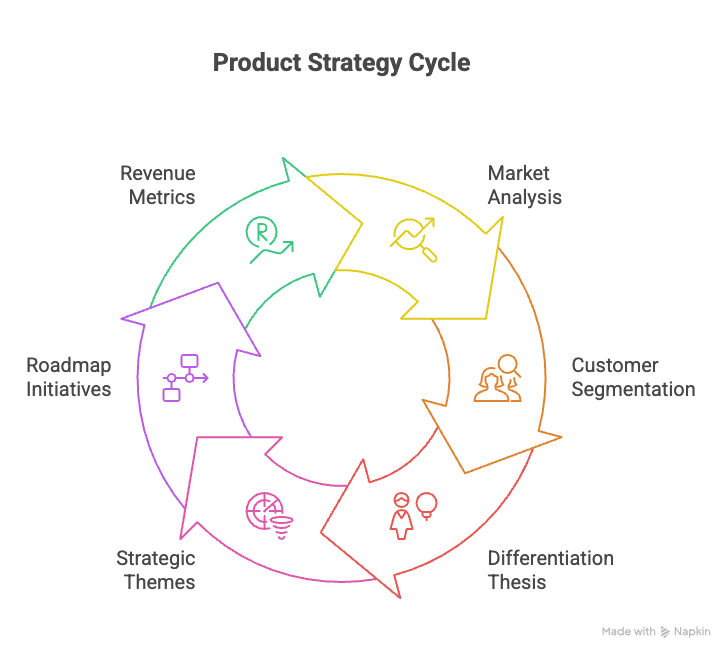
The work sits across five strategic layers, from market and competitive positioning through customer and segment strategy, the product thesis itself, prioritization against economic impact, and the measurement that says whether the thesis held. Each layer constrains the one below it.
The product strategist operates across five strategic layers.
1. Market and competitive positioning
In SaaS, competition is fluid.
A strategist evaluates:
- Market size and growth
- Category evolution
- Competitor positioning
- Pricing models
- Emerging AI-driven disruptors
The goal is not to copy competitors. It is to define differentiation.
Without differentiation, product management becomes reactive.
2. Customer insight synthesis
A strategist reframes problems at the economic level.
Instead of asking, “What feature do users want?” they ask:
- What economic pain is this customer segment experiencing?
- How does that pain affect retention or expansion?
- Is this a segment worth prioritizing?
Discovery becomes structured hypothesis testing.
AI now accelerates:
- Interview transcription
- Theme clustering
- Behavioral pattern detection
But judgment remains human.
3. Strategic roadmap direction
Product strategists define themes, not task lists.
Examples:
- Improve activation efficiency in SMB segment
- Increase expansion in mid-market accounts
- Build AI-powered workflow automation for enterprise
They connect roadmap themes directly to growth levers.
4. Portfolio prioritization
Strategists think in opportunity cost.
They balance:
- Core optimization
- Incremental improvements
- Strategic bets
- Platform investments
Every decision excludes another.
Weak strategy attempts to do everything.
Strong strategy chooses deliberately.
5. AI integration strategy
AI has transformed product strategy.
A strategist must determine:
- Where AI creates true user value
- Where AI reduces internal cost
- Where AI improves defensibility
- Where AI is simply hype
Adding AI features without a defensible thesis increases complexity without advantage.
How does a strategist differ from a product manager?
A product manager owns initiatives, writes briefs, coordinates delivery and tracks metrics. A strategist decides which initiatives matter in the first place, sets the positioning, and evaluates the multi-quarter bets. One works inside the frame and the other draws it.
This distinction is frequently misunderstood.
A product manager focuses on:
- Owning initiatives
- Writing briefs
- Coordinating delivery
- Tracking metrics
A product strategist focuses on:
- Deciding which initiatives matter
- Defining strategic positioning
- Evaluating multi-quarter investments
- Aligning roadmap to revenue
| Dimension | Product manager | Product strategist |
|---|---|---|
| Scope | Initiative-level | Portfolio-level |
| Time horizon | Short to mid-term | Mid to long-term |
| Primary metric | Feature performance | Growth and differentiation |
| Key question | How do we ship this well? | Should we build this at all? |
Why do SaaS companies need one?
Early-stage companies get strategy from the founder, and that works while there is one segment and one motion. Growth stage brings multiple segments, an expanding feature surface, rising acquisition cost, retention pressure and AI-driven competition. Execution stops being the bottleneck and direction starts being it.
Early-stage startups often rely on founders for strategy.
But growth-stage SaaS companies face new complexity:
- Multiple segments
- Expanding feature sets
- Rising CAC
- Retention pressure
- AI-driven competition
At this stage, execution is no longer the bottleneck. Direction is.
Common signals that a product strategist is needed:
- Retention plateau despite high velocity
- Expansion revenue inconsistent
- Roadmap debates are opinion-driven
- AI initiatives unclear in ROI
- Entering new segments without clear thesis
Execution without strategy compounds inefficiency.
How is AI reshaping the role?
It compressed the cycle. Teams can prototype in hours, run experiments in days and read behavior instantly, which raises competitive velocity for everyone at once. Differentiation gets harder as imitation gets cheaper, so judgment about what not to build matters more than it used to.
AI has compressed product cycles dramatically.
Today, teams can:
- Prototype in hours
- Deploy experiments in days
- Analyze user behavior instantly
This changes the strategist’s responsibility.
Three major shifts:
- Competitive velocity increases
- Differentiation becomes harder
- Mistakes scale faster
AI improves:
- Market research speed
- Insight synthesis
- Forecast modeling
- Scenario simulation
But AI cannot replace:
- Strategic trade-offs
- Positioning clarity
- Economic prioritization
- Long-term vision
How does the role change by stage?
Early stage runs on founder-led strategy, rapid experimentation and a high tolerance for uncertainty, with overbuilding before validation as the risk. Growth stage needs dedicated strategic ownership, structured discovery, a defined prioritization framework and multi-segment thinking. The failure is applying either stage’s habits to the other.
The role changes as SaaS matures.
Early-stage SaaS
- Founder-led strategy
- Rapid experimentation
- High uncertainty
Risk: Overbuilding before validation.
Growth-stage SaaS
- Dedicated strategic ownership
- Structured discovery
- Defined prioritization framework
- Multi-segment complexity
Risk: Sales-driven roadmap capture.
Scale-stage SaaS
- Portfolio management
- Platform architecture strategy
- AI-driven competitive moat
- Product ops layer
Risk: Bureaucracy slowing innovation.
Personal insight from operating as a fractional CPO
In multiple SaaS companies I have worked with, the absence of a clearly defined product strategist function was visible immediately.
Roadmap debates were tactical. Teams argued about features instead of growth levers.
Execution was efficient. Strategy was fragmented.
When we introduced:
- Clear growth lever prioritization
- Economic impact scoring
- Defined evidence thresholds
- Monthly roadmap recalibration tied to net dollar retention
Two things happened.
First, debates shortened. Second, expansion revenue became more predictable.
The shift was not adding process. It was clarifying trade-offs.
Strategy is not about having ideas. It is about choosing what not to pursue.
If roadmap discussions feel political rather than analytical, strategic ownership is missing.
Strategist or fractional CPO?
A strategist sets direction inside an existing structure. A fractional CPO sets direction and also owns the operating system that carries it, including how decisions get made and who makes them. If the gap is the thinking, hire the first. If the gap is the machine, hire the second.
Hiring a full-time product strategist makes sense when:
- Product-market fit is stable
- Complexity is increasing
- Multi-quarter bets require oversight
- Team size supports dedicated strategic leadership
However, many SaaS companies need strategic redesign before hiring permanent roles.
A fractional CPO may be more effective when:
- Strategy is unclear
- Governance cadence is weak
- Product and revenue are misaligned
- AI roadmap lacks direction
- Growth has plateaued
A fractional CPO can design:
- Product strategy framework
- Prioritization discipline
- Governance rituals
- AI integration roadmap
- Operating model alignment
Once the strategic layer is defined, scaling internal roles becomes easier and more effective.
Here at SaaS Fractional CPO we offer all these services to make sure your product grows efficiently. Make sure to check out our fractional CPO services and Product Strategy services.
Key takeaways
- A product strategist defines long-term SaaS direction
- The role focuses on growth levers, differentiation, and trade-offs
- AI increases the need for strategic clarity
- Growth-stage SaaS often needs explicit strategic ownership
- Execution without direction compounds inefficiency
- A fractional CPO can accelerate strategic design before scaling headcount
Clarify your product strategy before scaling execution
If your SaaS team executes efficiently but growth feels unpredictable, the issue may not be execution.
It may be strategic clarity.
As a fractional CPO, I help SaaS founders define product strategy, align roadmap decisions to revenue outcomes, and integrate AI into a defensible long-term vision.
If your roadmap debates feel tactical rather than strategic, it may be time to strengthen the strategic layer behind your product organization.
Explore fractional CPO services or request a strategic product assessment to evaluate where your product strategy needs reinforcement.
Executing well but growth feels random?
Get a senior, ex-CPO read on your biggest product bottleneck in 30 focused minutes. No pitch, no obligation.
Book a strategy callI have hired product people, and I have been one. Whichever title you pick, someone has to carry the decision.
See what a SaaS product manager owns →FAQs
What does a product strategist do?
A product strategist defines the long-term direction of a product by aligning customer insights, market positioning, competitive differentiation, and revenue goals into a coherent growth strategy.
How is a product strategist different from a product manager?
A product strategist focuses on long-term positioning and strategic trade-offs, while a product manager focuses on initiative execution and delivery.
Is a product strategist necessary in SaaS?
Growth-stage SaaS companies often benefit from a dedicated strategist when complexity increases and roadmap decisions require multi-quarter planning.
How does AI impact product strategy?
AI accelerates research and experimentation but increases competitive velocity, making strategic differentiation and disciplined prioritization more important.
When should a SaaS company hire a fractional CPO instead of a product strategist?
When strategy is unclear, governance is weak, or executive alignment is missing, a fractional CPO can design the strategic framework before scaling permanent roles.
What clients say
Read all 18 references“As a product manager, I can say that Sivan is very professional – always looking deeply on the discussed feature to understand end to end its effect on the whole product, and as well the eager to understand what would be the added value to the strategy of the company. Nothing was added without a clear scope of development, a clear understanding of the business owner and a clear way to measure the success or failure of this feature.”
“Leading by example, empowering, mentoring, and growing his product teams, he created great product culture and set us Product Managers up for success. His vision and strategic direction enabled us to create successful products that brought millions of dollars of revenue to the company and its clients.”
“As part of his role as VP Product, he identified creative ideas, developed sharp strategies and built the road map while focusing on customer experience and business needs.”